

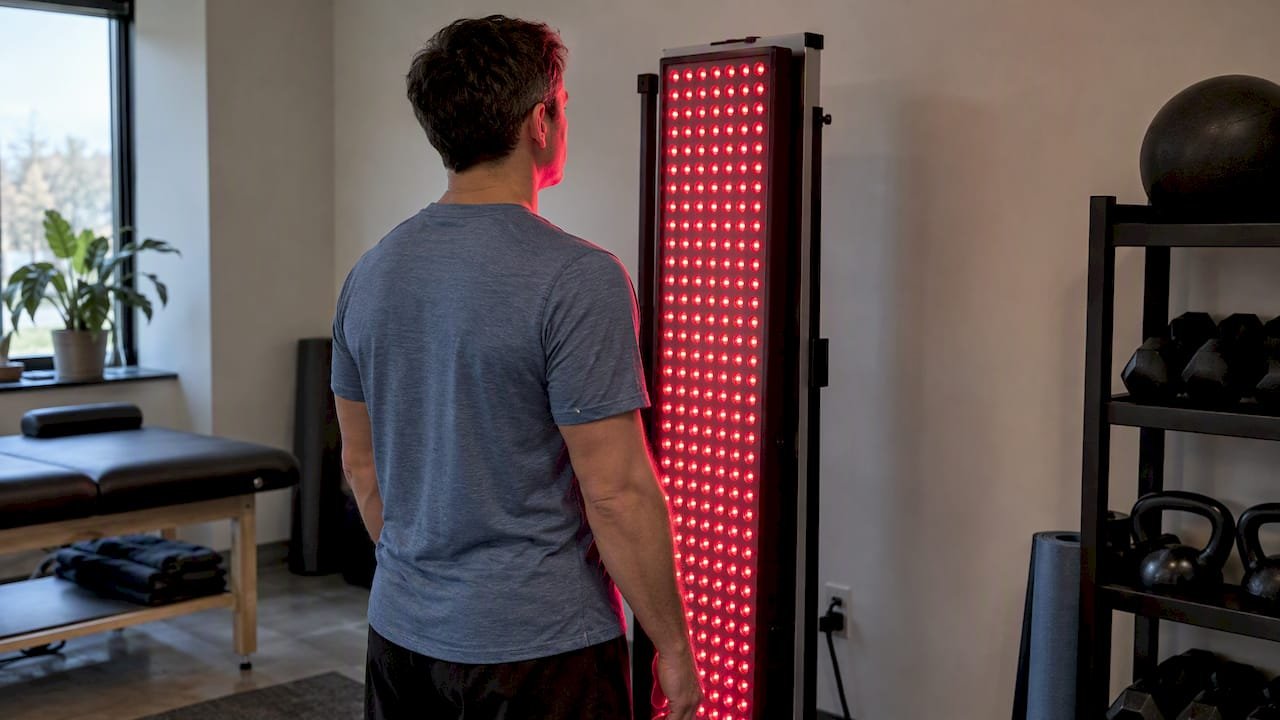
Red light can influence inflammation, but it is not a cure and it is not equally strong everywhere. Lab and cell studies show clear anti-inflammatory signaling. Human trials, especially for exercise recovery, are more mixed. Dose, timing and the state of the tissue decide whether you get a benefit at all. Used as one supportive piece of a broader plan, it can earn a place. Used as a stand-alone fix for a painful tendon or a chronic condition, it will probably disappoint.
Below we separate what is well supported from what is marketing, explain why dose matters so much, and show where red light fits in a recovery routine for busy adults.
TL;DR
- Photobiomodulation (the clinical name for red and near-infrared light therapy) can dampen inflammatory signaling in cells, but human results vary with dose and tissue condition.
- For muscle soreness, a 2025 review found low-certainty evidence of benefit, and some well-controlled studies found no difference from placebo.
- Dose (wavelength, power, total energy) matters more than the color of the lamp. High-powered home devices have been linked to burns and blisters.
- Red light works best as an adjunct to training, sleep, nutrition and medical care, never a replacement for them.
- If you have a persistent tendon, joint or skin problem, see a clinician before treating it yourself.
Table of Contents
- What red light does at the cellular level
- The hype gap: promising, not proven for everything
- Red light for muscle recovery: what the trials found
- Red light for tendonitis and joint pain
- Dose decides the outcome
- Skin inflammation and rosacea
- Why professional supervision changes the picture
- Our perspective
- How to use red light sensibly
- Red light at humn.
- FAQ
- Sources
What red light does at the cellular level
Photobiomodulation, or PBM, uses red light (roughly 600 to 700 nm) and near-infrared light (roughly 700 to 1000 nm) at low intensity. It is not heat therapy and it is not ultraviolet. A dermatology overview of the mechanism describes how light at these wavelengths is absorbed by cells and changes how they signal, with downstream effects on repair and on inflammatory messengers.
The inflammation story centers on a signaling pathway called NF-κB. A 2025 comprehensive review of PBM’s immune effects reports that PBM can modulate NF-κB in inflamed tissue, with one study noting up to a 30% reduction in activation. That helps lower inflammatory cytokines such as TNF-α, IL-1β and IL-6.
There is a catch that most product pages skip. The same photobiomodulation overview explains that the effect depends on context. PBM can suppress pro-inflammatory cytokines in activated inflammatory cells, yet in normal, non-inflamed cells it may switch NF-κB on to support healing and repair. So “anti-inflammatory” is not a fixed property of the light. Timing and the condition of the tissue change what it does.

The hype gap: promising, not proven for everything
If you have searched this topic, you have seen claims that red light fixes everything from wrinkles to joint pain. Medical experts writing in The Conversation say it shows promise for pain, inflammation and skin repair, but that rigorous human trials often fail to reproduce the results of small lab or animal studies. They also stress the difference between clinical-grade equipment and consumer devices.
A practical way to read the literature:
| Area | What the evidence looks like |
|---|---|
| Cellular inflammatory signaling | Consistent in lab studies; context-dependent |
| Muscle soreness after exercise | Mixed; low-certainty benefit in recent review |
| Muscle damage markers | Some trials positive, some no better than placebo |
| Tendon problems | Mixed and dose-sensitive; we would not rely on it alone |
| Chronic inflammatory conditions | Adjunct only, alongside standard care |
| Skin conditions such as rosacea | Preliminary |
That table is a summary of the sources discussed in this article, not a verdict on every study ever published.
Red light for muscle recovery: what the trials found
This is the question we hear most from members who train hard: does red light help me bounce back faster?
The honest answer is “maybe a little, under the right conditions.” A 2025 systematic review with meta-analysis found low-certainty evidence that PBM applied before exercise reduces muscle soreness, with a mean reduction of 12.27 points (95% CI -18.14 to -6.40). Some clinical trials reported that pre-exercise doses of 50 J lowered markers of muscle damage such as creatine kinase and IL-6.
Other work points the other way. A randomized trial of LED photobiomodulation found that it did not alter muscle recovery indicators and produced outcomes similar to cold-water immersion and active recovery. And a double-blind, placebo-controlled trial of pre-exercise 810 nm light tried to identify an optimal dose, then highlighted how sensitive results are to power and energy settings. A dose that suits one muscle group or type of exercise may do nothing for another.

A meta-analysis of near-infrared pre-irradiation looked at lower-limb strength and post-exercise damage and also tried to pin down dosage, which tells you how unsettled the question still is.
What this means for your training
- Expect modest effects at best. If red light helps you, it is likely a small nudge, not the reason you recover.
- Timing may matter. Much of the positive muscle research applies light before exercise, not after. We cover that in more detail in our guide to red light before a workout.
- Don’t skip the basics. Sleep, protein, total training load and stress management dominate recovery. See what the research says about sleep and muscle recovery.
Red light for tendonitis and joint pain
Tendon pain is where people most want red light to work, and where we urge the most caution. From the sources we reviewed, we did not find strong, consistent evidence we can point you to that red light resolves tendon problems on its own. Reviews of light-based treatment for tendons describe inconsistent results and low-quality evidence, and outcomes depend heavily on exact parameters.
What we can say responsibly:
- A tendon that hurts for more than a couple of weeks deserves an assessment from a physician or physical therapist. The cause is often load management, technique or a mismatch between training volume and tissue capacity.
- PBM, if used, belongs beside progressive loading and rehab, not instead of them. Practitioners describe it as a supportive therapy rather than a replacement for standard of care, within a plan that includes nutrition, stress management and medical oversight.
- Sharp pain, swelling that keeps growing, a joint that feels unstable, or pain after a fall are reasons to see a clinician first, not to buy a lamp.
Dose decides the outcome
The single most misunderstood idea in this field is dose. Stanford Medicine experts note that treatment outcome depends on wavelength, power density (irradiance) and total energy (fluence). Without control over those, you risk either an ineffective treatment or, with powerful home devices, thermal skin damage.
Two devices that both say “red light” can deliver wildly different energy to your skin in ten minutes. Distance from the panel, session length and the panel’s output all change the number. If a provider cannot tell you what they are delivering, you cannot judge what you are getting.
For a practical breakdown, see our page on red light therapy dosage: how long, how often and how strong.
A note on “FDA-cleared” labels
Many home devices advertise FDA clearance. That is not the same as the FDA approving every claim a manufacturer makes. Devices under the infrared heating lamp product code can be cleared without the agency endorsing marketing promises. The FDA’s adverse event database includes a report of a serious injury with blistering from a consumer red light device used as directed. One case is not a rate, but it shows why high-intensity unsupervised use deserves respect.
If you have darker skin, are on photosensitizing medication, or are treating a skin concern, read our notes on red light therapy risks and red light therapy for skin first, and ask your dermatologist or physician before starting.
Skin inflammation and rosacea
Because many top search results focus on skin, a quick word on it. For rosacea, evidence for light-based treatment is still preliminary. A review of light therapy from professional systems to consumer devices notes that topical medication remains first-line for redness, with light mainly considered an adjunct for residual visible blood vessels. If you have rosacea, a dermatologist should guide the plan. Red light is not something to experiment with on a flare.
Why professional supervision changes the picture
A supervised session differs from a lamp on your desk in three ways: someone selects the wavelength and energy for the goal, someone checks your skin and medications, and someone ties the session to everything else you are doing. That is the case made in a Sacramento clinic’s write-up on why dose and supervision matter for red light and inflammation, and we agree with the principle even though our approach is built around coaching rather than bone density.
Cost is also a factor if you are deciding between a clinic and a purchase. Our breakdown of clinic versus at-home red light pricing lays out the trade-offs.
Our perspective
We run a Gaithersburg facility built on four pillars: Resist, Recover, Renew and Rhythm. Red light sits in the Recover pillar, next to sauna, compression and acupuncture. That placement is deliberate. It is a tool in a system, not the system.
Here is how we think about it with members:
- Training comes first. Inflammation after hard sessions is part of how you adapt. Trying to switch it off completely is not the goal, and the research on context-dependent effects supports being thoughtful about when you use light.
- Habits beat gadgets. If sleep is five hours and stress is high, no panel will rescue recovery. That is why our coaching covers sleep, stress and nutrition alongside programming.
- Be honest about the evidence. The data on muscle soreness is mixed. We would rather tell you that than promise results. If red light feels useful to you and it is dosed sensibly, it can be a reasonable add-on. If it does nothing for you after a fair trial, drop it and put the time into something better.
- Pair modalities with purpose. Heat, compression, light and acupuncture each do different things. We look at what you are training for and how you respond, then build from there. Our pieces on what red light therapy actually does, infrared sauna benefits and acupuncture for muscle recovery explain how we weigh them.
The measure of any recovery tool is simple: are you training consistently, sleeping better and feeling better a month from now? If so, keep it. If not, change it.
— Josh
How to use red light sensibly
If you decide to try it, use this checklist.
- Check with a clinician if you have a condition. That includes persistent joint or tendon pain, a skin disease, a history of skin cancer, pregnancy, or medication that makes skin sensitive to light.
- Ask about the dose. A provider should be able to tell you wavelength, how long, and how far from the device.
- Start conservatively. More is not better. Over-treatment is where burns and wasted sessions happen.
- Protect your eyes as instructed by the device’s guidance.
- Track something. Soreness the next morning, sleep quality or session performance. Judge by results across several weeks, not one session.
- Keep the foundations. Strength training, protein, sleep and stress management do the heavy lifting.
- Reassess. If symptoms persist or worsen, stop and see a professional.
Red light at humn.
If you want to try red light inside a coached program rather than on your own, our recovery offering includes red light therapy alongside sauna, compression and acupuncture, in our Nordic-inspired space in Gaithersburg, MD. Pair it with small-group training or 1-on-1 coaching through membership, and your coach can help you decide what to use and when, based on how you train and how you feel. Pricing is not published online, so reach out through the site for details.
FAQ
Does red light therapy reduce inflammation?
It can change inflammatory signaling in cells, including lowering cytokines such as TNF-α and IL-6 in activated inflammatory cells, according to a 2025 review. Human clinical results are less consistent and depend on dose and tissue condition. It should be treated as a supportive therapy, not a stand-alone treatment.
Which color light is best for inflammation?
Research generally uses red light (about 600 to 700 nm) and near-infrared light (about 700 to 1000 nm), and experts say the exact wavelength, power and total energy all shape the outcome. No single color is best in every case. Near-infrared penetrates deeper, while red is typically used for surface tissue.
Can red light help with muscle recovery after workouts?
Possibly, a little. A 2025 meta-analysis found low-certainty evidence that pre-exercise PBM reduces soreness, while a controlled trial found no change in recovery indicators. Sleep, nutrition and training load matter more.
Is red light therapy safe?
Used at sensible doses it is generally considered low risk, but high-powered home devices have been linked to serious skin injury, including blistering reported to the FDA. Talk to a physician or dermatologist first if you have a skin condition, take photosensitizing medication or are pregnant.
Can red light treat tendonitis?
We would not count on it alone. Evidence for tendon problems is mixed, so see a physician or physical therapist for persistent pain and treat light as an add-on to proper rehab, not a replacement.
Sources
- Immunomodulatory effects of photobiomodulation: a comprehensive review (PMC, 2025)
- Photobiomodulation CME part I: overview and mechanism of action
- Red light therapy shows promise for pain relief, inflammation and skin conditions, but other claims might be hyped (The Conversation)
- Stanford Medicine: red light therapy, skin, hair and medical clinics
- Systematic review: photobiomodulation, intermittent pneumatic compression and neuromuscular electrical stimulation on muscle recovery
- Photobiomodulation by LED does not alter muscle recovery indicators (Frontiers in Physiology)
- Pre-exercise infrared low-level laser therapy (810 nm): what is the optimal dose?
- Near-infrared phototherapy preirradiation on lower-limb muscle strength and injury: systematic review and meta-analysis
- Practitioner guidance on PBM as an adjunct therapy
- FDA MAUDE adverse event report, infrared therapeutic heating lamp
- Light therapy from professional systems to consumer devices (Forum Dermatologicum)
No Comments.