

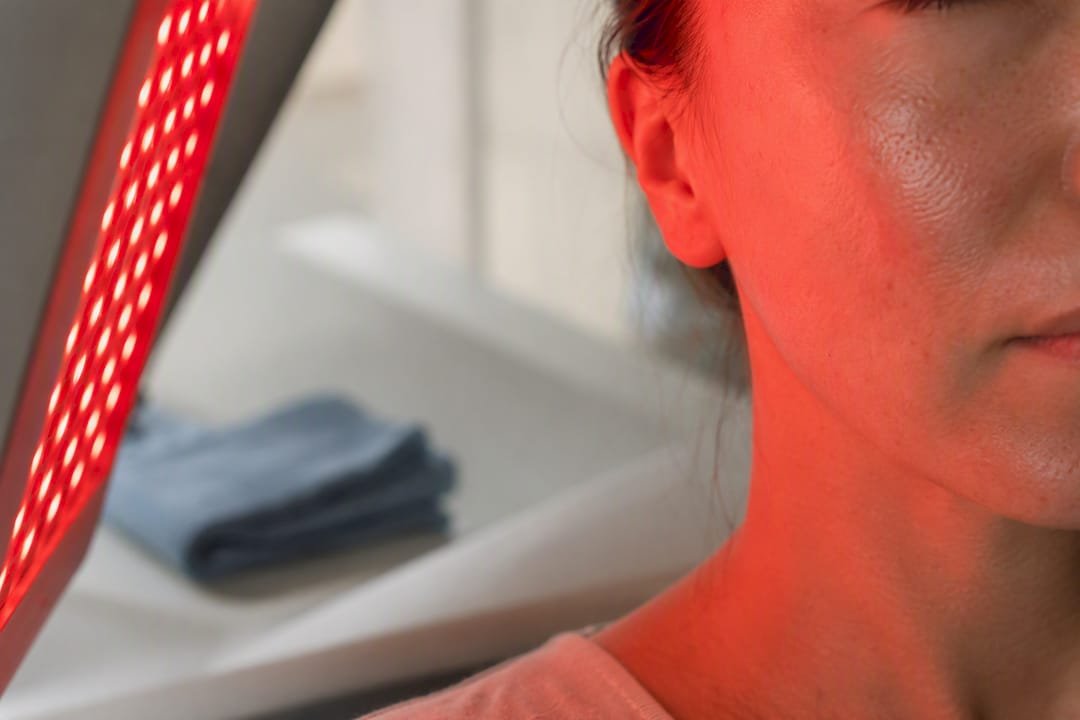
Red light therapy for skin can modestly improve acne and some visible signs of aging when used consistently at the right dose, and it carries a strong safety profile for most people. Evidence is stronger for wound healing and certain clinical uses than for cosmetic anti-aging claims, which still show promise but remain inconsistent across studies. It’s generally low-risk, though dosing and photosensitivity deserve real attention if you take certain medications or have light-sensitive skin conditions. The sections below break down the science by condition, the safe dose ranges, and how to choose a device or clinic without wasting money.
TL;DR:
- Red light therapy’s safety ceiling varies by skin tone, with darker skin requiring lower doses to prevent adverse reactions like blistering or prolonged redness.
- For acne, red light reduces inflammation over several weeks but is not a substitute for prescription treatments, especially in cystic or stubborn cases.
- Evidence for anti-aging effects shows microscopic collagen improvements, but visible skin changes are inconsistent and often minimal.
- Deep wound healing may occur faster initially, but long-term scar improvements are unreliable, making it more effective for acute healing than cosmetic resurfacing.
- In-office devices deliver higher irradiance and quicker results for complex skin issues, while home devices need longer, consistent sessions and careful dose management.
Table of Contents
- How Does Red Light Therapy Work on Skin?
- What Does the Research Say About Each Skin Condition?
- Is Red Light Therapy Safe for Skin?
- Clinic Treatment or At-Home Device: Which Fits Your Goal?
- How Much Red Light Therapy Should You Use?
- How Long Does It Take to See Results?
- How to Choose a Red Light Device or Clinic
- Who’s Behind This Guide
- What Actually Matters Here
- Where Supervised Red Light Therapy Fits Into Recovery
- Sources
How Does Red Light Therapy Work on Skin?
Red and near-infrared light don’t heat or burn skin cells the way a laser might. Instead, specific wavelengths get absorbed by a mitochondrial enzyme called cytochrome c oxidase, which appears to boost the cell’s ability to produce ATP, its basic energy currency. More available energy seems to translate into a cascade of downstream effects: improved local blood flow, a dampening of inflammatory signals, and increased fibroblast activity that drives collagen synthesis. This is the mechanism most often cited when researchers talk about photobiomodulation, the umbrella term for using light to trigger a cellular response rather than to cut, ablate, or thermally injure tissue.
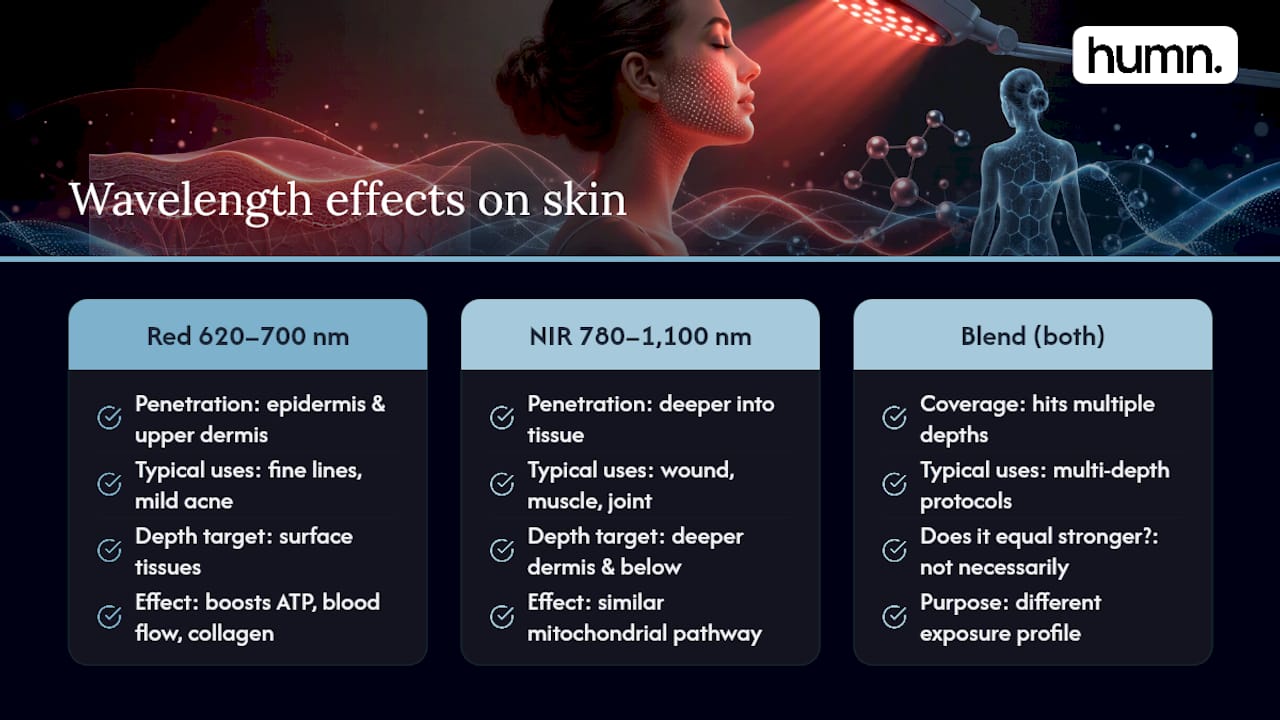
Wavelength matters here more than marketing copy usually admits. Red light, generally in the 620 to 700 nanometer range, penetrates the epidermis and upper dermis, which is why it gets used for surface concerns like fine lines and mild acne lesions. Near-infrared light, typically 780 to 1,100 nanometers, travels deeper into tissue, which is part of why it shows up more often in protocols aimed at deeper wound healing or muscle and joint recovery rather than surface cosmetic change. Devices that blend both wavelengths are trying to hit skin at multiple depths simultaneously, though blending wavelengths doesn’t automatically mean a stronger result. It just means a different exposure profile.
Irradiance, the power delivered per square centimeter, is the variable most home shoppers overlook. Two devices can both claim “red light therapy” while delivering wildly different amounts of energy to the skin, because output strength and distance from the panel change the real dose received. This is a big part of why comparing at-home devices to clinical study protocols is genuinely difficult. A narrative review covering 59 studies and 1,882 patients found that device heterogeneity across trials makes it hard to say with confidence which exact settings produce the best cosmetic outcome. Researchers know the biological pathway is plausible and repeatable in a lab setting. What’s still being worked out is the precise dose, wavelength combination, and treatment schedule that reliably produces a visible cosmetic change in a normal person’s bathroom, not just in a controlled trial.
Stanford Medicine researchers note that clinical evidence is more solid for hair growth and select medical uses than for broad cosmetic skin claims, which is a useful filter to keep in mind as you read anything promising dramatic overnight change.
What Does the Research Say About Each Skin Condition?
Evidence quality varies sharply depending on what you’re trying to treat. Some uses have a real, if modest, evidence base. Others are still riding on early or mixed data. Here’s how the major categories break down.
Acne. This is the most heavily studied dermatologic application of red LED light. The same 59-study narrative review found acne represented nearly a quarter of all treated conditions across the pooled research, more than any other single skin concern. Red light appears to calm inflammation associated with acne lesions and may work even better when paired with blue light or topical treatments, since blue light targets acne-causing bacteria while red light addresses the inflammatory response. Results in trials tend to show reduced lesion counts over several weeks rather than an overnight clearing, and the effect size in most studies is real but moderate, not a replacement for prescription-strength acne treatment in stubborn or cystic cases.
Skin rejuvenation and anti-aging. This is where the gap between marketing and data is widest. Trials measuring collagen density under the skin’s surface do show measurable increases after consistent red light exposure. Harvard Health notes that RLT can genuinely improve certain measurable skin markers, including some collagen and elasticity metrics, but that clinical visibility, meaning what you or someone else would actually notice looking at your face, varies a lot from person to person. A biopsy might show more organized collagen fibers while the person’s own perception of their wrinkles barely shifts. That disconnect between microscopic change and visible cosmetic outcome shows up again and again in the anti-aging literature, and it’s the single biggest reason to keep expectations modest.
Scars and wound healing. Some trials show faster early-stage healing, including reduced inflammation and quicker re-epithelialization in the initial days after an injury or procedure. Longer-term outcomes, like final scar appearance months later, are far less consistent. A wound that closes faster in week one doesn’t guarantee a flatter, lighter scar in month six. This is one of the clinical areas Stanford researchers point to as having comparatively firmer support, though it’s still not a guaranteed fix for established or hypertrophic scarring.
Hair growth. Worth mentioning briefly since it often gets lumped in with skin claims. Evidence supports red and near-infrared light for androgenetic alopecia, the common pattern hair thinning tied to genetics and hormones. It does not have comparable support for other causes of hair loss, like autoimmune-driven alopecia errata or hair loss from thyroid conditions or medication. If someone recommends red light therapy for hair loss without asking what type you have, that’s a gap in the advice, not a universal fix.
A few structural limitations run through almost all of this research:
- Most trials use different devices, wavelengths, and session schedules, making direct comparison difficult.
- Sample sizes in individual studies are frequently small, sometimes fewer than 30 participants per arm.
- Follow-up periods rarely extend past six months, so long-term durability of results is largely unknown.
- Blinding and placebo control are challenging with visible light sources, potentially introducing bias in some earlier studies.
The Springer Nature narrative review covering this same body of work explicitly calls for more randomized controlled trials with standardized dosing protocols, particularly for the self-administered devices now flooding the consumer market. That’s a polite academic way of saying the industry has outpaced the science.
Is Red Light Therapy Safe for Skin?
For most people, yes, with a few real caveats worth taking seriously. The American Medical Association notes that red light therapy is generally considered safe, with side effects that are typically mild and short-lived. That said, “generally safe” isn’t the same as “safe for everyone at any dose,” and the details matter.
Common short-term reactions include:
- Temporary redness at the treatment site
- Mild warmth or a light stinging sensation during or right after a session
- Occasional dryness or tightness, usually resolving within hours
Statistic to know: Dose-escalation research examining LED red light found dose-limiting adverse events, including blistering and prolonged redness, occurring at fluence levels around 480 J/cm² in individuals with skin of color and closer to 640 J/cm² in non-Hispanic Caucasian participants in some study arms. Safe upper ranges in these same trials were approximately 320 J/cm² for skin of color and up to roughly 480 J/cm² for lighter skin tones, underscoring that skin tone changes where the safety ceiling actually sits, not just how visible a burn might look.
That skin-tone difference isn’t a footnote. Melanin absorbs and scatters light differently, which changes how much energy reaches deeper tissue and how the skin responds to it. The American Academy of Dermatology recommends that people with darker skin start at lower doses and increase gradually rather than following a generic protocol built around lighter-skinned trial participants, since much of the earlier device testing simply didn’t include diverse skin types in proportion.
A second, quieter safety concern is photosensitivity. Certain medications, including some antibiotics, acne medications like isotretinoin, and specific diuretics, can make skin more reactive to light exposure, red light included. So can underlying conditions like lupus or porphyria. Anyone on a photosensitizing medication or managing a light-sensitive condition should talk to a clinician before starting a home device, not after noticing an odd reaction.
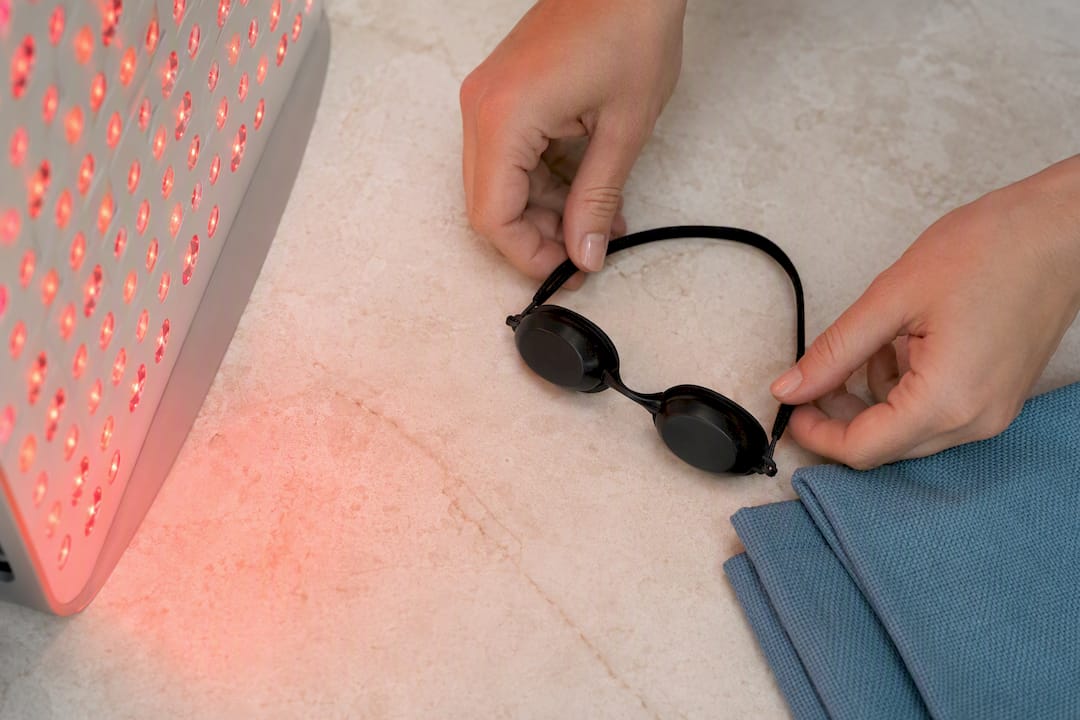
Eye protection deserves a direct mention too, since it’s easy to overlook with a light source that doesn’t feel as harsh as a tanning bed. Manufacturers of full-face masks and panel devices typically recommend closing your eyes or wearing the provided goggles during treatment. If you notice unusual pain, blistering, unusual warmth well beyond mild, or a reaction that doesn’t fade within a day, stop sessions and get it checked rather than pushing through, hoping it resolves. Long-term data on years of repeated chronic at-home use still doesn’t exist in any meaningful volume, which is a real gap the research hasn’t closed yet.
Clinic Treatment or At-Home Device: Which Fits Your Goal?
The honest answer depends on what you’re treating and how much power you actually need to get there. At-home devices, whether masks, flat panels, or handheld wands, generally deliver lower irradiance than the units used in dermatology offices or med-spas. That’s not automatically a flaw. It just means home devices typically require more frequent, longer sessions to approach a comparable cumulative dose, while clinic-grade equipment can often deliver more energy in fewer visits.
Common device categories break down roughly like this:
- At-home masks and panels: Lower power output, designed for frequent self-use, generally the most affordable entry point, best suited to mild maintenance goals like general skin tone or minor fine lines.
- At-home handheld wands: Targeted, useful for localized areas like a stubborn blemish or a small scar, but slow to cover larger surface areas.
- In-office LED panels and beds: Higher irradiance, shorter individual sessions, typically administered under professional supervision with a documented protocol.
One thing worth clearing up directly: FDA clearance is a safety and equivalence designation, not a stamp of proven cosmetic efficacy. A device earning 510(k) clearance has demonstrated it’s substantially similar in safety profile to an already-cleared predicate device. It has not necessarily been independently proven to deliver the specific anti-aging or acne outcome printed on the box. This is one of the more common points of confusion among shoppers, and it’s worth remembering every time a product page leans hard on the word “cleared” as if it settles the efficacy question.
A clinic setting makes more sense in a few specific situations: complex or long-standing scars, medical wound care that needs professional oversight, uncertain skin diagnoses where a dermatologist should rule out something more serious before you self-treat, or cases where you’ve tried an at-home device for months without any change and want an assessment of whether the issue is dose, technique, or simply a poor fit for photobiomodulation. The American Academy of Dermatology points out that most dermatologists use red light as one piece of a broader treatment plan rather than a standalone fix, which is a useful mental model whether you’re in an office chair or on your own bathroom floor. For a side-by-side look at what each route actually costs, humn’s breakdown of clinic versus at-home pricing is a useful next stop.
How Much Red Light Therapy Should You Use?
Dosing is where most people either underwhelm their skin with too little exposure or, less commonly, push into a range that starts causing irritation. The research gives useful boundaries even though it doesn’t hand over one universal number.
- Start conservative, especially with darker skin tones. Dose-escalation trials found safe upper fluence limits landing around 320 J/cm² for skin of color versus roughly 480 J/cm² for lighter skin before adverse events like prolonged redness or blistering became more likely. That gap is the whole reason a one-size protocol doesn’t work across skin types.
- Match session length to your device’s actual output. Trial protocols for skin endpoints commonly used sessions in the 10 to 20 minute range, several times a week, but the exact number depends entirely on the irradiance your specific panel or mask delivers. A weak device run for 10 minutes and a strong one run for 10 minutes are not delivering the same dose.
- Give it real time before judging results. Acne studies often measure change over several weeks. Skin rejuvenation research has stretched anywhere from a few months up to four to six months of consistent, repeated exposure before assessing outcomes.
- Increase gradually, not aggressively. If you tolerate a lower dose well after a couple of weeks, a modest increase in session length or frequency is reasonable. Jumping straight to daily maximum-length sessions in week one is how people end up with irritation instead of results.
- Watch for early warning signs and adjust. Persistent redness lasting more than a few hours, tightness, or any blistering means dial back immediately and reconsider whether your device’s rated output matches what your skin can handle.
Pro Tip: Keep a simple log, even just notes in your phone, tracking session date, duration, and any skin reaction. After four to six weeks, compare a current photo taken in the same lighting to your baseline. Skin change is gradual enough that memory alone will trick you into thinking nothing happened, even when a real, small improvement is sitting right there in the photos.
Clinics often use higher irradiance across fewer total sessions, while home routines lean on lower irradiance spread across more frequent use, which is part of why tracking cumulative dose rather than just session count gives a clearer picture of what your skin has actually received. For a deeper walk-through of frequency and titration specific to home devices, humn’s dosage guide covers the practical side in more detail.
How Long Does It Take to See Results?
Patience matters more here than with most skincare interventions. Acne studies frequently report visible reduction in lesion counts somewhere in the several-weeks range, often four to eight weeks of consistent sessions before a noticeable shift. Anti-aging and rejuvenation research runs longer, with some regimens studied across four to six months of repeated exposure before researchers assessed meaningful change.
It helps to separate two different kinds of “improvement” that get blurred together constantly. One is a microscopic or biomarker-level change, like increased collagen density measured through biopsy or imaging. The other is a visible cosmetic change, the kind you or a friend would actually notice in the mirror or in a photo. Studies consistently show the first happening more reliably than the second. Collagen synthesis can genuinely tick upward while your own perception of fine lines barely budges, which is exactly the disconnect Harvard Health flags when it recommends realistic expectations going in rather than after months of disappointment.
Once you do reach a result you’re satisfied with, red light therapy for skin isn’t a one-and-done treatment. Maintenance sessions, typically at a reduced frequency compared to the initial protocol, are generally needed to hold onto gains, since the biological effect fades once consistent exposure stops. Think of it less like a single procedure and more like a recurring habit, similar to how sunscreen only protects you on the days you actually apply it.
How to Choose a Red Light Device or Clinic
A short checklist saves you from the two most common mistakes: buying a device with vague or missing specs, or booking a clinic session without asking what outcome is realistic for your specific concern.
Before buying a device or booking treatment, confirm:
- Wavelength and irradiance are clearly listed. If a product page won’t tell you the exact nanometer range and power output, that’s already a red flag.
- FDA clearance status, understood correctly. Clearance signals hardware safety, not proof that the device delivers a specific cosmetic result, so ask what the clearance actually covers.
- Some reference to clinical evidence for your specific goal. A company that can point to a relevant trial, even a small one, is more credible than one leaning purely on testimonials.
- A reasonable warranty and return policy. Given how much variability exists between devices, being able to test one for a few weeks without financial risk matters.
- For clinics, ask directly: what’s the expected session schedule, what measurable goal are we tracking, and how will we know in eight or twelve weeks whether it’s working or not.
Ask a clinician screening questions too: does this device or protocol account for my skin type, am I on any medication that increases photosensitivity, and what would count as a realistic outcome for my specific concern versus a marketing promise. Red flags worth walking away from include vendors who can’t or won’t share wavelength specs, anyone promising dramatic overnight change, and clinics that skip a skin and medication screening before your first session.
Who’s Behind This Guide
This guide was written by Josh for humn, a fitness and lifestyle coaching facility that integrates recovery services, including supervised red light therapy sessions, directly into its coaching model rather than treating recovery as an afterthought. humn’s approach draws on running an active recovery suite where members use red light alongside sauna and compression as part of a broader recovery and performance plan, not as a standalone gadget purchase.
That hands-on context shapes how this guide frames the evidence: with real respect for what photobiomodulation can plausibly do, and equal honesty about where the research still falls short of the marketing. If you want to go deeper on what the evidence actually supports before trying it yourself, humn’s breakdown of what red light therapy does according to the evidence is a solid next read, as is the dosage guide for anyone weighing a home device against supervised sessions.
What Actually Matters Here
The research supports a specific, bounded claim: red light therapy for skin produces real but modest effects, strongest for acne and certain wound-healing contexts, more uncertain for broad anti-aging promises. That’s not a failure of the technology. It’s just a more honest place to start than most product marketing allows.
Where conventional advice falls short is treating every red light device as interchangeable and every outcome as guaranteed with enough patience. Dose matters. Skin type matters. The gap between a lab biopsy showing more collagen and your own face looking visibly different in the mirror is real, and most sellers skip right past it.
If you’re going to try this, prioritize getting your dose and skin-type fit right before worrying about which fancy features a device advertises. A correctly dosed basic panel will outperform an expensive, poorly matched one every time. Start conservative, track your response honestly, and treat six weeks as a checkpoint, not a finish line.
— Josh
Where Supervised Red Light Therapy Fits Into Recovery
If dosing correctly and tracking your response honestly sound like the hard part, that’s exactly where supervised sessions earn their keep. A recovery suite integrates red light therapy alongside sauna, compression, and acupuncture as part of a coached recovery plan rather than a standalone purchase you’re left to figure out on your own.

This setup benefits people who want their dosing and schedule guided rather than guessed at, anyone dealing with a more complex skin or recovery need where a generic home protocol isn’t cutting it, and clients who’d rather have red light therapy folded into a broader coaching plan that already covers strength training, sleep, and stress. Coaches build red light sessions around your actual goals instead of handing you a device and a hope. If you want to see how recovery access fits into the full coaching model, start with humn’s recovery services page, or explore how 1-on-1 coaching for busy professionals works before booking a visit to see the Gaithersburg facility in person.
Sources
The 59-study narrative review remains the most comprehensive look at where dermatologic evidence for red LED light currently stands, acne included. Stanford Medicine’s summary and Harvard Health’s guide both offer clinician-level context on realistic expectations. The American Academy of Dermatology and the American Medical Association provide practical safety guidance. None of this replaces an actual conversation with a dermatologist or your own physician about your specific skin and medication history.
This article is general information, not a substitute for advice from a qualified doctor. Consult a qualified healthcare professional about your own circumstances before acting on anything here.
- Photobiomodulation and Photodynamic Therapy Using Red LED Light in Dermatology: A Narrative Review (Bratislava Medical Journal / Duke-hosted listing)
- Phase I / dose-escalation and safety data for LED red light (PMC article)
- Red light therapy: What the science says | Stanford Medicine
- Red light therapy for skin care | Harvard Health
- Is red light therapy right for your skin? | American Academy of Dermatology
No Comments.