

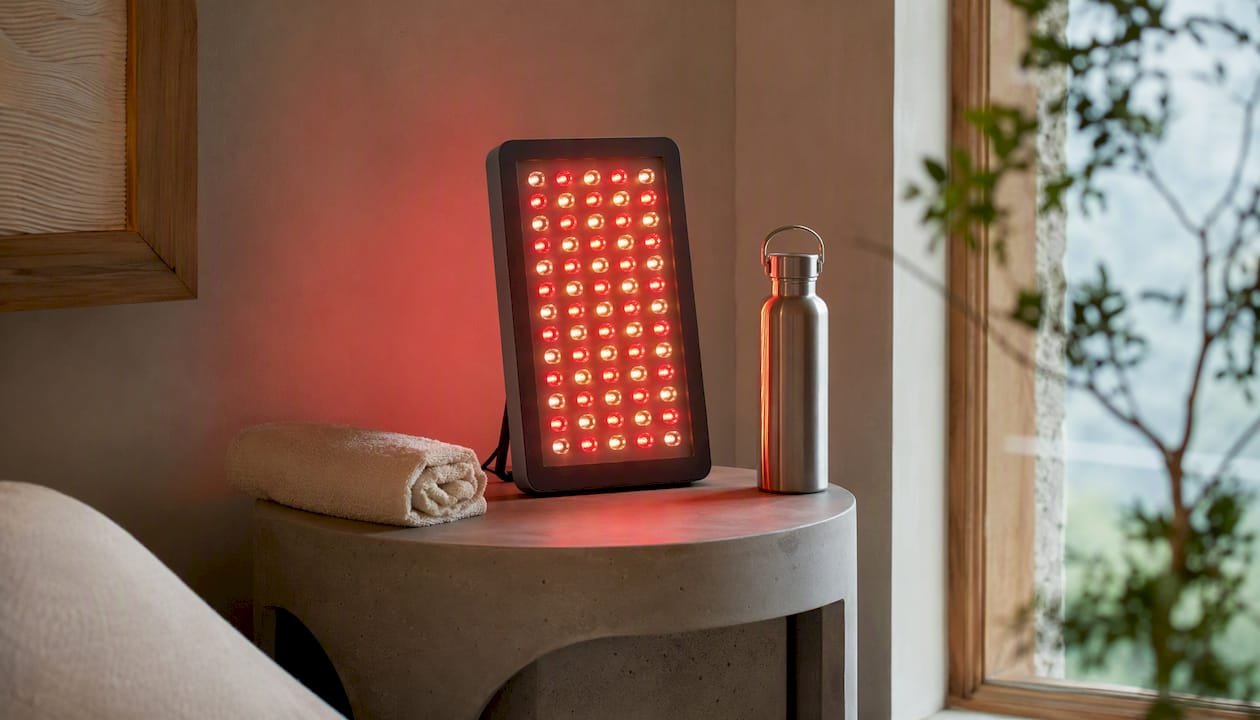
Red light therapy runs $25–$200 per clinic session or $30–$9,995+ for an at-home device, depending on where you go and what you buy. CareCredit’s national data puts the average session at $55, with a typical range of $43–$106 across the country. The decision rule is straightforward: if you plan to use red light therapy three or more times per week for several months, a mid-range panel ($300–$800) almost always pays for itself within one to three months. If you’re testing it out or targeting a specific clinical concern, start with studio sessions first.
Quick price snapshot:
- Clinic/studio sessions: $25–$200 per visit (average ~$55)
- Face masks: $50–$500
- Mid-size panels: $300–$800
- Full-body home systems: $800–$6,000+
- Premium multi-panel setups: $1,500–$9,995+
HSA/FSA note: Typically, red light therapy for cosmetic purposes is not covered by insurance or HSA/FSA funds. However, if a healthcare provider documents a qualifying medical condition such as chronic pain, wound healing, or a skin disease, reimbursement via HSA/FSA may be available. Always confirm eligibility with your plan administrator.
Key Takeaways
A mid-range at-home panel ($300–$800) typically breaks even against regular clinic visits within one to three months for users who go three or more times per week, making device ownership the better long-term value for consistent users.
| Point | Details |
|---|---|
| Clinic session cost | Sessions average $55 nationally, with a typical range of $43–$106; memberships cut this to under $15/session. |
| At-home device range | Devices run $30–$9,995+ depending on type; mid-size panels ($300–$800) suit most home users. |
| Break-even timeline | A $500 panel versus $75/session clinic visits at 3×/week pays for itself in under one month. |
| Insurance and HSA/FSA | Insurance rarely covers cosmetic use; HSA/FSA may apply with a physician’s documented medical indication. |
| humn recovery access | humn’s Gaithersburg membership includes red light therapy as part of a coached recovery program, removing per-session costs for regular users. |
Table of Contents
- How much does red light therapy cost at a clinic?
- What does an at-home red light therapy device cost?
- What factors drive red light therapy pricing up or down?
- How many sessions do you need, and what does a full course cost?
- Does insurance, HSA, or FSA cover red light therapy?
- Clinic sessions, memberships, or an at-home device: which makes sense for you?
- What to look for when buying an at-home red light device
- Practical ways to lower your red light therapy costs
- How these price estimates were built
- When clinic visits beat a device, and when they don’t
- Red light therapy access is part of the humn recovery membership
- Sources
How much does red light therapy cost at a clinic?
Per-session pricing varies more than most people expect, and the type of provider is the biggest driver.
By provider type:
- Med spas and wellness studios: $25–$100 per session for targeted or full-panel treatments. These are the most common entry points and typically use consumer-grade or prosumer LED panels.
- Dermatology offices: $75–$200+ per session. The American Academy of Dermatology notes that wearable and clinical phototherapy devices used in dermatology settings require professional oversight, which justifies the premium.
- Physical therapy and sports recovery clinics: $40–$150 per session, often bundled with other modalities like compression or cold therapy.
- Medical centers and hospital-affiliated dermatology: $100–$300+ for specialized phototherapy protocols. NYU Langone’s phototherapy services illustrate how medical-grade equipment and clinical staff push costs well above what a wellness studio charges.
How packages change the math:
Paying per session is the most expensive way to use a clinic long-term. Most studios offer tiered packages that cut the effective per-session rate significantly:
- Single session: $50–$150 (no commitment, highest per-session cost)
- 5-session pack: Often 10–20% off the single rate
- 10-session pack: Commonly 20–30% off
- Monthly unlimited membership: $59–$199/month, which can push effective per-session cost below $15 for daily users
Example course calculations:
- 4 sessions/week at $75 each: $300/week, $1,200/month
- 4 sessions/week on a $129/month unlimited plan: ~$3.23 per session
- 2 sessions/week at $60 each: $480/month, $5,760/year
Regional pricing matters too. Urban markets like New York, Los Angeles, and Chicago trend toward the higher end of the range. Rural and mid-sized markets often sit closer to the $40–$70 band. Studio sessions commonly run $25–$200, with memberships priced $59–$199/month reducing per-session cost for regular users.
What does an at-home red light therapy device cost?
At-home devices span a wider price range than most buyers realize, and the gap between a $50 mask and a $3,000 panel is not just marketing. Coverage area, irradiance output, and build quality all shift meaningfully across tiers.
| Device Type | Price Range | Best For |
|---|---|---|
| Handheld/spot devices | $30–$300 | Targeted spots, travel |
| Face masks | $50–$500 | Facial skin, convenience |
| Tabletop/mid-size panels | $300–$800 | Face, neck, upper body |
| Full-body panels | $800–$6,000 | Whole-body recovery, skin |
| Premium multi-panel systems | $1,500–$9,995+ | Clinical-grade home setups |
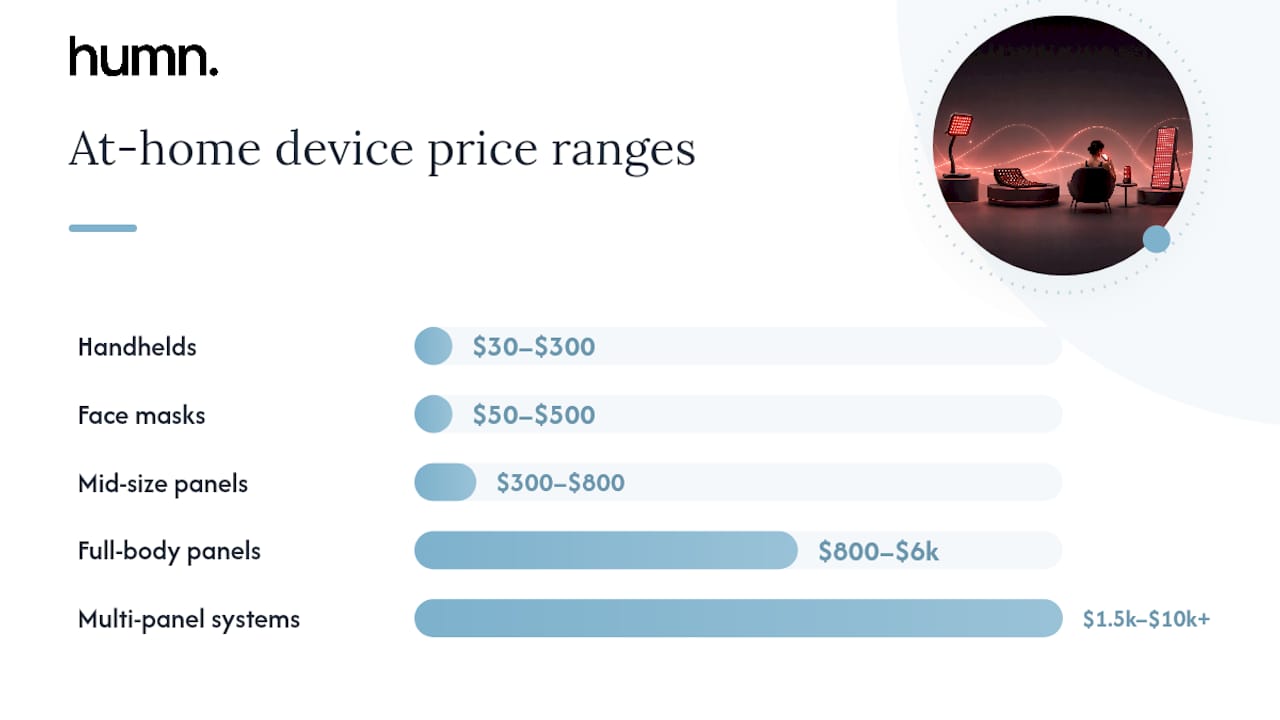
Device tiers range from handhelds at $30–$300 to premium multi-panel systems at $1,500–$9,995+, with full-body home systems capable of paying off quickly for frequent users.
What you actually get at each tier:
- $30–$150 handhelds: Low irradiance, small treatment area, fine for spot treatments on a single joint or small skin patch. Expect longer session times to compensate for lower power output.
- $150–$500 masks: Convenient and hands-free for facial use. Quality varies enormously. Better masks include both 630–660nm red and 810–850nm near-infrared LEDs; cheaper ones often use only one wavelength band.
- $300–$800 mid-panels: The sweet spot for most home users. Enough coverage for face, neck, and upper body. Better-built panels in this range publish irradiance data and carry 2–3 year warranties.
- $800–$6,000 full-body systems: Designed for full-body recovery sessions. Meaningful investment, but for someone doing daily sessions, the per-use cost drops fast.
- $1,500–$9,995+ multi-panel setups: Modular systems that can be expanded. Closest to clinical-grade output for home use.
Break-even example for a mid-range panel:
A $500 panel versus $75/session clinic visits: at three sessions per week, you’d spend $900/month at the clinic. The panel pays for itself in under three weeks of equivalent use. Even at two sessions per week ($600/month clinic cost), break-even arrives in the first month. Mid-range panels often pay for themselves within months for regular users.
A word on cheap options: Sub-$100 panels and no-name masks from marketplace sellers rarely publish irradiance data. That’s a red flag. Low irradiance means longer sessions to achieve the same dose, and some devices don’t reach therapeutic thresholds at all.
What factors drive red light therapy pricing up or down?
Understanding what you’re actually paying for makes it easier to spot a good deal versus an overpriced one.
Wavelength and spectrum
The Cleveland Clinic’s overview of red light therapy explains that red light therapy uses LED light (no UV) and is applied for skin and soft-tissue goals. The two primary wavelength bands are:
- Red (630–660nm): Penetrates the skin’s surface layers. Used for skin rejuvenation, collagen support, and wound healing.
- Near-infrared (NIR, ~810–850nm): Penetrates deeper into muscle and joint tissue. More relevant for pain management and recovery.
Devices and clinics that offer both wavelengths simultaneously cost more but cover a wider range of goals. A face mask with only 630nm LEDs won’t do much for joint pain.
Irradiance: the number that actually matters
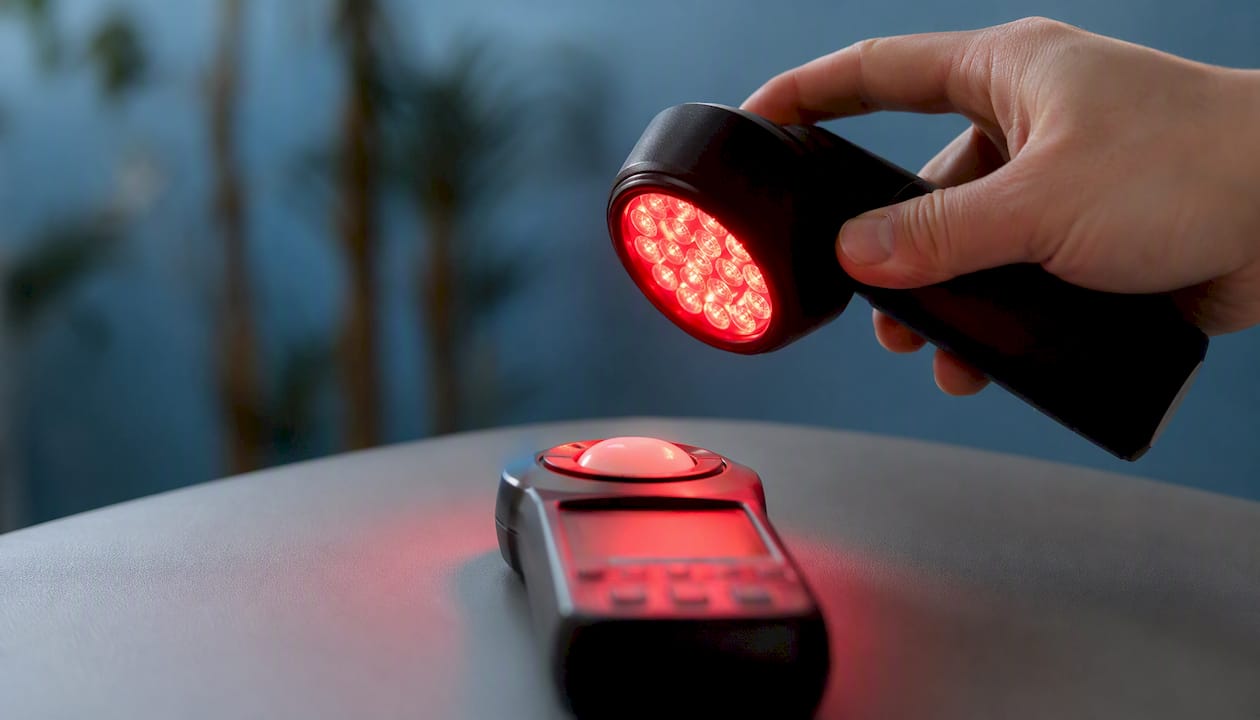
Irradiance (measured in mW/cm²) tells you how much light energy reaches your skin per unit of time. Higher irradiance means shorter sessions to achieve the same dose. A device rated at 100 mW/cm² at 6 inches requires roughly half the session time of one rated at 50 mW/cm² at the same distance. Marketing copy often lists peak irradiance at the LED surface, not at treatment distance. Always ask for irradiance measured at 6 inches (15 cm) or your intended treatment distance.
Provider-side cost drivers
At a clinic, you’re paying for more than the light itself:
- Device acquisition and maintenance costs (clinical panels run $5,000–$50,000+)
- Staff training and credentials
- Facility overhead (rent, insurance, utilities)
- Session supervision and protocol customization
That’s why a dermatology office charges $150 for the same 20-minute session a wellness studio charges $50 for. The device and oversight are different categories entirely.
Questions to ask before booking or buying:
- What wavelengths does the device emit, and are both red and NIR included?
- What is the irradiance at my treatment distance (6 inches)?
- How long are sessions, and how many are recommended per week?
- Is there a warranty, and what does it cover?
- For clinics: what credentials does the staff hold, and what device brand/model do you use?
Pro Tip: Ask any device seller for third-party irradiance test data, not just the spec sheet. Reputable brands publish independent lab measurements. If a seller can’t provide that, treat the irradiance claim as unverified.
How many sessions do you need, and what does a full course cost?
Per-session price is only part of the budget. The total cost of a treatment course depends on your goal, frequency, and whether you’re going to a clinic or using a device at home.
Typical protocol ranges by goal:
- Skin rejuvenation: 3–5 sessions/week for 4–12 weeks, then maintenance 1–2×/week
- Chronic pain or joint recovery: 3–5 sessions/week ongoing; many users continue indefinitely
- Post-workout muscle recovery: 3–5 sessions/week aligned with training schedule
- Hair growth (low-level laser/light therapy): 3×/week for 16–26 weeks minimum before evaluating results
Consistency matters far more than occasional sessions. Sporadic use rarely produces the results that drive people to buy devices in the first place.
Clinic vs. home cost over time (representative example):
The clinic column assumes no package discount. With a $129/month unlimited membership, 12 months of clinic access costs $1,548. Still more than the device, but a reasonable trade-off if you value supervision, variety of modalities, or don’t want to manage equipment.
For most consistent users, an at-home panel pays for itself in 1–3 months, which aligns with the break-even math above.
Does insurance, HSA, or FSA cover red light therapy?
The short answer: probably not through insurance, but possibly through HSA/FSA with the right documentation.
What to expect:
- Health insurance: Rarely covers red light therapy for cosmetic purposes. Coverage for specific medical indications (psoriasis, wound healing, certain pain conditions) may exist under some plans, but it’s not standard. AARP confirms that insurers generally won’t cover cosmetic treatments, though HSA/FSA may be used with documentation.
- HSA/FSA accounts: Possible for medically indicated use. If a physician documents that red light therapy is being used to treat a diagnosed condition, many plan administrators will approve it. Clinics that work with medical patients often accept HSA/FSA debit cards directly and can provide treatment notes.
- At-home devices: Some HSA/FSA administrators approve device purchases when accompanied by a Letter of Medical Necessity from a physician. This is worth pursuing if you have a documented condition and a qualifying account balance.
Financing and payment plans:
- Many premium device brands offer financing through third-party providers (CareCredit, Affirm, Klarna). Monthly payments on a $600 panel can run $50–$100/month depending on the term.
- Some clinics offer package payment plans, especially for longer treatment courses.
- Buy-now-pay-later services can make a $1,000+ device feel affordable, but the total cost is the same. If you’re not certain you’ll use the device consistently, financing a premium system is a risk worth thinking through before committing.
Clinic sessions, memberships, or an at-home device: which makes sense for you?
The financially sensible path depends on how often you’ll actually use it, what you’re treating, and whether you need clinical oversight.
Decision flow:
- Start with a studio trial if you’ve never tried red light therapy. A few sessions at $50–$75 each tells you whether you respond well before you spend $500+ on a device.
- Stay with clinic sessions or a membership if you go 1–2 times per week, prefer not to manage equipment, or are treating a condition that benefits from professional supervision.
- Buy a mid-range panel if you plan to use it 3+ times per week for more than two months. The math almost always favors ownership at that frequency.
- Consider a full-body system only if daily whole-body recovery is a consistent part of your routine and you have the space for it.
Goal-to-path mapping:
- Chronic joint or back pain: A device wins on cost and convenience for long-term daily use. Supervision matters early on; a few clinic sessions to establish protocol, then home use.
- Skin rejuvenation (face): A quality mask ($150–$400) or mid-panel handles this well at home. Clinic sessions make sense for one-off treatments or if you want a dermatologist’s input on a specific concern.
- Post-workout recovery: A mid-panel or full-body system fits naturally into a home gym setup. Recovery-focused memberships at facilities that include red light access are a strong alternative if you train at a facility anyway.
- Hair growth: Dedicated low-level light therapy (LLLT) devices designed for scalp use are the standard home option. Clinic-based protocols exist but require long-term commitment.
Practical factors beyond cost: Travel time to a clinic adds up. A 20-minute session plus 30 minutes of commuting is a real barrier to the 3–5×/week consistency most protocols require. At-home devices remove that friction entirely, which often means better adherence.
What to look for when buying an at-home red light device
Most marketing copy for red light devices is written to impress, not to inform. Here’s what to actually check.
Buying checklist (in priority order):
- Wavelength(s): Confirm the device emits 630–660nm red and/or 810–850nm NIR. Both together is better for most goals. A device that only lists “red light” without a specific nm range is a yellow flag.
- Irradiance at treatment distance: Look for mW/cm² measured at 6 inches. Aim for at least 20–50 mW/cm² at treatment distance for a reasonable session time. Higher is generally better, up to a point.
- Treatment area: Match the panel size to your goal. A 6"×8" panel won’t cover your back. A full-body panel is overkill for facial use.
- Session time recommendations: Reputable brands specify session duration based on their irradiance output. Vague guidance (“use as needed”) suggests the brand hasn’t done the dose math.
- Warranty: Two years minimum for a mid-range panel. Premium systems should carry 3+ years. No warranty is a hard pass.
- Verified specs: Third-party lab testing or published irradiance maps. If the brand only offers a spec sheet with no independent verification, treat the numbers skeptically.
Red flags to walk away from:
- Irradiance claims without a stated measurement distance
- No warranty or a 30-day-only return window
- Claims about weight loss, detox, or organ function (not supported by the evidence base for consumer LED devices)
- No customer support contact or no physical business address
Hidden costs to budget for:
- Eye protection: $10–$30 (required for near-infrared exposure near the face)
- Panel stand or mounting hardware: $30–$150 for larger panels
- Electricity: A 300W panel running 20 minutes daily adds roughly $2–$5/month to your electric bill at average US rates
Practical ways to lower your red light therapy costs
A few tactics make a real difference, especially in the first few months.
- Use intro offers: Most studios offer a first-session discount or a trial week. Use these to evaluate the clinic and the modality before committing to a package.
- Buy a package, not single sessions: A 10-session pack at 25% off saves $150–$375 at typical clinic rates. If you’re going to commit to a course, buy the pack upfront.
- Join a recovery membership: At $59–$199/month with unlimited access, a membership at a facility that includes red light therapy can cost less per month than four individual sessions. Memberships priced $59–$199/month can reduce effective per-session cost below $15 when used frequently.
- Consider refurbished or open-box devices: Some reputable brands sell certified refurbished panels at 20–30% off retail. Check the warranty terms before buying.
- Negotiate package pricing: Clinics with slower weekday slots often discount packages for clients who commit to off-peak times. It doesn’t hurt to ask.
- Trial before you buy a device: Spend $200–$300 on clinic sessions first. If you’re going consistently and seeing results, then buy the device. You’ll know the protocol works for you before making a larger investment.
Break-even example: A $500 mid-range panel versus $75/session clinic visits at three sessions per week. Clinic cost over two months: $1,800. Device cost over two months: $500 plus minimal electricity. You save $1,300 in the first two months alone, and every session after that is essentially free.
How these price estimates were built
These estimates draw from several data types:
- National pricing surveys and aggregators: CareCredit’s national average data ($55 average, $43–$106 range), Red Light Finder’s 2026 studio and membership pricing, and INIA’s 2026 clinic and device breakdowns
- Retail device pricing: Current retail ranges from major device categories, cross-referenced across multiple sources
- Clinical guidance: Cleveland Clinic, the American Academy of Dermatology, and NYU Langone for session protocol context and medical-grade pricing justification
- Regional sampling: Urban/rural variance noted qualitatively; specific state-level data from CareCredit’s state breakdown
What was excluded: Vendor promotional pricing, one-off clinical procedures outside standard red light protocols (e.g., laser resurfacing, photodynamic therapy with photosensitizers), and international pricing. All figures are rounded for readability and reflect general US market conditions. Prices change; always verify with your local provider or retailer before budgeting.
When clinic visits beat a device, and when they don’t
The conventional wisdom on red light therapy is that buying a device is always the smarter long-term play. That’s mostly true, but it glosses over a few things worth saying plainly.
A device only pays off if you actually use it. The people who buy a $600 panel and use it twice are not saving money. They’re paying $300 per session. The break-even math assumes consistent use, and consistency is the one variable no spec sheet can guarantee. That’s why starting with clinic sessions isn’t just a “try before you buy” hedge. It’s a real test of whether you’ll build the habit.
There’s also a meaningful difference between what a wellness studio offers and what a dermatologist or physical therapist offers. If you’re dealing with a diagnosed condition, a clinical setting gives you protocol oversight, documentation for potential HSA/FSA reimbursement, and a professional who can adjust the approach if something isn’t working. A home panel gives you none of that. For chronic pain or a skin condition with a medical component, the premium for clinical oversight is often worth paying, at least initially.
Where the device wins decisively is for recovery-focused users who are already training consistently and want to add red light to their routine without adding a commute. Three to five sessions per week is the threshold where ownership almost always makes financial sense, and it’s also the frequency that produces the most consistent results. The two things align.
At humn, the approach is to pair recovery modalities with a structured training and coaching program, so the red light access is part of a system rather than a standalone purchase. That context matters. A device sitting in a corner is not the same as a recovery protocol you actually follow.
Red light therapy access is part of the humn recovery membership
For busy professionals in Gaithersburg, MD who want consistent red light therapy without buying and managing a device, humn’s recovery membership includes access to red light therapy alongside sauna and compression modalities. That combination, built into a structured membership, removes the per-session math entirely.
humn’s membership model means you’re not paying $75–$150 per clinic visit every time you want a recovery session. You get red light access as part of a broader program that includes coaching, strength training, and lifestyle support. For members using recovery three or more times per week, the membership cost compares favorably to both pay-per-session clinic pricing and the upfront cost of a premium home device. The difference is that you’re also getting the coaching and accountability structure that makes the habit stick.
If you’re weighing your options, the most useful next step is a conversation about what your recovery goals actually are and how frequently you’d realistically use the service. Book a consultation at humn to talk through membership options and see the facility.
Sources
These are the primary references used to build the estimates in this article. Check them directly to verify current pricing and clinical guidance before making a purchase or booking decision.
- What Is Light Therapy? Types, Pricing and How it Works
- Does Red Light Therapy Really Work on Wrinkles?
- How Much Does Red Light Therapy Cost? Complete 2026 Breakdown | RedLightOS
- Red Light Therapy Cost Breakdown: What to Expect in 2026 | Red Light Finder
- How Much Does Red Light Therapy Cost? 2026 Pricing Guide | Red Light Finder
- Red Light Therapy Cost: At-Home vs. Clinic Pricing 2026 – INIA
- Red light therapy — Cleveland Clinic
- Wearable light therapy — American Academy of Dermatology
- Phototherapy and laser treatment for vitiligo — NYU Langone Health
Prices vary by region, provider, and device brand. Always confirm current rates directly with your local clinic or retailer before finalizing a budget.
This article is general information, not a substitute for advice from a qualified doctor. Consult a qualified healthcare professional about your own circumstances before acting on anything here.
No Comments.