


Red light therapy is low risk for most healthy adults when used at recommended doses, but it isn’t risk-free. The main dangers are dose-dependent skin irritation and blistering at high fluences, plus eye damage if you skip protective eyewear during facial treatments. If you have a photosensitive condition, take a photosensitizing medication, or have darker skin, talk to a clinician before starting.
TL;DR:
- Higher fluence levels increase the risk of skin irritation and blistering, especially in people with darker skin tones, at lower dose thresholds than lighter skin.
- People with photosensitive conditions, photosensitizing medications, or pregnancy should consult a healthcare professional before using red light therapy.
- Proper eye protection is essential during facial treatments to prevent retina strain, particularly with high-powered devices, and should never be overlooked.
- Clinical devices are generally safer in supervised settings due to calibrated power, fixed protocols, and screening, unlike the variability seen with home-use devices.
- Long-term safety data on frequent or prolonged use is limited, so red light therapy should be viewed as a supplement, not a cure, and used cautiously by higher-risk groups.
Table of Contents
- What Red Light Therapy Risks Have to Do With How It Works
- Side Effects and Dose-Related Risks From Clinical Trials
- Who Should Avoid Red Light Therapy or Use Extra Caution
- Eye Safety Risks You Shouldn’t Skip
- At-Home Devices vs. Clinical Equipment: Where the Real Risk Sits
- Practical Precautions That Actually Lower Your Risk
- How Supervised Red Light Sessions Reduce Risk in a Recovery Setting
- A Realistic Take on Red Light Therapy’s Promise and Limits
- Where to Try Red Light Therapy With Real Screening in Place
- Where to Read More on Red Light Therapy Safety
- Sources
What Red Light Therapy Risks Have to Do With How It Works
Red light therapy relies on photobiomodulation, a process where red and near-infrared light wavelengths (roughly 630 to 850 nanometers) interact with cells to influence mitochondrial activity. Most consumer devices, and the clinical panels used in dermatology and recovery settings, sit somewhere in that range, though the depth of penetration varies by wavelength and power output.
Red light around 630 to 660 nanometers tends to act mostly on the skin’s surface layers. Near-infrared light, closer to 810 to 850 nanometers, reaches somewhat deeper, but even the best clinical arrays don’t penetrate far enough to meaningfully treat deep joint inflammation or systemic conditions, according to researchers at Stanford Medicine. That’s a real gap between marketing claims and biology.
Device type matters here more than most buyers realize. A handheld wand, a full face mask, a standing panel, and a clinical array can all use the same wavelength range yet deliver wildly different power densities. That variation is exactly why the same treatment protocol can be harmless on one device and irritating on another.
Side Effects and Dose-Related Risks From Clinical Trials
Most people who try red light therapy correctly experience nothing worse than mild, short-lived discomfort. The risk climbs as the dose climbs, and that relationship is documented in controlled research, not just anecdote.
Reported mild effects include:
- Temporary redness that fades within a few hours
- Mild, transient pain during or right after a session
- Minor skin irritation at the treatment site
By the numbers: In randomized controlled trials, red LED light stayed safe at fluences up to 480 J/cm² for non-Hispanic Caucasian participants, but dose-limiting adverse events, including blistering, showed up at lower fluences (around 320 J/cm²) in skin of color.
That gap matters for anyone assuming “more light equals more benefit.” It doesn’t. Higher fluence raises the odds of prolonged redness and blistering well before it delivers extra benefit, and the threshold where that happens depends heavily on skin tone.
The reassuring part: short-term studies consistently describe red light therapy as low acute risk, and there’s no evidence linking it to skin cancer the way ultraviolet exposure is linked to it. The less reassuring part is that long-term safety data remains limited, so nobody can yet say with confidence what years of repeated home use might do.
Who Should Avoid Red Light Therapy or Use Extra Caution
Certain groups face meaningfully higher risk, and this is where most red light therapy safety guides get too vague to be useful.
- People with photosensitive conditions, including lupus, can see symptoms worsen with light exposure, since these conditions already involve an abnormal skin reaction to light.
- Anyone taking photosensitizing medications — certain antibiotics and retinoids are common examples — should check their medication list with a clinician first, since these drugs can amplify red light therapy’s effect on the skin.
- People with darker skin tones face a higher risk of persistent redness, hyperpigmentation, and blistering, because dose-escalation trials show skin of color tolerates lower maximal fluences before adverse events appear.
- Pregnant individuals face limited research on red light therapy specifically, so it’s worth raising with a prenatal provider before adding it to a routine.
Pro Tip: If you have darker skin, start with a shorter session than the device manual recommends, and check the treated area again a few days later for delayed redness or dark spots before doing a second full-length session.
The American Academy of Dermatology echoes this, recommending that people with darker skin start at lower intensity and consult a board-certified dermatologist before relying on at-home devices.
Eye Safety Risks You Shouldn’t Skip
Facial and periorbital red light treatments carry a specific risk that skin treatments don’t: direct light exposure near the eyes can strain the retina over repeated sessions, particularly with higher-powered devices.
- Wear the eye protection provided with the device, or opt for opaque goggles rated for the device’s wavelength range, any time treatment happens near the face.
- Never stare directly into an active light source, even briefly, and check the manufacturer’s instructions for the recommended distance from the eyes.
- If you have an existing eye condition such as macular degeneration or cataracts, get clearance from an eye specialist before facial sessions.
- Use the shields built into masks and panels rather than treating with eyes uncovered “just this once.”
At-Home Devices vs. Clinical Equipment: Where the Real Risk Sits
The biggest safety gap in red light therapy isn’t the technology itself. It’s the mismatch between unsupervised home use and how the treatment is actually studied.
- Clinical-grade devices are typically more powerful and offer finer control over fluence and session length than consumer masks or wands.
- FDA clearance for a red light device confirms it meets safety standards. It does not confirm the device works better than a competing model, and clearance categories vary by intended use.
- There’s no single standardized dosing protocol across conditions. Trials use different wavelengths, fluences, and schedules, which is part of why experts caution against taking marketing claims about optimal dosing at face value.
- Misuse risk climbs with overuse. Running sessions too frequently, holding a device too close to the skin, or extending session length beyond instructions raises heat exposure and cumulative dose without added benefit.
Home devices generally run at lower power than clinical arrays, which caps the ceiling on how much harm they can cause in a single session. But lower power doesn’t mean zero risk, especially with daily use over months. If you’re weighing which option fits your situation, it helps to understand the dosage differences between clinic and at-home devices before committing to either one.
Practical Precautions That Actually Lower Your Risk
A few habits separate people who use red light therapy without incident from people who end up with a burn or a rash they didn’t expect.
- Review your medications and medical history first. If you’re on a photosensitizing drug or manage a light-sensitive condition, get input from a clinician before starting.
- Test a small area if you have darker skin, using a shorter session than recommended, then wait a few days before scaling up.
- Always use eye protection for facial sessions, follow the device’s stated session time, and avoid touching or applying heat to the treated area right afterward.
- Watch for warning signs. Blistering, skin that stays discolored past a few days, or new pain at the treatment site means stop and see a dermatologist or your primary care provider.
Pro Tip: Keep a simple log of session length, device setting, and skin response for your first two weeks. Patterns that predict irritation almost always show up before anything serious happens.
Rosacea and other reactive skin conditions deserve their own caution here. If you’re prone to flushing or visible redness, it’s worth reading dermatology guidance on LED use for rosacea before adding red light sessions to your routine.
How Supervised Red Light Sessions Reduce Risk in a Recovery Setting
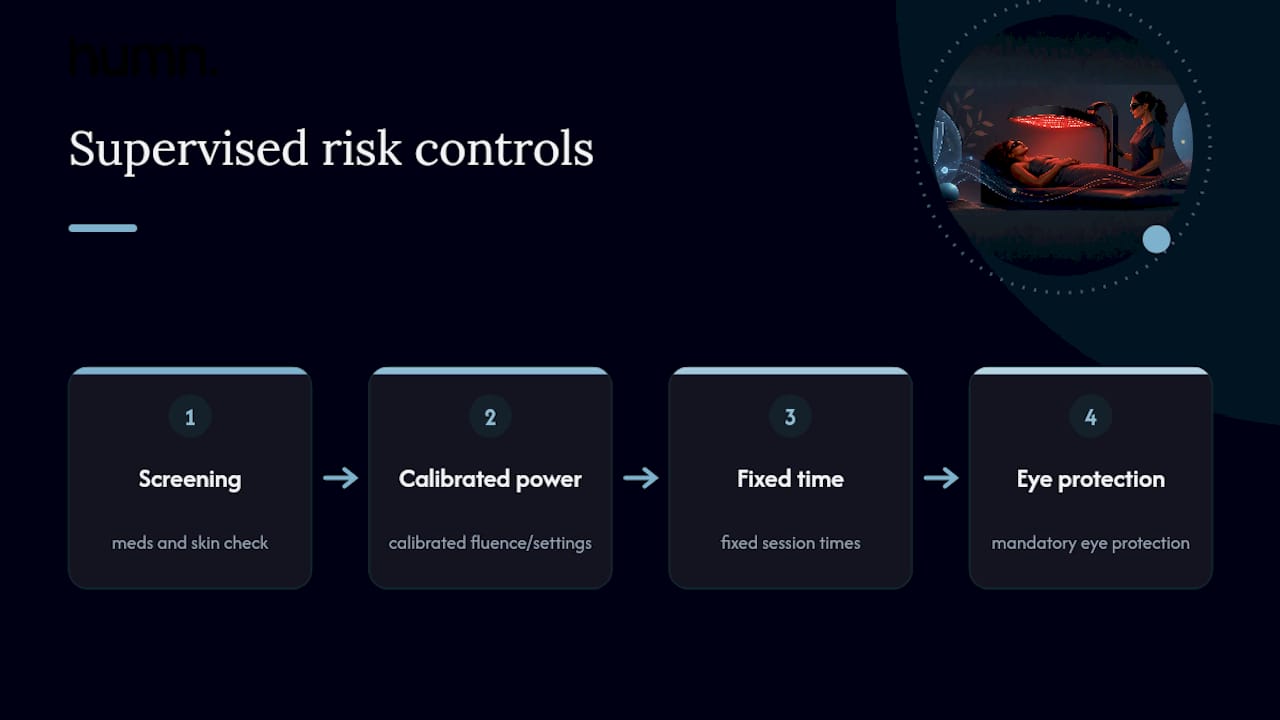
Supervised settings handle red light therapy risk differently than a device sitting in someone’s bathroom. Before a session, staff typically run through a quick screen: current medications, any diagnosed skin or light-sensitivity conditions, and a visual skin check.
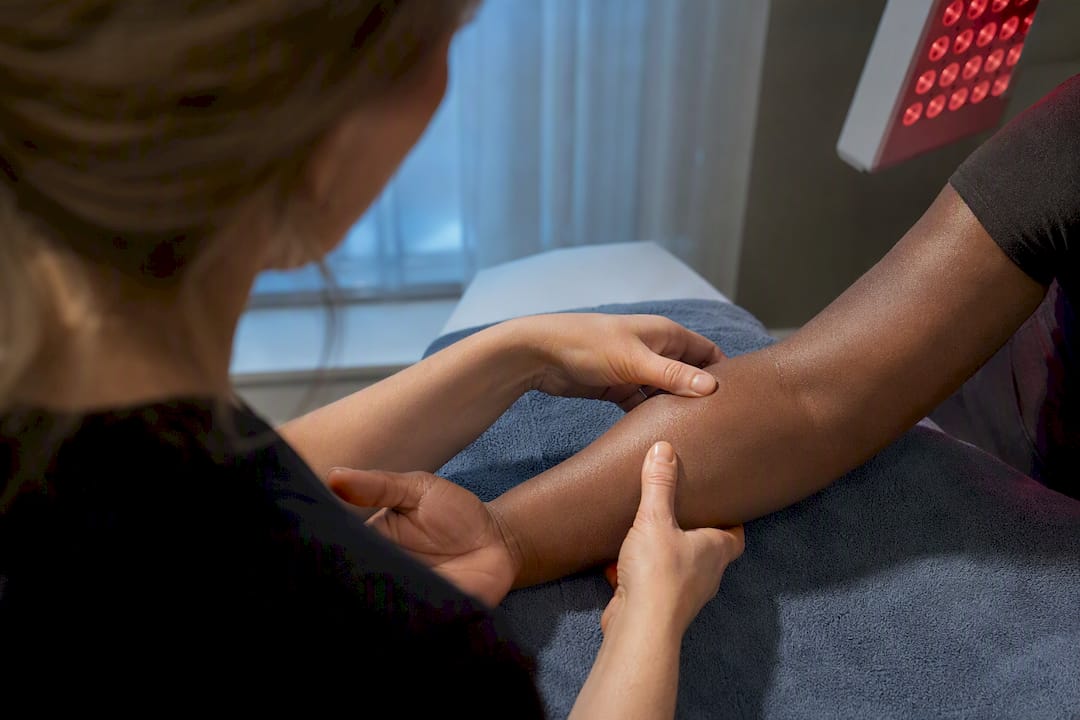
Session controls matter just as much. Calibrated power settings, fixed session times, and mandatory eye protection remove the guesswork that causes most at-home mishaps. This kind of structure reflects what safety researchers already recommend: calibrated fluence and consistent screening lower the odds of adverse events compared with unsupervised use. Readers curious about timing relative to training can see how it fits around workouts and recovery windows.
A Realistic Take on Red Light Therapy’s Promise and Limits
Red light therapy has genuine, well-documented promise for certain dermatologic and recovery uses, but the gap between what marketing implies and what the evidence supports is wide. Dosing standards don’t exist yet across conditions, and that uncertainty gets buried under confident product copy.
My honest read: treat red light therapy as a supplement to good recovery habits, not a fix for anything serious. Screen yourself for contraindications, respect the eye protection, and lean toward supervised sessions if you fall into a higher-risk group. Skepticism toward bold claims is a feature, not a flaw, in how you should approach this.
— Josh
Where to Try Red Light Therapy With Real Screening in Place
Some supervised recovery programs treat red light therapy as one tool inside a structured plan, not a standalone miracle device, and the difference from home units mostly comes down to oversight. Sessions run at calibrated power settings, staff check for the contraindications covered above before anyone starts, and eye protection is part of the protocol, not an afterthought.

That structure is the practical advantage over an at-home mask: someone is actually watching for skin response, adjusting settings, and catching issues early instead of leaving it to a manual and guesswork. It’s built into humn’s broader recovery offering alongside sauna, compression, and acupuncture, all coached as part of a longer-term plan rather than a one-off purchase. If you want to see whether supervised red light sessions fit your recovery routine, consider visiting a local facility that offers supervised sessions and ask about adding recovery access to your membership.
Where to Read More on Red Light Therapy Safety
For deeper reading beyond this guide, the Cleveland Clinic covers general benefits and side effects, the American Academy of Dermatology offers skin-tone specific guidance, and the dose-escalation trials on PMC detail the exact fluence thresholds referenced throughout this article.
This article is general information, not a substitute for advice from a qualified doctor. Consult a qualified healthcare professional about your own circumstances before acting on anything here.
Sources
- Safety of light emitting diode-red light on human skin: two randomized controlled trials
- Red light therapy for skin care - Harvard Health
- Red Light Therapy: Benefits, Side Effects & Uses (Cleveland Clinic)
- Red light therapy: What the science says (Stanford Medicine)
- Is red light therapy right for your skin? (AAD)
No Comments.