

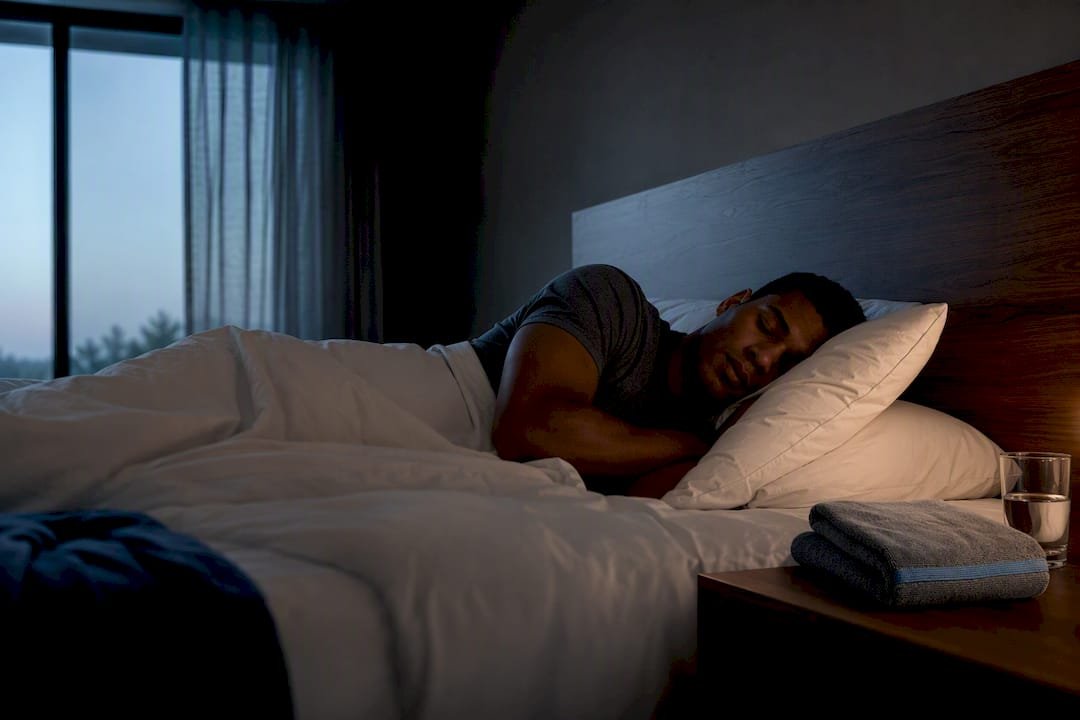
Sleep is essential to muscle repair, not a passive backdrop to it. Aim for consistent, mostly uninterrupted nightly sleep, roughly 7 to 9 hours, because that window preserves anabolic signaling and protein synthesis. Cut sleep short and your body shifts toward a catabolic state within a single night, undermining the exact repair processes your training depends on.
TL;DR:
- Sleep deprivation, even for one night, reduces muscle protein synthesis by approximately 18% and disrupts hormonal balance by increasing cortisol and decreasing testosterone.
- Continuously deep, uninterrupted sleep is critical, as fragmented sleep elevates inflammation and impairs recovery, regardless of total sleep duration.
- Athletes should aim for 7 to 9 hours of consistent, high-quality sleep, with more emphasis on slow-wave sleep early in the night to optimize hormone release.
- Prioritizing regular wake times, a wind-down routine, and minimal sleep disturbances enhances recovery more effectively than focusing on supplemental recovery modalities.
- For best results, fix sleep and protein intake before adding tools like massages or cold exposure, and consider coaching for accountability and personalized habits.
Table of Contents
- How Sleep and Muscle Recovery Work at the Hormonal Level
- How Much Sleep Do Athletes Actually Need for Recovery?
- Sleep Strategies That Actually Improve Muscle Repair
- Where Sleep Fits Among Other Recovery Tools
- How Coaching Turns Sleep Science Into Daily Habits
- The Priority Order That Actually Works
- Consider Coaching If Sleep Keeps Slipping
- Sources
- FAQ
How Sleep and Muscle Recovery Work at the Hormonal Level
Muscle repair is a hormonal event, and most of it happens on a schedule tied to your sleep architecture. Human growth hormone release peaks during early slow-wave sleep, the deep, non-REM stage that dominates the first few sleep cycles of the night. That timing is why coaches care less about “hours in bed” and more about protecting the front half of the night, when growth hormone release is tightly linked to slow-wave sleep.
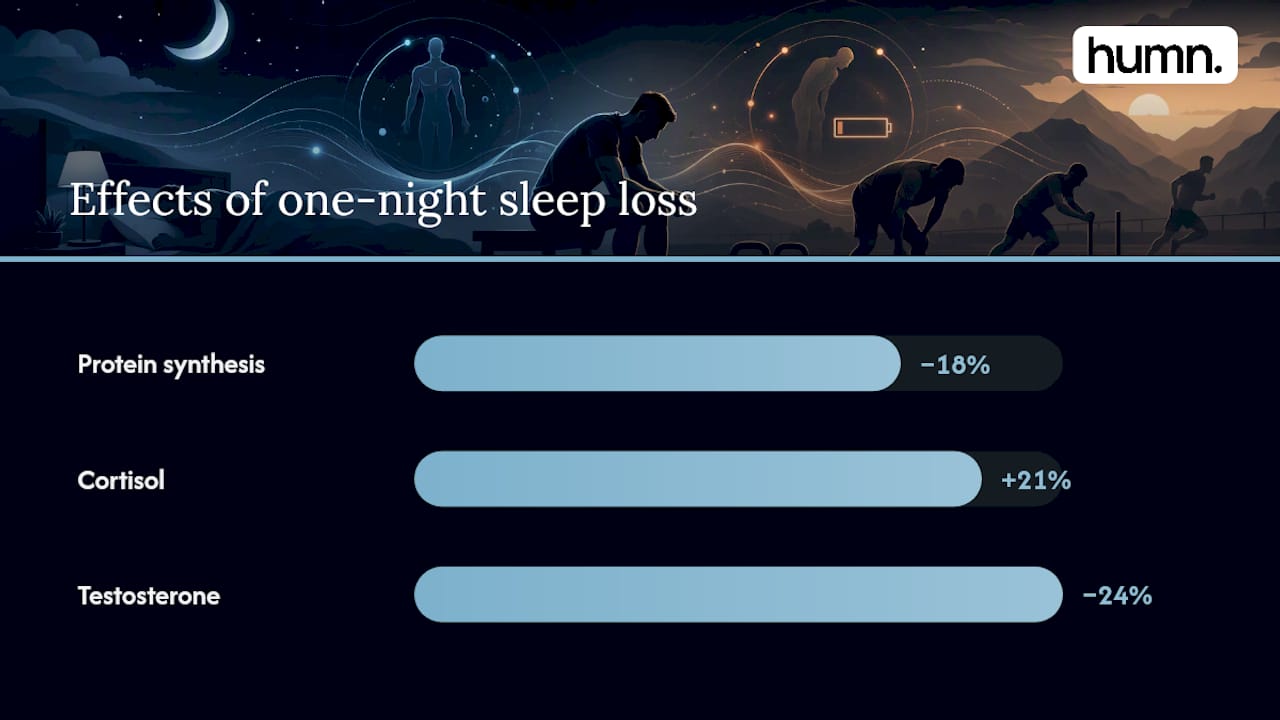
The clinical evidence on sleep loss is blunt. A single night of total sleep deprivation cuts postprandial muscle protein synthesis by about 18%, according to a randomized crossover trial on acute sleep deprivation. The same study found cortisol rose 21% and testosterone dropped 24% after just one sleepless night, a hormonal profile that favors tissue breakdown over repair.
That’s not a one-night problem, either. Repeated sleep restriction over several nights produces similar reductions in myofibrillar protein synthesis in healthy young men, suggesting the damage compounds rather than resets each morning.
Sleep fragmentation adds another layer. Interrupted sleep, even when total hours look adequate, raises inflammatory markers and blunts the hormonal and inflammatory profile that governs recovery. Chronic sleep problems also carry longer-term risk: population data links sleep deprivation and inverted sleep-wake cycles to a substantially higher rate of metabolic and muscle-mass complications.
A few caveats matter here. Hormonal responses to sleep loss vary by sex, age, and training status, and most of the acute-deprivation trials use small samples of young, trained men. That means the exact percentages won’t map onto every body, but the direction of the effect (less sleep, worse repair signaling) holds consistently across populations.
The one-night effect of sleep deprivation:
- Muscle protein synthesis: down about 18%
- Cortisol: up 21%
- Testosterone: down 24%
- Inflammatory markers: elevated with fragmented sleep
How Much Sleep Do Athletes Actually Need for Recovery?
Seven to nine hours per night is the baseline for adults, according to established sleep and recovery guidance, and athletes in heavy training blocks often land at the higher end or need extra recovery sleep on top of it. That’s not a rounded-up marketing number. It reflects the time your body needs to cycle through enough slow-wave sleep to sustain hormone release and complete the repair work triggered by resistance training.
The strength connection shows up outside the lab, too. A large cross-sectional study found men sleeping fewer than 6 hours a night had measurably lower grip strength than those sleeping 7 to 8 hours, independent of other lifestyle factors. That’s population-level evidence, not a controlled trial, but it lines up with what the deprivation studies show in isolation.
Quantity is only half the story. Two people can each log 8 hours, and the one with fragmented, interrupted sleep recovers worse than the one with continuous, deep sleep. Uninterrupted slow-wave sleep protects anabolic processes even when total time in bed is identical between two people.
A few practical notes:
- Naps count, but don’t replace night sleep. They help acute fatigue, not chronic sleep debt.
- Consistency matters as much as total hours. A stable sleep and wake schedule improves quality even at the same nightly duration.
- Chronic fragmentation deserves a professional look. If you’re sleeping 8 hours and still waking exhausted, ask about undiagnosed sleep apnea or another sleep disorder rather than assuming it’s a training or diet issue.
Sleep Strategies That Actually Improve Muscle Repair
Most sleep advice is generic. The habits that actually move the needle on recovery are specific, testable, and boring in the best way. Here’s what to prioritize, in order:
- Lock in a consistent bed and wake time, including weekends. Your circadian rhythm governs when growth hormone and cortisol cycle, and an erratic schedule disrupts both even if total sleep hours stay the same.
- Build a 30 to 60 minute wind-down window. Dim lights, cut screen time, and skip intense conversations or work right before bed.
- Cut caffeine by early afternoon and alcohol close to bedtime. Alcohol in particular fragments sleep architecture and suppresses the deep sleep stages tied to muscle repair, which is worth reading more on if you train hard and drink regularly, see how alcohol affects muscle recovery.
- Keep the bedroom cool, dark, and quiet. A bedroom in the mid to high 60s Fahrenheit with blackout coverage and minimal noise supports longer stretches of uninterrupted sleep.
- Time hard training sessions earlier when you can. Maximal-intensity work late at night can delay sleep onset; if an evening session is unavoidable, leave 2 to 3 hours before bed to let your nervous system come down.
- Distribute protein across the day, including a dose before sleep. 20 to 40 grams post-workout and again in the evening keeps anabolic sensitivity up, which matters more when sleep is imperfect.
- Use short naps strategically. A 20 to 40 minute nap can offset acute fatigue after a hard session, but long or late naps eat into your sleep drive and fragment the night ahead.
Pro Tip: Sleep trackers are useful for spotting patterns, like a caffeine cutoff that’s too late or a bedtime that keeps slipping, but don’t chase a perfect nightly score. A consistent, unremarkable routine beats an obsessively optimized one that changes every night.
Where Sleep Fits Among Other Recovery Tools
Sleep and protein intake are the foundation. Everything else, from cold plunges to massage guns, is a layer on top, not a substitute. A review of recovery techniques found massage and water immersion do reduce delayed-onset muscle soreness and perceived fatigue, but their effects on the actual biochemical markers of muscle damage are inconsistent. Compression garments and cold exposure show similarly mixed results depending on the study.
That doesn’t make those tools worthless. It means they’re marginal gains stacked on a base that has to be solid first.
- If sleep is inconsistent, fix that before adding modalities.
- If sleep is dialed in, next prioritize protein timing and total daily intake.
- Only after both are solid does it make sense to add massage, cold exposure, or active recovery days for incremental benefit.
Spending money on recovery gadgets while sleeping 5 or 6 hours a night is optimizing the wrong variable.
How Coaching Turns Sleep Science Into Daily Habits
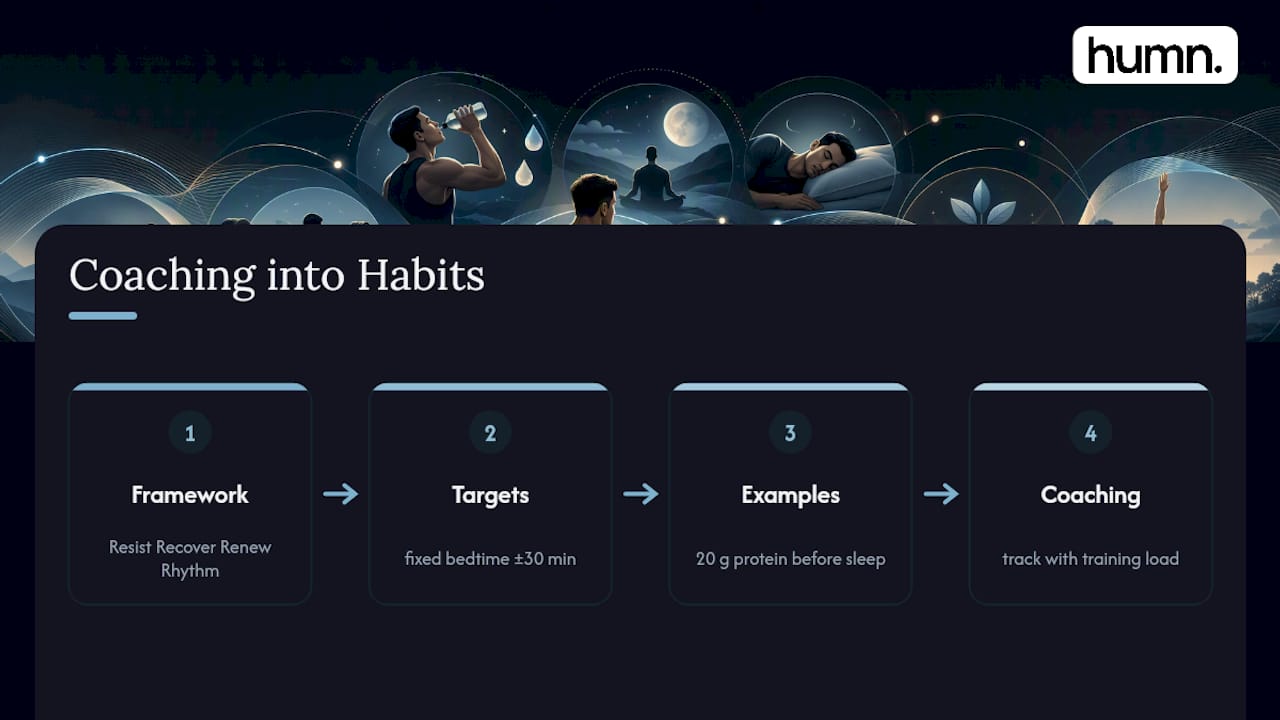
Most people don’t need more sleep research. They need someone to help them apply it consistently, which is where humn’s approach to recovery as a fitness pillar comes in. humn’s four-pillar framework, Resist, Recover, Renew, and Rhythm, treats sleep timing and consistency as a coached variable inside Rhythm, not an afterthought.
In practice, that means small, specific targets: a fixed bedtime within a 30-minute window, or 20 grams of protein before sleep on hard training days. Coaches track these alongside training load, adjusting one habit at a time instead of overhauling a client’s entire evening at once.
The Priority Order That Actually Works
Sleep comes first, then protein, then training structure. Everything else is secondary until those three are consistent.
Two changes worth trying this week: pick one fixed wake time and hold it for seven straight days, and add a small protein dose in the hour before bed. Track how you feel, not just how you perform, and if poor sleep persists despite real effort, talk to a physician about ruling out a sleep disorder.
— Josh
Consider Coaching If Sleep Keeps Slipping
Reading about sleep hygiene is one thing. Actually changing a bedtime you’ve kept for ten years is another, and that’s the gap coaching is built to close. Clients can work with coaches through small-group training, 1-on-1 coaching, and access various recovery services, so sleep and recovery targets get built into your program instead of living on a separate to-do list you’ll ignore by Thursday.

The advantage isn’t more information. It’s accountability and an individualized habit plan that adjusts when your schedule, training load, or sleep quality shifts, something a generic sleep app can’t do. If chronic short sleep or fragmented nights have been quietly capping your strength gains, explore humn’s recovery services and see what a coached plan looks like for your specific schedule.
FAQ
Is 5 hours of sleep bad for muscle recovery?
Yes. Five hours falls well below the 7 to 9 hour range tied to healthy protein synthesis, and even a single night of total sleep deprivation has been shown to cut muscle protein synthesis by roughly 18% while raising cortisol and lowering testosterone.
How many hours of sleep are required for muscle recovery?
Most adults need 7 to 9 hours per night to support the hormonal and protein synthesis processes behind muscle repair, with some athletes in heavy training blocks needing the higher end of that range.
Is 7 hours of sleep enough for muscle repair?
Seven hours sit at the low end of the recommended range and works for many people, but quality matters as much as quantity. Fragmented 7-hour sleep recovers worse than continuous, uninterrupted 7-hour sleep.
Does napping help muscle recovery?
Short naps of 20 to 40 minutes can ease acute fatigue after hard training sessions, but they don’t replace nighttime sleep and long or late naps can fragment your sleep schedule.
What’s more important for recovery, sleep or protein?
Sleep and protein both function as foundational, not optional, inputs, but the evidence on hormonal disruption from sleep loss suggests sleep should be the first thing you fix before optimizing protein timing or adding other recovery tools.
No Comments.