

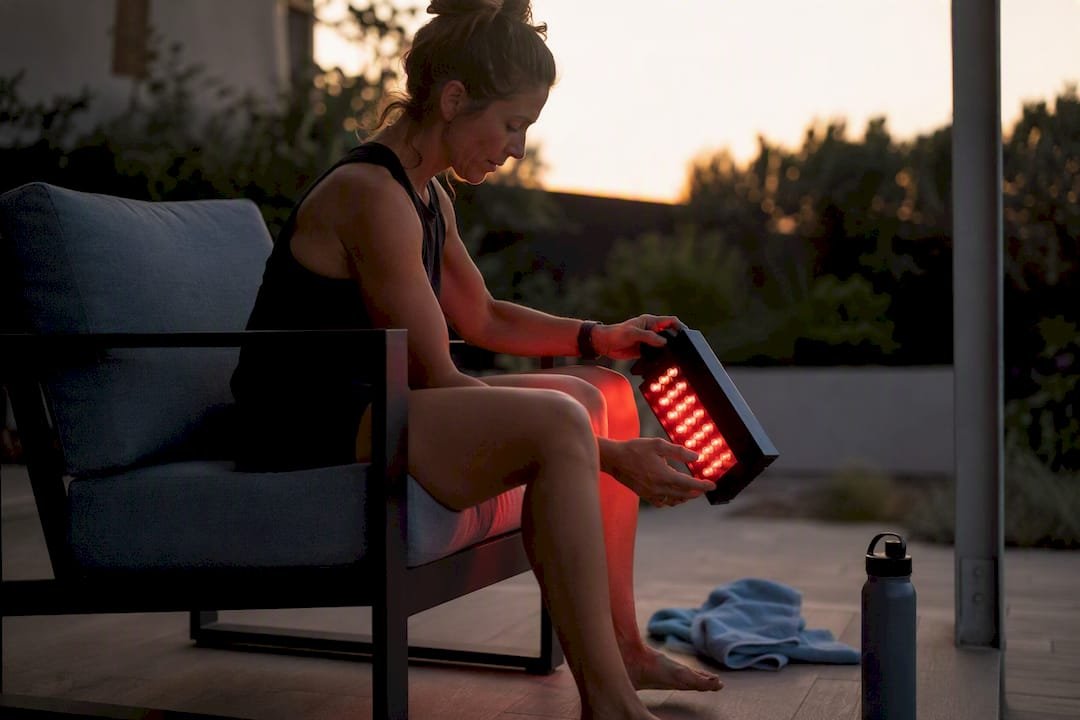
Red light therapy delivers moderate-certainty benefits for a specific set of conditions, knee osteoarthritis disability, burning mouth pain, fibromyalgia fatigue, and hair density, while most skin and sleep claims remain lower-certainty and still developing. No outcome yet has high-certainty backing, according to the most comprehensive umbrella review of randomized clinical trials on the topic. That doesn’t mean it’s a wash. It means you should know exactly where the science is strong before you spend money on it.
Here’s the current breakdown:
- Moderate certainty: knee osteoarthritis disability, burning mouth pain, hair density, some cognitive measures
- Low to very low certainty: wrinkle reduction, acne, sleep quality, general muscle recovery
- Mechanistically plausible but under-studied: wound healing, cognitive performance, fibromyalgia beyond fatigue
The rest of this guide covers how it works, what the trials actually measured, safety rules, and a realistic starting protocol.
Key Takeaways
Red light therapy delivers moderate-certainty relief for specific conditions like knee osteoarthritis and hair density, but most other benefits remain preliminary and dose-dependent.
| Point | Details |
|---|---|
| Strongest evidence | Knee osteoarthritis disability, burning mouth pain, fibromyalgia fatigue, and hair density have moderate-certainty support. |
| Mechanism matters | Effects come from mitochondrial stimulation via cytochrome c oxidase, not from heat, so dose and wavelength determine results. |
| Skin results are real but modest | Trials show improved collagen and roughness scores, but sample sizes are small and protocols vary widely. |
| Sleep evidence is preliminary | PBM improved subjective sleep scores in small trials, but objective measures often show no change. |
| Personalized recovery matters | humn. integrates red light therapy into its Recover pillar, adjusting dose alongside training load and sleep coaching. |
Table of Contents
- How Does Red Light Therapy Work?
- Does Red Light Therapy Improve Skin?
- Can Red Light Therapy Help With Chronic Pain?
- What About Hair Regrowth, Sleep, and Other Claims?
- Is Red Light Therapy Safe? Side Effects and Contraindications
- How Do You Choose a Device and Dosing Schedule?
- How humn. Uses Red Light Therapy in Recovery Programming
- How to Try Red Light Therapy Safely
- What the Research Actually Supports, and What It Doesn’t
- Add Red Light Therapy to a Real Recovery System
- Sources
How Does Red Light Therapy Work?
Photobiomodulation, the clinical term for red light therapy, uses light in roughly the 600 to 1100 nanometer range to trigger a specific cellular reaction rather than heat tissue. At therapeutic doses, red and near-infrared wavelengths are absorbed by cytochrome c oxidase, an enzyme inside mitochondria, which boosts ATP production, modulates nitric oxide release, and reduces oxidative stress, according to a mechanistic review of photobiomodulation. That cascade is the biological basis for claims about tissue repair and pain reduction.
The catch is dose. Four variables determine whether a session does anything at all:
- Wavelength: red (roughly 630 to 700 nm) tends to target skin depth; near-infrared (780 to 1100 nm) penetrates deeper into muscle and joint tissue
- Irradiance: how much light energy hits the skin per second, measured in milliwatts per square centimeter
- Energy density: total dose delivered, measured in joules per square centimeter
- Session duration: too short under-doses tissue; too long can blunt the effect
This is why two “red light therapy” devices can produce wildly different results. One delivers a calibrated, clinically-relevant dose; the other is essentially a red bulb.
Pro Tip: Before buying or booking anything, ask for the irradiance (mW/cm²) and total energy density (J/cm²) the device delivers at treatment distance. If a seller can’t answer, treat the product as unverified.
Does Red Light Therapy Improve Skin?
Skin is where red light therapy built its consumer reputation, and the trial data is genuinely encouraging, within limits. A controlled trial of red and near-infrared light treatment found measurable improvements in skin roughness, fine lines, and intradermal collagen density in treated groups compared to controls.
Multiple controlled trials link consistent red and near-infrared exposure to increased collagen density and improved complexion scores versus untreated skin.
That’s a real signal, but it comes with caveats:
- Sample sizes in most skin trials are small, often a few dozen participants per arm
- Protocols vary widely in wavelength, dose, and session frequency, making it hard to compare studies directly
- Wound-healing results are mixed, some trials show faster closure, others show no difference from placebo
Clinic-grade devices generally outperform at-home units for consistency. Stanford Medicine’s review of the evidence notes that consumer devices frequently lack controlled, calibrated output, which is the main reason results vary so much between users.
Can Red Light Therapy Help With Chronic Pain?
Pain and musculoskeletal complaints have the strongest clinical support of any red light therapy use case. An umbrella review of multiple meta-analyses and randomized trials found moderate-certainty evidence that PBM reduces pain in burning mouth syndrome and improves disability scores in knee osteoarthritis, according to the umbrella review published in Systematic Reviews.
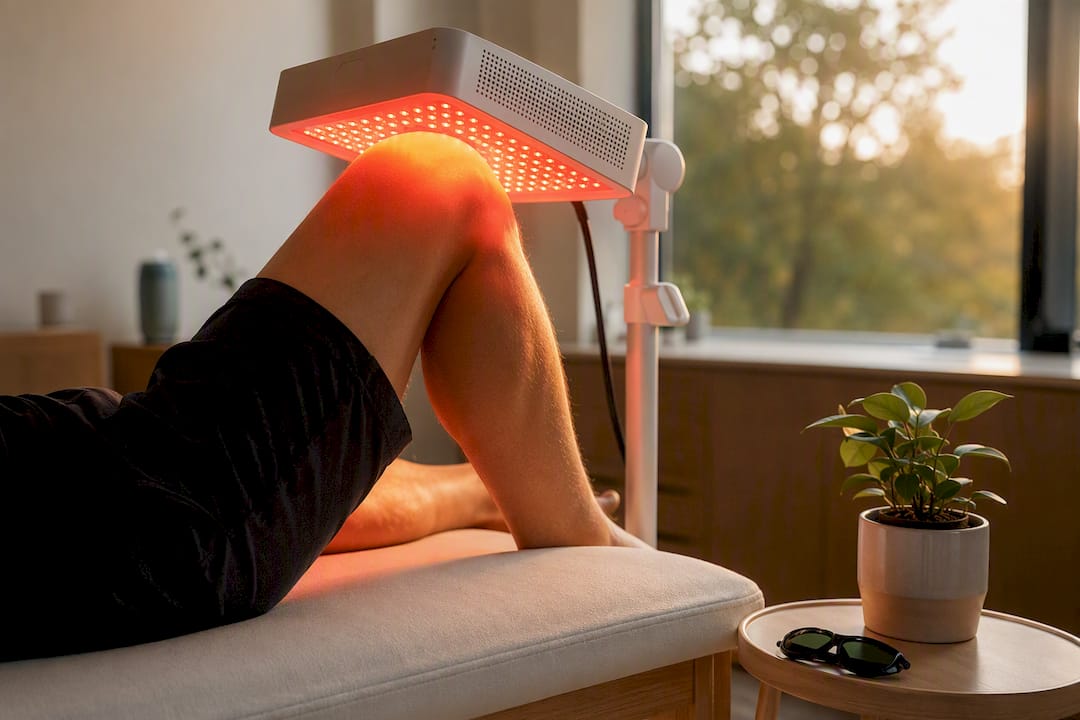
Fibromyalgia fatigue also showed a moderate-certainty benefit. Mechanistically, PBM appears to reduce inflammatory mediators and alter nerve membrane potentials, producing measurable analgesia in some peripheral pain conditions, though maintenance treatments are often required for chronic cases rather than a one-time fix.
Set expectations accordingly:
- Acute soreness often responds within a few sessions
- Chronic conditions like osteoarthritis typically need ongoing treatment, not a short course
- PBM works best as one part of a broader pain management plan, not a standalone cure
What About Hair Regrowth, Sleep, and Other Claims?
The catch: benefits appear to fade once treatment stops, so it functions more like a maintenance therapy than a cure.
Sleep is more of a mixed bag. A 2026 systematic review and meta-analysis of five randomized trials found PBM improved Pittsburgh Sleep Quality Index scores by a mean difference of 1.25 points versus sham, though the evidence was limited and heterogeneous. A separate sham-controlled trial of a wearable near-infrared device found subjective relaxation improved, but objective actigraphy data showed no real difference between active and sham groups. If you’re experimenting with light-based sleep aids, avoid bright red light exposure right before bed and pair it with broader sleep hygiene habits instead of expecting it to work alone.
Cognitive function and general wound healing show early, promising signals but need more high-quality trials before anyone can make firm claims.
Is Red Light Therapy Safe? Side Effects and Contraindications
At therapeutic doses, photobiomodulation is nonthermal and carries a low risk profile overall. This is part of why it’s become popular as a recovery add-on rather than a medical last resort.
Still, it isn’t risk-free for everyone. Specific groups need to check with a clinician first:
- Anyone with active cancer or infection near the treatment area
- Pregnant individuals should avoid thoracoabdominal exposure
- Anyone on photosensitizing medication (some antibiotics, retinoids)
Eye safety matters more than most people assume. Never look directly into a panel, and use provided eye protection during full-body sessions. Full contraindication guidance is worth reviewing in detail through resources like this breakdown of who should avoid red light therapy.
Pro Tip: Temporary redness or mild warmth after a session is normal and typically resolves within an hour. Persistent irritation lasting more than a day is a sign to stop and reassess your device settings.
How Do You Choose a Device and Dosing Schedule?
Reading a spec sheet is the single most useful skill for evaluating any red light product. Three numbers matter:
- Wavelength (nm): confirms whether the device targets skin (red) or deeper tissue (near-infrared)
- Irradiance (mW/cm²): determines how much energy reaches your skin per second at a given distance
- Energy density (J/cm²): the total dose per session, calculated from irradiance and time
Most clinical trials use sessions in the 10 to 20 minute range, delivered three to five times per week, though exact protocols vary by condition and device output. Trying to replicate a clinical dose with an underpowered consumer panel usually just wastes time.
Clinic-grade equipment tends to deliver more consistent, verified output, which matters if you’re targeting a specific clinical outcome. At-home devices can work for maintenance once you’ve established what dose actually helps you, provided you check the manufacturer’s dosage specs against what trials actually used, not just marketing language.
How humn. Uses Red Light Therapy in Recovery Programming
At humn., red light therapy isn’t a standalone gadget sitting in a corner. It’s built into the Recover pillar of our four-part framework, sitting alongside sauna, compression, acupuncture, and the sleep and stress coaching that actually determines whether recovery tools work long-term.
Recovery only compounds when it’s paired with the training and lifestyle habits driving fatigue in the first place. A red light session after a heavy lower-body day means something different than one on a rest day, and dosing should reflect that.
Coaches personalize session length and frequency based on training load and individual goals, rather than applying one generic protocol to every member. That’s consistent with how the broader recovery pillar is designed to function.
How to Try Red Light Therapy Safely
Before starting, run through a short checklist:
- Rule out contraindications with a doctor if you have a chronic condition, are pregnant, or take photosensitizing medication
- Identify the specific area or symptom you’re targeting, don’t treat your whole body hoping something improves
- Confirm the device’s wavelength and energy density match what’s been used in relevant trials
From there, a reasonable starter protocol looks like 10 to 15 minutes per session, three to five times a week, evaluated over 8 to 12 weeks. Track something concrete: photos under consistent lighting for skin goals, a 1 to 10 pain scale for joint or muscle complaints, or a sleep diary if that’s your target.
Stop and consult a clinician if you notice worsening pain, unusual skin changes, or no measurable change after the full evaluation window. Consistency costs more than the device itself. Missing sessions or measuring the ongoing cost against your actual usage will tell you faster than any spec sheet whether it’s worth continuing.
Pro Tip: Take your baseline photo or pain score on day one, before your first session. Without it, you’re guessing at week eight instead of measuring.
What the Research Actually Supports, and What It Doesn’t
The biggest gap in how red light therapy gets discussed is the confusion between “statistically significant” and “life-changing.” The umbrella review data is genuinely good news, nine conditions showed real effects. But moderate certainty for knee osteoarthritis disability doesn’t mean everyone with joint pain will feel dramatic relief. It means the average effect across trials was real and measurable, which is a different promise than what most marketing implies.
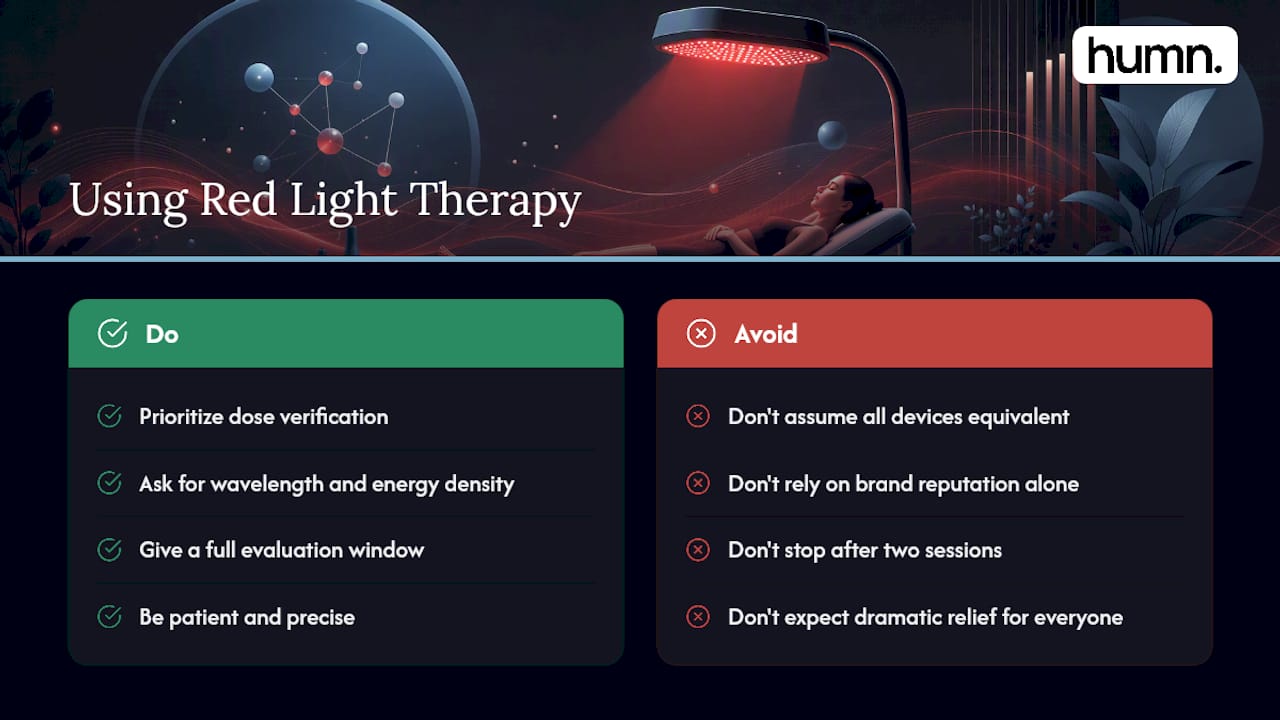
Where conventional advice falls short is treating red light therapy as a single product category. A ten-minute session under an uncalibrated panel and a properly dosed clinical treatment are not the same intervention, even though they get marketed identically. That gap explains most of the frustrated reviews you’ll find online.
If you’re prioritizing anything first, prioritize dose verification over brand reputation. Ask what wavelength and energy density you’re actually getting. Then give it the full evaluation window, not two sessions, before deciding whether it’s working. The evidence rewards patience and precision, not enthusiasm.
— Josh
Add Red Light Therapy to a Real Recovery System
Buying a panel and using it inconsistently in your living room is the most common way people waste money on red light therapy. humn. is built for readers who want the dosing, frequency, and combination with other recovery tools handled by someone who tracks it, not guessed at alone. Our Recover pillar pairs red light sessions with sauna, compression, and acupuncture, calibrated against your actual training load instead of a generic timer.
That combination is the practical difference between a device sitting unused after three weeks and a protocol that actually compounds over months. If you’re already training with us or considering it, ask your coach how red light fits your current program. Explore the Recover pillar and book a session to see how it’s built into your plan from week one.
This article is general information, not a substitute for advice from a qualified doctor. Consult a qualified healthcare professional about your own circumstances before acting on anything here.
Sources
- Effects of photobiomodulation on multiple health outcomes: an umbrella review of randomized clinical trials | Systematic Reviews
- Photobiomodulation mechanisms and clinical effects - PMC
- 2026 systematic review and meta-analysis on PBM and sleep
No Comments.