


You can raise your VO2 max at almost any age, and the recipe is less complicated than most plans make it sound: regular aerobic work, some of it hard, some of it easy, supported by strength training and enough recovery to absorb it all. Research shows both steady moderate training and high-intensity intervals improve VO2 max, so the best plan is the one you can repeat every week for months. Below is how to measure where you are, how to build a week around it, and what the evidence says about using sauna as part of your recovery.
TL;DR
- VO2 max is the most oxygen your body can use per kilogram of body weight per minute during maximal effort. Most healthy adults can raise it with consistent training.
- Moderate continuous training and high-intensity intervals both work. Intervals are more time-efficient, which matters if your calendar is tight.
- A practical week combines one or two hard interval sessions, one or two easy aerobic sessions, and two strength sessions.
- Regular sauna use acutely lowers blood pressure, and some studies show added benefit when it is paired with exercise. Check with your doctor first if you have uncontrolled hypertension or heart disease.
- Recovery, sleep and a repeatable routine decide whether the training sticks.
Table of Contents
- What VO2 max actually measures
- What the research says about training
- VO2 max training versus zone 2
- A practical weekly plan
- Sauna and VO2 max: what the evidence supports
- Our perspective
- Train, recover and track it in one place
- FAQ
- Sources
What VO2 max actually measures
VO2 max is the volume of oxygen your body can consume per kilogram of body weight per minute during maximal exercise. It reflects how well your lungs, heart, blood and muscles work together to deliver and use oxygen. That is why it shows up so often in conversations about endurance and long-term health.
Because the number is expressed per kilogram, body weight matters. Weight loss can raise relative VO2 max even when your heart and lungs have not changed, simply because the denominator got smaller. Keep that in mind when your number moves: some of the change may be fitness, and some may be body composition.
How to measure or estimate it
The gold standard is a graded exercise test in a laboratory. You run or pedal while the intensity climbs until you cannot continue, and a mask captures the gases you breathe in and out. Cleveland Clinic describes this lab test as the most accurate method, with heart-rate-based fitness trackers and submaximal field tests as practical ways to estimate it.
For most people, an estimate is enough. What matters is the trend. Use the same device, the same type of test and similar conditions each time, and compare your own numbers over months rather than against a friend’s. The American College of Sports Medicine notes that accurate heart-rate measurement and appropriate maximum heart rate equations improve estimates of cardiorespiratory fitness and the exercise prescriptions built from them. A watch that guesses your maximum heart rate badly will guess your VO2 max badly too.
What the research says about training
The headline finding is reassuring. A review of exercise intensity and VO2 max found that both lower-intensity and high-intensity training raise VO2 max across many populations, including sedentary and healthy adults, although which is better remains unclear.
A few details help you design your week:
- Intensity needs to be meaningful. In healthy adults, training above roughly 60% of VO2 max is likely to improve maximal oxygen uptake. You do not need to be gasping on every session, but a gentle stroll will not move the needle for most fit people.
- Harder work is more efficient. Research on young healthy adults found that higher-intensity training can produce similar aerobic adaptations with lower total training volume and shorter sessions than lower-intensity endurance work.
- You have several levers. Harvard Health lists higher intensity, interval training, longer sessions and changing the type of exercise as ways to keep challenging the body once it adapts.
- Results depend on where you start. Gains vary with baseline fitness and age, but most healthy adults see significant improvements across a range of intensities.
If you are new to structured cardio, the biggest jump usually comes from simply showing up consistently. If you are already fit, the extra gains come from adding intensity or variety.
VO2 max training versus zone 2
People often frame this as a choice: hard intervals for VO2 max or easy zone 2 for your aerobic base. The research does not force that choice. Both intensity ranges improve VO2 max, and they do different jobs in a week.
- Easy aerobic work (zone 2) is conversational-pace training. It builds your base, is easy to recover from, and can be done often. We cover the case for it in our guide to zone 2 cardio.
- Interval work pushes you to a high heart rate for short blocks. It costs more recovery but delivers more adaptation per minute.
For a busy adult, a blend makes sense: most of your aerobic minutes easy, with one or two short, hard sessions that give VO2 max a direct push. If you lift as your main activity, this plan for building an aerobic base alongside strength shows how to add cardio without losing what you have built in the gym.
A practical weekly plan
Here is a template for a healthy adult with a full calendar. Adjust it to your current fitness, and talk with your doctor before ramping up intensity if you have a heart condition, high blood pressure or symptoms during exercise. Intensity should be above the minimum needed for a training effect but below the level that causes significant symptoms or blood-pressure abnormalities.
| Day | Session | Length | Effort |
|---|---|---|---|
| Monday | Strength, full body | 40 to 50 min | Challenging, 1 to 3 sets of 8 to 12 reps |
| Tuesday | Intervals | 30 min total | 4 rounds of 3 to 4 min hard, equal time easy |
| Wednesday | Rest or walk | 20 to 30 min | Very easy |
| Thursday | Strength, full body | 40 to 50 min | Challenging |
| Friday | Easy aerobic | 40 to 60 min | Conversational |
| Saturday | Optional second interval session or long easy session | 30 to 60 min | Hard or easy, not both |
| Sunday | Recovery | Any | Walk, mobility, sauna |
Treat the exact intervals as a starting point, not a prescription. The principle is what counts: a couple of hard efforts, a few easy ones, strength twice a week, and real days off.
Why strength belongs in a VO2 max plan
Strength training is easy to skip when your goal is a cardio number, but it earns its place. The American Heart Association’s statement notes that resistance training can improve blood pressure and cardiovascular risk factors independently of aerobic training. For healthy adults, it describes a program of 8 to 10 exercises for the major muscle groups, 1 to 3 sets of 8 to 12 repetitions, at least twice a week.

If your blood pressure runs high, start with this safe approach to strength training with high blood pressure. To see how the two types of training fit into one week, read how to combine cardio and strength training.
How to stay on schedule
Most stalled VO2 max plans fail on logistics, not physiology. A few habits help:
- Schedule sessions like meetings. Put the hard days in your calendar first and build the easy days around them.
- Shorten rather than skip. A 20-minute interval session beats a missed 45-minute one. Our piece on how many workouts per week to aim for explains why consistency beats heroic weeks.
- Let your body vote on hard days. Resting heart rate, sleep and how you feel can tell you whether to push or back off. Our HRV guide walks through that daily decision.
- Test your timing. Some people train better in the morning, others in the evening. This workout-time experiment helps you find out before you change your routine.
Fueling the hard days
Interval days and long sessions ask more of your energy supply. Eating enough carbohydrate around hard sessions helps, and session-focused carb cycling templates show one way to organize it. Some athletes also look at supplements for endurance athletes as a convenience. Food, sleep and consistent training come first, and a doctor or dietitian is the right person to ask if you take medication or have a health condition.
If you are returning to exercise after quitting smoking, cardio is one of the best ways to rebuild capacity, and these workouts after quitting smoking are a gentle way to begin.
Sauna and VO2 max: what the evidence supports
Sauna does not replace training. But it is a popular recovery habit, and the research on heat exposure is interesting enough to understand.
Sauna and blood pressure
A 2024 review of passive heat therapies reports that regular sauna use acutely lowers both systolic and diastolic blood pressure, and that Finnish sauna bathing is associated with improved peripheral endothelial function. “Acutely” matters: the drop happens during and after a session. If you check your pressure right after a sauna, expect it to read lower than usual, and do not use that reading to judge your resting baseline.
The same review advises that people with uncontrolled hypertension or heart disease consult a doctor before using saunas, because heat changes how blood moves through the body. Stand up slowly, drink water, and leave the room if you feel dizzy or lightheaded.
Sauna combined with exercise
Research on sauna bathing alongside training is the part most relevant to VO2 max. A study in the American Journal of Physiology reported that regular sauna bathing combined with exercise provided additive benefits for cardiorespiratory fitness and systolic blood pressure compared with exercise alone in some studies. The word “some” is doing real work here: the evidence is promising, not settled, and the sauna adds to your training rather than standing in for it.

Sauna, immunity and longevity
Finnish sauna use has been linked with longevity, and the same review lists anti-inflammatory, cytoprotective and antioxidant properties among the proposed benefits of passive heat therapies, along with effects on cardiovascular and immune function. These are associations and proposed mechanisms. They are good reasons to treat sauna as a sensible part of a recovery routine, but not a guarantee of any specific outcome, and not a reason to train less.
Using sauna for endurance training
If you want to add sauna to an endurance block, keep it simple:
- Use it after training or on a rest day, not before a hard interval session.
- Start with shorter sessions and build up as you tolerate the heat.
- Hydrate before and after.
- Note how your sleep and next-day training feel, and adjust.
Our perspective
Most people treat VO2 max as a number to chase. We treat it as a result of a system. Strength, aerobic work, sleep, stress, food and recovery all move it, and a plan that ignores any one of them tends to stall.
That is why we build coaching around habits first. The best interval session in the world does nothing if you cannot repeat it for six months. We would rather help you land two hard sessions, two strength sessions and a recovery routine you actually keep than hand you a perfect plan you drop in week three.
Recovery is part of the training, not a reward for it. Our members have sauna, compression and red light therapy available alongside their coaching, so the day after a hard session has a plan too. A dedicated coach can then watch how you respond, adjust the week, and keep progress measurable.
Josh
Train, recover and track it in one place
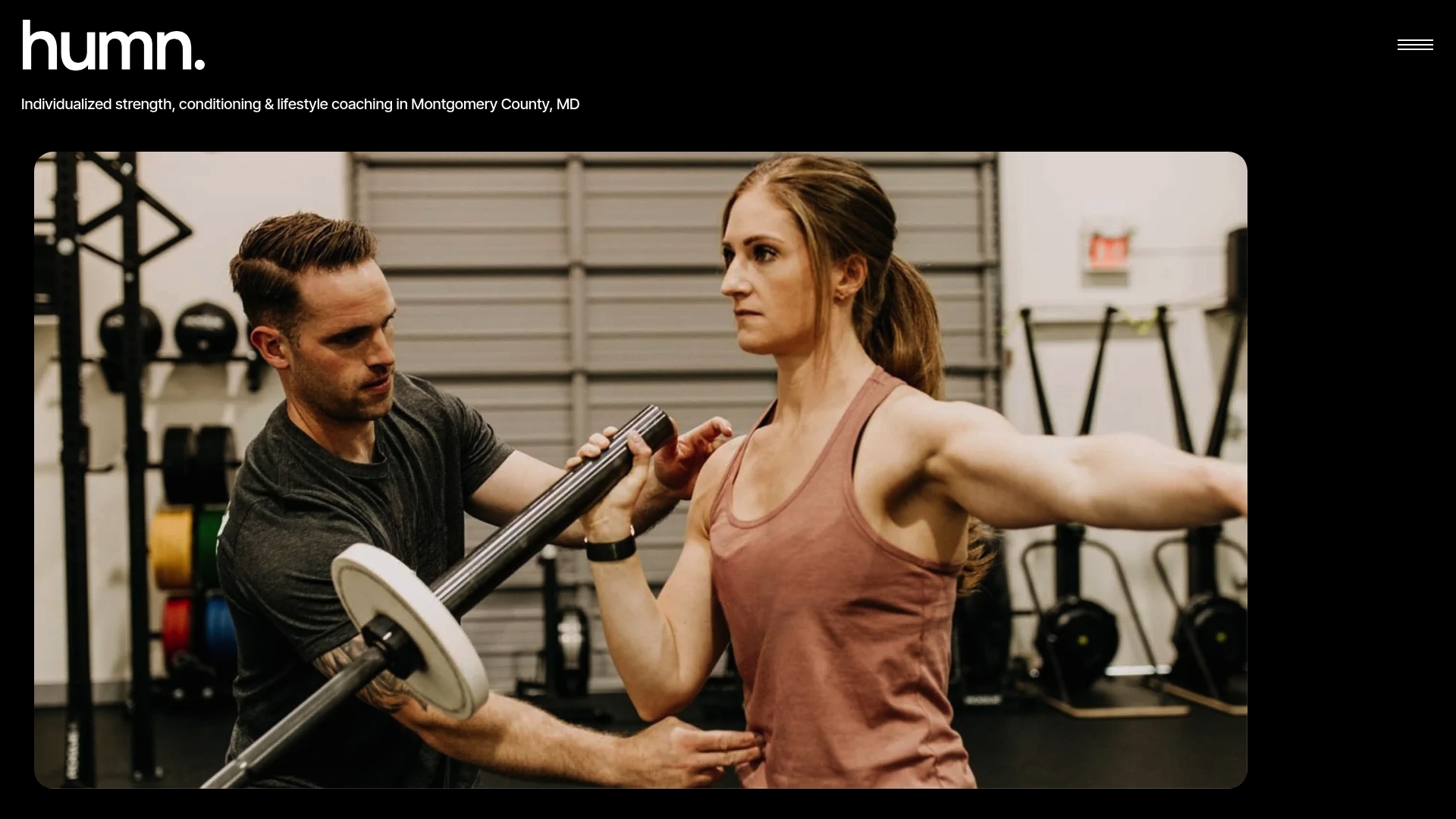
If you would rather not build and manage this yourself, that is what we do at humn. in Gaithersburg, MD. Our membership combines small-group personal training and coaching and guidance with a coach who knows your goals, your schedule and how you recover. Our recovery services, including sauna, compression, red light therapy and acupuncture, are there for the days between hard sessions.
Want nutrition support to go with it? Our 1:1 nutrition coaching builds eating habits around your training week. If you want to see how a sauna routine fits a membership, our page on infrared sauna cost in Gaithersburg is a good starting point.
FAQ
How long does it take to improve VO2 max?
There is no single timeline, because gains depend on your starting fitness, age and how consistently you train. Research shows that most healthy adults see significant improvements, and beginners usually see the fastest early change. Track your estimate over several months using the same method.
Is VO2 max training better than zone 2?
Neither is clearly better. The research shows both lower-intensity and high-intensity training raise VO2 max. Intervals do it in less time, while easy sessions are simpler to recover from and repeat, so most plans use both.
Does sauna lower blood pressure?
Regular sauna use acutely lowers systolic and diastolic blood pressure, meaning during and after the session. If you have uncontrolled hypertension or heart disease, talk to your doctor before using one.
Can sauna help my endurance?
Some studies show that sauna bathing combined with exercise gives additional benefits for cardiorespiratory fitness compared with exercise alone. It works as an add-on to training, not a replacement for it.
How can I check my VO2 max without a lab?
Heart-rate-based fitness trackers and submaximal field tests give reasonable estimates, while a laboratory graded exercise test is the gold standard. Use the same method each time so you can compare your own results.
Sources
- VO2 Max: How To Measure and Improve It, Cleveland Clinic
- The Effect of Exercise Training Intensity on VO2max, PMC
- Physical activity, cardiorespiratory fitness, and health, PMC
- The Effect of Training Intensity on VO2max in Young Healthy Adults, PMC
- VO2 max: What is it and how can you improve it?, Harvard Health
- Resistance Exercise Training in Individuals With and Without Cardiovascular Disease, American Heart Association
- Estimating cardiorespiratory fitness, ACSM
- The multifaceted benefits of passive heat therapies, PMC
- Effects of regular sauna bathing in conjunction with exercise, American Journal of Physiology
- Top supplements for endurance athletes
- Workouts after quitting smoking
No Comments.