

Use your morning RMSSD relative to your 7-day rolling baseline to decide whether to push, train as planned, or pull back. That single rule, applied consistently, is how heart rate variability moves from an interesting number on your wrist to a genuine training tool.
Here is what each decision looks like in practice:
- Push (hard session): RMSSD is at or above your weekly mean, trend is stable or rising. Go as planned or add intensity.
- Train as planned (normal session): RMSSD is within your typical variation range. Stick to the program.
- Recover or go low-intensity: RMSSD is meaningfully below your weekly mean, especially if the drop persists more than one day or coincides with poor sleep or elevated resting heart rate.
Pro Tip: Before changing your training based on a single HRV reading, add one wellness question: “How did I sleep, and how do I feel right now?” A low RMSSD paired with a subjective wellness dip is a much stronger signal than either alone.
For measurement: take your reading first thing in the morning, supine or seated, before coffee or conversation. A 1–5 minute recording is acceptable for daily monitoring, and morning HRV baselines measured consistently over at least 7 days are what make the numbers meaningful. RMSSD is the metric to use for daily checks.
Key Takeaways
Using morning RMSSD relative to your 7-day rolling baseline, combined with a simple subjective wellness check, is the most reliable daily method for translating HRV into training decisions.
| Point | Details |
|---|---|
| Daily decision rule | Compare morning RMSSD to your 7-day mean; train hard, maintain, or recover based on where you fall relative to your personal CV range. |
| Measurement setup | Measure supine or seated, first thing in the morning, for 1–5 minutes; collect 7 days before drawing conclusions. |
| Weekly adaptation tracking | Use RMSSDMEAN to track adaptation trends and RMSSDCV to detect acute disturbances across fixed 7-day blocks. |
| Main limitation to remember | HRV can paradoxically rise in overreached athletes; always cross-reference with subjective wellness and performance data before making major program changes. |
| humn. coaching | humn. integrates HRV monitoring with personalized strength, recovery, and habit coaching to turn readiness data into consistent training outcomes. |
Table of Contents
- How HRV and training are connected: the physiology that matters
- How HRV is measured: metrics, timing, and devices
- Non-training factors that change your HRV
- Day-to-day HRV decision protocol: what to do each morning
- Using HRV to plan training blocks and track adaptation
- Limitations and common pitfalls when using HRV for training
- Which HRV tools and apps are worth using?
- How to set up an HRV program you will actually follow
- What the evidence actually says about HRV-guided training
- How training modality changes what your HRV is telling you
- A coach’s honest take on HRV data
- humn. turns your HRV data into a training plan that actually fits your life
- Sources
How HRV and training are connected: the physiology that matters
Heart rate variability measures the millisecond-to-millisecond variation between consecutive heartbeats. A higher baseline RMSSD generally reflects stronger parasympathetic (vagal) tone, which is associated with better recovery capacity and readiness to train hard.

Your autonomic nervous system runs two competing branches. The sympathetic branch accelerates heart rate and mobilizes resources during stress, including hard training. The parasympathetic branch does the opposite: it slows the heart, promotes repair, and restores homeostasis. HRV is essentially a window into how well those two branches are balanced at any given moment.
Training stress shifts that balance toward sympathetic dominance, which is normal and necessary for adaptation. The problem is when sympathetic dominance persists without adequate recovery, which is where HRV becomes useful. A morning RMSSD that stays suppressed across multiple days is a signal that the body has not yet returned to parasympathetic recovery mode.
Which metrics actually matter for athletes:
- RMSSD (root mean square of successive differences): the standard for daily monitoring. Sensitive to short-term changes, easy to compute from a 1–5 minute recording, and well-validated for field use.
- SDNN (standard deviation of all R–R intervals): better for longer recordings; reflects overall autonomic variability rather than just parasympathetic tone.
- lnRMSSD (natural log of RMSSD): used to normalize the distribution and reduce skew, common in research and some apps.
A high morning RMSSD typically means the body has recovered well and is primed for a demanding session. A low reading, particularly one that sits below your personal baseline for several consecutive days, suggests the system is still under load. The key word is personal: what counts as high or low depends entirely on your own established baseline, not a population average.
How HRV is measured: metrics, timing, and devices
Measure first thing in the morning, before you get out of bed, before caffeine, and before checking your phone. Supine (lying flat) or seated are both acceptable postures, but pick one and keep it consistent. A 2–5 minute recording gives you a reliable RMSSD average; ultra-short 1-minute protocols are also acceptable for daily field monitoring when processed consistently and aggregated into weekly metrics.
What each metric represents
RMSSD captures beat-to-beat variation driven primarily by the parasympathetic branch, which is why it responds quickly to acute stressors like a hard workout, a poor night of sleep, or a glass of wine. SDNN reflects the total power of autonomic variability across a longer window and is less useful for daily checks. HRV “score” is a proprietary composite that most consumer apps generate from RMSSD or SDNN, normalized to your personal baseline. The score is convenient but less transparent than the raw metric.
Device accuracy: what the research actually says
Chest-strap ECG sensors provide more accurate R–R interval data for short RMSSD recordings than wrist-based PPG devices, which are more prone to motion artifact and contact variability. Rings sit between the two in terms of accuracy, with better skin contact than a wrist watch but still relying on PPG.
| Device type | Measurement method | Accuracy for RMSSD | Approx. cost | Training platform integration | Metrics reported |
|---|---|---|---|---|---|
| Chest strap (e.g., Polar H10) | ECG (R–R intervals) | Highest | $100 device only | Pairs with HRV4Training, Elite HRV, TrainingPeaks | Raw RMSSD, SDNN, lnRMSSD |
| Ring (e.g., Oura) | PPG (optical) | Good for trends | $300+ device with monthly subscription | Limited direct export; strong app ecosystem | HRV score, RMSSD, resting HR, sleep |
| Band (e.g., WHOOP) | PPG (optical) | Good for trends | subscription-based pricing | Strong; integrates with training logs | HRV, strain, recovery score, sleep |
| Wrist watch (PPG) | PPG (optical) | Moderate; motion-sensitive | Varies widely | Varies by brand | HRV score, resting HR |
| Phone mic (e.g., HRV4Training camera) | PPG via camera | Acceptable for daily trends | App cost only | Direct export to training log | RMSSD, lnRMSSD |
Pro Tip: If you want clinical-grade R–R accuracy for short recordings, use a validated chest strap like the Polar H10. For passive, multi-day trend context, a ring or band is more practical. The best device is the one you will actually use every morning.
Measurement protocol checklist
- Same time each morning, same posture, same duration
- No caffeine, alcohol, or intense activity in the hour before
- Breathe normally; do not try to control your breathing
- Log 7 consecutive days before drawing any conclusions
- Note confounders (travel, illness, late night) in your log
Non-training factors that change your HRV
Many things move your RMSSD that have nothing to do with how hard you trained yesterday. Ignoring this is one of the most common mistakes athletes make when they first start using HRV data.
Common confounders and how to handle them:
- Poor sleep: Even one night of reduced sleep quality suppresses RMSSD. Log sleep duration and quality alongside HRV.
- Alcohol: Even moderate intake the night before can drop RMSSD noticeably the next morning. Mark those days in your log.
- Illness or infection: HRV often drops before other symptoms appear. A sustained unexplained dip is worth noting.
- Mental stress: Psychological load activates the sympathetic branch just as physical training does. High-stress work weeks show up in your numbers.
- Travel and time zone shifts: Jet lag disrupts circadian rhythm and autonomic balance. Flag travel days and give yourself 2–3 days before trusting the data again.
- Caffeine timing: Late-day caffeine can affect overnight recovery and morning HRV. Consistent caffeine habits matter more than abstinence.
- Medications: Beta-blockers, stimulants, and some antidepressants alter autonomic tone directly. If you take any of these, your absolute RMSSD values may not match typical athlete ranges.
Pro Tip: When your RMSSD drops and you are not sure why, check resting heart rate and ask yourself one question: “Did anything unusual happen in the last 24 hours?” A low HRV with an obvious explanation (late flight, poor sleep, stressful day) is usually not a training signal. A low HRV with no explanation is worth taking seriously.
The distinction between temporary and sustained changes matters. A single low reading after a hard session or a disrupted night is expected. Three or more consecutive suppressed readings, especially without a clear external cause, suggest the body is genuinely under-recovered and training load should be reduced.
Day-to-day HRV decision protocol: what to do each morning
The decision rule is straightforward once your baseline is established. Compare today’s RMSSD to your 7-day mean (RMSSDMEAN). The weekly mean and coefficient of variation computed from a fixed 7-day block separate chronic adaptation from acute disturbances.
How to compute your weekly metrics:
- Record RMSSD for 7 consecutive mornings.
- Calculate RMSSDMEAN: add all 7 values, divide by 7.
- Calculate RMSSDCV: divide the standard deviation of those 7 values by the mean, multiply by 100. This gives you a percentage that represents your normal day-to-day variation.
Decision thresholds (practical, not absolute):
- Within your normal CV range: Train as planned.
- Slightly below mean (within 1 CV unit): Reduce intensity or volume by 10–20%. Keep the session, just dial it back.
- Substantially below mean (more than 1 CV unit) or falling trend lasting more than a week: Take a recovery day or consult your coach before proceeding.
Two brief examples show how this plays out differently depending on context.
That rising trend during reduced load is a textbook positive adaptation signal. The right call: maintain the taper, perhaps add one quality session if the trend holds.
A strength athlete records a single RMSSD reading meaningfully below the weekly mean on a Monday. Sunday night involved poor sleep after a long travel day. No other readings that week are suppressed. The right call: treat Monday as a moderate session or active recovery, re-measure Tuesday, and proceed normally if the reading normalizes.
Morning routine checklist:
- Measure RMSSD (same time, same posture, same duration)
- Rate subjective wellness: sleep quality, mood, muscle soreness (1–5 scale)
- Check today’s reading against your 7-day mean
- Note any confounders from the past 24 hours
- Select training action: push / as planned / reduce / recover
HRV is one input. Pairing it with subjective wellness scores and simple performance checks consistently reduces misinterpretation. No single biomarker should dictate major program changes alone.
Using HRV to plan training blocks and track adaptation
Weekly RMSSD metrics give you a longer lens. Where daily readings tell you what to do today, the weekly mean and CV tell you whether your training block is working.
Use a fixed 7-day window (Sunday through Saturday works well) and compute RMSSDMEAN and RMSSDCV at the end of each week. The mean tracks the adaptation trend; the CV tracks how much your autonomic system is being disturbed from day to day.
What the patterns mean:
- Rising weekly mean during a taper or deload: Good sign. Parasympathetic tone is recovering. The body is absorbing the prior training block.
- Rising weekly mean during a build phase: Strong adaptation signal. You are handling the load well.
- Rising CV during a heavy training phase: Expected. High training stress creates more day-to-day variability. Watch for it to normalize as the week progresses.
- Persistently elevated CV (3+ weeks) without a rising mean: The body is not adapting. Consider a recovery week or a reduction in training density.
- Flat or falling mean across a full block: Load may be too high, recovery too low, or both. Time to reassess.
A systematic review of studies through 2025 found that higher RMSSD and SDNN before and after exercise are generally associated with better performance and faster recovery across multiple studies, though methodological heterogeneity across samples and measurement protocols means the associations are consistent in direction rather than precise in magnitude.
Recommended actions by pattern:
- Rising mean + low CV: increase load or add a quality session
- Stable mean + moderate CV: maintain current block
- Falling mean + high CV: add a recovery week
- Flat mean + low CV for 3+ weeks: schedule a performance test; you may be undertrained or stale
- Falling mean + rising CV for 2+ weeks: reduce load immediately, prioritize sleep and recovery modalities
Integrating these weekly signals into periodization planning gives you an objective check on whether your training blocks are producing the adaptation you intended.
Limitations and common pitfalls when using HRV for training
HRV is a powerful readiness signal, but it is not infallible. The most common mistakes come from treating it as more precise or universal than it actually is.
Pitfalls to avoid:
- Treating absolute values as universal: A “good” RMSSD for a 25-year-old endurance athlete may be very different from a “good” RMSSD for a 45-year-old recreational lifter. Your personal baseline is the only meaningful reference.
- Overreacting to a single low day: One suppressed reading, especially after a hard session or a disrupted night, is normal. Changing your whole program based on one data point is a mistake.
- Using poor-quality devices: Wrist-based PPG devices are more prone to motion artifact and can produce unreliable R–R data for short recordings. Chest-strap ECG sensors remain the gold standard for accuracy in this context.
- Ignoring sport modality differences: HRV responds differently to endurance training versus strength or HIIT. Applying endurance-based interpretation rules to a strength athlete’s data leads to poor decisions.
- Not combining with subjective data: HRV alone cannot tell you whether a suppressed reading reflects fatigue, illness, stress, or poor sleep. Subjective wellness scores fill that gap.
- Missing paradoxical responses: Post-exercise RMSSD can actually increase in functionally overreached athletes, which means a rising HRV is not always a green light. Cross-reference with performance and subjective tolerance.
Pro Tip: Before making any major program change based on HRV trends, run a simple performance check: a timed effort, a strength test, or even a subjective rating of perceived exertion at a fixed intensity. If performance holds and HRV is low, the signal may be noise. If both are declining, act.
Population differences add another layer of complexity. Older athletes tend to have lower absolute RMSSD values. Female athletes show hormonal cycle-driven fluctuations that can make week-to-week comparisons less clean. Athletes with longer training histories often show smaller day-to-day HRV variation because their systems are more resilient. None of this makes HRV less useful; it just reinforces why personal baseline always beats population cutoff.
Which HRV tools and apps are worth using?
Choose your setup based on what you actually need. If you want the most accurate R–R interval data for serious daily monitoring, a validated chest strap paired with a dedicated HRV app is the right call. If you want passive, multi-metric trend data with minimal friction, a ring or band gets you there.
| Tool | Best for | Method | Accuracy | Cost | Integration | Key metrics |
|---|---|---|---|---|---|---|
| Polar H10 | Accuracy-focused athletes, research-grade data | ECG chest strap | Highest | $100 device | HRV4Training, Elite HRV, TrainingPeaks | Raw RMSSD, SDNN, lnRMSSD |
| Oura Ring | Sleep + HRV trend tracking, convenience | PPG ring | Good for trends | $300+ device with monthly subscription | Limited export; strong native app | HRV score, RMSSD, sleep stages, resting HR |
| WHOOP | Continuous recovery monitoring, subscription model | PPG band | Good for trends | subscription-based pricing | Strong; training log integration | HRV, strain, recovery score, sleep |
| HRV4Training | Athletes who want RMSSD without a chest strap | Phone camera PPG | Acceptable for daily trends | $10 app | TrainingPeaks, Training Log export | RMSSD, lnRMSSD, training load context |
| Elite HRV | Athletes pairing a chest strap with detailed analysis | Pairs with Polar H10 or other BLE straps | Highest (with chest strap) | Free basic / paid tiers | Export to TrainingPeaks and others | RMSSD, SDNN, HRV score, trend charts |
Who each option suits:
- Polar H10: The go-to for anyone who wants the most reliable short-recording RMSSD data. No subscription, pairs with multiple apps, and chest-strap ECG accuracy is well-documented for R–R interval work.
- Oura Ring: Strong choice if sleep data matters as much as HRV. The ring form factor means you actually wear it, which drives compliance. Less useful for athletes who want raw RMSSD export.
- WHOOP: The subscription model is a real cost consideration, but the continuous monitoring and recovery score are genuinely useful for athletes training 5+ days per week. The strain metric adds context that pure HRV apps lack.
- HRV4Training: Remarkable for what it is: a phone camera reading that produces usable RMSSD data. Best for athletes who want a low-friction daily check without buying hardware. The app also logs training context, which helps interpret trends.
- Elite HRV: Pairs best with a Polar H10 or similar Bluetooth chest strap. The analysis dashboard is more detailed than most consumer apps, and the free tier covers the basics for most athletes.
Practical starting point: If accuracy matters and you are serious about daily monitoring, start with a Polar H10 paired with Elite HRV or HRV4Training. If you want passive tracking with minimal morning effort, Oura or WHOOP will serve you well. The phone-camera approach via HRV4Training is a legitimate entry point if you are not ready to invest in hardware.
How to set up an HRV program you will actually follow
The biggest barrier to HRV-guided training is not the science. It is compliance. A six-step setup keeps the friction low enough that the habit actually sticks.
- Choose your device. Polar H10 for accuracy; Oura or WHOOP for passive convenience; HRV4Training app if you want to start with zero hardware cost.
- Set your measurement protocol. Same time (immediately after waking), same posture (supine or seated), same duration (1–5 minutes). Set a phone alarm labeled “HRV” so it becomes automatic.
- Collect 7 days of baseline data. Do not change training during this week. Just measure and log. Note any confounders each day (sleep quality, alcohol, travel, illness).
- Compute your weekly metrics. Add your 7 RMSSD values and divide by 7 for RMSSDMEAN. Calculate the standard deviation of those 7 values, divide by the mean, and multiply by 100 for RMSSDCV. Most apps do this automatically.
- Define your decision thresholds. Within your CV range: train as planned. Slightly below: reduce intensity. Substantially below or multi-day trend down: recovery day. Adjust thresholds after 4 weeks of data.
- Integrate with your coach or training platform. Share your weekly mean and CV with your coach at the start of each week. Most platforms (TrainingPeaks, Google Sheets) accept manual or exported HRV logs.
Behavioral tips that keep compliance high:
- Keep the recording under 3 minutes. Longer is better for accuracy, but a 1-minute reading you actually take beats a 5-minute reading you skip.
- Log one wellness question immediately after measuring: “How did I sleep and how do I feel?” Rate it 1–5. That single question adds more interpretive value than any additional sensor.
- Review your weekly mean every Sunday. Five minutes of reflection on the week’s trend is enough to inform the next block.
- If you miss a day, skip it. Do not average in a missed reading or try to make it up. Just resume the next morning.
Pro Tip: Behavior-based fitness programs that build HRV measurement into a morning routine alongside sleep logging and a simple wellness check tend to produce far better long-term compliance than programs that treat HRV as a standalone tech add-on. The habit architecture matters as much as the device.
Platform integration options:
- TrainingPeaks: accepts HRV data via manual entry or third-party sync (HRV4Training exports directly)
- Training log spreadsheet (Google Sheets): simple and flexible; easy to compute RMSSDMEAN and CV manually
- Oura and WHOOP native apps: built-in trend analysis, no manual computation needed
- Share weekly summary with your coach via email or app message at the start of each training week
What the evidence actually says about HRV-guided training
The evidence is strongest for endurance athletes using RMSSD-based daily monitoring. For strength and HIIT athletes, the picture is more complex and requires individualized interpretation.
Where the evidence is solid:
- Randomized trials of HRV-guided training in endurance athletes, including work summarized by TrainingPeaks, show that athletes who adjusted training intensity based on daily HRV readings produced larger improvements in running performance than those following fixed programs.
- A systematic review of studies through 2025 found consistent associations between higher RMSSD and SDNN and better performance and faster recovery, though heterogeneity in measurement methods and athlete populations means effect sizes vary.
- Narrative reviews support RMSSD as the preferred metric for daily field monitoring, with ultra-short recordings and weekly aggregation as practical, validated approaches.
Where caution is warranted:
- Evidence for strength-specific adaptations is thinner. The autonomic responses to resistance training are more variable and less predictable than endurance responses.
- Female-specific samples are underrepresented in most HRV research. Hormonal cycle effects on HRV are real but not yet well-standardized in the literature.
- Standardized device protocols are lacking across studies, which makes direct comparison of absolute values across research difficult.
- Study heterogeneity means you cannot take a specific effect size from one paper and apply it to your own training with confidence.
The practical takeaway: use HRV as a directional signal, not a precise measurement. The trend matters more than any single number, and the combination of HRV with subjective wellness and performance data is more reliable than HRV alone.
How training modality changes what your HRV is telling you
HRV is not equally sensitive to all types of training, and this is where a lot of athletes get tripped up. HRV is well-supported for endurance programming but shows more complex, often transient responses in resistance and high-intensity training, so the interpretation rules are different depending on what you do.
By modality:
- Endurance training: Expect parasympathetic-driven improvements in RMSSD over a well-structured training block. A rising weekly mean during a build phase is a reliable positive signal. Sustained suppression is a meaningful warning.
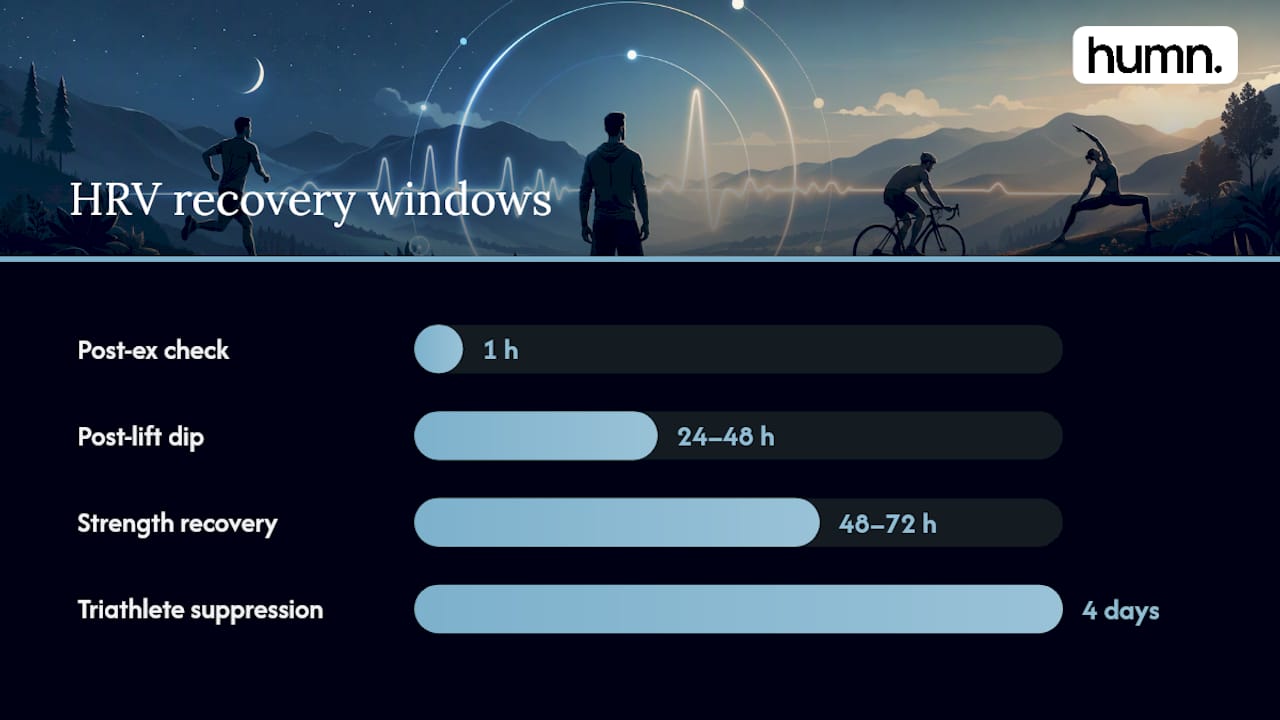
- Strength training: Acute sympathetic responses after heavy lifting can suppress RMSSD for 24–48 hours, even in well-recovered athletes. Do not interpret a single post-lifting dip as overtraining. Rely more on subjective wellness and performance tests for strength-specific decisions.
- HIIT: Large acute sympathetic spikes are normal after high-intensity intervals. What matters is how quickly RMSSD returns to baseline. Slow return-to-baseline kinetics across multiple sessions is a more meaningful signal than the acute dip itself.
For athletes who combine cardio and strength training, the mixed autonomic signals can make daily HRV interpretation genuinely tricky. A suppressed reading after a heavy squat session followed by a tempo run may reflect normal acute fatigue rather than systemic under-recovery.
Pro Tip: For strength and HIIT athletes, add post-exercise HRV kinetics to your monitoring: measure HRV 60 minutes after a hard session and again the next morning. If the morning reading has not returned to within your normal CV range, that is a more reliable signal than the acute post-session dip alone.
Short examples of divergent responses and suggested tweaks:
- A powerlifter in a peak block sees RMSSD drop 20% the morning after a max-effort day. Subjective wellness is fine, sleep was good. The right call: treat it as expected acute fatigue, proceed with a lighter accessory session, and re-measure the next morning.
- A triathlete in a high-volume week sees RMSSD drop 12% and stay there for 4 days, with subjective fatigue scores also declining. That combination, sustained HRV suppression plus subjective decline, is a clear signal to reduce volume or add a rest day. The paradoxical HRV increase seen in functionally overreached athletes is another reason to always cross-reference with how the athlete actually feels and performs.
For strength blocks specifically, consider extending your recovery window assessment to 48–72 hours rather than the standard 24-hour morning check. The autonomic system takes longer to normalize after maximal strength efforts than after moderate aerobic work.
A coach’s honest take on HRV data
HRV data is most useful when it confirms what a good coach already suspects, and most dangerous when it substitutes for that judgment entirely.
At humn, coaches integrate HRV with simple performance checks and a short daily wellness question. The HRV number rarely dictates a major program change on its own. What it does is give coaches and clients a shared, objective reference point for conversations that might otherwise be purely subjective: “You feel tired, but is that productive fatigue or something we need to address?”
How coaches actually use HRV in practice:
- Setting the SWC (smallest worthwhile change): Coaches use the client’s own CV to define what counts as a meaningful HRV shift versus normal noise. This prevents overreaction to single low days.
- Explaining HRV to clients: The most effective framing is simple: “Think of it as a daily readiness score based on your nervous system, not your muscles.” Clients who understand the basic concept engage with the data more consistently.
- Using HRV for accountability and behavior nudges: A client whose HRV drops every Monday after weekend alcohol consumption does not need a lecture. The data makes the connection visible. That is often enough.
- Combining with humn’s four-pillar framework: HRV sits naturally within the Recover and Renew pillars. It informs when to use recovery services like sauna, compression, and red light therapy, and when to prioritize sleep and stress management over adding training volume.
The evidence-based coaching approach at humn treats HRV as one signal within a broader system, not a standalone prescription. That framing, HRV as context rather than command, is what separates useful monitoring from data anxiety.
humn. turns your HRV data into a training plan that actually fits your life
Tracking HRV is straightforward. Knowing what to do with the data is where most athletes get stuck, especially when the signal is ambiguous or the training context is complex.
humn. pairs HRV monitoring with bespoke strength and recovery programming and behavior-based habit coaching, so your readiness data translates into consistent performance gains rather than daily second-guessing. Coaches at humn. set your personal SWC, interpret your weekly trends in the context of your full training picture, and adjust your program before problems compound. The facility’s recovery services, including sauna, compression, red light therapy, and acupuncture, give you the tools to act on low-HRV days rather than just note them.
If you are ready to stop interpreting your HRV data alone, 1-on-1 coaching at humn. is the clearest next step. Book a consultation and bring your last two weeks of HRV data. That is enough to start building a program around your actual readiness, not a generic template.
Sources
These are the sources that informed the recommendations in this guide, selected for authority and practical relevance.
- Monitoring Training Adaptation and Recovery Status in Athletes Using Heart Rate Variability via Mobile Devices: A Narrative Review - PMC
- Heart Rate Variability in Sports: From Monitoring to Maximizing Recovery and Performance
- How to Use Heart Rate Variability Data in Your Training
This article is general information, not a substitute for advice from a qualified doctor. Consult a qualified healthcare professional about your own circumstances before acting on anything here.
No Comments.