


Personalized nutrition coaching is one-on-one guidance that builds a tailored meal-and-habit plan around your actual life, then holds you accountable through an ongoing feedback loop until the results stick. The best programs don’t hand you a static meal plan and wish you luck. They run a deep intake, track your progress week by week, and adjust the plan as your body and schedule change. If you’re ready to stop guessing and start working with someone who knows your history, your goals, and your obstacles, book a free discovery session and come prepared with a rough food log and a sense of your typical week.
What you can realistically expect from a quality program:
- Sustained energy through meals timed and composed around your actual schedule, not a generic template
- Body-composition progress that holds because the habits behind it are built to last
- A better relationship with food by learning how to make decisions, not just follow rules
Table of Contents
- What does a high-quality personalized nutrition coaching program look like?
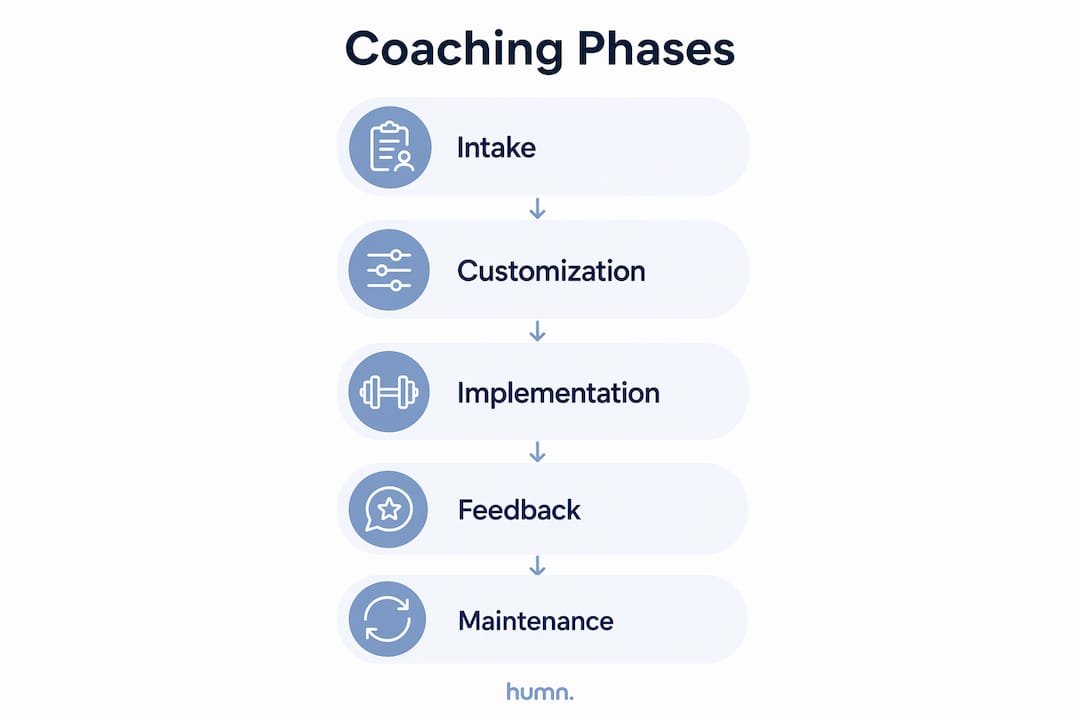
- How the coaching process unfolds from intake to maintenance
- Who should deliver your coaching, and which credentials matter?
- How is nutrition coaching typically priced?
- How do you choose the right nutrition coach for your situation?
- Why humn is a strong option for 1:1 nutrition coaching
- What trust signals should you look for in a coaching program?
- Key Takeaways
- The coaching philosophy that actually produces results
- Ready to start with humn’s 1:1 nutrition coaching
- Useful sources for further reading
What does a high-quality personalized nutrition coaching program look like?
The intake is where you find out whether a program is genuinely personalized or just wearing the label. A real one-on-one nutrition coaching program starts with a front-loaded session that covers your health history, sleep patterns, stress load, current medications, recent labs if you have them, and a food audit of what you actually eat, not what you think you should eat. That’s a very different starting point than a five-minute questionnaire.
After intake, delivery typically happens through a combination of scheduled video calls, structured weekly or biweekly check-ins, and asynchronous messaging for questions between sessions. The key operational difference between a template plan and genuine coaching is the feedback loop: your coach reads your weekly reflections, responds with non-automated, personalized notes, and adjusts the plan based on what’s actually happening. Contact frequency varies by program, but one live session every two weeks plus weekly written check-ins is a common baseline for mid-tier programs.
What a coach will do is teach you how to think about food, not just what to eat. What a coach won’t do, in a well-run program, is make every decision for you. The goal is your autonomy, not your dependence. Behavior-based programs that address root causes like sleep and stress alongside nutrition consistently outperform calorie-only approaches for long-term adherence.
| Phase | What happens |
|---|---|
| Intake (Week 1) | Health history, food audit, labs review, goal setting |
| Weeks 2–4 | Daily or weekly tracking, first habit targets, baseline data |
| Weeks 4–8 | Plan adjustments, progress check-ins, behavior coaching |
| Month 3–6 | Maintenance roadmap, reduced check-in frequency, off-boarding |
Pro Tip: Bring three things to your intake session: a rough food log from the past five days, a list of any medications or supplements you take, and a written description of your typical weekday and weekend. Coaches who do this well will use all three before they suggest a single change.
How the coaching process unfolds from intake to maintenance
The process follows a predictable arc, even though the content is different for every client. It starts with the investigative intake described above, then moves into an early-habit phase where the coach identifies one or two high-leverage changes rather than overhauling everything at once. This is deliberate. Stacking too many changes in week one is one of the most reliable ways to produce short-term compliance and long-term dropout.
By weeks 4–8, most clients have a working rhythm: they know what they’re tracking, they’ve had a few feedback cycles with their coach, and the plan has already been adjusted at least once based on real data. That adjustment cycle is what separates precision-nutrition coaching from a plan you could download for free.
| Milestone | Common deliverables |
|---|---|
| Intake session | Personalized baseline plan, habit targets, tracking setup |
| 4 weeks | First plan revision, energy and sleep baseline established |
| 4–6 weeks | Body-composition data, digestion improvements, habit consolidation |
| 3–6 months | Maintenance roadmap, reduced coach dependency, off-boarding plan |
The off-boarding phase matters more than most people expect. A good coach builds you a maintenance roadmap so you can stop tracking without losing ground. The goal of premium 1:1 coaching is that you eventually don’t need the coach anymore, because you’ve internalized the decision-making framework. Programs that skip this phase tend to produce clients who cycle back in six months having lost most of their progress.
Who should deliver your coaching, and which credentials matter?
Credentials aren’t everything, but they’re the fastest way to filter out coaches who are operating outside their scope. The most rigorous credential in the field is the Registered Dietitian (RD) or Registered Dietitian Nutritionist (RDN), which requires a supervised clinical internship and a national board exam. A Licensed Dietitian Nutritionist (LDN) is the state-licensed equivalent in states that require it. Certified Nutrition Coaches, such as those certified through NASM’s nutrition program, have a defined scope of practice that covers habit coaching and general nutrition guidance but does not extend to medical nutrition therapy.
When medical conditions are involved, the credential question becomes a referral question. If you’re managing a chronic condition, taking GLP-1 medications, or working through a metabolic issue, a clinician-integrated coaching model that coordinates with your physician is worth the higher price point. Coaches who don’t have a clear referral pathway for medical situations are a red flag, regardless of their other qualifications.
Practical signals to look for beyond credentials:
- Documented process: Can they walk you through exactly what happens from intake to off-boarding?
- Response-time commitment: Do they specify when and how they respond to messages?
- Transparent scope: Do they clearly state what’s included and what isn’t?
- Case examples: Can they describe outcomes for clients with similar goals or conditions?
Red flags worth walking away from: guaranteed rapid weight-loss timelines, no mention of a referral process for medical issues, and vague answers about how often you’ll actually hear from them. Nutrition for women navigating menopause, for example, involves hormonal and metabolic variables that require a coach with specific experience in that area, not just general weight-loss coaching.
How is nutrition coaching typically priced?
Individual coaching in the U.S. commonly runs $200–$500 per month for entry-to-mid-tier programs. Premium programs with higher coach contact, lab integration, or clinician oversight typically run $600–$1,200 or more per month. What you’re actually buying at each tier is different.
| Tier | Typical monthly cost | What’s usually included |
|---|---|---|
| Entry | $200–$500/month | Biweekly check-ins, basic meal guidance, messaging access |
| Mid-tier | $500–$600/month | Weekly sessions, custom macro roadmap, plan revisions |
| Premium | $600–$1,200+/month | Biweekly live sessions, labs review, clinician coordination, maintenance roadmap |
Billing shapes vary: some programs charge month-to-month, others sell multi-month packages (typically 3 or 6 months) at a slight discount. Per-session rates exist but are less common in 1:1 coaching because the model depends on continuity. Before you sign anything, confirm the cancellation and rescheduling policy in writing. Specifically: how much notice is required to reschedule, whether unused sessions roll over, and what happens if you need to pause.
How do you choose the right nutrition coach for your situation?
The discovery call is your interview, not theirs. Most reputable coaches offer a free 20–30 minute intro call, and that’s your window to ask the questions that actually matter. Here’s a practical sequence:
- Ask about their credential and scope. What can they address, and what do they refer out?
- Ask about contact frequency. How often will you have live sessions? What’s the response window for messages?
- Ask to see a sample onboarding roadmap. Not a finished plan, just the process they use to get from intake to first recommendations.
- Ask how they handle clients who plateau or struggle. A coach who has a clear answer here has seen it before.
- Ask about exit planning. What does off-boarding look like, and how do they prevent clients from becoming dependent?
- Ask for their cancellation and refund policy. Any hesitation here is a signal.
Selection criteria worth weighting heavily: evidence of behavior-first methods (not just macro tracking), a defined communication cadence, and a client load that allows for genuine personalization. A coach managing 200 clients simultaneously cannot give you non-automated responses. Practitioners recommend asking specifically about message response time and the level of customization before you commit.
If you’re comparing multiple discovery calls, request a sample client roadmap or a de-identified case example. The quality of that document tells you more about the program than any marketing copy.
Why humn is a strong option for 1:1 nutrition coaching
humn operates out of Gaithersburg, MD, and its approach to nutrition coaching is built into a four-pillar framework: Resist, Recover, Renew, and Rhythm. That structure matters because nutrition doesn’t exist in isolation. What you eat affects how you recover, how you sleep, and how you perform in training. A program that addresses all four pillars simultaneously produces different results than one that treats nutrition as a standalone service.
The 1:1 coaching model at humn is built around habit-first programming and dedicated coach access, not generic templates. Clients who get the most out of it tend to be busy professionals who want a long-term partner, not a short-term fix. The integrated recovery services, including sauna, compression, red light therapy, and acupuncture, mean that the physical environment supports the coaching work rather than sitting separate from it.

If you’re in the Montgomery County area and want to see how the model fits your goals, a free discovery session is the right first step. You can learn more about what premium 1:1 coaching looks like at humn before you book.
What trust signals should you look for in a coaching program?
Credentials on the team page are the floor, not the ceiling. What you’re actually looking for is evidence that the program has a documented process, transparent policies, and a track record of outcomes that match your goals.
Credibility signals worth checking:
- Named coaches with verifiable credentials (RD, RDN, LDN, or a certified nutrition coach with a clear scope statement)
- Transparent refund and cancellation terms published on the website, not just available on request
- Clinician partnerships or a documented referral pathway for clients with medical conditions
- Published workflows showing what intake, check-ins, and off-boarding actually look like
Client outcomes to look for in testimonials or case studies: sustained habit change over six months or more, improved sleep and energy (not just weight), and preserved muscle mass in clients managing medications like GLP-1s. Those specifics signal that the program is doing real work, not just producing short-term scale wins.
For clients with specialized needs, such as women managing nutrition through menopause, it’s worth seeking out a coach with documented experience in that area. The nutritional demands during menopause are distinct enough that general weight-loss coaching often misses the mark.
Key Takeaways
Personalized 1:1 nutrition coaching delivers lasting results when it combines a deep intake, habit-based behavior change, regular feedback loops, and a clear maintenance roadmap from day one.
| Point | Details |
|---|---|
| Intake depth matters | A real program audits your health history, sleep, stress, and labs before suggesting any changes. |
| Pricing reflects service level | Entry programs run $200–$500/month; premium programs with clinician access run $600–$1,200+. |
| Credentials define scope | RD/RDN is the highest standard; always confirm referral pathways if you have medical conditions. |
| Off-boarding is non-negotiable | A quality program builds a maintenance roadmap so you can sustain results without ongoing coaching. |
| humn integrates nutrition with recovery | humn’s four-pillar framework connects nutrition coaching to training, recovery, and habit change in one program. |
The coaching philosophy that actually produces results
Most people who’ve tried nutrition programs before didn’t fail because they lacked willpower. They failed because the program handed them a plan without teaching them how to think. A habits-first approach changes that equation. When the work is done right, a client leaves the program knowing how to adjust their own nutrition when life changes, because life always changes.
What I’ve seen work consistently is treating the coaching relationship as a partnership with a defined end goal: the client’s independence. That means the early sessions are investigative, the middle sessions are iterative, and the final sessions are about building confidence in the client’s own judgment. A coach who wants you to stay dependent on them indefinitely is not serving your long-term interest.
The commitment required from the client’s side is real: weekly reflections, honest tracking, and a willingness to adjust when the data says something isn’t working. Programs that promise results without that level of engagement are selling something else.
Ready to start with humn’s 1:1 nutrition coaching
humn offers a free discovery session for adults in the Gaithersburg, MD area who want to see whether the integrated coaching model fits their goals. The session covers your current habits, your health history, and what a realistic first 90 days would look like, with no obligation to continue.

A recommended starter path at humn includes an intake assessment, biweekly 1:1 sessions, messaging access between sessions, and a maintenance roadmap built into the program from the start. Recovery services, including sauna, compression, and red light therapy, are available alongside coaching for clients who want the full integrated approach.
Cancellation and rescheduling policies are discussed at intake. The expectation is a minimum commitment that gives the habit-based process enough time to produce measurable results, typically 90 days. For busy professionals who want a long-term partner rather than a short-term program, the benefits of 1:1 coaching at humn are worth a single conversation. Book your free discovery session at livehumn.com.
Useful sources for further reading
| Source | Why it’s useful |
|---|---|
| USDA MyPlate | Federal nutrition guidelines by life stage; useful baseline for understanding general dietary recommendations. |
| NIH / PMC — Behavior Change Research | Peer-reviewed evidence on behavior-based interventions and long-term dietary adherence. |
| NASM Certified Nutrition Coach | Explains the scope and standards for certified nutrition coaches; useful for verifying coach credentials. |
| Precision Nutrition | Leading habit-based coaching framework; describes what biweekly check-ins and behavior-first programs look like in practice. |
| humn — livehumn.com | Booking and program details for humn’s integrated nutrition and lifestyle coaching in Gaithersburg, MD. |
No Comments.