


At minimum: 150 minutes of moderate aerobic activity plus two strength sessions per week. For most goals, that translates to a practical target of several workouts per week. Beginners often do well on a few strength sessions per week, while more experienced lifters may need more frequent sessions, and general health maintenance just means moving on most days while hitting those two strength minimums. Consistency beats any specific number.
TL;DR:
- Most beginners can build a sustainable routine with 2 to 3 full-body resistance sessions per week, focusing on technique and gradual overload.
- Training frequency should match your goals, with 3 to 4 sessions per week suitable for muscle gain and performance, and most major muscle groups responding best to about twice weekly.
- Recovery between intense workouts generally requires 1 to 3 days for the same muscle groups to rebuild, making consistent spacing essential for progress.
- The total weekly activity should reach 150 to 300 minutes of moderate exercise, with short bouts like walks or yard work counting toward those goals.
- Prioritize consistency and realistic scheduling over ambitious plans, adjusting workout frequency as your schedule and recovery capacity change.
Table of Contents
- What Counts Toward Your Weekly Workout Minimum?
- How Many Days Should I Work Out for My Goal?
- Full-Body, Upper/Lower, or Push/Pull/Legs: Which Structure Fits Your Week?
- How Much Rest Do You Actually Need Between Workouts?
- How Do You Pick a Workout Frequency You’ll Actually Keep?
- Sample Weekly Workout Schedules by Experience Level
- How humn. Turns Frequency Guidelines Into a Real Plan
- What Actually Drives Results: Frequency or Consistency?
- Ready to Build a Frequency You’ll Actually Stick To?
- Sources
- FAQ
What Counts Toward Your Weekly Workout Minimum?
The CDC’s physical activity guidelines set the baseline every other recommendation builds on: 150 minutes of moderate aerobic activity per week, or 75 minutes of vigorous activity, plus strength training for all major muscle groups at least twice a week. Push past 150 minutes toward 300, and you get additional health benefits, according to the same guidelines.
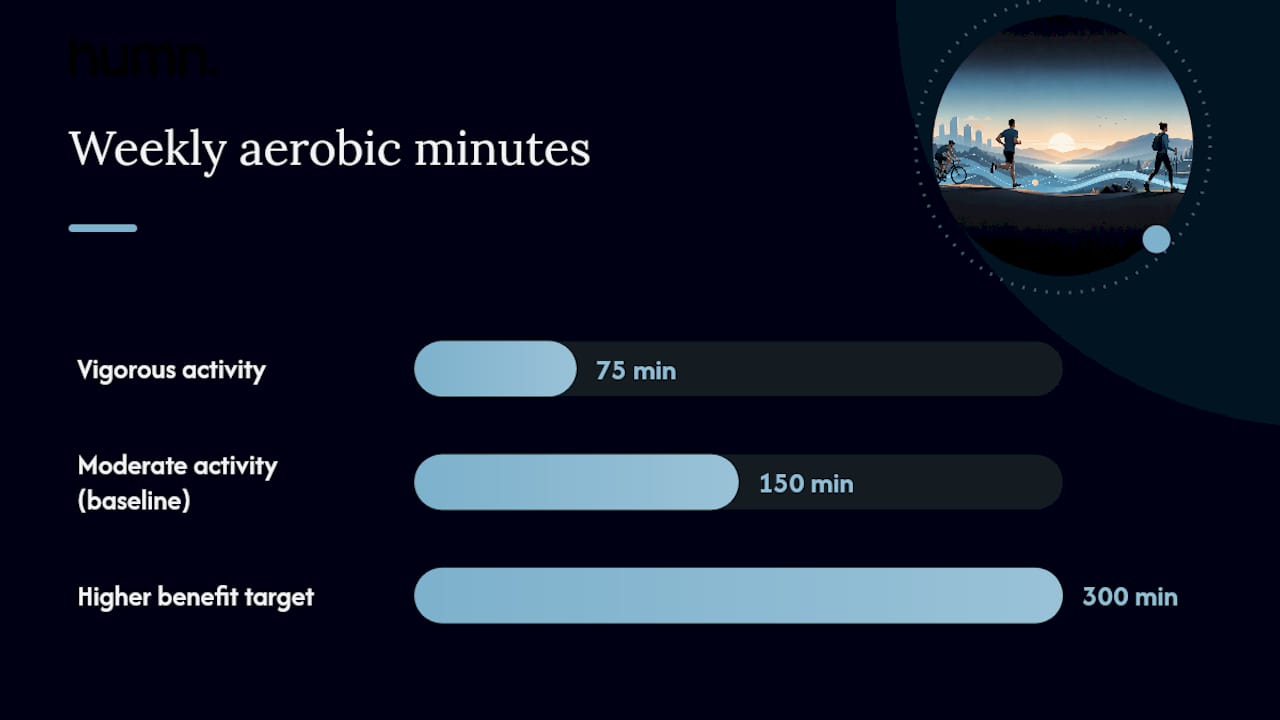
Intensity math matters here. One minute of vigorous activity counts roughly the same as two minutes of moderate activity, which means you can mix a hard 20-minute run with a relaxed 40-minute walk and land in the same weekly bucket. You don’t need a single long workout to hit these numbers. The NHS notes that spreading activity across five 30-minute sessions works just as well as fewer, longer ones, and it’s usually easier to stick with.
What actually counts toward that 150 minutes:
- Brisk walking, hiking, or biking on flat ground
- Recreational swimming or doubles tennis
- Yard work like mowing or raking
- Dancing, water aerobics, or a moderate group fitness class
- Running, HIIT circuits, singles tennis, or hill cycling (vigorous category)
Short bouts add up. A 10-minute walk at lunch, a 15-minute bike commute, and a 20-minute evening walk equal 45 minutes without a single dedicated “workout session.” The Cleveland Clinic backs the same combination: 150 minutes of moderate cardio plus two strength days, framed specifically around heart health and weight control.
How Many Days Should I Work Out for My Goal?
The right number depends entirely on what you’re training for, and lumping every goal into one generic “3 times a week” answer does readers a disservice. Here’s how the ranges actually break down.
General health and longevity calls for spreading movement across most days of the week rather than cramming it into a couple of long sessions. Aim for 150 to 300 minutes of moderate activity plus two strength sessions. This is the floor, not a target to chase past.
Weight loss or fat loss usually needs a higher frequency: a practical target of several workouts per week combining strength training with cardio. Strength preserves muscle while you’re in a calorie deficit, and the added cardio volume helps create that deficit without requiring extreme restriction.
Beginner strength training responds well to just 2 to 3 resistance sessions per week. Novices see fast early strength gains almost regardless of frequency, according to research on resistance training for beginners, so the priority at this stage is technique and gradual progressive overload, not volume.
Muscle building for intermediate to advanced lifters typically means 3 to 6 sessions per week, often organized into split routines that target different muscle groups on different days. A peer-reviewed review of training frequency found that novices tend to gain strength on 2 to 3 sessions weekly, while advanced trainees often need 4 to 6 sessions to keep progressing, largely because they need more total volume spread across more recovery windows.
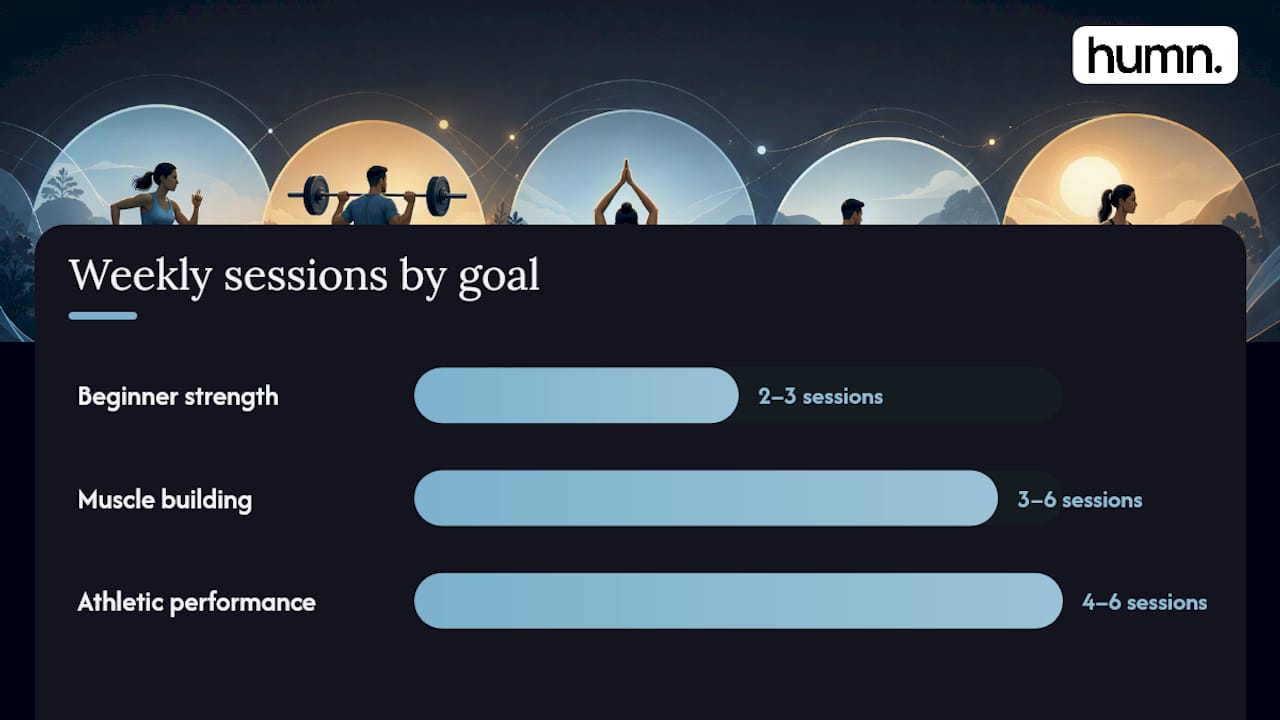
Athletic performance demands the most: 4 to 6 sessions per week combining sport-specific conditioning, strength work, and skill practice, with recovery days planned deliberately rather than left to chance.
Notice the pattern. Frequency climbs as training experience and specificity climb. A beginner chasing an advanced lifter’s 6-day split isn’t being ambitious. They’re skipping the adaptation window their body actually needs.
Full-Body, Upper/Lower, or Push/Pull/Legs: Which Structure Fits Your Week?
How you structure your sessions matters as much as how many you schedule. Each of these three structures works, but they fit different weekly frequencies.
- Full-body training fits 3 sessions per week best. Every session hits your major muscle groups, so a Monday/Wednesday/Friday pattern gives each area roughly 48 hours to recover. Sessions run 45 to 60 minutes and this structure is the most forgiving for beginners or anyone with an unpredictable schedule.
- Upper/lower splits fit 4 sessions per week. You train upper body twice and lower body twice, which still gets each muscle group trained about twice weekly, the frequency most research ties to consistent strength gains. Sessions tend to run 45 to 75 minutes depending on how much accessory work you add.
- Push/pull/legs splits fit 4 to 6 sessions per week. This structure suits people who want more per-session focus and can commit to more days. Run it twice through in six days, or once through with a rest day mixed in, and you can combine cardio and strength on the same days without overloading any single muscle group.
The through-line across all three: most major muscle groups respond best to being trained about twice a week. Pick the structure that gets you there without turning your calendar into a puzzle you dread solving.
How Much Rest Do You Actually Need Between Workouts?
Recovery is where the adaptation actually happens, not the workout itself. Training breaks muscle fibers down; rest is when they rebuild stronger. Skip that step often enough and you’re just accumulating fatigue instead of fitness.
For the same muscle groups, NASM’s guidance on recovery points to a window of roughly 1 to 3 days between hard sessions, with more intense programs needing the longer end of that range. This is why full-body training three times a week works so cleanly. It naturally builds in that spacing.
Active recovery days aren’t wasted days. A light walk, gentle mobility work, easy swimming, or a short yoga session keeps blood flowing to tired muscles without adding new training stress. Watch for these red flags that signal you need more rest, not less:
- Fatigue that doesn’t improve after a full night’s sleep
- Performance that’s declining instead of holding steady or improving
- Trouble sleeping despite feeling physically tired
- Nagging joint or tendon pain that doesn’t fade between sessions
Pro Tip: If you hit two of these signs in the same week, don’t just push through, and don’t fully stop. Swap your next scheduled hard session for an active recovery day instead, then reassess after 48 hours.
How Do You Pick a Workout Frequency You’ll Actually Keep?
Start by being honest about your real week, not the week you wish you had, and consider meal planning for one to support your consistent workout nutrition. Look at your actual schedule, your energy levels at different times of day, and any recurring obligations that eat into evenings or mornings. Then pick the highest frequency you can realistically sustain for the next three months, not the next three weeks.
Consistency predicts progress better than an ambitious frequency you abandon by week four. A conservative start, something like 3 workouts a week, gives you room to build the habit before you add complexity.
A few tactics that make frequency stick:
- Time-block your workouts the same way you’d block a meeting, so they’re not the first thing that gets cut
- Combine strength and cardio in one session on busy weeks instead of trying to fit in separate days for each
- Use micro-sessions (10 to 15 minutes) on days when a full workout isn’t realistic
- Track adherence, not just performance. Hitting 4 out of 5 planned sessions consistently beats hitting 6 out of 6 for two weeks and then crashing
- If your schedule genuinely won’t support extra days, prioritizing fitness around a busy calendar often matters more than the total number you’re chasing
The American Heart Association frames this well: the right frequency is whatever’s realistic for you to sustain, not the number that looks best on paper.
Sample Weekly Workout Schedules by Experience Level
- Beginner (2 to 3 sessions): Two full-body strength sessions (Monday, Thursday) plus two short cardio bouts or brisk walks (Tuesday, Saturday), with active recovery or full rest on the remaining days. This mirrors the pattern beginners respond well to for early strength gains without overwhelming a new routine.
- Intermediate (3 to 4 sessions): Two full-body strength days (Monday, Thursday), one dedicated conditioning or cardio day (Wednesday), and one optional lighter session (Saturday), with rest scheduled around whichever day feels most depleted.
- Advanced (5 to 6 sessions): A push/pull/legs split run through nearly twice weekly, with one planned low-intensity day mixed in to protect recovery. Real-world versions of this exact structure are laid out in sustainable fitness schedule examples if you want to see it mapped hour by hour.
Every one of these plans respects the same principle: major muscle groups get roughly two touches a week, and no plan runs hard sessions back to back without a buffer.
How humn. Turns Frequency Guidelines Into a Real Plan
Weekly frequency can be built around a comprehensive approach addressing strength work, sleep, stress, recovery, and sustainable scheduling.
For busy professionals, that often looks like 2 to 3 coached sessions a week, built around a 90-minute weekly strength framework with 1 to 2 rest days planned in, not left to chance. If you’ve been mapping out your own sample schedule from this guide, a coach-backed version is worth comparing against it.
What Actually Drives Results: Frequency or Consistency?
Most people fixate on finding the “perfect” number of weekly workouts, as if there’s a magic four or five that unlocks results everyone else is missing. There isn’t. The research on training frequency consistently shows a range, not a single number, because the honest answer depends on training age, recovery capacity, and how much life is competing for your time that particular month.
What I’d push back on is the idea that missing your target frequency one week means the plan failed. Progressive overload, doing slightly more over time, matters more than hitting an exact day count every single week. A beginner who trains twice a week for six months consistently will out-progress someone doing five days for three weeks and then quitting.
Start conservative. Track whether you’re actually showing up, not just whether your plan looks ambitious on paper.
— Josh
Ready to Build a Frequency You’ll Actually Stick To?
Figuring out the right weekly frequency on paper is one thing. Sticking to it when work gets busy or motivation dips is another problem entirely, and it’s the one most people actually struggle with. This structure can be supported through small-group personal training, 1-on-1 coaching, and recovery access, so the frequency you land on isn’t just theoretically correct, it’s realistic for your actual week.

Coaches can help you set a starting frequency based on your schedule and recovery capacity, then adjust it as your habits solidify, rather than handing you a generic template and hoping it fits. If you want to see how that coaching model works before committing, personal training explained breaks down what a session and a plan might look like. You can also start by booking a consult to map your own realistic weekly number, with or without a coach in the room.
Sources
FAQ
Is Working Out 5 Days a Week Too Much?
Not for most healthy adults, especially with a structured split like upper/lower or push/pull/legs that spaces hard sessions on the same muscle groups by 1 to 3 days. It becomes too much only if recovery signs, like persistent fatigue or declining performance, start showing up.
Is Exercising 3 Times a Week Enough?
Yes, for general health and for beginner strength gains, 3 sessions a week combined with daily movement toward the 150 minute weekly minimum is enough to see real progress. It’s often the most sustainable starting point for people new to consistent training.
What Is the 3-3-3 Rule for Workouts?
Definitions vary across fitness sources, but one common version refers to training 3 days a week, for 3 exercises per session, across 3 sets each, as a simple structure for beginners. It’s not an official public-health guideline, just a memorable starting framework.
Can I Exercise 7 Days a Week?
You can, if most of those days are lower intensity or active recovery rather than hard training on the same muscle groups. The CDC guidelines support daily movement as long as strength sessions for the same muscle groups get adequate spacing.
No Comments.