

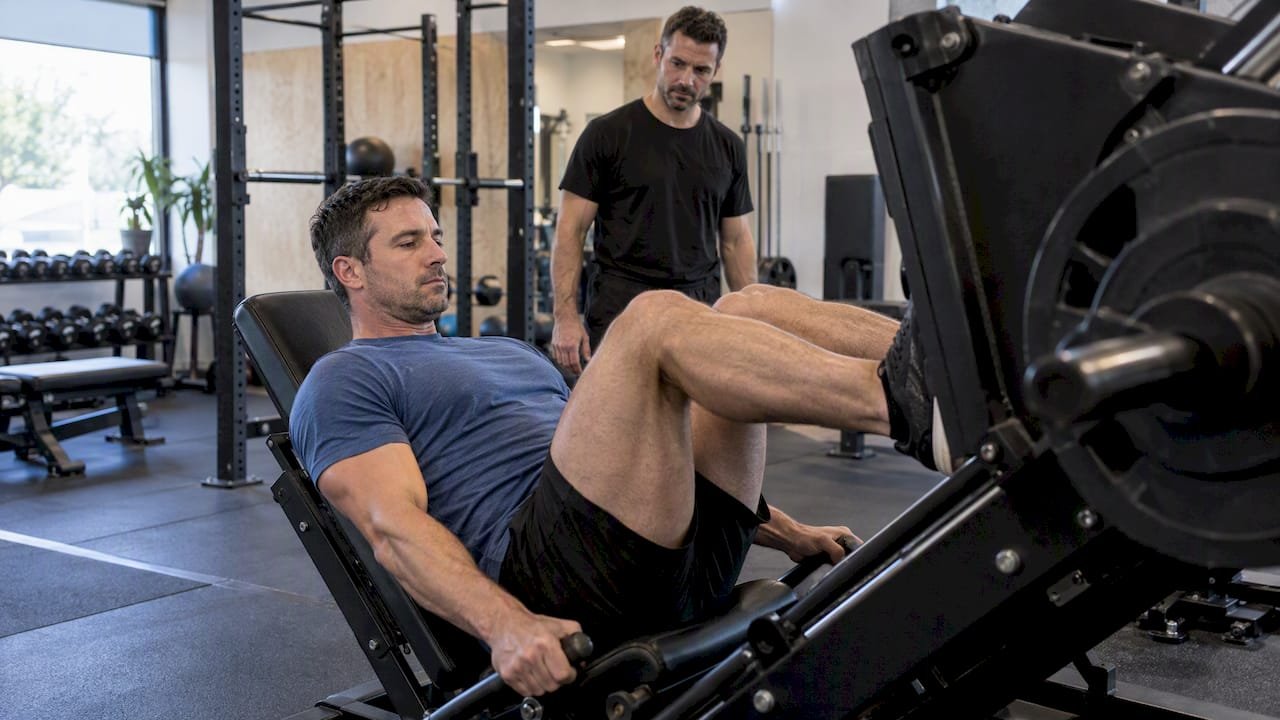
You can preserve and build strength with 2 to 3 short, focused sessions per week when you prioritize weekly set volume, compound lifts, and selective time-saving techniques. The 2026 ACSM resistance training update and a narrative review on time-efficient programming both support this approach for healthy adults with limited schedules.
TL;DR:
- Performing at least four weekly sets per muscle group using compound movements maximizes efficiency for strength and hypertrophy.
- Supersets, drop sets, and rest-pause techniques can significantly reduce workout time but increase internal stress and recovery demands.
- Short sessions benefit from focusing on multi-joint exercises, load ranges of 6 to 15RM, and limiting warm-ups to exercise-specific ramp-up sets.
- Progressive overload should occur by adding weight when repetitions become easy, rather than increasing exercise volume excessively.
- For sustained progress, prioritize consistency with simple templates, and incorporate coaching and proper nutrition to manage fatigue and recovery effectively.
Table of Contents
- Core principles of time-efficient strength training
- Supersets, drop sets, and rest-pause: what actually saves time
- Session templates for different time budgets
- Programming by experience level: beginner to advanced
- Recovery, fatigue, and when time-saving backfires
- A practical implementation checklist and habit cues
- Why coached, habits-first programming makes efficiency sustainable
- Nutrition to support strength gains on a tight schedule
- Using apps and wearables to train smarter, not longer
- Pitfalls that quietly erase your time savings
- Rest interval strategies built for short sessions
- Choosing compound movements that maximize minimal time
- Why consistency beats novelty for busy people
- How humn. supports busy adults who want time-efficient strength gains
- FAQ
- Sources
Core principles of time-efficient strength training
The biggest lever in a short workout is not the clock. It is weekly volume. A narrative review on designing time-efficient training programs recommends at least four weekly sets per muscle group as a practical minimum for maintaining and building strength, using a loading range of roughly 6 to 15 repetitions per set. The 2026 ACSM resistance-training update adds more texture to that number: about 10 sets per muscle group per week supports hypertrophy, while 2 to 3 sets of heavy loads, around 80% of one-rep max, drive strength gains. Neither source asks you to chase exotic protocols. They ask you to accumulate enough quality sets across the week, however your schedule allows you to fit them in.
Exercise selection does most of the heavy lifting here, literally. Bilateral, multi-joint movements, think leg press or squat, a horizontal push like a bench or chest press, and a horizontal pull like a row, recruit several muscle groups at once. That means fewer exercises are needed to cover your major muscle groups in a session, which is exactly what a time-crunched lifter needs. A single leg press works quads, glutes, and hamstrings together instead of training each in isolation across three separate movements.
Load selection follows a similar logic of efficiency. The ACSM update clarifies that training to failure is not required for most healthy adults to see results, which matters because grinding every set to failure adds fatigue and recovery time without proportional benefit for most goals. A 6 to 15RM range covers both strength and hypertrophy outcomes well enough that you do not need separate rep schemes for separate goals in a short program.

Warm-ups deserve the same efficiency mindset. The time-efficient training review found that limiting warm-ups to exercise-specific routines, a couple of lighter-load ramp-up sets before your working sets, serves lifters better than long general warm-ups or static stretching when the goal is strength, not flexibility. If mobility or flexibility is a separate goal for you, treat it as its own session rather than tacking it onto a short strength workout.
A few principles anchor everything that follows:
- Weekly volume beats session length: four or more sets per muscle group per week is a reasonable floor for maintaining and building strength.
- Compound lifts first: a squat or leg press, a horizontal push, and a horizontal pull cover most of your body in three exercises.
- Loads in the 6 to 15RM range work for both strength and hypertrophy goals without needing two different programs.
- Skip the long warm-up: a couple of ramp-up sets specific to the exercise you are about to do is usually enough.
Supersets, drop sets, and rest-pause: what actually saves time
Three techniques show up constantly in time-efficient programming, and they are not interchangeable. A superset pairs two exercises back to back with no rest between them. A drop set continues an exercise past initial fatigue by immediately reducing the load and continuing for more repetitions. Rest-pause breaks a single set into clusters, resting just long enough (often 15 to 20 seconds) to squeeze out a few more reps at the same load.
The evidence on supersets is the most developed. A systematic review and meta-analysis of superset versus traditional training covering 19 studies found that supersets meaningfully cut session duration while producing chronic strength and hypertrophy adaptations comparable to traditional sets, as long as total weekly volume is matched. The trade-off: supersets raise blood lactate and perceived exertion, so the time you save shows up partly as added internal stress. The same analysis found that agonist-antagonist pairings, like a chest press paired with a row, preserve volume better than pairing two exercises for the same muscle group, which tends to be more fatiguing and can erode the quality of your second exercise.
Drop sets carry a similar profile. A 2026 meta-analysis on the acute and chronic effects of drop-set training found comparable long-term hypertrophy and strength outcomes to traditional training, with higher perceived exertion and lactate response in the moment and potentially greater recovery demands afterward. An earlier 2023 systematic review on drop sets and hypertrophy reached a similar conclusion: drop sets can match traditional training for muscle growth while shortening session time, though the review notes that sample sizes remain small and methods vary across studies, so this finding deserves a cautious read rather than a confident one.
| Technique | How it works | Time saved | Main trade-off |
|---|---|---|---|
| Superset | Two exercises back to back, no rest | Cuts rest time between movements | Higher lactate and perceived exertion |
| Drop set | Same exercise, reduce load, continue past fatigue | Extends one set instead of adding sets | Higher acute fatigue, possibly more recovery time needed |
| Rest-pause | Short rest clusters within one set | Fewer total sets needed for the same reps | Demanding on connective tissue and focus |
Pro Tip: Save rest-pause and drop sets for machines or well-practiced lifts where form breakdown under fatigue is less risky, and reserve free-weight compound lifts for traditional sets with full rest.
None of this means these techniques are superior tools for adaptation. They are tools for conserving time, and conserving time comes at the cost of higher internal load. Use agonist-antagonist supersets as your everyday time-saver since they protect volume without excessive fatigue. Reserve drop sets for short, focused hypertrophy blocks rather than every session. Lean on rest-pause only when a session is genuinely too short for additional sets, since it is the most taxing of the three per unit of time saved.
Session templates for different time budgets
Here are three ready-to-use templates that apply the principles above, built around compound lifts and volume targets rather than arbitrary exercise counts.
- 10 to 15 minutes: three rounds of a leg press or goblet squat, a horizontal push (dumbbell or machine chest press), and a horizontal pull (seated row or inverted row), each for 6 to 10 reps, minimal rest between exercises within a round, 60 to 90 seconds between rounds.
- 20 to 30 minutes: two supersets performed for three rounds each: superset one pairs a squat variation with a horizontal pull, superset two pairs a horizontal push with a hip hinge (Romanian deadlift or hip thrust), resting 60 to 90 seconds between supersets.
- 45 to 60 minutes: traditional straight sets for four to five compound lifts (squat, bench or chest press, row, overhead press, hip hinge), 3 sets each in the 6 to 10RM range with 2 to 3 minutes of rest between sets for the heaviest lifts.
Weekly scheduling determines whether these sessions actually add up to the volume target. A couple of examples:
- Two-day schedule: two 45 to 60 minute full-body sessions per week, each hitting every major muscle group with 2 to 3 sets, reaching the four-plus weekly sets per muscle group.
- Three-day schedule: three 20 to 30 minute superset sessions per week, splitting push, pull, and leg emphasis slightly differently each day while still touching every muscle group multiple times.
Progression within any of these templates follows one rule: when your planned rep range feels easy for two sessions in a row, add load rather than adding sets. This keeps sessions short while still driving the progressive overload that produces results, and it is far simpler to track than juggling exercise-by-exercise logs. Logging sets per muscle group per week, rather than every individual lift, matches how the underlying research measures volume and makes your weekly target easy to check at a glance. Our guide to progressive strength training for beginners walks through this kind of load progression in more detail.
Programming by experience level: beginner to advanced
Your starting point changes how aggressively you can use time-saving techniques, because technique and recovery capacity both take time to build.
- Beginners do best with 1 to 2 sessions per week focused entirely on multi-joint movements and technique. Traditional straight sets, not supersets or drop sets, let you focus on form without added fatigue clouding your ability to feel what a lift should feel like.
- Intermediate lifters can move to 2 to 3 sessions per week aimed squarely at the four-plus weekly sets per muscle group target, introducing supersets and the occasional drop set once technique is reliable under fatigue.
- Advanced or severely time-crunched lifters can periodize short blocks (2 to 4 weeks) that lean more heavily on rest-pause and drop sets to compress volume into less time, followed by a deload week of lighter traditional sets to let accumulated fatigue dissipate.
The thread connecting all three tiers is that advanced techniques are a lever you pull once the fundamentals are solid, not a shortcut around them. A beginner who starts with drop sets before mastering a hinge or a press pattern is trading a learning opportunity for fatigue that teaches very little. Our piece on strength training for longevity looks at how even modest weekly time commitments can sustain long-term strength when the fundamentals are in place.
Recovery, fatigue, and when time-saving backfires
Saving time in the gym often means spending more somewhere else: in recovery. Both the superset meta-analysis and the drop-set meta-analysis point to the same pattern. Supersets show a training-efficiency effect size of roughly 1.74 standard deviations in session time reduction while raising blood lactate and perceived exertion compared with traditional sets, meaning the time saved shows up as added internal stress that your body still has to absorb.
That trade-off is manageable with a few practical rules:
- Space high-fatigue sessions apart: avoid back-to-back days of drop sets or rest-pause work on the same muscle groups.
- Treat sleep and protein intake as part of the program, not an afterthought, since both affect how well you recover from higher perceived exertion.
- Watch for stalling performance or persistent soreness as signs to drop back to traditional sets for a week or two.
- Favor traditional sets over advanced techniques when you are chasing a maximal strength goal or going through a demanding stretch of life, since lower internal load protects your ability to recover and perform consistently.
Advanced techniques are not a superior method of training adaptation. They are a way to conserve clock time, and that trade needs to be made deliberately rather than by default in every session. Our overview of overtraining signs and recovery covers the warning signs worth watching for if you lean on these techniques often.
A practical implementation checklist and habit cues
A short workout only works if you actually show up for it consistently. A few habits make that easier:
- Pre-load your equipment and timer before you start so the session begins the moment you walk in, not five minutes later.
- Pick your warm-up in advance: one or two ramp-up sets for your first lift, nothing more, unless flexibility is a separate goal.
- Track sets per muscle group weekly, not every exercise individually, so hitting your four-plus target takes seconds to check.
- Time-block your sessions on your calendar like any other appointment, and stack them next to an existing habit, like training right after you drop kids off or right before a shower you were taking anyway.
- Set a micro-goal for the week: one more rep, one more plate, one more session, rather than a distant outcome goal.
Pro Tip: Lay out your gym clothes or bag the night before a short session. The fewer decisions standing between you and the workout, the more likely it happens.
A one-week micro-plan might look like two 20 to 30 minute superset sessions early in the week and one 45 to 60 minute traditional session on the weekend when you have more time, together covering your weekly volume target without any single day asking too much of your schedule. Our article on why consistency beats perfection digs further into building habits that outlast motivation.

Why coached, habits-first programming makes efficiency sustainable
Time-efficient training works best when the people guiding it are responsible for more than the workout itself. At humn., programming runs through four pillars: Resist, Recover, Renew, and Rhythm, each addressing a different piece of what makes short, effective sessions sustainable over months and years rather than weeks. Resist covers the strength work itself. Recover addresses the fatigue that advanced techniques like supersets and drop sets create. Renew focuses on nutrition and the inputs that support adaptation. Rhythm ties sleep, stress, and daily habits into the picture so a short session does not get undone by a chaotic week around it.
Coaching matters most exactly where the research gets nuanced: deciding when a drop set is worth the added fatigue, when to back off toward traditional sets, and how to progress load safely as technique improves. A coach watching your form under fatigue, tracking your weekly volume, and adjusting your plan around a stressful week at work solves a problem that a generic app or template cannot.
Nutrition to support strength gains on a tight schedule
Shorter sessions do not reduce the importance of nutrition, since the adaptation that builds strength happens between workouts, not during them. Adequate protein intake spread across the day supports the muscle repair that follows a session built around compound lifts and higher internal load techniques like supersets or drop sets. Total daily calories matter too: a significant calorie deficit makes it harder to recover from higher-effort sessions and can blunt the strength gains you are training for.
Timing matters less than total intake for most lifters, but eating a meal with protein and carbohydrates in the hours around a session supports recovery when sessions are frequent. If your schedule is tight enough that meal planning feels like another task competing for time, that is worth solving directly rather than ignoring, since under-fueling undercuts the efficiency you built into your training. Our guide to fueling workouts with proper nutrition breaks this down further, and 1:1 nutrition coaching is available for readers who want a personalized plan rather than general guidelines.
Using apps and wearables to train smarter, not longer
A simple tracking method matters more than a sophisticated one. Logging sets per muscle group per week in a notes app or a basic spreadsheet captures the exact metric the research ties to results, without the overhead of logging every rep of every exercise. Wearable devices that track heart rate can help you gauge effort during supersets or drop sets, where perceived exertion and lactate response run higher than traditional sets, giving you an early signal before fatigue becomes counterproductive.
Rest timers built into most fitness apps remove the guesswork from short rest windows in superset or rest-pause work, which matters because drifting rest periods are one of the easiest ways to lose the time efficiency you built into a session. The goal with any tool is the same: spend less mental energy managing the workout so you can spend more effort on the lift itself.
Pitfalls that quietly erase your time savings
A few habits consistently undo an otherwise efficient program. Chasing failure on every set adds fatigue without matching benefit for most healthy adults, according to the 2026 ACSM update, and that fatigue often bleeds into longer rest periods or a worse next session. Overloading a short session with too many exercises is another common mistake: three or four compound lifts cover more ground than seven isolation exercises squeezed into the same window.
Skipping the warm-up entirely, rather than trimming it to exercise-specific ramp-up sets, raises injury risk without actually saving meaningful time. And treating every session like a maximal event, pushing drop sets or rest-pause every single workout, trades short-term time savings for recovery debt that eventually forces a missed session or an extended break, which costs far more time than it saved.
Rest interval strategies built for short sessions
Rest interval length should match your technique, not a fixed habit. Traditional heavy compound lifts, particularly in the 45 to 60 minute template, benefit from 2 to 3 minutes of rest to allow near-full recovery between sets, since shortchanging rest on a heavy squat or press tends to reduce the load you can handle on the next set. Superset formats flip this logic: the “rest” happens while you perform the paired exercise, which is exactly how supersets compress session time without necessarily cutting total work.
Rest-pause intervals of roughly 15 to 20 seconds are short by design, meant to let just enough recovery happen to complete a few more reps at the same load rather than a fresh set. The practical rule is to match your rest strategy to your goal for that session: longer rest when chasing a heavier single lift, compressed or overlapping rest when the priority is finishing a full-body session in a fixed window.
Choosing compound movements that maximize minimal time
Exercise selection is where time efficiency is won or lost before a single set is performed. A leg press or squat variation, a horizontal push such as a bench or chest press, and a horizontal pull such as a row cover the vast majority of major muscle groups in just three movements, which is the backbone of every template in this guide. Adding a hip hinge, like a Romanian deadlift or hip thrust, rounds out posterior chain coverage without requiring a fourth exercise category.
The selection principle is simple: choose movements that recruit multiple joints and muscle groups simultaneously over single-joint isolation work, since isolation exercises require more total exercises, and therefore more time, to achieve the same weekly volume target per muscle group. Readers who also train for cardiovascular goals can see how to fit both into a tight schedule in our guide to combining cardio and strength training.
Why consistency beats novelty for busy people
The plan that works is the one you actually do for months, not the one that looks most sophisticated on paper. I have watched people chase increasingly complex protocols, cycling rest-pause one week and drop sets the next, when a boring, repeatable superset session performed consistently would have gotten them further. Novelty feels like progress. Consistency is what actually produces it.
The trade-off worth making deliberately is picking a simple template you can repeat for months over one that demands constant recalibration. Save the advanced techniques for when your schedule genuinely has no more room, not as a default setting. A plan that fits your actual week, even an imperfect one, beats a theoretically optimal plan you abandon in three weeks.
— Josh
How humn. supports busy adults who want time-efficient strength gains
Building strength on a tight schedule gets easier with a coach managing the variables you do not have time to think through yourself: weekly volume, technique under fatigue, and how hard to push supersets or drop sets on any given week — see more on how to build strength with limited equipment. We offer coaching that applies the same principles covered in this guide, compound lifts, matched volume, and selectively used advanced techniques, inside a structured program built around your schedule rather than a generic template.

What that looks like in practice:
- Guided programming that adjusts your weekly sets and technique choices as life gets busier or lighter.
- Recovery support, including sauna, compression, and red light therapy, for the added fatigue that comes with higher-intensity, time-efficient methods.
- Personalized nutrition coaching to make sure your eating habits match the training stimulus you are putting in.
If a coached, habits-first approach sounds like a better fit than programming it all yourself, our membership options outline how small-group training and 1-on-1 coaching fit together at humn.
FAQ
What is the 3-3-3 rule for strength training?
The 3-3-3 rule is not a term defined in major strength-training research or guidelines, so definitions vary depending on where you encounter it. Some use it informally to describe three exercises, three sets, and three times a week, which lines up reasonably well with the evidence-based minimum of a few compound lifts performed across a handful of weekly sessions.
What is the 3-2-1 rule for working out?
Like the 3-3-3 rule, the 3-2-1 rule is not a standardized term from peer-reviewed training research, and informal versions vary. One common interpretation splits a week into three strength sessions, two cardio sessions, and one recovery or mobility day, though this framing comes from general fitness commentary rather than a specific guideline.
Is 30 minutes of weights 3 times a week enough?
Thirty minutes three times a week is enough for most healthy adults when sessions prioritize compound lifts and reach roughly four or more weekly sets per muscle group, a target supported by research on time-efficient training. Using supersets within that window can help you accumulate enough volume without extending the session.
Is working out 4 days and resting 3 days good?
A four-day training split with three rest days works well for many lifters, particularly intermediate or advanced trainees who want to hit several muscle groups more than once per week. What matters most is total weekly volume per muscle group rather than the specific day count, so a four-day split only helps if each session still contributes meaningfully toward your weekly set target.
How do I know when to use supersets versus traditional sets?
Agonist-antagonist supersets work well as a default time-saving strategy since they preserve training volume while cutting session length, according to research comparing superset and traditional training. Reserve traditional straight sets for your heaviest compound lifts or during weeks when recovery capacity is already stretched thin.
Sources
- No Time to Lift? Designing Time-Efficient Training Programs for Strength and Hypertrophy: A Narrative Review
- ACSM resistance-training guidelines update 2026
- Superset Versus Traditional Resistance Training Prescriptions: A Systematic Review and Meta-analysis
- Acute and Chronic Effects of Drop-Set Training: A Meta-Analysis and Systematic Review
- Effects of Drop Sets on Skeletal Muscle Hypertrophy: A Systematic Review and Meta-analysis
No Comments.