


Progressive strength training is defined as the systematic increase of training demands over time to force the body to continuously adapt, building greater muscle strength, size, power, and endurance. The industry term for the core mechanism is progressive overload, and it is the single most researched principle in resistance training science. Without it, your body adapts to a fixed workload and stops improving. The 2026 ACSM position stand, which analyzed 137 systematic reviews covering more than 30,000 participants, confirms that progressive resistance training is the fundamental requirement for any meaningful strength gain. If you want to get stronger, this principle is non-negotiable.
What is progressive strength training and how does it work?
Progressive strength training works by applying a training stimulus that exceeds what your body is currently used to. Your muscles respond to mechanical tension and metabolic stress by rebuilding stronger. When the stimulus stays the same, adaptation stops. That is the plateau most people hit after a few months of doing the same workout.
The ACSM’s 2026 analysis of over 30,000 participants confirms that adaptation plateaus without progressive overload. This means your current routine, no matter how hard it felt when you started, eventually becomes maintenance work rather than a growth stimulus.
Four primary variables drive progress: volume (total sets and reps), intensity (load relative to your maximum), frequency (how often you train a muscle), and technique quality. Adjusting any one of these variables upward creates a new challenge for your body to meet. The key is doing so gradually and consistently, not all at once.

Progressive overload encompasses multiple variables beyond just adding weight, including mechanical tension, metabolic stress, rest intervals, tempo, range of motion, and technical improvements. That breadth is what makes the method so durable across all fitness levels.
How training age changes your rate of progress
Your training age, meaning how long you have trained consistently, directly determines how fast you can progress. Beginners see gains session to session, intermediates over weeks, and advanced lifters over months. That timeline is based on 18 or more months of consistent training data.
This is actually great news for beginners. You will see the fastest, most dramatic improvements of your entire fitness life in your first year. The body responds aggressively to a new stimulus when it has never encountered it before. Advanced athletes work harder for smaller gains because their bodies have already adapted to a high baseline.
What are the common methods to apply progressive overload?
Most people think progressive overload means adding weight to the bar every session. That works early on, but it is not the only tool available, and it is not always the right one. Progression includes volume, frequency, rest periods, tempo, and exercise variation as valid tools alongside load increases.
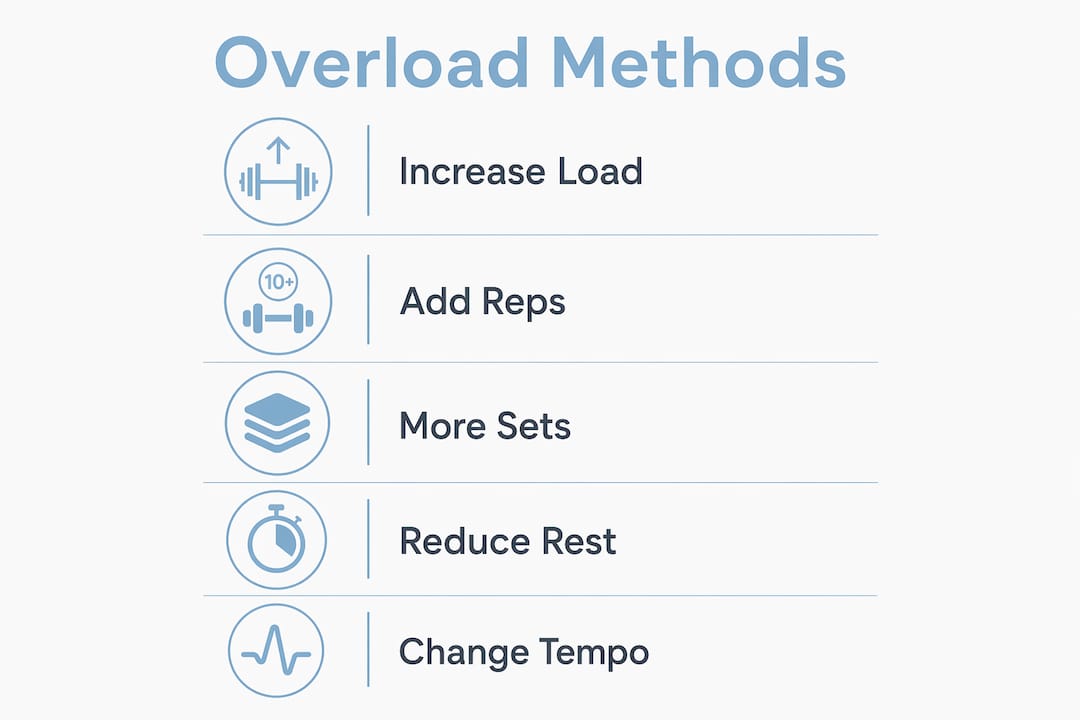
Here are the main methods you can use:
- Add weight. The most direct method. Increase the load by the smallest increment available, typically 2.5–5 lbs for upper body and 5–10 lbs for lower body movements.
- Add reps. If you are prescribed 3 sets of 8 and can complete 3 sets of 10 with good form, you have progressed. Add weight at the next session.
- Add sets. Increasing from 3 sets to 4 sets raises total volume without changing load or reps.
- Reduce rest periods. Cutting rest from 90 seconds to 60 seconds increases metabolic stress and cardiovascular demand on the same workload.
- Manipulate tempo. Slowing the eccentric phase (the lowering portion of a lift) increases time under tension and training stimulus without adding a single pound.
- Expand range of motion. Progressing from a partial squat to a full-depth squat is a legitimate and demanding form of overload.
- Increase training frequency. Moving from training a muscle group once per week to twice per week adds volume and stimulus over time.
Pro Tip: Match your progression method to your goal. If you want maximum strength, prioritize load increases at 70–85% of your one-rep max. If you want muscle size, volume increases through additional sets and reps are equally effective. If you are managing fatigue or returning from a break, tempo and rest manipulation let you progress without taxing your joints.
The smartest programs cycle through these methods rather than relying on one indefinitely. When weight increases stall, shift to volume. When volume gets unmanageable, cut sets and increase intensity. This cycling approach keeps progress moving without burning you out.
Is progressive strength training more effective than other approaches?
Non-progressive training produces maintenance, not gains. If you repeat the same workout at the same weight and volume indefinitely, your body has no reason to change. That is not a theory. It is the physiological reality of how adaptation works.
A common misconception is that more complex or “advanced” training methods produce superior results. A 2026 systematic review in Sports Medicine using Bayesian network meta-analysis found that advanced resistance training methods do not show clear superiority over traditional, well-designed progressive training in healthy adults. Complexity does not beat consistency.
“It never gets easier, you just go faster.” Effort stays constant, but your output capacity expands. That means you need more load or volume over time just to maintain the same training stimulus. This is why progressive overload is not optional for anyone who wants to keep improving.
The rate of progression varies significantly by individual. Genetics, sleep quality, nutrition, stress levels, and training history all influence how fast you adapt. Two people following the same program will not progress at the same rate. That is normal, and it is why managing fatigue alongside challenge is the real skill in long-term training.
Regular resistance training also carries health benefits that extend well beyond strength numbers. Resistance training reduces all-cause mortality risk by approximately 21% and lowers cardiovascular, cancer, and diabetes risk. That data reframes strength training as a long-term health investment, not just a fitness goal.
How can beginners start a progressive strength training program?
Starting a progressive strength training program does not require a complex plan. It requires a clear baseline, a manageable starting point, and a system for tracking progress. Here is a practical process:
- Assess your starting point. Pick 3–5 compound movements: squat, deadlift, bench press, row, and overhead press. Test a weight you can lift for 8–10 clean reps with good form. That is your baseline.
- Start lighter than you think you need to. Most beginners start too heavy and stall within weeks. Beginning at 60–70% of your perceived maximum leaves room to add weight for several sessions in a row.
- Add small increments consistently. Aim to add weight or reps each session for the first 3–6 months. Intermediate lifters can improve their one-rep max by 10–15% in 12 weeks with a structured program. Beginners often exceed that rate.
- Track every session. Write down your sets, reps, and weight. You cannot manage what you do not measure. A simple notebook or a notes’ app works fine.
- Train 2–4 sessions per week. Effective programs use 2–4 sessions per week with compound lifts at 70–85% of your one-rep max for best adaptations. Start at two sessions if you are new to training.
- Prioritize recovery. Muscles grow between sessions, not during them. Sleep, protein intake, and rest days are not optional extras. They are part of the program.
- Adjust every 4–6 weeks. Review your log. If you have been adding weight or reps consistently, keep going. If progress has stalled for two or more weeks, adjust one variable: add a set, reduce rest, or change the exercise variation.
Pro Tip: Protein intake directly supports muscle adaptation. Aim for 0.7–1 gram of protein per pound of bodyweight daily. Without adequate protein, your body lacks the raw material to rebuild stronger muscle tissue, regardless of how well you train.
Beginners should expect visible strength gains within 4–8 weeks and noticeable body composition changes within 8–12 weeks. Patience and consistency outperform any specific program. The best progressive strength training program is the one you will actually follow for months, not the most sophisticated one on paper.
Key Takeaways
Progressive strength training produces lasting results because it forces continuous adaptation through systematic increases in volume, load, frequency, or tempo.
| Point | Details |
|---|---|
| Core definition | Progressive overload is the systematic increase of training demands to drive ongoing muscle and strength adaptation. |
| Multiple progression tools | Load, reps, sets, tempo, rest, and range of motion are all valid ways to increase training stimulus. |
| Training age matters | Beginners progress session to session; intermediates weekly; advanced lifters monthly. |
| Complexity is overrated | Advanced training methods do not outperform well-structured traditional progressive programs in healthy adults. |
| Recovery is part of the program | Managing fatigue through sleep, nutrition, and rest days is as important as the training itself. |
Why most people misunderstand progression
The biggest mistake I see is treating progressive overload as a single lever: add weight or fail. That framing causes people to push load increases past what their recovery can support, get hurt, and then conclude that “lifting heavy isn’t for them.” It is a frustrating and entirely avoidable cycle.
What actually works is treating progression as a system with multiple inputs. Some weeks you add weight. Other weeks you add a set. Other weeks you slow down the tempo and feel the muscle work harder at the same load. All of those count. All of them drive adaptation. The skill of tracking training and avoiding the urge to set a personal record every session is what separates people who train for decades from people who burn out in six months.
The psychological side matters too. Tracking your progress creates a visible record of what your body can do now versus three months ago. That record is motivating in a way that no external goal can replicate. You are not chasing a number on a scale. You are watching your capacity expand in real time.
Long-term, the goal is not to be the strongest person in the room. The goal is to still be training, feeling good, and getting stronger at 50, 60, and beyond. That requires patience, good recovery habits, and a willingness to play the long game. The people who do that consistently are the ones who get the most out of this method.
— Josh
Structured coaching for your strength progression
Building a progressive strength training program that actually fits your life takes more than a template. It takes someone who understands where you are starting, what your body responds to, and how to adjust when progress stalls.
At Livehumn, coaches in Gaithersburg, MD build individualized strength and conditioning programs designed around your training age, goals, and recovery capacity. Every program tracks progress systematically and adjusts in real time, so you are never guessing whether you are moving forward. If you are ready to train with structure and support, explore membership options and see what a whole-person approach to strength looks like in practice.
FAQ
What is the progressive resistance training definition?
Progressive resistance training is the practice of systematically increasing training demands over time to force ongoing muscular adaptation. The ACSM identifies it as the fundamental requirement for improving muscle strength, power, size, and endurance.
How long does it take to see results from progressive strength training?
Beginners typically notice strength gains within 4–8 weeks and visible body composition changes within 8–12 weeks. Intermediate lifters can improve their one-rep max by 10–15% in 12 weeks with a structured program.
Is progressive strength training effective for older adults?
Yes. Regular resistance training reduces all-cause mortality risk by approximately 21% and lowers cardiovascular, cancer, and diabetes risk across age groups. Older adults benefit significantly from structured progressive programs when load and recovery are managed appropriately.
Do I need to add weight every session to make progress?
No. Progressive overload includes increasing reps, sets, training frequency, reducing rest periods, slowing tempo, and expanding range of motion. Adding weight is one tool among many, and cycling through these methods produces more sustainable long-term progress.
How many days per week should beginners train?
Effective programs use 2–4 sessions per week with compound lifts at 70–85% of your one-rep max. Beginners should start at two sessions per week to allow adequate recovery before increasing frequency.
No Comments.