


Fueling your workout with proper nutrition means consuming the right balance of carbohydrates, protein, and fluids at the right times to maximize energy output, endurance, and muscle recovery. Sports nutrition researchers call this practice “exercise nutrition,” and it covers everything from what you eat three hours before training to how you refuel in the hour after. Get it right, and you perform better, recover faster, and adapt more effectively to training stress. Get it wrong, and even a well-designed program stalls. The strategies below are grounded in 2026 exercise nutrition guidelines and apply whether you train for strength, endurance, or general fitness.
How to fuel your workout with proper nutrition: pre-exercise timing and food choices
Pre-workout nutrition is the most studied area of exercise nutrition, and the research points to one clear principle: what you eat before training depends almost entirely on how much time you have before you start.
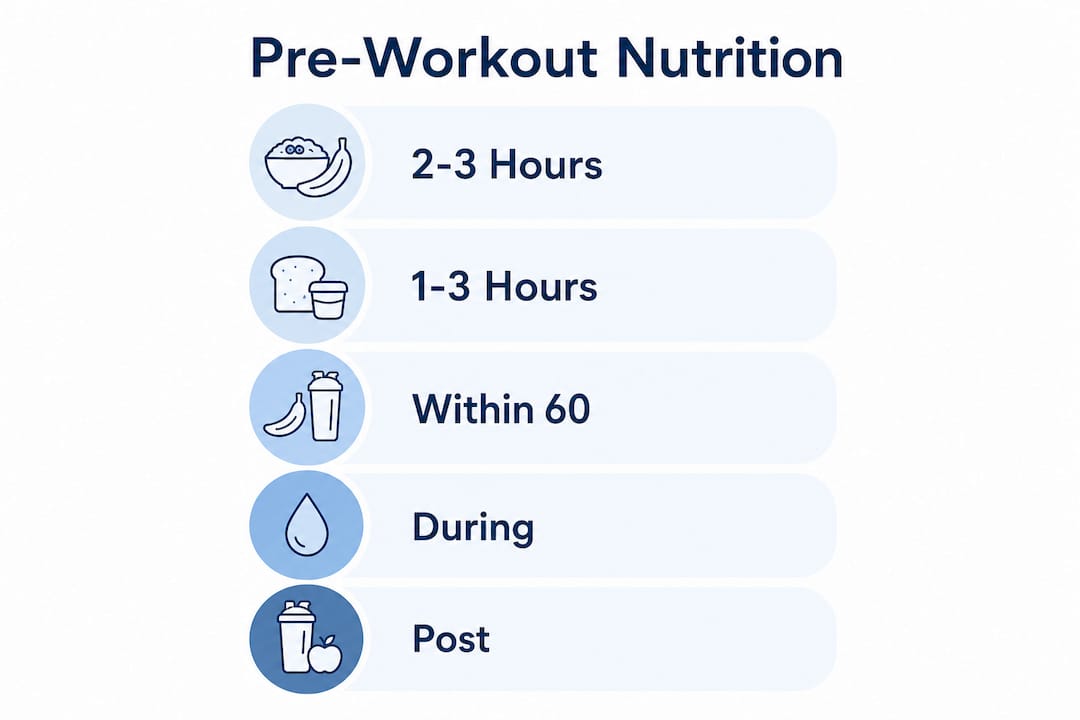
Eating 1–3 hours before training
The standard pre-workout window is 1–3 hours before exercise. During this window, consume 30–60g of carbohydrates and 15–25g of protein, keeping fat and fiber low to speed digestion. A meal in this range typically runs 250–400 calories. That calorie target matters because too little leaves you under-fueled, and too much sits heavy in your stomach during training.
Practical examples for this window include:
- Grilled chicken with white rice and a small portion of steamed vegetables
- Greek yogurt with a banana and a drizzle of honey
- Oatmeal with protein powder stirred in and a handful of berries
- Two eggs on white toast with a glass of orange juice
Notice that all of these are lower in fat and fiber than a typical “healthy” meal. That is intentional. Pre-workout meals prioritize easily absorbed energy over the fiber-rich whole foods that serve you well at other meals. The goal is fuel delivery, not general health optimization.
Eating within 60 minutes of training
When you have less than an hour before your session, the approach shifts. Eat 0.25–0.5g of fast-digesting carbohydrates per pound of body weight, with minimal protein and almost no fat. For a 160-pound athlete, that means roughly 40–80g of carbohydrates from sources like a banana, rice cakes, or a sports drink. Keep it small and simple.
Pro Tip: If you train early in the morning and cannot stomach a full meal, a banana with a small amount of peanut butter or a sports drink consumed 20–30 minutes before your session is enough to prime performance without causing GI distress.
Hydration and caffeine before exercise
Hydration status going into a workout is built over the previous 24 hours, not the 20 minutes before you train. Drinking 16–20oz of water an hour before exercise tops off your fluid levels but cannot compensate for a day of poor hydration. Treat pre-exercise water as a final check, not a rescue strategy.

Caffeine is a well-supported ergogenic aid. Taking 3–6mg of caffeine per kg of body weight 45–60 minutes before training delays fatigue and improves both strength and endurance output. For a 75kg athlete, that is roughly 225–450mg, the equivalent of two to four cups of coffee. Start at the lower end if you are sensitive to caffeine.
| Timing before workout | Carbohydrates | Protein | Fat and fiber |
|---|---|---|---|
| 2–3 hours | 30–60g | 15–25g | Low |
| 30–60 minutes | 0.25–0.5g per lb body weight | Minimal | Very low |
| Under 30 minutes | 15–30g fast-digesting | None | None |
What should you eat during a workout for sustained energy?
Most athletes do not need to eat during workouts shorter than 45 minutes. For sessions that run longer, or for high-intensity training that depletes glycogen quickly, in-workout fueling makes a measurable difference.
Carbohydrate intake of 30–90g per hour during exercise improves endurance and delays fatigue for sessions lasting longer than 45 minutes. The range is wide because individual tolerance and exercise intensity both affect how much you can absorb and use. Start at 30g per hour and increase based on how your body responds.
The best forms of in-workout fuel depend on the type of training:
- Sports drinks provide carbohydrates and electrolytes simultaneously, making them the most practical option for most athletes during continuous aerobic exercise.
- Energy gels deliver a concentrated carbohydrate dose (typically 20–25g per packet) and work well for runners and cyclists who need quick absorption without bulk.
- Bananas or dates are whole food alternatives that work for lower-intensity sessions where digestion is not a limiting factor.
- Rice cakes or chews suit athletes who prefer real food and have trained their gut to handle solids during exercise.
Electrolyte balance matters as much as carbohydrates during long sessions. Sodium is the primary electrolyte lost in sweat, and replacing it prevents cramping and supports fluid retention. A sports drink with 200–300mg of sodium per serving covers most athletes’ needs during moderate-intensity training in normal conditions.
Pro Tip: Train your gut the same way you train your muscles. Practice in-workout fueling during long training sessions, not for the first time on race day or during a competition. GI tolerance improves with consistent exposure.
What are the best post-workout nutrition strategies?
Post-workout nutrition drives muscle repair, glycogen replenishment, and recovery. The two nutrients that matter most are protein and carbohydrates, and both need to show up in your post-exercise meal.
Protein after training stimulates muscle protein synthesis, the process by which your body repairs and builds muscle tissue. Research consistently supports a target of 20–40g of high-quality protein in the post-workout meal. Sources like chicken, eggs, Greek yogurt, cottage cheese, and whey protein all provide the essential amino acids needed for repair. Total daily protein intake drives muscle adaptation more than precise timing, so if your post-workout meal is delayed by an hour or two, it will not derail your progress as long as your overall daily intake is sufficient.
The “anabolic window,” the idea that you must eat protein within 30 minutes of finishing a workout or lose your gains, is largely a myth for athletes eating adequate daily protein. The window is real but much wider than fitness culture suggests. Aim to eat within two hours of training, and you will capture the recovery benefit.
Carbohydrates after training replenish muscle glycogen, the stored fuel your muscles burned during exercise. Key post-workout nutrition practices include:
- Eat a carbohydrate and protein meal within two hours of finishing your session. A 3:1 or 4:1 carbohydrate-to-protein ratio works well for endurance athletes with back-to-back training days.
- Prioritize whole food sources like rice, sweet potatoes, fruit, or oats to restore glycogen and provide micronutrients that support recovery.
- Rehydrate with water or an electrolyte drink to replace fluids lost through sweat. A practical rule is to drink 16–24oz of fluid for every pound of body weight lost during training.
- Include anti-inflammatory foods like berries, leafy greens, or fatty fish in your post-workout meal to support tissue repair and reduce soreness.
Athletes training for strength and conditioning benefit from treating post-workout nutrition as a non-negotiable part of the session, not an afterthought.
What nutrition mistakes hurt workout performance?
The most common nutrition errors are not about eating the wrong foods in general. They are about eating the wrong foods at the wrong time relative to training.
Eating a large, fibrous meal 30–60 minutes before exercise causes GI distress and performance problems. The reason is physiological: digestion requires blood flow, and exercise redirects blood flow to working muscles. When both processes compete, neither wins. Bloating, cramping, and nausea are the predictable result.
Skipping pre-workout nutrition entirely is one of the most common and costly mistakes athletes make. Training fasted may work for low-intensity sessions, but it consistently impairs performance in strength and high-intensity work. Under-fueling is not discipline. It is a barrier to the adaptation you are training for.
Over-relying on caffeine is another frequent error. Caffeine improves performance, but it does not replace carbohydrates. Athletes who use stimulants to push through sessions without adequate fuel are borrowing energy they will pay back in poor recovery and accumulated fatigue.
Ignoring individual gut tolerance is the mistake that derails race-day and competition performance most often. Refined carbohydrates digest faster and reduce GI distress when consumed close to a workout, but every athlete’s tolerance is different. What works for one person causes cramping in another. Test your fueling strategy in training, not in competition. Pair your nutrition approach with a consistent training periodization plan so your fueling adapts as your training load changes.
Key Takeaways
Fueling your workout with proper nutrition requires matching carbohydrate and protein intake to your training timing, intensity, and recovery needs, with hydration as a non-negotiable foundation throughout.
| Point | Details |
|---|---|
| Pre-workout timing drives food choice | Eat 30–60g carbs and 15–25g protein 1–3 hours before training; simplify to fast carbs within 60 minutes. |
| In-workout fueling matters after 45 minutes | Consume 30–90g of carbohydrates per hour during sessions longer than 45 minutes to delay fatigue. |
| Post-workout protein targets recovery | Aim for 20–40g of high-quality protein within two hours of finishing your session. |
| Total daily intake outweighs perfect timing | Consistent daily protein and carbohydrate intake drives adaptation more than hitting a precise post-workout window. |
| Hydration is built over 24 hours | Pre-exercise water intake is a final check, not a substitute for consistent daily fluid consumption. |
Why I stopped chasing perfect timing and started eating more
The nutrition advice I see athletes obsess over most is timing. Eat within 30 minutes. Hit your macros to the gram. Never train fasted. I spent years chasing that precision, and the honest result was a lot of stress and very little additional performance gain.
What actually moved the needle was simpler: eating enough total food, consistently, across the whole day. Nutrition periodized to training cycles outperforms rigid daily rules because your body’s fuel demands shift with training load. A heavy leg day requires more carbohydrates than an active recovery walk. Treating every day identically is a mismatch.
The athletes I have seen make the fastest progress are not the ones with the most precise meal timing. They are the ones who stay consistent with their overall intake and adjust based on how they feel and perform. Experiment with your pre-workout meals. Find what sits well in your stomach. Build a post-workout routine that you actually follow. Personalization beats perfection every time.
— Josh
Nutrition coaching that fits your training at humn
Knowing the principles is one thing. Applying them to your specific schedule, training load, and food preferences is where most athletes get stuck.

At humn in Gaithersburg, MD, 1-on-1 coaching integrates nutrition guidance directly into your training program. Coaches work with you to build pre and post-workout eating habits that match your actual life, not a generic meal plan. The approach covers timing, portion sizing, and daily intake targets, all adjusted as your training evolves. If you are ready to stop guessing and start fueling with a plan that works, humn is built for exactly that.
FAQ
What should I eat before a workout?
Eat 30–60g of carbohydrates and 15–25g of protein 1–3 hours before training, keeping fat and fiber low. Within 60 minutes of exercise, switch to fast-digesting carbohydrates like a banana or rice cakes.
How long before a workout should I eat a full meal?
Eat a full meal 2–3 hours before training to allow adequate digestion. Closer to your session, stick to small, easily digested snacks with fast carbohydrates and minimal fat.
Do I need to eat during my workout?
For sessions under 45 minutes, in-workout fueling is generally unnecessary. For longer or high-intensity sessions, consuming 30–90g of carbohydrates per hour improves endurance and delays fatigue.
How important is post-workout protein timing?
Post-workout protein timing matters, but the window is wider than most athletes think. Eating 20–40g of high-quality protein within two hours of finishing your session captures the recovery benefit without requiring immediate consumption.
Does total daily protein matter more than workout timing?
Total daily protein intake drives muscle adaptation more than precise meal timing. Consistent daily intake across all meals is the foundation; post-workout timing is a secondary consideration.
No Comments.