


Consistency is the single strongest predictor of long-term fitness success, outperforming program complexity, workout intensity, and even nutrition precision. The debate around why consistency beats perfection in fitness is not academic. Adherence over months and years drives better health outcomes than any perfectly designed program you execute twice and abandon. Research shows 50% of new gym members quit within six months, and burnout from unsustainable intensity is the leading cause. The fix is not a better program. The fix is showing up regularly, imperfectly, and without guilt.
Why consistency beats perfection fitness: the science of steady effort
The most counterintuitive finding in exercise science is that modest, regular effort outperforms sporadic peak performance. Exercising just once a week at a slow pace reduces all-cause mortality risk by 27%. That number should stop you cold. It means a single 30-minute walk, done weekly without fail, delivers measurable protection against early death.
The reason is physiological adaptation. Your body responds to repeated stress by building stronger muscle fibers, denser bones, and more efficient cardiovascular pathways. Infrequent intense sessions spike cortisol and cause tissue breakdown without giving the body enough recovery cycles to rebuild. Frequent moderate sessions, by contrast, create a steady signal that tells your body to adapt and grow stronger over time.
“The goal is not to be perfect. The goal is to be consistent enough that your body never forgets what it feels like to move.”
Fitness adherence research consistently shows that the athletes who last are not the most intense. They are the most regular.
Experts recommend targeting 80% adherence to fitness goals as the optimal threshold for long-term progress. That means if you plan four workouts a week, completing three of them is not failure. It is success. The 80% standard gives you room to be human while still generating the compound effect that produces real results.
| Approach | Frequency | Intensity | Long-term outcome |
|---|---|---|---|
| Consistent effort | 3–5x per week | Moderate | Steady progress, low dropout |
| Sporadic perfection | 1–2x per week | Very high | Short-term gains, high burnout |
| Minimal movement | 1x per week | Low | Mortality risk reduction, habit foundation |
| All-or-nothing | Varies wildly | Extreme | Injury risk, habit collapse |
The compound effect of regular training is not linear. Each session builds on the last. Miss one and you lose little. Miss six weeks and you lose the neural pathways, the cardiovascular base, and the habit itself. Consistency protects all three.
How does perfectionism hurt your fitness progress?
Perfectionism in fitness takes a specific and destructive form. Maladaptive perfectionism creates a cycle where any deviation from the ideal plan feels like total failure. Miss Monday’s workout and suddenly the whole week is “ruined.” That catastrophic thinking leads to skipping Tuesday, Wednesday, and Thursday too.
This is not a motivation problem. It is a cognitive pattern called all-or-nothing thinking, and it is one of the most common reasons adults abandon fitness routines. The perfectionist does not just want to work out. They want to work out perfectly, at the right time, with the right gear, feeling fully energized. When those conditions are not met, they do not go at all.
The psychological cost compounds quickly:
- Decision paralysis: Perfectionists spend more time researching the optimal program than actually training. The search for the perfect routine becomes a substitute for action.
- Catastrophic thinking: One missed session becomes evidence of personal failure, triggering shame and withdrawal.
- Compensatory overtraining: Overtraining after missed workouts increases injury risk and metabolic burnout, making the next session even harder to complete.
- Rigid scheduling: Half of new gym members quit because their programs are too rigid, prioritizing flawlessness over sustainability.
Adaptive perfectionism, by contrast, sets high standards while allowing for self-compassion when those standards are not met. The adaptive perfectionist misses a workout and adjusts. The maladaptive perfectionist misses a workout and quits.
Pro Tip: Set a “minimum viable session” standard. On days when a full workout feels impossible, commit to just 5–10 minutes of light movement. Minimum viable movement keeps the habit loop intact and prevents the psychological break that leads to extended absences.
What are the best strategies for building fitness consistency?
Building lasting fitness consistency requires reducing friction, not increasing willpower. Willpower is a finite resource. Friction is a design problem you can solve.

Simplify your routine first
Setting a convenient, realistic routine with a small number of core movements is the most effective starting point for beginners and returning exercisers alike. Three exercises done three times a week will outperform a 12-exercise program done once. Fewer decisions mean fewer opportunities to opt out.
Build your consistency system step by step
- Anchor workouts to existing habits. Habit stacking, pairing a new behavior with an established one, is one of the most researched methods for building automaticity. Work out right after your morning coffee or immediately after dropping the kids at school.
- Set a realistic weekly frequency. Two to three sessions per week is a more sustainable starting point than five. You can always add more. Quitting and restarting costs far more than gradual progression.
- Adjust intensity based on energy, not ego. A 60% effort workout still counts. It still builds the habit, maintains the neural pathway, and keeps your body in motion. Intensity can fluctuate. Frequency should not.
- Plan your response to missed sessions in advance. Decide now that one missed workout means you show up the next scheduled day, not that you double the next session. Compensatory overtraining after missed workouts does more harm than the missed session itself.
- Track attendance, not performance. Measure how often you show up, not how well you perform each time. Attendance is the variable you control. Performance follows.
Pro Tip: Place your workout clothes next to your bed the night before. Physical environment design reduces the number of decisions between waking up and working out, which is where most consistency breaks down.
Consistent training vs. chasing the perfect program
The fitness industry profits from the belief that the right program will change everything. New training methods, periodization models, and recovery protocols all promise superior results. The problem is that optimization without consistency produces decision fatigue and lost progress. Switching programs every three weeks means you never complete the adaptation cycle any program requires.
The “perfect program” myth is particularly damaging because it feels productive. Researching, planning, and purchasing new programs creates the sensation of progress without requiring the actual work of showing up. Optimization becomes a mechanism for avoiding commitment.
| Attribute | Consistent approach | Perfection-seeking approach |
|---|---|---|
| Program changes | Rare, intentional | Frequent, reactive |
| Response to missed sessions | Adjust and continue | Restart or quit |
| Confidence over time | Builds steadily | Fluctuates with performance |
| Injury risk | Low to moderate | High from overtraining |
| Long-term adherence | High | Low |
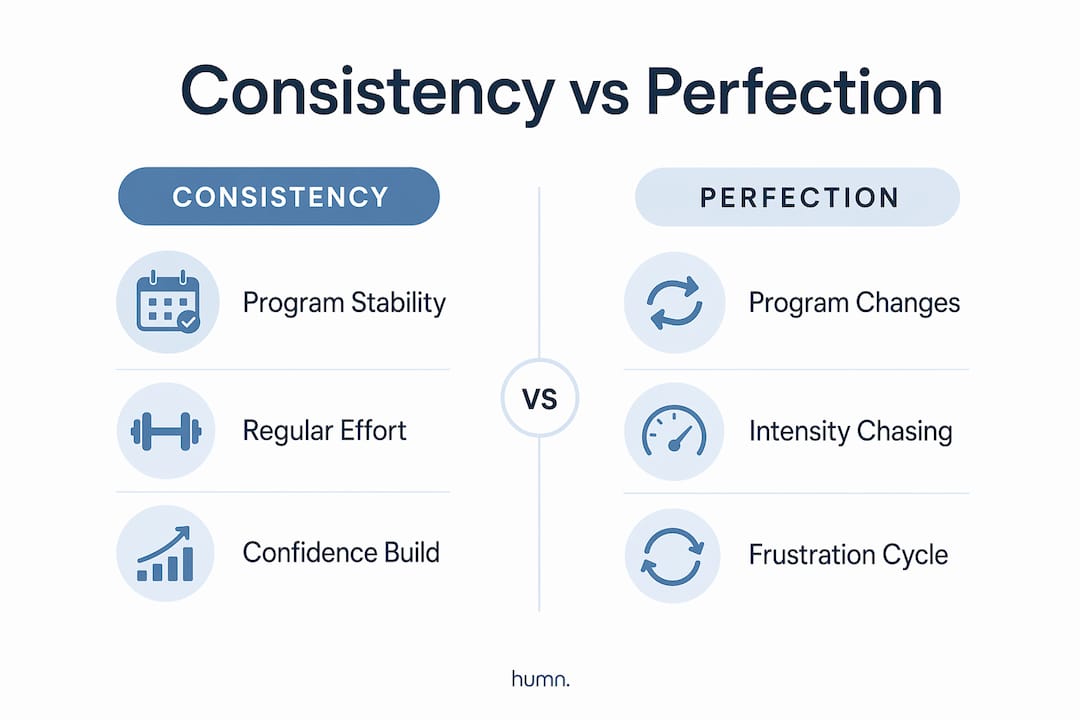
Consistency builds confidence in a way that perfection never can. Every session you complete, regardless of quality, is evidence that you are someone who works out. That identity compounds. After six months of showing up three times a week, you do not need motivation. You need to maintain a habit that has become part of who you are.
The benefits of consistency in fitness extend beyond physical adaptation. Regular exercisers report better sleep, lower stress, and stronger self-efficacy across other areas of life. These benefits do not come from the perfect workout. They come from the regular one.
Key Takeaways
Consistency in fitness produces better long-term results than perfection because regular, sustainable effort drives adaptation, habit formation, and confidence in ways that sporadic intense training cannot replicate.
| Point | Details |
|---|---|
| Modest effort still saves lives | Exercising once a week at a slow pace reduces all-cause mortality risk by 27%. |
| 80% adherence is the target | Completing 80% of planned workouts is the optimal threshold for lasting progress without burnout. |
| Perfectionism causes dropout | Maladaptive perfectionism and rigid programs are leading causes of gym attrition within six months. |
| Minimum viable movement works | Five to ten minutes of light activity on hard days keeps the habit loop intact and prevents extended breaks. |
| Simplicity beats complexity | Fewer exercises done regularly outperform elaborate programs executed inconsistently. |
The uncomfortable truth about “perfect” workouts
I spent two years designing what I thought was the ideal training week. Periodized strength work, zone 2 cardio, mobility sessions, and recovery protocols all mapped out to the hour. And I followed it perfectly for about three weeks before life intervened and the whole structure collapsed.
What I learned from that collapse, and from watching hundreds of people go through the same cycle, is that the perfect program is a trap. The more elaborate the system, the more points of failure it contains. One busy week, one sick kid, one work deadline, and the whole thing falls apart. Then comes the guilt, the “I’ll restart Monday” thinking, and the two-week gap that becomes a two-month gap.
The people I have seen make the most durable progress are not the ones with the best programs. They are the ones who show up when it is inconvenient, who do a 20-minute session when they planned 60, and who never let a missed day become a missed week. They treat fitness like brushing their teeth. Not something they feel inspired to do. Something they just do.
At humn, the whole approach is built around this reality. The four-pillar framework of Resist, Recover, Renew, and Rhythm exists because fitness is not just about workouts. It is about building a life where movement fits naturally, where recovery is planned, and where the habit is protected from the perfectionism that kills most routines. The goal is never a perfect week. The goal is a sustainable year.
— Josh
humn’s approach to building lasting fitness habits
Sustainable fitness does not come from finding the right program. It comes from having the right support system around you.

humn is a coaching facility in Gaithersburg, MD, built specifically for adults who want fitness habits that last. Through individualized strength and lifestyle coaching, small-group training, and dedicated recovery access, humn builds programs around your actual schedule, not an ideal one. The Resist, Recover, Renew, and Rhythm framework addresses sleep, stress, and nutrition alongside training, because consistency requires a whole-person approach. If you are ready to stop restarting and start building, explore humn membership options and find the structure that fits your life.
FAQ
Why does consistency matter more than workout intensity?
Adherence over time is the strongest predictor of fitness outcomes, outweighing program design or intensity. Regular moderate effort produces more adaptation than sporadic intense sessions because the body needs repeated signals to change.
What is the 80% adherence rule in fitness?
The 80% adherence principle means completing roughly 80% of your planned workouts is the optimal target for long-term progress. It builds in flexibility for real life while maintaining enough frequency to drive consistent adaptation.
How do I recover from a missed workout without losing momentum?
Show up on your next scheduled day at normal intensity. Compensatory overtraining after missed sessions increases injury risk and makes future sessions harder, so skipping the makeup session is the smarter move.
What is minimum viable movement and does it actually work?
Minimum viable movement means doing 5–10 minutes of light activity on days when a full workout is not possible. This approach keeps the habit loop active and prevents the psychological break that leads to extended absences from training.
How long does it take for fitness consistency to become a habit?
Habit formation timelines vary by person and behavior, but research on behavioral automaticity suggests that consistent repetition over several weeks is required before a behavior feels automatic. Showing up at the same time, in the same place, with the same routine accelerates that process significantly.
No Comments.