

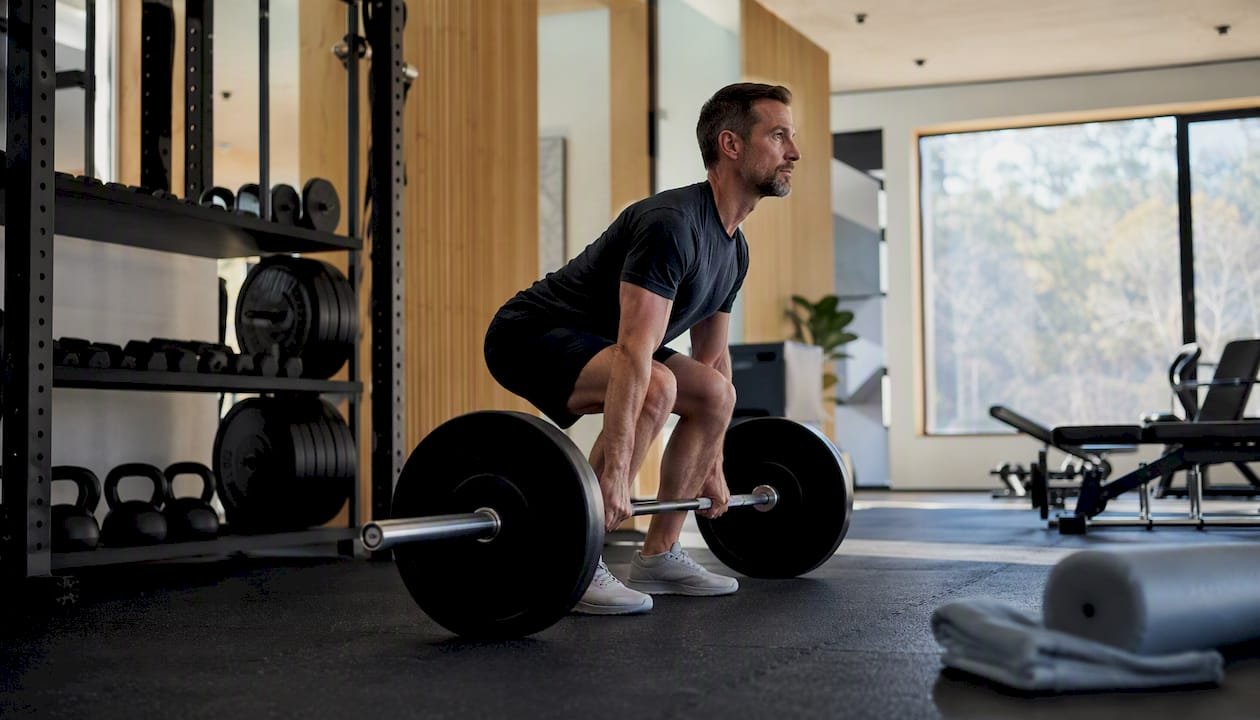
Resistance training of roughly ninety to a little under 120 minutes per week is linked to meaningfully lower mortality risk in the largest long-term cohort study on this question to date. A 2026 analysis published in the British Journal of Sports Medicine tracked approximately 147,374 adults for up to 30 years and found this range of weekly resistance training was associated with a lower all-cause mortality risk. Benefits were even larger for cardiovascular and neurological causes of death, and they grew further when resistance training was combined with regular aerobic activity.
The practical takeaway is straightforward: two 45–60 minute full-body sessions per week, performed at near-failure intensity within 5–15 reps, gets most adults into the sweet spot. More is not necessarily better. The Harvard T.H. Chan School of Public Health summarized that benefits plateau past a certain weekly threshold for most outcomes.
A few things to hold in mind before reading further:
- The association is observational. The cohort data cannot prove causation or fully rule out confounding.
- “Resistance training” in the study includes free weights, machines, bodyweight, and resistance bands — not just gym lifting.
- The combination of strength and aerobic training produced the largest mortality reductions, not either alone.
- Two sessions per week at near-failure intensity is a reasonable, evidence-aligned starting point for most healthy adults.
Key Takeaways
| Point | Details |
|---|---|
| Weekly target | 90–119 min/week of resistance training linked to 13% lower all-cause mortality in the BJSM cohort. |
| Session structure | Two to three non-consecutive sessions/week; 4–6 compound movements; 2–4 sets of 5–15 reps at near-failure (2RIR). |
| Combine with aerobic activity | Adding aerobic exercise to resistance training produced the largest mortality reductions in the cohort data. |
| Intensity over volume | Near-failure stimulus within 5–15 reps drives adaptation; exceeding ~120 min/week adds no additional mortality benefit. |
| humn coaching | humn’s 1-on-1 and small-group programs in Gaithersburg, MD deliver individualized strength programming, progressive overload tracking, and integrated recovery to support long-term adherence. |
Table of Contents
- What the research actually shows about strength training for longevity
- How much is too much? Dose, upper limits, and safety
- How 90–120 weekly minutes translates into real sessions
- Pairing resistance training with aerobic activity for maximum benefit
- Why strength training affects how long you live
- What a qualified coach does that a static plan cannot
- How to start safely, including modifications for older adults
- The case for quality over quantity, and what the research misses
- Strength programming that matches the evidence, session by session
- Sources
What the research actually shows about strength training for longevity
The 2026 BJSM cohort analysis is the most detailed long-term dataset on resistance training and mortality to date. Here is what it found and what supporting evidence adds.
The BJSM cohort study
The study followed approximately 147,374 adults for up to 30 years, measuring self-reported weekly minutes of resistance training across dose categories. Key findings:
- Regular moderate resistance training was associated with lower all-cause mortality.
- Cardiovascular and neurological mortality risks were also reduced at this training dose.
- Benefits plateaued beyond a moderate weekly duration for most outcomes.
- Combining high aerobic activity with moderate resistance training produced the largest mortality risk reductions observed.
The exposure was self-reported, which introduces measurement error. The cohort demographics also limit direct generalizability to all populations. These are real limitations, and the authors acknowledge them.
Supporting systematic reviews
A peer-reviewed synthesis on PubMed Central links resistance training to improved metabolic, musculoskeletal, and functional outcomes that track with lower disease burden over time. A PubMed-indexed review on resistance exercise and healthy aging concludes that preserving musculoskeletal function through resistance training is one of the most reliable levers for maintaining independence in older adults. These reviews do not prove the mortality numbers, but they explain the biological pathways that make them plausible.
The joint effect with aerobic activity
The combined-program finding is the most practically important signal in the data. Adults who met aerobic activity targets and also performed 90–120 minutes of resistance training per week showed the largest mortality risk reductions across multiple cause categories. The two modalities appear to be complementary, not interchangeable.
Statistic to anchor on: 90–119 min/week of resistance training was associated with a 13% lower all-cause mortality risk across a cohort of ~147,374 adults tracked up to 30 years.
How much is too much? Dose, upper limits, and safety
The dose–response curve here is not linear. Benefit accumulates up to roughly 90–120 minutes per week, then flattens. Some analyses show a potential U-shaped signal at very high weekly volumes, where extreme training loads may attenuate the benefit or introduce new risks. The most likely explanations are measurement error (people who report very high weekly minutes may be misclassifying activity type) and confounding by health status or competitive training patterns that carry their own injury and overuse risks.
For practical purposes, the ceiling message is this: once you are consistently hitting two quality sessions per week, adding a third session is reasonable, but chasing volume beyond 120 minutes per week is not supported by the mortality data.
Signs you may be doing too much:
- Joint pain that persists more than 48 hours after a session
- Unexplained fatigue or declining performance across consecutive weeks
- Sleep disruption tied to training load
- Loss of motivation or dread before sessions (a behavioral overtraining signal)
- Cardiac symptoms during or after training (chest tightness, palpitations, unusual shortness of breath) — these require immediate medical attention, not a rest day
Conditions that warrant medical clearance before starting:
- Uncontrolled hypertension or recent cardiac event
- Osteoporosis with fracture history
- Neurological conditions affecting balance or coordination
- Recent surgery or active joint inflammation
Recovery scheduling matters as much as training load. Non-consecutive sessions allow the mechanical and metabolic adaptations from each session to consolidate before the next stimulus arrives.
Pro Tip: When your performance stops improving across three consecutive sessions at the same load, that is the signal to add weight or reps, not to add another session. Quality of stimulus beats quantity of sessions.
How 90–120 weekly minutes translates into real sessions
Minutes per week is a research metric. What you actually need is a session structure. University of Sydney Charles Perkins Centre guidance on lifting for longevity specifies the key variables: near-failure intensity within 5–15 reps, controlled tempo, 90–120 seconds of rest between sets, and 2–3 non-consecutive sessions per week.
Two practical splits that hit the target:
- Two 45–60 minute full-body sessions (Monday/Thursday or Tuesday/Friday): the simplest structure for most adults, easiest to schedule, and sufficient to drive adaptation
- Three 30–40 minute sessions (Monday/Wednesday/Friday): slightly more frequency, shorter sessions, works well for people who find 60-minute blocks hard to protect
What each session should include:
- 4–6 compound, multi-joint movements: squat pattern, hip hinge, horizontal push, horizontal pull, vertical push or pull, and optionally a loaded carry
- 2–4 sets per exercise, 5–15 reps, stopping 1–2 reps short of failure (the “2RIR” rule: two reps in reserve)
- 90–120 seconds rest between sets
- Controlled tempo on the lowering phase (roughly 2–3 seconds down)
Equipment hierarchy for longevity-focused training:
- Barbell and rack (highest loading potential, best for progressive overload)
- Dumbbells (accessible, unilateral options, joint-friendly angles)
- Cable machines (constant tension, lower joint stress at end range)
- Resistance bands (portable, excellent for beginners and warm-up activation)
- Bodyweight (always available; limited upper-load ceiling but effective for movement quality)
If you cannot, hold the load and focus on tempo and control.
Pro Tip: *Spend the first 5–8 minutes of every session on movement prep, not static stretching.
For a structured beginner plan, the progressive strength training guide at humn walks through the first 8 weeks in detail.

Pairing resistance training with aerobic activity for maximum benefit
The cohort data is unambiguous on this point: the combination of resistance training and aerobic activity produced the largest mortality risk reductions, not either modality alone. Harvard Health’s summary of the BJSM findings specifically highlights that combined programs had some of the largest observed reductions across cause categories.
Practical pairing strategies:
- Alternate days: strength Monday/Thursday, aerobic Tuesday/Saturday. The most recovery-friendly structure, keeps quality high in both modalities.
- Same-day, separated by time: strength in the morning, aerobic in the evening (or vice versa). Acceptable when schedule demands it; prioritize strength first if building muscle mass is the primary goal.
- Same-session, sequenced: strength first, then 20–30 minutes of steady-state cardio. Efficient but limits peak performance in both; better for maintenance than for building.
Aerobic targets that complement 90–120 minutes of resistance training:
- 150 minutes per week of moderate-intensity aerobic activity (brisk walking, cycling, swimming) aligns with standard public-health guidelines and pairs well with two strength sessions
- 75 minutes per week of vigorous-intensity activity (running, rowing, HIIT) is the equivalent volume and fits a tighter schedule
Pro Tip: If you are choosing between adding a third strength session or adding one aerobic session, the mortality data favors the aerobic session once you are already hitting 90–120 minutes of resistance training. The joint-effect benefit is real.
For a detailed weekly template combining both modalities, humn’s guide to combining cardio and strength training covers scheduling and intensity sequencing.
Why strength training affects how long you live
The mortality associations in cohort data need a biological explanation to be credible. Several well-documented mechanisms connect resistance training to the outcomes observed.
Muscle mass and function
Sarcopenia, the age-related loss of muscle mass and strength, accelerates after age 50 and is independently associated with falls, fractures, hospitalization, and mortality. Resistance training is the most effective intervention for slowing sarcopenia. Greater muscle mass also improves glucose disposal, reducing the metabolic burden that drives type 2 diabetes and cardiovascular disease.
Metabolic effects
A peer-reviewed synthesis links resistance training to improved insulin sensitivity, favorable body composition changes, and reductions in systemic inflammation markers. These are direct upstream drivers of cardiovascular and metabolic disease risk.

Bone density
Mechanical loading from resistance training stimulates bone remodeling. This is particularly relevant for postmenopausal women and older men, where bone density loss accelerates and fracture risk rises sharply. Preserved bone density reduces fracture-related mortality and hospitalization.
Cardiovascular and neurological protection
The National Institute on Aging specifically notes that greater muscle strength is associated with lower risk of Alzheimer’s disease and cognitive decline, supporting a neurological mechanism that goes beyond vascular health alone.
Key figure: The NIA links stronger muscles to reduced Alzheimer’s risk, consistent with the 27% lower neurological mortality observed in the BJSM cohort data.
What a qualified coach does that a static plan cannot
A well-designed program on paper and a well-executed program in practice are different things. The gap between them is where coaching earns its value.
- Baseline movement assessment. A coach identifies compensations, mobility restrictions, and strength imbalances before loading them. A static plan cannot do this.
- Individualized load prescription. Age, training history, comorbidities, and recovery capacity all affect where to start and how fast to progress. A 65-year-old with osteopenia needs different loading parameters than a 40-year-old with no training history.
- Progressive overload management. Coaches track performance across sessions and adjust load, volume, and intensity systematically. This is what separates programs that produce results from programs that plateau.
- Recovery integration. Scheduling non-consecutive sessions, monitoring sleep quality, and adjusting training load during high-stress periods are all decisions a coach makes in real time.
- Nutrition alignment. Protein intake of approximately 1.0–1.6 g/kg/day, distributed across meals with a post-exercise protein-containing meal, supports muscle retention with aging. A coach connects this to the training stimulus rather than leaving it as a separate concern.
- Behavior change support. Long-term adherence is the actual variable that determines whether the mortality associations in cohort data apply to you. Habit-based coaching addresses the behavioral side of consistency.
What to look for when selecting a coach for longevity-focused training:
- Experience working with adults over 50 or with clinical populations
- A structured movement screen in the initial assessment
- Metrics-driven progression (they track your numbers, not just your effort)
- Explicit recovery and lifestyle integration, not just workout programming
Pro Tip: Ask any prospective coach how they handle a week when you are sick, traveling, or under unusual stress. A good answer involves modifying the plan, not skipping it. Adaptability is the skill that drives long-term adherence.
How to start safely, including modifications for older adults
The research on strength training and longevity is compelling, but the first four weeks of any new program carry the highest injury risk. Movement quality and load tolerance come before intensity.
A four-week starter roadmap:
- Weeks 1–2: Focus entirely on movement quality. Use bodyweight or very light resistance. Perform each pattern (squat, hinge, push, pull) for 2 sets of 10–12 reps with a slow, controlled tempo. The goal is motor learning, not fatigue.
- Weeks 3–4: Add light external load (resistance bands or light dumbbells). Introduce 3 sets per exercise. Begin tracking reps and perceived effort. Aim to finish each set feeling like 3–4 reps remain.
Common modifications for joint issues or balance limitations:
- Squat pattern: chair-assisted squat (sit to stand), box squat, or goblet squat with a counterbalance
- Hip hinge: Romanian deadlift with dumbbells instead of a barbell, or a hip hinge to a box
- Push: wall push-up progressing to incline push-up, then floor push-up
- Pull: resistance band row seated or standing, progressing to a cable row or dumbbell row
Harvard Health recommends starting with bodyweight movements and progressing to bands and dumbbells before adding heavier loads — a conservative, scalable approach that reduces early dropout from soreness or injury.
Safety checklist before each session:
- No acute joint pain or swelling
- Adequate sleep the night before (less than 5 hours meaningfully impairs neuromuscular performance)
- Hydrated and not fasted for more than 4–5 hours
- Warm-up completed before any working sets
For a full beginner progression with exercise-by-exercise guidance, the humn beginner’s guide to progressive strength training covers weeks 1 through 8 with clear load and rep targets.
The case for quality over quantity, and what the research misses
The 90–120 minutes per week finding is a useful anchor, but it can be misread. The cohort data measured time, not quality. Forty-five minutes of near-failure compound training is not the same as 45 minutes of casual machine circuits. The University of Sydney’s Charles Perkins Centre guidance makes this explicit: the longevity stimulus comes from proximity to failure within 5–15 reps, not from time on task.
What the observational data also cannot capture is the compounding effect of consistency over years. A person who trains twice a week for 10 years accumulates a fundamentally different physiological profile than someone who trains intensely for six months and stops. The mortality associations in the BJSM cohort reflect long-term habitual behavior, not short-term programs.
humn’s four-pillar framework, Resist, Recover, Renew, and Rhythm, is built around exactly this insight. Resistance training (Resist) is one pillar, but it only produces durable outcomes when recovery, lifestyle renewal, and behavioral rhythm support it. That systems view is what separates a program that works for two years from one that works for twenty.
Start with two sessions per week. Make them hard enough to count. Build the habit before you build the volume.
Strength programming that matches the evidence, session by session
The research points to a clear prescription. Executing it consistently, with the right intensity and progression, is where most people need support.
humn’s 1-on-1 coaching program is built around exactly the variables the evidence identifies: individualized load prescription, near-failure intensity tracking, progressive overload management, and recovery integration through modalities like sauna, compression, and red light therapy. Every member starts with a movement assessment, not a generic program.

For adults in the Gaithersburg, MD area who want a structured, evidence-based path to the 90–120 minute weekly target, humn offers small-group and 1-on-1 coaching options in a boutique facility designed for long-term adherence. Book an initial assessment to get a program built around your movement baseline, schedule, and goals.
Sources
The findings in this article draw on the following primary sources. Where noted, findings are observational and cannot establish causation.
- Long-term resistance training with all-cause and cause-specific mortality: assessing dose-response and joint associations with aerobic physical activity | British Journal of Sports Medicine
- Moderate amount of strength training each week could boost longevity | Harvard T.H. Chan School of Public Health
- Strength training over decades linked to longer life - Harvard Health
- Lifting for longevity Strength training simplified - The University of Sydney
- PMC article summarizing resistance training benefits
- Stronger muscles linked lower risk Alzheimer’s - NIA
This article is general information, not a substitute for advice from a qualified doctor. Consult a qualified healthcare professional about your own circumstances before acting on anything here.
No Comments.