


The fastest path to real strength and health for busy professionals is a repeatable short-workout system: three 30-minute full-body strength sessions per week, plus one or two short conditioning or active-recovery sessions. Strength work delivers benefits that last longer than pure cardio adaptations, which makes it the smarter time investment when your calendar is the real constraint. The templates below give you the exact structure, and the weekly plans that follow map it to your schedule.
TL;DR:
- Three 30-minute full-body strength sessions weekly build durable muscle and support longevity, especially when integrated into a consistent routine.
- Short conditioning or active-recovery sessions, like micro-mobility or brisk walks, can fill gaps on busy days and maintain progress.
- Fixed, repeatable workout templates reduce decision fatigue and improve adherence, with scheduling on the calendar as commitments.
- Progression should focus on perceived effort and reps in reserve rather than maxing out, to prevent overtraining and sustain results.
- Coaching tailored to individual schedules and needs enhances compliance and prevents the common pitfalls of random workout choices.
Table of Contents
- Three Repeatable Busy Professional Workouts You Can Use Today
- Weekly Plans for Different Calendars
- How to Make Short Workouts Actually Stick
- Plug-and-Play Session Scripts
- Recovery and Nutrition That Make Short Workouts Pay Off
- Why This System Holds Up Under Scrutiny
- What Busy Professionals Get Wrong About Short Workouts
- Get a Coached Plan Built Around Your Actual Schedule
- Sources
Three Repeatable Busy Professional Workouts You Can Use Today
You don’t need a new plan every week. You need one good template you can run on autopilot, because the decision fatigue of “what should I do today” is what kills most fitness routines before they start. Pick one of these three and stick with it for at least a month.
Template A: 30-minute full-body strength. Three to four compound lifts (squat, hinge, push, pull), 3 sets of 8 to 12 reps, 60 to 90 seconds rest between sets. This is the backbone of 30 minute strength training for anyone short on time, and it builds the kind of durable strength that Harvard Health notes holds up better over time than cardio-only fitness.
Template B: 20-minute HIIT. Warm up for 3 to 5 minutes, then run 40 seconds of work against 20 seconds of rest, or 30/30 if you’re newer to intervals. Rotate through bike sprints, kettlebell swings, rowing, or bodyweight moves like squat jumps. Scale intensity down before you scale volume up.
Template C: 10 to 15 minute micro sessions. A mobility flow, a bodyweight circuit, or a brisk walk. These fill the gaps on your worst days.
Use Template A when you have a bench, rack, or dumbbells and 30 minutes. Use Template B when you’re pressed for time but have decent cardiovascular fitness already. Use Template C when travel or meetings have eaten your whole day and something is better than nothing.
Weekly Plans for Different Calendars
Match the plan to the week you actually have, not the week you wish you had.
- Minimal 3-day strength plan (Monday, Wednesday, Friday): three 30-minute full-body sessions, roughly 90 minutes total per week. This is the floor for maintaining strength and function, and it’s the plan most busy professionals should default to.
- 5-day hybrid plan: two 30-minute strength sessions, two 20-minute HIIT or Zone 2 cardio sessions, one micro-recovery session. Total time investment stays under two and a half hours, but the frequency helps with fat-loss support and conditioning.
- Travel or peak-workload plan: one focused 30-minute strength session when you can get it, and micro sessions (10 to 15 minutes) on every other day you have access to a hotel room or hallway.
Weekly volume drives outcomes; for added support, consider medical adjuncts like weight-loss medications that can complement your nutrition and recovery strategies. Three sessions a week maintains strength and supports longevity. Four to five sessions, with intentional progression, moves you toward visible strength gains and better body composition.
How to Make Short Workouts Actually Stick
Most people don’t fail at working out. They fail at deciding to work out, over and over, until deciding feels exhausting. Precision Nutrition’s research on decision fatigue makes the case plainly: fixed, repeatable templates beat fresh workout plans every single time, because you remove the friction of choosing.
A few tactics that actually move the needle:
- Treat your workout like a client meeting. Block it on your calendar and set a reminder, because “I’ll fit it in later” rarely survives a full inbox.
- Keep a standing equipment checklist so you’re not hunting for a resistance band five minutes before your session.
- Use the same 60-second warm-up template every time. No decisions, just movement.
- Set an interval timer app for HIIT days so you’re not watching the clock mid-set.
- Track two numbers: your weekly completion rate and your session RPE (rate of perceived exertion). If completion drops or RPE creeps up for two weeks straight, that’s your deload signal.
Pro Tip: Put your workout on the calendar the same time every week, same as a recurring meeting. The brain treats scheduled blocks as commitments, not suggestions, and that alone can fix half your adherence problem.
Plug-and-Play Session Scripts
Here’s what each template looks like in practice, down to the rep.
- 30-minute full-body script. Warm up 5 minutes (bodyweight squats, arm circles, hip hinges). Then: goblet squat or trap-bar deadlift, 3 sets of 8 to 12 reps; dumbbell bench press or push-up, 3 sets of 8 to 12; bent-over row or lat pulldown, 3 sets of 8 to 12. Finish with a 5-minute circuit (kettlebell swings, plank holds, farmer carries) for a metabolic kicker. A well-structured 30-minute session built this way can support both fat loss and muscle gain when you’re consistent about it.
- 20-minute HIIT script. Warm up 3 minutes. Run 12 rounds of 40 seconds work, 20 seconds rest, alternating between two movements (bike sprints and mountain climbers, or rowing and squat jumps). Cool down for 3 minutes. Scale by reducing round count before reducing intensity, and leave at least one recovery day between HIIT sessions to manage fatigue.
- 10 to 15 minute micro script. A 5-minute mobility flow (hip openers, thoracic rotations, ankle circles), followed by a 3-round bodyweight circuit: 10 squats, 10 push-ups, 20-second plank.
For progression, use RPE and reps in reserve rather than chasing max weight every week. Leaving 1 to 2 reps in reserve on your main lifts keeps intensity high without burying you in fatigue, and it’s how you turn a fixed template into something that keeps producing results month over month.
Recovery and Nutrition That Make Short Workouts Pay Off
Recovery is where short workouts either compound into real progress or quietly stall. Aim for roughly 0.7 to 1.0 grams of protein per pound of body weight daily. That target supports muscle repair without requiring meal prep gymnastics.
- Prioritize sleep before any supplement or recovery gadget. It’s the highest-leverage recovery tool you have.
- Spend five minutes post-session on mobility work and hydration. Add compression if you already use it.
- Watch for overreach signs: elevated resting heart rate, stalled lifts, or dragging energy for more than a few days.
- When you spot those signs, deload by cutting volume roughly 30 to 40% for a week rather than skipping entirely.
Short, structured active recovery habits fit into a workday without eating into your actual training time. If you want deeper recovery support built into your routine, humn’s recovery resources go further into sauna, compression, and mobility protocols.
Why This System Holds Up Under Scrutiny
This template isn’t guesswork. It reflects what Harvard Health documents about strength training’s durability compared to cardio-only approaches, and it applies the fixed-template principle that Precision Nutrition recommends for beating decision fatigue.
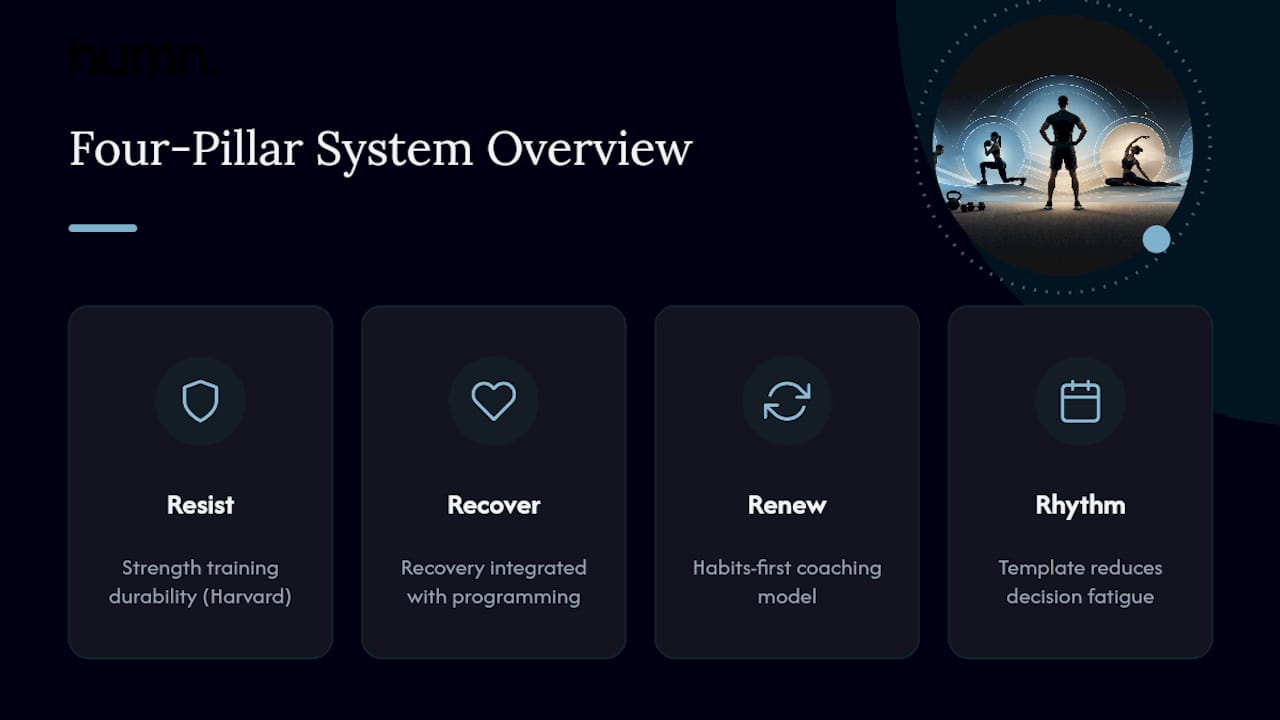
The four-pillar framework, Resist, Recover, Renew, and Rhythm, is built around this logic: busy professionals don’t need more workout options, they need a system that removes friction and compounds over time. Author Josh draws on that habits-first coaching model in shaping these templates, treating programming, recovery, and scheduling as one connected problem rather than three separate ones. If you want to see how that framework translates into individualized coaching, The page on what a systems-based fitness program is worth a look.
What Busy Professionals Get Wrong About Short Workouts
Most advice on time-crunched training treats the workout as the whole problem. It isn’t. The workout is the easy part. The real failure point is everything around it: the decision of when to train, what to do when you’re tired, and whether you adjust intensity before you burn out completely.
Here’s what I’d push back on: the fitness industry loves to sell “efficiency” as more intensity packed into less time. That’s backwards for most professionals. The people who actually stick with training for years aren’t the ones grinding the hardest HIIT session they can find. They’re the ones who picked a boring, repeatable strength template and showed up for it three times a week for two years straight.
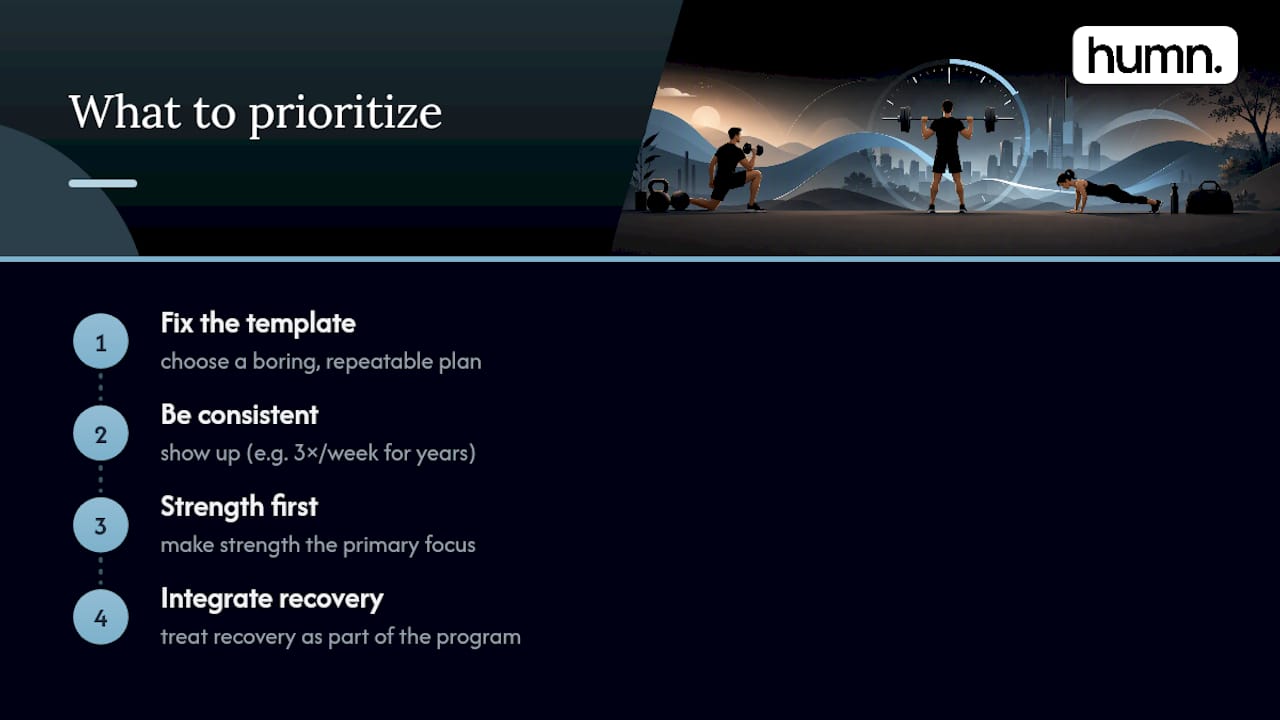
If you take one thing from this article, take this: fix your template before you fix your intensity. A mediocre plan you actually follow beats a perfect plan you abandon in March. Strength first, conditioning second, and recovery treated as part of the program, not an afterthought, is the order that actually produces results.
— Josh
Get a Coached Plan Built Around Your Actual Schedule
Templates get you moving, but a coach adjusts the plan when your week falls apart, your knee acts up, or your progress stalls for no obvious reason. This is an alternative to guessing your way through DIY programming: instead of piecing together workouts between meetings, you get small-group and one-on-one coaching, plus recovery access, built specifically around a working professional’s calendar.
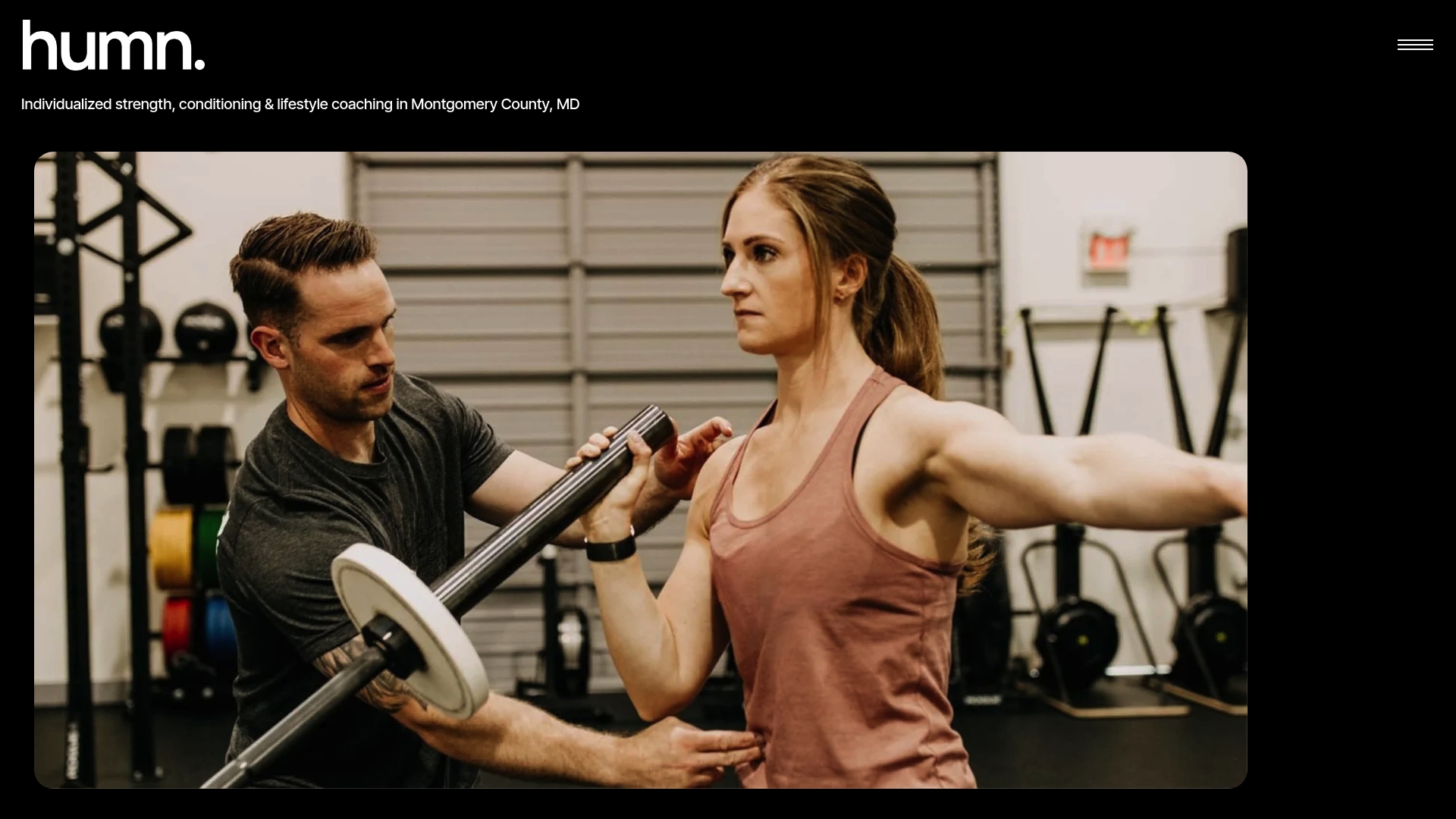
An initial consult maps your current fitness level, your actual weekly time budget, and your goals, then builds a plan around it, so you skip months of trial and error most people spend adjusting their own programming. That’s the real time savings: not a shorter workout, but a shorter path to a plan that actually fits your life. If the strength-first approach in this article made sense to you, the strength training for longevity program is the natural next step. Reach out to book a consult and see what a coached version of this system looks like for your week.
Sources
- How to overcome decision fatigue in fitness — Precision Nutrition
- Strength training builds more than muscles — Harvard Health
- Best 30-Minute Workout for Fat Loss and Muscle Gain — Healthline
No Comments.