

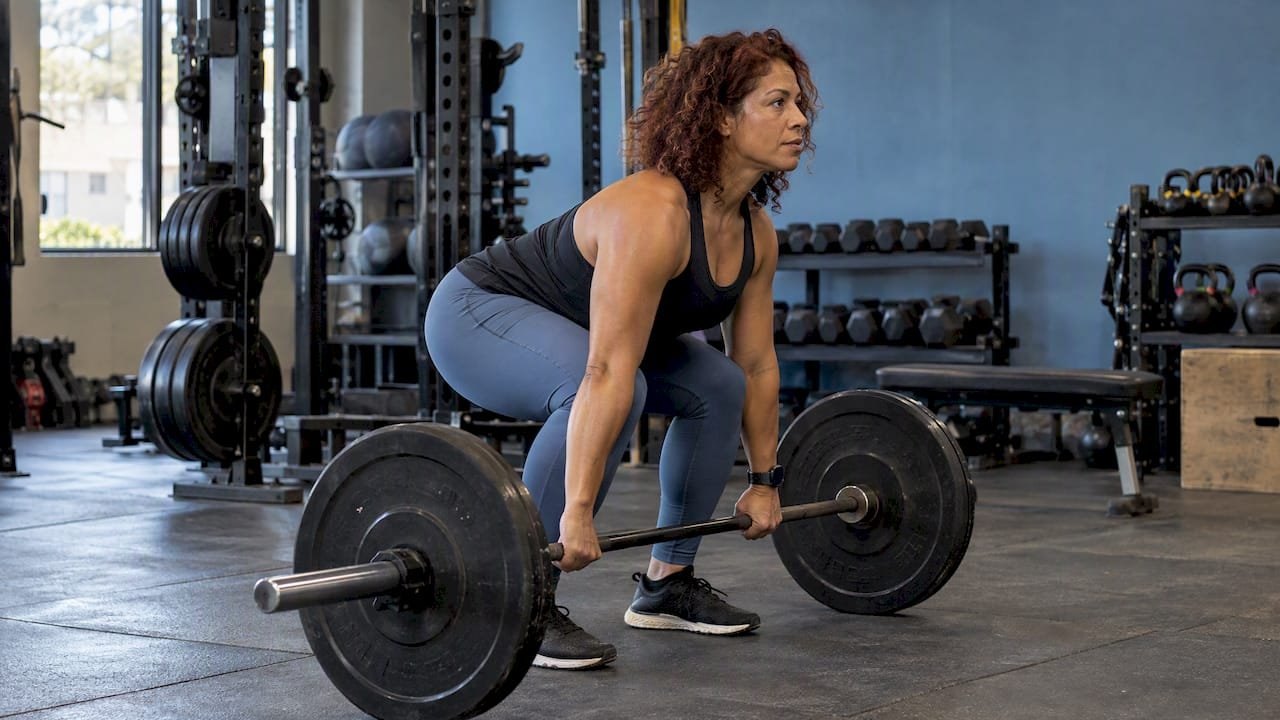
Strength training is one of the most useful things you can do during perimenopause. Aim for two to three full-body sessions a week, start with loads you can manage, and add weight gradually. Pair that with walking, enough sleep and a real rest day, and you have a plan that fits a full calendar. This guide shows how many days to lift, what a week looks like, how heavy to go and how to recover, so you can start this week.
TL;DR
- Lift 2 to 3 days a week, using all the major muscle groups, with 1 to 3 sets of 8 to 12 repetitions to start, per ACSM guidance for the perimenopausal years.
- Yes, you can build muscle in this stage. Research on menopausal women points to three sessions a week for at least 6 weeks.
- Progress gradually toward challenging loads. Safety and technique come before heavy weight.
- Add aerobic work, balance work and flexibility, and protect at least one full rest day.
- Talk to your doctor before major changes, and see a pelvic floor physical therapist if you have pelvic symptoms.
Table of Contents
- Why perimenopause changes how you train
- What the evidence says you can expect
- How many days a week to lift
- A sample perimenopause workout plan for a busy week
- How heavy, and how to progress
- Recovery is part of the program
- Perspective
- Train with a coach in Gaithersburg
- FAQ
- Sources
Why perimenopause changes how you train
Perimenopause is the three to five years leading into menopause. Stanford’s Lifestyle Medicine team notes that loss of lean, quality muscle and fat gain are common in this window, and that regular strength and resistance training can offset some of the physiologic changes.
The mechanism is partly hormonal. A professional fact sheet from Exercise is Medicine Australia explains that losing protective estrogen is linked with faster decline in bone mineral density, tendon degeneration, loss of pelvic floor muscle tone and increased insulin resistance. Those are the areas that lifting is well placed to support.
The American College of Sports Medicine frames it the same way. In its perimenopause exercise guide, strength training is especially important now because it helps counter age-related muscle loss and supports bone strength, metabolic health, insulin sensitivity and daily function.
In practical terms, that means the same hour you used to spend on steady cardio may now earn you more when part of it goes to lifting. If you are also looking at the bigger picture for your forties and beyond, our guide to strength training for women over 40 covers the starting steps.
What the evidence says you can expect
Muscle and strength
Can you build muscle during perimenopause? Yes. A 2023 review found that exercise effectively improves muscle mass and strength in menopausal women, with resistance training three times a week for 20 to 90 minutes, for at least 6 weeks, working best. The same finding appears in the full-text version of the review.

That range is wide on purpose. A 25-minute session you actually attend beats a 90-minute session you skip.
Bones, metabolism and function
A review of strength exercise in menopausal women reported benefits for strength, physical activity, bone density and hormonal and metabolic levels. Bone is a long game. If that is your main concern, read how clinician-guided training builds bone density over 8 to 12 months.
UHealth experts at the University of Miami add that metabolism slows with age and that strength training can counteract muscle loss by preserving and building muscle.
Does lifting weights lower estrogen?
This is a common worry, and the research is reassuring on the practical question. A 2015 meta-analysis of 18 randomized trials found only a small reduction in circulating estradiol with physical activity, and the authors reported that the changes were probably not clinically significant. A separate systematic review found no statistically significant overall effect on free estradiol, while noting that studies varied a lot in method.
One study did find that resistance training lowered estradiol inside muscle tissue in postmenopausal women, with or without estrogen therapy. Does that undermine the gains? Not according to a 2024 evidence review, which concluded that exercise-related hormone rises are neither necessary nor sufficient to explain strength and muscle gains from resistance training. Your muscles respond to the training stimulus itself.

How many days a week to lift
The floor is set by the Physical Activity Guidelines for Americans: muscle-strengthening activity at least 2 days a week. ACSM’s perimenopause guidance goes to 2 to 3 weekly resistance sessions, beginning with manageable loads and progressing toward 1 to 3 sets of 8 to 12 repetitions for all major muscle groups.
Here is how to choose between two and three:
| Your situation | Start with | Why |
|---|---|---|
| New to lifting, or returning after a long break | 2 full-body days | Leaves room to learn technique and recover |
| Some experience, steady schedule | 3 full-body days | Matches the frequency used in the muscle-building research |
| Very tight weeks | 2 sessions of 20 to 30 minutes | Meets the national minimum and keeps the habit alive |
| Running or other endurance sport | 2 days, placed away from hard runs | See our strength plan for runners |
Someone aged 50 asking how often to lift gets the same answer: two to three days, with at least a day between sessions that load the same muscles.
A sample perimenopause workout plan for a busy week
This is a template, not a prescription. ACSM’s weekly targets for the perimenopausal years are resistance training 2 to 3 days, 150 minutes of moderate aerobic activity (or 75 minutes vigorous), flexibility work 2 to 3 days and balance work. Its guidance also suggests starting with 10 to 15 minute sessions and building up, and spreading aerobic work over several days.
| Day | Plan | Time |
|---|---|---|
| Monday | Full-body strength A | 30 to 45 min |
| Tuesday | Brisk walk | 20 to 30 min |
| Wednesday | Mobility and balance | 15 min |
| Thursday | Full-body strength B | 30 to 45 min |
| Friday | Brisk walk or easy bike | 20 to 30 min |
| Saturday | Optional third strength day, or a longer walk | 30 to 45 min |
| Sunday | Full rest | 0 |
Full-body session A
Build each session around movement patterns, not body parts:
- Squat or goblet squat, 2 to 3 sets of 8 to 12
- Push: push-up (incline if needed) or dumbbell press, 2 to 3 sets of 8 to 12
- Hinge: Romanian deadlift with dumbbells or a kettlebell, 2 to 3 sets of 8 to 12
- Row: cable, band or dumbbell row, 2 to 3 sets of 8 to 12
- Carry or plank, 2 sets of 30 to 45 seconds
Full-body session B
- Step-up onto a box or stair, 2 to 3 sets of 8 to 12 per leg
- Overhead press, 2 to 3 sets of 8 to 12
- Hip bridge or hip thrust, 2 to 3 sets of 8 to 12
- Lat pulldown or assisted pull-up, 2 to 3 sets of 8 to 12
- Side plank or suitcase carry, 2 sets per side
No weights at home? The UHealth experts suggest bodyweight options like planks and stepping up and down a stair. That is enough to begin.
Fitting it into a packed week
- Put sessions in the calendar like meetings, with the same days each week.
- Short beats skipped. Ten to fifteen minutes still counts while you build the habit.
- Stack walks onto existing routines: calls, school pickup, lunch.
- Keep two sessions as your non-negotiable minimum, and treat the third as a bonus.
If consistency is your sticking point, a 3-week accountability test is a good way to find out what support you need.
How heavy, and how to progress
Most perimenopause advice stops at “lift weights.” The more useful question is how hard to push.
Start conservatively. For women new to strength training, the Stanford team recommends gradually working toward loads heavy enough to approach failure in 4 to 6 reps for 3 to 5 sets, always prioritizing safety. They also cite experts who say prioritizing “lifting heavy” at a level that feels challenging to you is particularly effective for muscle composition during the transition.
That is a destination, not a first-week instruction. A sensible path:
- Weeks 1 to 4: learn the patterns with light loads, 1 to 2 sets of 10 to 12. Stop with a few reps in reserve.
- Weeks 5 to 8: add a set, and add weight when you can finish every set with good form.
- Weeks 9 and beyond: lower the reps and raise the load on your main lifts, following the 8 to 12 range first, then moving toward heavier work as technique and confidence allow.
- Throughout: change one variable at a time (weight, reps or sets), and write it down.
Coaching helps here, because form on a hinge or squat is hard to judge on your own. If you are returning from a layoff or an injury, our 4-week restart plan gives a careful way back.
A note on the pelvic floor
Loss of pelvic floor muscle tone is one of the changes associated with falling estrogen. Kegels help, but ACOG warns that pushing down instead of pulling up can make pelvic organ prolapse worse, and that a pelvic floor physical therapist can teach correct technique. If you notice heaviness, bulging or leaking when you lift, see one before you add load.
Recovery is part of the program
Muscle is built between sessions. The UHealth guidance suggests at least one full rest day a week, plus sleep and hydration, listening to your body and adjusting intensity to your energy, and speaking with your doctor before major fitness or lifestyle changes. ACSM likewise stresses consistency and rest days for muscle groups you have just worked.
Perimenopause can disturb sleep and mood, which makes this pillar harder and more important. A few habits pay off:
- Protect sleep. Our piece on sleep and muscle recovery lays out the habits that matter most.
- Choose your rest days well. The right number depends on your goal; see how many rest days you need and what to do on them.
- Manage stress as training load. Work pressure and poor sleep draw on the same recovery budget as your workouts. This emotional resilience checklist offers ideas for building steadier daily habits.
- Plan the 24 hours after a session. Our 24-hour recovery timeline walks through food, movement and sleep.
These habits are the reason we think of training as one part of a system, not the whole of it.
Perspective
We see the same pattern in women who come to us in perimenopause. They have been doing more: more cardio, more restriction, more early mornings. And they feel worse. The issue is rarely effort. It is that the plan was built for a body that is no longer the one showing up.
Our view is that strength training should be the anchor in this stage, and that it works best inside a system. That is why humn. is built on four pillars: Resist, Recover, Renew and Rhythm. Lifting is the Resist pillar, but it only pays off if recovery, sleep, stress and nutrition are working alongside it.
This is also why we favor small groups and 1-on-1 coaching over a gym floor and a printed program. A coach can adjust load on a low-energy week, correct a hinge before it becomes a habit, and track your progress over months instead of days. We are not interested in short-term transformations. We want to be a long-term partner in your strength, your resilience and your quality of life.
Josh
Train with a coach in Gaithersburg
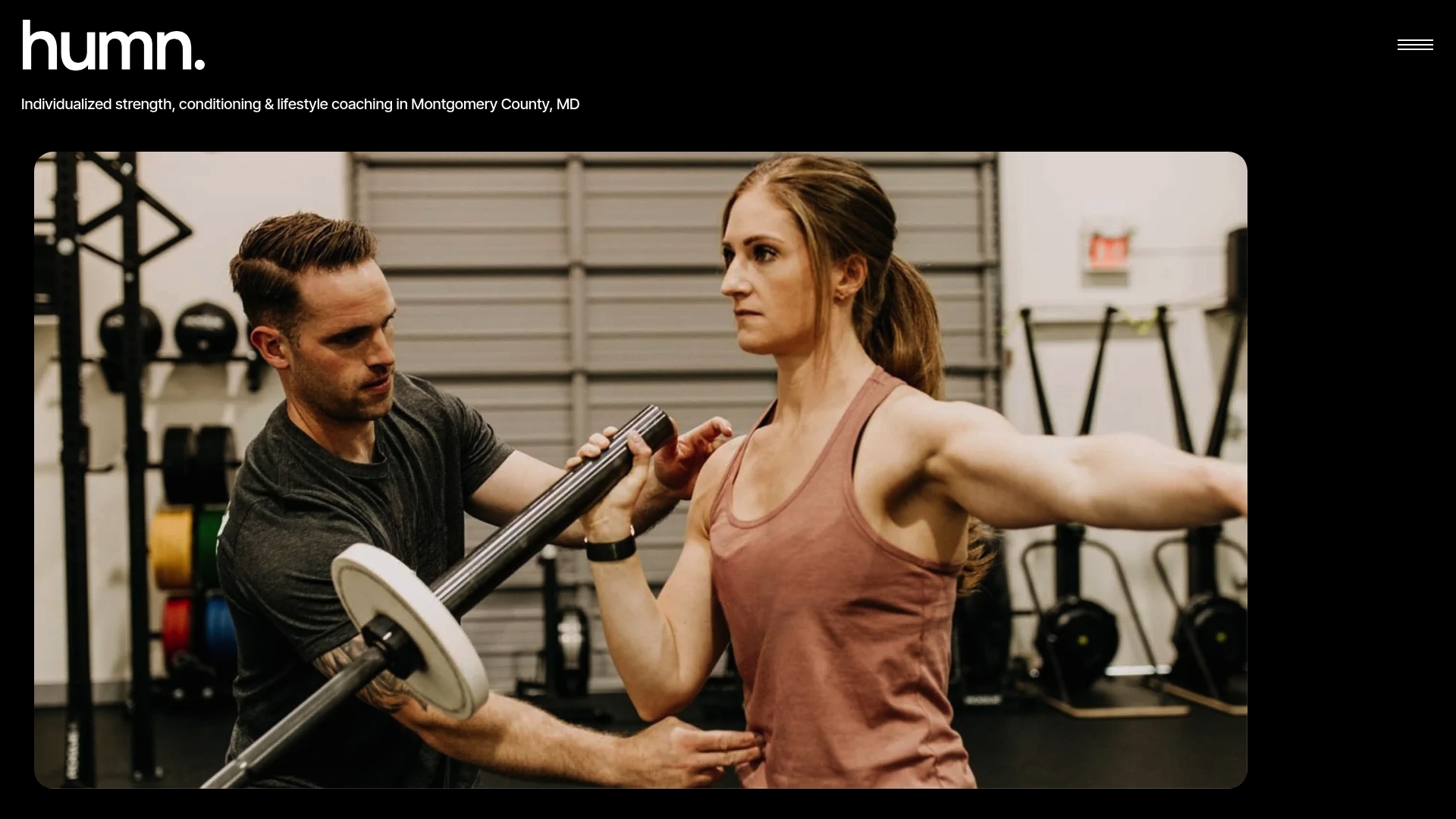
If you live or work near Gaithersburg, MD, humn. combines small-group personal training, 1-on-1 coaching and recovery services in one boutique space. Coaches build habits-first programming around your strength, sleep, stress and nutrition, with structured progress tracking. See how it works on our membership page.
On the recovery side, we offer sauna, compression, red light therapy and acupuncture through our recovery services. If food is the piece you are missing, our 1:1 nutrition coaching turns your training into a plan you can sustain. Not sure whether small groups suit you? Read about building a habit in 6 to 8 weeks with small group training.
FAQ
How many days a week should a perimenopausal woman strength train?
Two to three days is the evidence-based range. The Physical Activity Guidelines for Americans set a minimum of 2 days of muscle-strengthening activity, and ACSM recommends 2 to 3 sessions during perimenopause. Research on muscle gains in menopausal women used three sessions a week.
Can you build muscle during perimenopause?
Yes. A 2023 review found that exercise effectively improves muscle mass and strength in menopausal women, with three weekly resistance sessions for at least 6 weeks working best. Progress comes from steadily increasing load, so track your lifts.
Does lifting weights lower estrogen?
The research suggests any effect on circulating estrogen is small. A 2015 meta-analysis reported changes that were probably not clinically significant, and training-related gains do not depend on hormone spikes. Talk to your doctor if you are using hormone therapy or have specific concerns.
Should I stop cardio during perimenopause?
No. ACSM still recommends 150 minutes of moderate aerobic activity a week, or 75 minutes of vigorous activity, spread across several days. The shift is to give strength training a firm place in the week, not to drop walking or other cardio.
Sources
- Strength Training During Perimenopause, Stanford Lifestyle Medicine
- The Efficacy of Strength Exercises for Reducing the Symptoms of Menopause (PMC)
- Menopause and Exercise, Exercise is Medicine Australia
- Being Active During the Perimenopausal Years, ACSM
- How to Exercise Effectively in Perimenopause and Menopause, UHealth
- Effect of non-pharmacological interventions on muscle mass and strength, PubMed
- Effect of non-pharmacological interventions, full text (PMC)
- Hormones, Hypertrophy, and Hype: An Evidence-Guided Primer (PMC)
- Intramuscular sex steroid hormones after resistance training, ScienceDirect
- Effect of physical activity on sex hormones in women: a meta-analysis (PMC)
- Effects of exercise on sex steroid hormones (PMC)
- Physical Activity Guidelines for Americans talking points, ODPHP
- 5 Things I Wish All Women Knew About Pelvic Organ Prolapse, ACOG
- Your Comprehensive Checklist for Supporting Emotional Resilience
No Comments.