

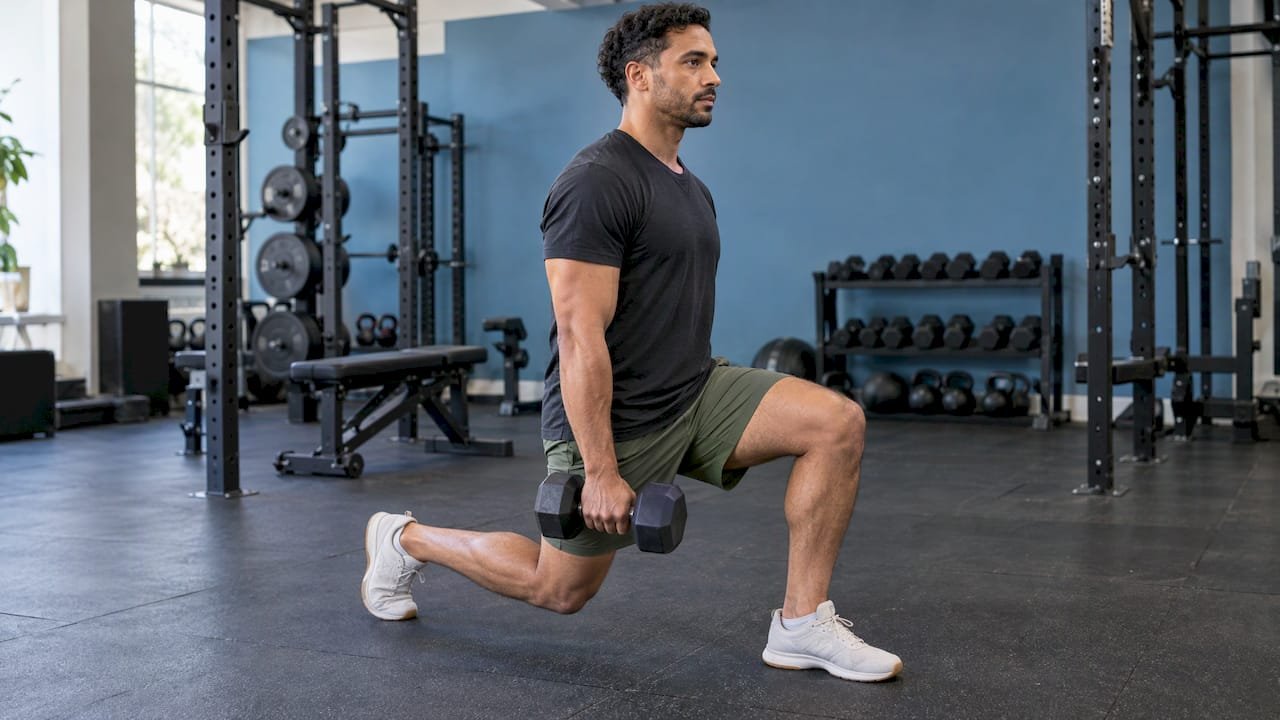
Two strength sessions a week are enough to get stronger if each one trains your whole body, uses a few multi-joint lifts, and gets a little harder over time. Below you will find two complete full-body workouts (A and B), the sets, reps and rest to use, how to schedule them, how to progress, and how to adjust the plan when time, equipment or experience is limited.
TL;DR
- Train on two nonconsecutive days, such as Monday and Thursday, and hit every major muscle group in each session.
- Pick one squat or leg press, one hinge, one push, one pull and one carry or core move per workout, for 2 to 3 sets of 6 to 15 reps.
- Add weight or reps gradually once the target reps feel easy. Consistency matters more than a perfect program.
- Two days is a strong base for beginners and a solid maintenance dose for experienced lifters. If you want to keep pushing maximal strength, you may eventually need more volume.
- Recovery is part of the plan: sleep, food and rest days decide how much of the work you keep.
Table of Contents
- Is two days a week really enough?
- Who this plan fits
- How to schedule your two sessions
- The structure: two workouts, five movement patterns
- Sets, reps and effort
- How to progress week to week
- What results to expect
- Recovery between your two sessions
- Adapting the plan to your life
- Common mistakes
- Perspective
- Train with a coach in Gaithersburg
- FAQ
- Sources
Is two days a week really enough?
For most adults, yes. Mayo Clinic advises training all major muscle groups at least twice a week, and notes that a single set of 12 to 15 repetitions, taken to the point where the muscles are tired, is enough for health and fitness benefits. The ACSM 2026 position stand summary gives the same minimum of two days per week and adds that the biggest jump in results comes from going from no resistance training to some. Its advice is to keep things simple and show up regularly.
The research on frequency explains why. A 2018 systematic review found that higher training frequencies tend to go with larger strength gains, but that the effect is largely driven by total training volume, not frequency itself. A 2018 meta-analysis in Sports Medicine - Open found no significant difference in strength gains between low and high frequencies when volume was matched. In plain terms: if you do the same number of hard sets in a week, splitting them over two days works about as well as splitting them over four.
There is one honest boundary. The NSCA notes that two days per week is effective for novices, while people already used to resistance training may find it sufficient mainly for maintenance, not for raising maximal strength. So treat this plan as a foundation you can build on, and as a dependable floor for the weeks when life is full.

Who this plan fits
This template suits you if:
- You are new to lifting, or returning after a long break.
- You work long days, travel, or have family commitments that make four sessions unrealistic.
- You run, play a sport or do other cardio and want strength work that does not crowd out the rest of your week. Our weekly strength plan for runners shows how to fit it around mileage.
- You want to maintain the strength you have built while other things take priority.
If you are completely new to the lifts, our guide to learning eight compound lifts first is a good companion to the movement list below.
How to schedule your two sessions
Space the workouts so your muscles get time to recover. The NSCA suggests nonconsecutive days with one to three days between sessions, and gives Monday and Thursday as an example. Mayo Clinic’s guidance is to rest one full day between sessions that work the same muscle group. Because each of your sessions is full body, that means no back-to-back days.
Good pairings:
| Pattern | Session 1 | Session 2 | Gap |
|---|---|---|---|
| Weekday classic | Monday | Thursday | 2 days, then 3 days |
| Weekend plus midweek | Saturday | Wednesday | 3 days, then 4 days |
| Tight schedule | Tuesday | Friday | 2 days, then 4 days |
Pick the pattern you can repeat for months. A plan you complete 90 percent of the time beats a better plan you complete half the time.
The structure: two workouts, five movement patterns
Each workout covers the same patterns with different exercises, so you train every major muscle group twice a week while keeping variety. You alternate Workout A and Workout B, or run A in one session and B in the next, then repeat.
A 2021 review on time-efficient training recommends prioritizing bilateral multi-joint exercises, including a leg-pressing movement, an upper-body pull and an upper-body push, and aiming for at least four weekly sets per muscle group at a load in the 6 to 15 repetition maximum range. Two sessions of two sets each meets that floor. Three sets each gives you room to grow.
Workout A
| Order | Pattern | Example exercise | Sets x reps |
|---|---|---|---|
| 1 | Squat | Goblet squat or leg press | 3 x 8-12 |
| 2 | Horizontal push | Dumbbell bench press or push-up | 3 x 8-12 |
| 3 | Horizontal pull | One-arm dumbbell row or seated cable row | 3 x 8-12 |
| 4 | Hinge | Romanian deadlift with dumbbells | 2 x 8-10 |
| 5 | Core | Plank or dead bug | 2 x 30-45 seconds |
Workout B
| Order | Pattern | Example exercise | Sets x reps |
|---|---|---|---|
| 1 | Hinge | Trap bar deadlift or kettlebell deadlift | 3 x 6-10 |
| 2 | Single-leg | Split squat or step-up | 2 x 8-10 per leg |
| 3 | Vertical push | Dumbbell overhead press | 3 x 8-12 |
| 4 | Vertical pull | Lat pulldown, assisted pull-up or band pulldown | 3 x 8-12 |
| 5 | Carry | Farmer carry | 2 x 30-40 seconds |
These are examples, not requirements. Swap in whatever you can do with good form and without pain. If your knees limit squatting depth, see our strength training with bad knees guide. If your lower back is a concern, our lower back pain strength training guide walks through safer options.
Warm-up (5 to 8 minutes)
Start with a couple of minutes of easy movement, then do one or two light sets of your first lift. The time-efficiency review recommends exercise-specific warm-ups, which means rehearsing the lift you are about to do instead of stretching everything. For a squat day, that is a few bodyweight squats, then a lighter goblet squat, then your working weight.

Sets, reps and effort
The evidence gives you a range, not a single magic number.
- Reps: The 2021 review recommends a 6 to 15 repetition maximum range for time-efficient programs. Mayo Clinic says one set of 12 to 15 repetitions at a resistance that tires the muscles is sufficient for most people looking for general health and fitness.
- Sets: The 2026 ACSM position stand lists 2 to 3 sets per session, at least two sessions a week, and full range of motion among the factors that enhance voluntary strength. It also reports that training to momentary fatigue and the type of equipment did not consistently change strength outcomes.
- Effort: Finish each set feeling you could do perhaps one to three more good reps. Your last reps should be slow and controlled, not sloppy.
A practical default: use the heavier end (6 to 10 reps) for big lifts such as the deadlift and squat, and the middle to higher end (10 to 15) for rows, presses and pulldowns.
Rest between sets
Rest long enough to lift well on the next set. One to three minutes works for most lifts, with the longer end for deadlifts and squats. A small study reported by Health used two-minute rests in its two weekly 30-minute sessions.
How to progress week to week
Progression is simple. Mayo Clinic’s advice: when you can easily do more repetitions, gradually increase the weight or resistance. Here is a version that works in practice.
- Choose a rep range for each lift, for example 8 to 12.
- Start at a weight where you finish 8 reps with a couple left in reserve.
- Each session, try for one more rep on each set, until every set reaches the top of the range (12).
- Then add a small amount of weight (the smallest jump your equipment allows) and drop back to 8 reps.
- Repeat.
If you are logging, keep it to three numbers per lift: weight, reps, and how hard it felt. Our progressive strength training beginner’s guide covers this in more depth.
A 12-week roadmap
| Weeks | Focus | Sets per exercise | Notes |
|---|---|---|---|
| 1-2 | Learn the movements | 2 | Light loads, stop well short of failure |
| 3-6 | Build the habit and the reps | 2-3 | Add reps first, then weight |
| 7-10 | Add load | 3 | Heavier end of each rep range |
| 11 | Consolidate | 2-3 | Same weights, cleaner reps |
| 12 | Easier week, then reassess | 2 | Lower load, then restart with new numbers |
Week 12 is a lighter reset, not a test. Take notes on which lifts moved most, then rotate a couple of exercises in Workout A and B and start again.
What results to expect
Give it about two months before judging. One small study summarized by Health found that two weekly 30-minute strength sessions, using 8 to 12 repetitions per set and two-minute rests, led to noticeable improvements in muscle size and strength after two months. It is a small study, so read it as encouraging rather than a promise. What you can usually count on early is better technique, more reps with the same weight, and movements that feel easier.
Recovery between your two sessions
With only two sessions, how you recover decides how much you keep. The basics:
- Space the sessions. The NSCA’s one-to-three-day gap and Mayo’s full rest day are your minimums.
- Stop if something hurts. Mayo Clinic advises stopping an exercise that causes pain, then either lowering the weight or trying it again in a few days. Sharp or joint pain, or pain that lingers, is a reason to see a physician or physical therapist.
- Plan the days in between. Walking, easy cycling and mobility work all fit. For ideas on pacing recovery days between sessions, a framework built for another sport still applies to the same logic of rest, movement and frequency.
- Sleep and food. These are the quiet multipliers. Our 24-hour workout recovery plan lays out a day-after routine.
Adapting the plan to your life
The ACSM’s 2026 guidance moves away from one-size-fits-all prescriptions and stresses that programs should be individualized around personal goals, enjoyment and safety so you keep doing them. Here is how to bend the template.
If you have 30 minutes
The time-efficiency review notes that supersets, drop sets or rest-pause training can roughly halve session length while maintaining volume. Pair a push with a pull (bench press and row), or a squat with a core move, and alternate between them with short rests. Cut the warm-up to one or two ramp-up sets. Our pages on time-efficient strength training and busy professional workouts go deeper.
If you only have a few dumbbells or bands
The same review lists bands and bodyweight exercises as options when equipment is limited. Goblet squats, push-ups, single-arm rows, Romanian deadlifts with dumbbells, split squats and band pulldowns cover every pattern above.
If you are over 40
The template is the same: two days, full body, progressive loading, and enough recovery. Our guide on strength training for women over 40 and our overview of strength training for longevity show how to scale it.
If you are experienced
Use the heavier end of the ranges, add a third set to the first two lifts, and add load more deliberately. Following the NSCA’s point, if your goal is raising maximal strength rather than maintaining it, treat two days as the starting point and add a session when your schedule allows.
Common mistakes
- Changing exercises every week. You cannot progress what you do not repeat. Keep the same lifts for at least four to six weeks.
- Going to failure on everything. The ACSM review found training to momentary fatigue did not consistently affect strength, so there is no need to grind every set.
- Skipping the pull. Many people press more than they row. Keep pushing and pulling sets roughly even.
- Treating the plan as all or nothing. Missed a session? Do the next one as scheduled. Do not double up.
Perspective
At humn., we build training around the whole person, not just the workout. Two sessions a week is a realistic place for many busy professionals to start, and the plan above is a sound template for it.
What we see matter most is behavior. A well-designed program only works if it fits the calendar, so we start with habits first: when you train, how you sleep, how you handle stress and what you eat. Progress is tracked so you know it is working, and the plan changes as your life does.
That is the thinking behind our four pillars: Resist, Recover, Renew and Rhythm. Two focused strength sessions are the Resist pillar. The recovery, nutrition and routine around them are what make the sessions pay off over years rather than weeks. A dedicated coach helps you keep all of that connected.
Josh
Train with a coach in Gaithersburg
If you want this plan built around your schedule, body and goals, we can do that. At humn. in Gaithersburg, MD, our membership includes small-group personal training and coaching and guidance, led by dedicated coaches who track your progress. Recovery access, including sauna, compression and red light therapy, is available on our recovery page, and we offer 1:1 nutrition coaching for the food side of the equation.
If you are a busy professional who wants a long-term partner rather than a gym key card, visit humn. to see how membership works.
FAQ
Can I build muscle with only two workouts a week?
Yes, especially if you are new to lifting or returning to it. A 2018 meta-analysis found no significant difference in strength gains between low and high frequencies when volume was equal, so two well-planned full-body sessions with enough hard sets can work. Progress usually slows as you get more advanced, and you may then want a third session.
How long should each session take?
Plan on 45 to 60 minutes with full rests, or about 30 minutes using supersets. A small study reported by Health used two 30-minute sessions a week and saw noticeable gains in muscle size and strength after two months.
Should I do the same workout twice or alternate A and B?
Either works. Doing the same full-body session twice makes progress easy to track, while alternating A and B adds variety and lets you cover more exercises. Beginners often do best repeating one workout for the first few weeks, then switching to A and B.
What if I feel pain during an exercise?
Stop. Mayo Clinic advises lowering the weight or trying the exercise again in a few days. If pain is sharp, affects a joint or does not go away, see a physician or physical therapist before continuing.
Sources
- Strength training: Get stronger, leaner, healthier, Mayo Clinic
- Resistance Training Position Stand infographic, ACSM
- Effect of Resistance Training Frequency on Gains in Muscular Strength, PubMed
- Weekly Training Frequency Effects on Strength Gain, Sports Medicine - Open
- Determination of Resistance Training Frequency, NSCA
- No Time to Lift? Designing Time-Efficient Training Programs, PMC
- American College of Sports Medicine Position Stand, PMC
- How Much Strength Training You Need to Build Muscle, Health
- Pickleball Recovery Day: What to Do and How Often
No Comments.