

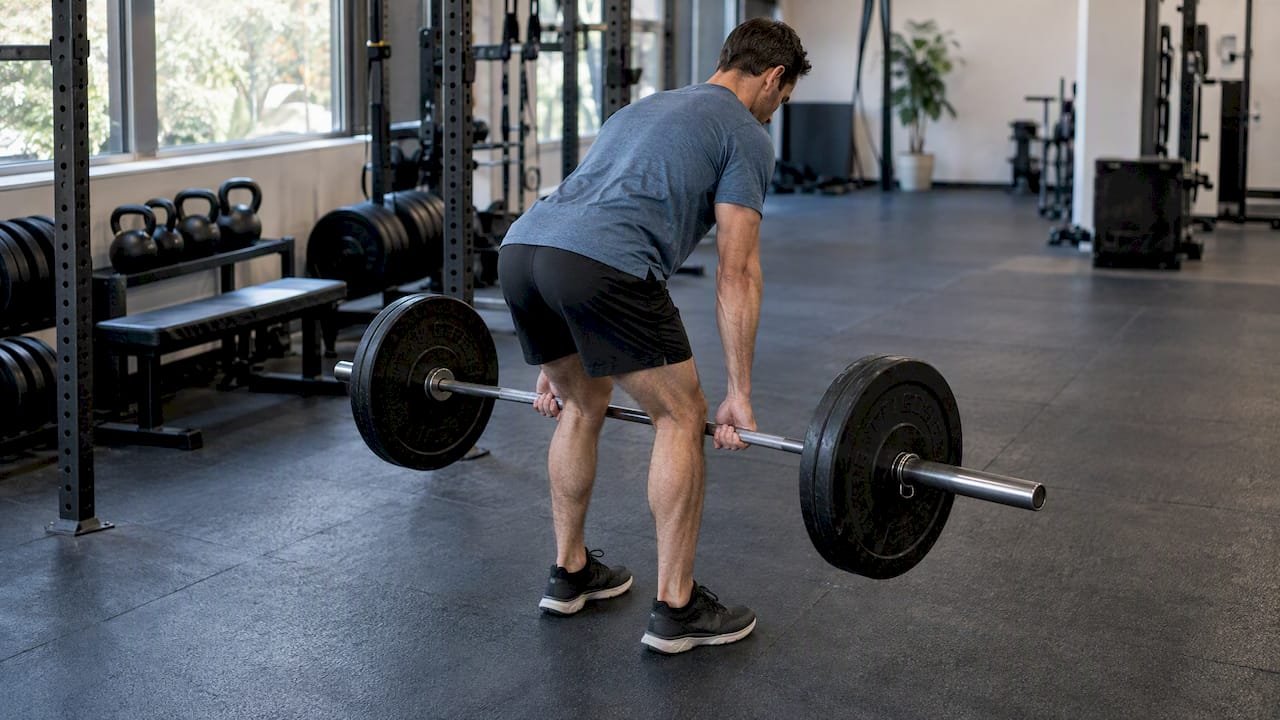
Runners should lift two to three times a week, build the sessions around a few compound and single-leg movements, and keep heavy work away from their hardest runs. That is the short answer. The rest of this guide covers why it works, which exercises earn a place, how to fit them into a real week, and where the evidence is weaker than the headlines suggest.
TL;DR
- Aim for two or three short strength sessions a week. Consistency beats complexity, and a plan you keep doing beats a perfect one you drop.
- Build around squats, hinges (deadlift patterns), rows, single-leg work and calf strength. Add jumps if you have a base.
- Heavy lifting and plyometrics can improve running economy and time-trial performance, with little effect on VO2 max.
- Do not stack heavy lifting on your speed day or long run. If you must double up, keep it light and activating.
- Strength work will not make you injury-proof. Train your own weak links instead of copying a generic routine.
Table of Contents
- What lifting does for your running
- What strength training will not do
- How often, and how hard
- The exercises worth your time
- Fitting it around your running week
- Busy week, short on time
- Our perspective: individualized beats generic
- Recovery is part of the program
- Work with us in Gaithersburg
- Common mistakes runners make in the weight room
- FAQ
- Sources
What lifting does for your running
Most runners lift to avoid injury. The stronger case is performance. A meta-analysis of strength training methods in middle- and long-distance runners found that high-load training (80% of one-rep max or more) and combined methods, such as heavy lifting plus plyometrics, improved time-trial and time-to-exhaustion performance. The effect on VO2 max was trivial, so the gain comes from somewhere else: your muscles and tendons produce force more efficiently.
That “somewhere else” is running economy, the energy you spend at a given pace. In a meta-analysis of highly trained runners, programs that combined plyometric and resistance exercise, done two to three times a week for 8 to 12 weeks, had a large beneficial effect on economy compared with control groups.
The type of training matters too. Another review of running economy at different speeds points to high-load lifting as especially useful for runners with a high VO2 max and at faster speeds, while plyometrics help economy at slower speeds (12 km/h or below, roughly a 8:03 per mile pace or slower). If most of your miles are easy and conversational, jumps and hops deserve a spot next to the barbell.
What strength training will not do
Let’s be straight about injuries. A 2026 systematic review of recreational runners found the current evidence does not support a significant protective effect of strength training on overall injury rates. That does not mean lifting is pointless. It means “do some squats and you will never get shin splints” is a myth.
The practical takeaway is to be specific. If your left calf always tightens at mile eight, or your hips drop on the long run, build the program around that. A generic routine copied from a video is a starting point, not a diagnosis. If you have pain that lingers, see a physician or physical therapist before loading it.
How often, and how hard
The general-population guidance lines up with the running research. The American College of Sports Medicine’s 2026 position stand recommends training all major muscle groups at least twice a week, and stresses that the biggest step is going from no resistance training to some. It also notes that training to failure and complex periodization were not consistently necessary for healthy adults.
For runners, that translates to:
- Frequency: two sessions a week is the floor. A third short one is useful in the off-season or a base phase.
- Session length: 30 to 45 minutes is plenty. You are not trying to become a bodybuilder.
- Load: heavy enough that the last two reps of a set are slow. The research on high-load work uses 80% of one-rep max or above, but build there over weeks, not in your first session. If you are new to the barbell, start with our beginner’s guide to progressive strength training.
- Reps: 3 to 5 sets of 3 to 6 reps for main lifts once technique is solid. Higher reps (8 to 12) for single-leg and accessory work.
- Progression: add a little weight or a rep when every set feels controlled. That is all progressive overload means.
The exercises worth your time
Experts writing for distance runners favor compound, multi-joint movements like squats, deadlifts and rows over isolation work like biceps curls. They give the most return per minute and also support posture late in a run.
| Movement | What it trains | Why runners need it |
|---|---|---|
| Squat or goblet squat | Quads, glutes, trunk | Force production every stride |
| Romanian deadlift or trap-bar deadlift | Hamstrings, glutes, back | Hip extension, pelvis control |
| Split squat or reverse lunge | Single-leg strength | Running is a series of single-leg landings |
| Single-leg Romanian deadlift | Balance, hamstrings, hips | Stability under load |
| Row | Upper back, lats | Posture and arm drive when tired |
| Calf raise (straight and bent knee) | Calves, Achilles | Absorbs and returns force at push-off |
| Step-up | Glutes, quads | Hill and stair strength |
| Box jump, pogo hop, drop jump | Elastic power | Better economy, especially at easy paces |
| Plank or side plank | Trunk | Keeps the torso steady |
If the barbell lifts are new to you, our plan for learning eight compound lifts first walks through them in order. For a broader view of why movement quality matters, see what functional strength training is.
A note on plyometrics
Jumping adds load to tendons quickly. Start with a few low-amplitude sets (two sets of six pogo hops, say), keep them early in the session when you are fresh, and increase only when the previous week felt easy. Skip them on days when your calves or Achilles are already sore.

Fitting it around your running week
The biggest mistake is stacking everything on the same day. Hospital for Special Surgery guidance advises against doing high-load strength work on the same day as your hardest runs, such as speed sessions or long runs. If you have to combine them, keep the lifting to stabilization and activation, like glute bridges and calf raises, rather than exhausting the muscles you need for the run.
Other coaching guidance does suggest pairing strength with a hard run day so you keep true rest days. Both approaches can work. The common thread is that your easy days stay easy and your hard days are separated from heavy leg lifting by as much as your schedule allows.
A sample week for a recreational half-marathoner
| Day | Run | Strength |
|---|---|---|
| Monday | Easy 30 to 40 minutes | Rest or mobility |
| Tuesday | Intervals or tempo | Light activation only (glute bridges, calf raises) |
| Wednesday | Off or easy | Lift A: squat, row, split squat, calf raise, plank |
| Thursday | Easy | Rest |
| Friday | Easy 30 minutes | Lift B: deadlift pattern, step-up, single-leg RDL, jumps, side plank |
| Saturday | Long run | Nothing |
| Sunday | Rest | Walk, mobility |
This is a template, not a prescription. Move days to match your life, and drop a lift before you drop a rest day.
Taper and race weeks
Keep a little strength work in the final weeks, but cut volume and stop heavy sets well before race day. You want to arrive fresh, not sore from a new exercise.
Busy week, short on time
A 25-minute session still counts. Pick one squat variation, one hinge, one row and one single-leg movement, and do three hard sets of each. Resist the urge to turn it into a fast-paced circuit. For busy runners, “effective” is the goal rather than “efficient,” and a circuit built for sweat is not the same as a session built for strength. Our guides to time-efficient strength training and busy professional workouts show how to get there on two or three short sessions a week.
If you are also trying to balance miles and lifting in the same week, how to combine cardio and strength training covers ordering and spacing in more depth.
Our perspective: individualized beats generic
We coach people in Gaithersburg who run, lift and hold down demanding jobs, and the pattern we see is rarely a lack of effort. It is a lack of a system. Runners tend to treat strength work as an optional extra that gets cut the first time a work trip lands on a Wednesday. Then they wonder why it never sticks.

At humn. we build around four pillars: Resist, Recover, Renew and Rhythm. For a runner, Resist is the lifting described above. Recover is what lets you absorb it. Renew covers the sleep, stress and nutrition that decide whether Thursday’s session helps or just adds fatigue. Rhythm is the habit layer: the same days, the same start time, a plan small enough to survive a bad week.
The ACSM authors make a similar point: individualized programs beat one-size-fits-all prescriptions, and a program that is too demanding to maintain loses its effect. We agree. A marathoner with a desk job and a stiff right hip needs a different plan from a 5K runner coming back from a calf strain, and a coach who watches you move can tell the difference in one session. The most useful thing we do is not pick clever exercises. It is to pick the version you will still be doing in March.
— Josh
Recovery is part of the program
Lifting adds a second source of fatigue on top of your mileage. Sleep, protein and easy movement carry most of the weight, and we cover a simple routine in our 24-hour workout recovery plan and our list of active recovery ideas. Many runners also add compression after runs as part of the routine. If recovery is the missing piece in your week, our piece on why recovery is a fitness pillar explains how we think about it.
Some endurance athletes also look into supplements around training. One retailer publishes a page on cordyceps as a pre-workout for endurance athletes if you want to read about it. Treat it as reading, not advice: check with your physician or a registered dietitian before adding any supplement, especially if you take medication.
Work with us in Gaithersburg
If you would rather have a coach build and adjust this for you, that is what we do. humn. offers small-group personal training, 1-on-1 coaching and on-site recovery (sauna, compression, red light therapy and acupuncture) in a boutique facility. You can see how the pieces fit on our membership page, explore the recovery options, or add 1:1 nutrition coaching if fueling is where your training falls apart. If you are not sure it is worth it, our 90-day test for personal training is a fair way to judge.
Common mistakes runners make in the weight room
- Going too light, forever. Sets of 20 with a tiny dumbbell do little for force production. Build toward loads that feel challenging.
- Chasing soreness. Being unable to walk downstairs on Friday is a cost, not a result, when you have a long run Saturday.
- Skipping single-leg work. Bilateral lifts are good, but you run on one leg at a time.
- Changing everything every week. Keep the same core lifts for 8 to 12 weeks, which is the window the research on running economy used.
- Ignoring upper body and trunk. A strong back and steady torso help you hold form in the last miles.
- Treating it as insurance. The evidence on injury prevention is mixed, so judge your program on how you run and move, not on a guarantee.
FAQ
How many days a week should runners lift?
Two is the minimum that matches both the ACSM guidance and the 2 to 3 sessions used in running-economy studies. Add a third short session only if your running volume and recovery allow it. Start with one if you are brand new and build up.
Should I lift before or after a run?
It depends on the run. After an easy run is usually fine. Avoid heavy lifting before or after speed work or a long run, and keep any same-day work to light activation like glute bridges and calf raises.
Will lifting make me bulky or slow?
The research on trained runners points the other way: heavy and combined strength training improved time-trial performance and running economy, with little change in VO2 max. Significant size gain takes a high-calorie diet and dedicated hypertrophy training, which a runner’s two short sessions do not provide.
Can I do this at home?
Yes, to a point. Split squats, step-ups, single-leg hinges, calf raises and planks need little equipment. To progress to the heavy loads the research used, you will eventually want a barbell or trap bar and a coach to check your form.
Does strength training prevent running injuries?
Not reliably. A 2026 review of recreational runners did not find a significant protective effect on overall injury rates, so use strength work to address your specific weak points. If you have ongoing pain, see a physician or physical therapist.
Sources
- ACSM: updated resistance training guidelines (2026)
- Strength training methods and middle- and long-distance runners’ performance, meta-analysis
- Strength training and running economy in highly trained runners, meta-analysis
- Strength training and running economy at different speeds, meta-analysis
- Strength training and injury prevention in recreational runners, systematic review
- Runner’s World: strength training for distance runners
- Runner’s World: strength workouts for runners
- HSS: strength training for runners
No Comments.