

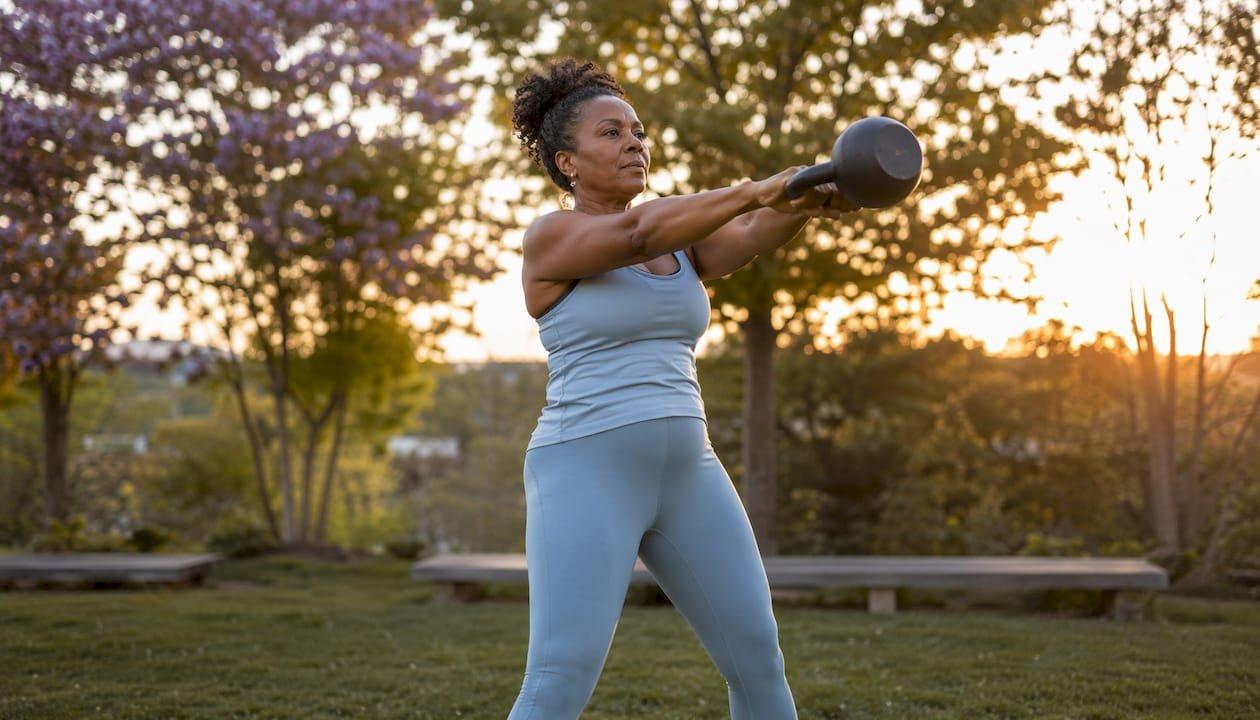
Functional strength training is resistance work built around multi-joint movement patterns — squat, hinge, push, pull, lunge, carry, and rotate — specifically designed to make everyday physical tasks easier, safer, and more sustainable. It trains strength, stability, mobility, and coordination together, not in isolation, so the gains you build in the gym transfer directly to carrying groceries, climbing stairs, getting off the floor, or keeping up with your kids.
Here is what that means in practice:
- What it trains: Multiple muscle groups and joints working together through patterns that mirror real-life demands, rather than targeting a single muscle in a fixed plane.
- Primary benefit: Strength that transfers. According to Cleveland Clinic, functional training is designed to preserve independence as people age by reflecting their actual daily movement demands.
- Who it serves: Adults at any fitness level, from post-rehab patients to recreational athletes. A Medical News Today overview confirms that functional training recruits multiple muscle groups simultaneously to improve real-world performance.
Table of Contents
- How functional training differs from traditional strength training
- The real benefits of functional strength training
- Core movement patterns and the exercises that build them
- How to build a functional strength session
- Equipment you need (and what you can substitute at home)
- Safety, progression, and when to expect results
- Why functional strength training works: the science behind it
- A short action plan you can start this week
- Key Takeaways
- The part most people get wrong about functional training
- Ready to train with a coach who maps this to your actual life?
- Useful sources and further reading
How functional training differs from traditional strength training
The core difference is intent. Traditional strength training, particularly isolation work, targets specific muscles to build size or correct a single weak point. Functional training targets movement patterns to improve how your whole body performs a task. One approach builds a bigger bicep; the other makes you better at lifting a box off the floor without tweaking your back.
| Dimension | Functional approach | Traditional/isolation approach |
|---|---|---|
| Primary goal | Transfer strength to real-life movement | Develop targeted muscle size or strength |
| Movement type | Multi-joint, compound, pattern-based | Single-joint or machine-guided isolation |
| Typical sets × reps | a few sets of low to moderate repetitions for loaded exercises, with higher reps for bodyweight work | 3–5 sets × 6–12 reps |
| Equipment needs | Bodyweight, kettlebells, bands, dumbbells | Barbells, machines, cables |
| Transfer to daily life | High — mirrors real movement demands | Lower — strength stays in the trained plane |
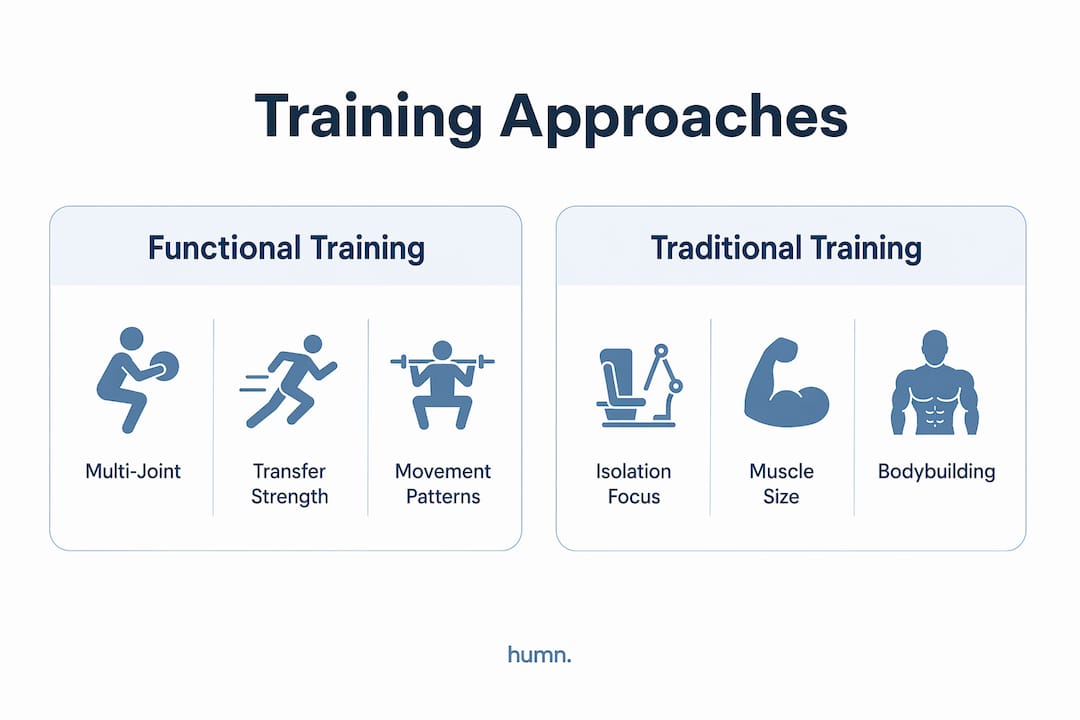
Neither approach is wrong. They serve different goals, and the best programs often blend both.
Practical implications:
- Prioritize functional work if your goal is moving better, reducing injury risk, or maintaining independence as you age.
- Add traditional lifts (like a barbell curl or leg press) when you need to address a specific strength deficit or build muscle mass in a targeted area.
- Combining both is common: functional movements as the session foundation, isolation work as accessory.
Pro Tip: Add one or two functional movements to the end of an existing strength session rather than overhauling your whole program. A farmer’s walk and a single-leg deadlift take eight minutes and immediately start building the carry and hinge patterns most people are missing.
The real benefits of functional strength training
Functional training improves balance, coordination, grip strength, mobility, and the kind of full-body power that shows up in daily life. That is the short version. The longer version is that these gains compound in ways that matter more as you get older.
Think about the physical demands of a normal Tuesday: carrying a bag of groceries up a flight of stairs, picking up something heavy from a low shelf, steadying yourself on an uneven sidewalk. Each of those tasks draws on the same movement patterns functional training develops. Harvard Health notes that adults who perform well on functional fitness tests like grip strength, sit-to-stand, and single-leg stance have a lower risk of falling compared to those who do not.
Key benefits:
- Balance and fall prevention: Improved single-leg stability and proprioception directly reduce fall risk, especially in adults over 50.
- Movement efficiency: Training compound patterns reduces the energy cost of everyday tasks and corrects the muscle imbalances that cause chronic aches.
- Grip and carrying strength: Farmer’s walks and loaded carries build the grip and core control needed to carry anything from a suitcase to a child.
- Joint health and mobility: Multi-joint movements keep joints moving through their full range under load, which maintains cartilage health and reduces stiffness.
- Time-efficient full-body stimulus: Because functional movements recruit multiple muscle groups at once, a 40-minute session can deliver a whole-body training effect that would take twice as long with isolation work.
A 2025 systematic review found that longer functional training interventions produce broad fitness gains across strength, power, and agility in middle-aged and older adults. Shorter-term programs also show measurable improvements in functional movement and balance with regular sessions.
Core movement patterns and the exercises that build them
These seven movement families are the foundation of transferable strength. Master them and you have covered nearly every physical demand daily life throws at you.
Pro Tip: Start at a slower tempo than feels necessary. Neurological adaptation is the primary driver of early improvement — your nervous system needs to learn the pattern before adding load or speed makes any sense. Rushing this phase is the most common beginner mistake.
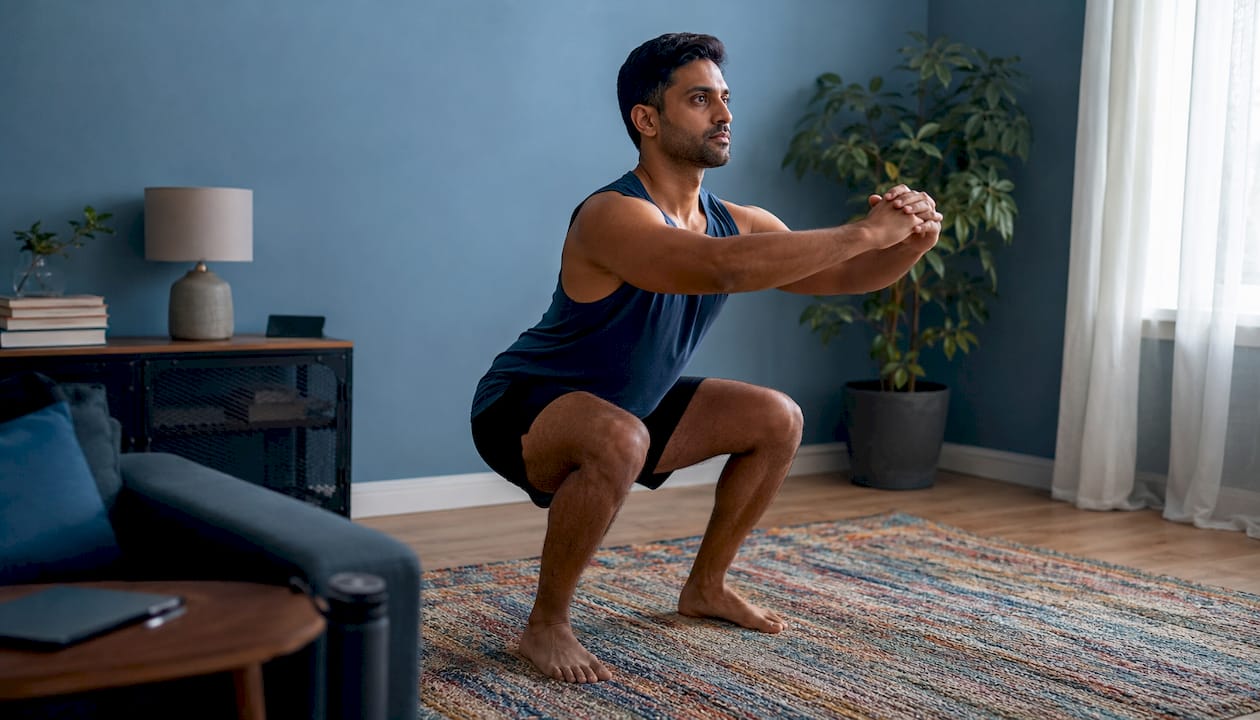
- Squat: Bodyweight squat (regression: box squat); goblet squat with a kettlebell. Cue: chest up, knees track over toes. Everyday transfer: getting in and out of a chair or car.
- Hinge: Romanian deadlift with dumbbells (regression: hip hinge to a wall). Cue: push hips back, maintain a neutral spine. Everyday transfer: picking anything up from the floor.
- Push: Push-up (regression: incline push-up on a counter); dumbbell overhead press. Cue: brace your core, don’t shrug. Everyday transfer: pushing open a heavy door, placing items on a high shelf.
- Pull: Resistance band row (regression: seated band pull); dumbbell single-arm row. Cue: lead with the elbow, not the hand. Everyday transfer: opening doors, pulling a loaded cart.
- Lunge: Reverse lunge (regression: stationary split squat); walking lunge with dumbbells. Cue: front knee stays over the ankle. Everyday transfer: climbing stairs, stepping over obstacles.
- Carry: Suitcase carry with a kettlebell (regression: carry a full water jug in one hand). Cue: stand tall, resist lateral lean. Everyday transfer: carrying groceries, luggage, or a child.
- Rotate: Pallof press with a band; medicine ball wall slam. Cue: rotate from the hips, not the lower back. Everyday transfer: reaching across your body, twisting to look behind you while driving.
Each pattern can be scaled from a rehab drill to a high-load strength movement by adjusting load, range of motion, or tempo. A sit-to-stand, for example, is simultaneously a rehab exercise, a bodyweight squat, and a loaded goblet squat depending on where you are in your training.
How to build a functional strength session
Aim for multiple sessions per week. That frequency, sustained for several weeks, is enough to produce measurable improvements in functional movement and balance, according to the systematic review evidence. Twelve or more weeks produces broader gains across strength, power, and agility. For sustainable fitness schedules, most adults do well starting with two sessions and adding a third once the pattern feels automatic.
| Session | Total time | Core movements | Sets × reps | Equipment |
|---|---|---|---|---|
| Beginner | 35–40 min | Goblet squat, incline push-up, band row, reverse lunge, suitcase carry | 3 × 8–10 | Kettlebell, band |
| Intermediate | 40 min | Romanian deadlift, overhead press, single-arm row, walking lunge, Pallof press | 3–4 × 6–8 | Dumbbells, band |
| Short maintenance | — | Goblet squat, push-up, band row, farmer’s walk | 3 × 6–8 | Kettlebell or dumbbells |
Each session follows the same basic structure: a 5-minute dynamic warm-up (leg swings, hip circles, arm circles), 3–5 main functional movements, one accessory movement, and a 5-minute cool-down with light stretching. Rest 90–120 seconds between sets for loaded compound work.
Progression rules:
- Week 1–2: Focus on form and tempo. Do not add load until the pattern is clean.
- Week 3–4: Increase reps by 1–2 per set when the current range feels controlled.
- Week 5–6: Increase load by the smallest available increment (typically 5 lbs).
- Week 7–8: Add complexity — a single-leg variation, a longer carry distance, or a slower eccentric.
- Every 4–6 weeks: Take a deload week at 50–60% of your usual load to let the nervous system consolidate gains.
Equipment you need (and what you can substitute at home)
Effective functional training needs very little. Bodyweight alone covers most of the seven movement patterns, and a single inexpensive tool opens up the rest.
Scalable equipment options:
- Bodyweight: Covers squats, lunges, push-ups, and rotational work with zero cost. The limiting factor is progressive overload — you will eventually need external load to keep improving.
- Resistance bands: Cheap, portable, and excellent for rows, Pallof presses, and assisted single-leg work. A set of three bands (light, medium, heavy) handles most needs.
- Kettlebell: The single most versatile piece of functional equipment. One kettlebell handles goblet squats, farmer’s walks, Romanian deadlifts, and swings. A 16 kg (35 lb) bell suits most beginners.
- Pair of dumbbells: Adjustable dumbbells give you the most flexibility for pressing, rowing, and loaded lunges without taking up much space.
- Farmer-walk objects: Any heavy, grippable object works — a loaded backpack, two full water jugs, or grocery bags with handles.
For desk workers, posture improvement without a gym is a natural complement to functional training, since the same hip-hinge and carry patterns that build gym strength also counteract the forward-head, rounded-shoulder posture that accumulates from sitting.
Safe loading notes: When using household items, check the grip before you lift. A slippery handle or an awkward shape changes the load path and increases wrist strain. Start lighter than you think you need to.
Safety, progression, and when to expect results
The several-week timeframe is well-supported. Studies show that multiple sessions per week over several weeks improves functional movement and balance in middle-aged adults, and the 2025 systematic review confirms that interventions lasting 12 or more weeks produce broader gains. Individual results vary based on starting fitness, consistency, sleep, and nutrition — but the direction of change is reliable when the programming is sound.
Red flags to watch for:
- Sharp or shooting joint pain during a movement (stop immediately; this is not normal muscle fatigue).
- Persistent imbalance or dizziness that does not resolve after the first two weeks.
- Lower back pain that worsens with hinging movements (usually a form issue — reduce load and slow the tempo before continuing).
- Swelling or instability in a joint after a session.
If any of these appear, stop the movement and consult a physical therapist or physician before continuing. Adaptive fitness programming can help you modify exercises around existing limitations rather than pushing through them.
Micro-progression sequence: Increase reps → increase range of motion → increase load → add instability (single-leg, offset load). Never jump two steps at once.
The early weeks of a functional program often feel deceptively easy. That is the neurological adaptation phase: your nervous system is learning to recruit stabilizer muscles it has been ignoring. Strength gains become more visible after week 4–6, once the motor patterns are grooved and you can safely add load.
Why functional strength training works: the science behind it
The mechanism is specificity. Multi-joint, task-specific training improves the motor patterns and neuromuscular coordination required for those exact tasks. Train a squat pattern under load and your nervous system gets better at coordinating the hip, knee, and ankle joints together — which is exactly what standing up from a chair demands.
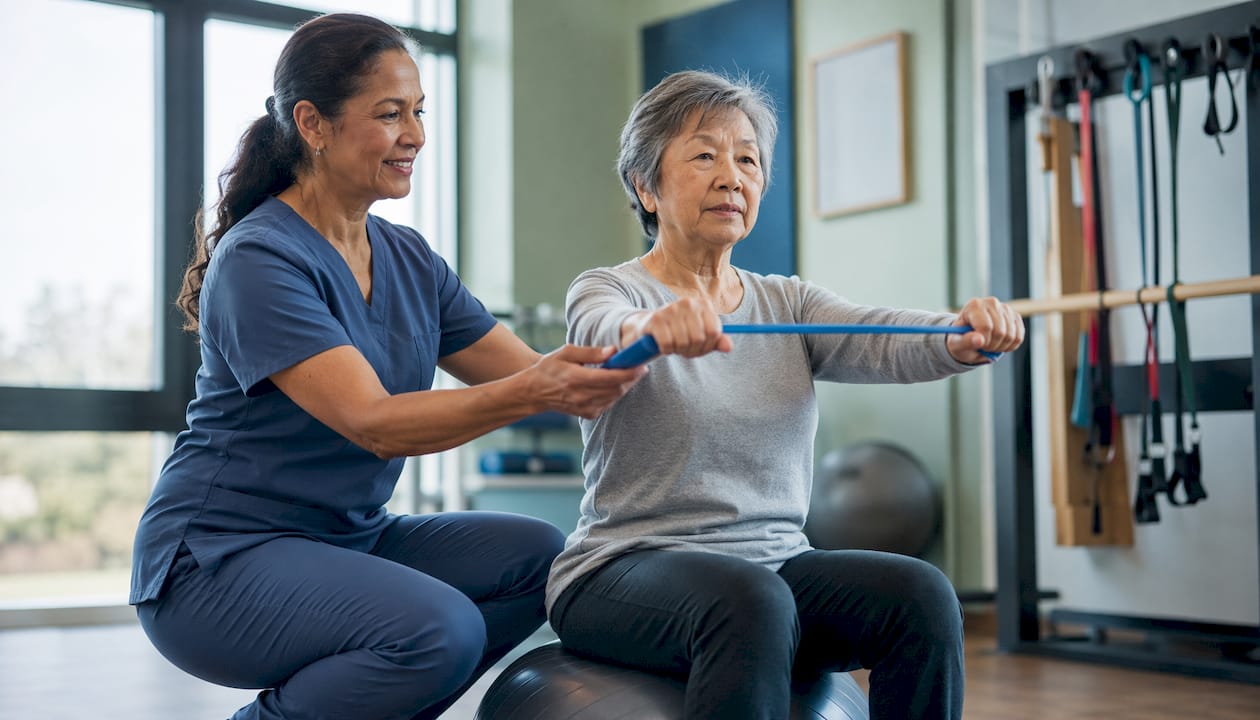
Medical News Today explains that functional training emphasizes integrated movement and stabilizer recruitment. Early adaptation is primarily neurological: beginners improve because their nervous system learns to fire the right muscles in the right sequence, not because muscle fibers have grown yet. Hypertrophic gains follow later, typically after 6–8 weeks of consistent loading.
The kinetic chain concept is central here. Harvard Health notes that coordinated joint sequencing and stabilizer recruitment are what distinguish functional training from machine-based isolation work. A leg press strengthens the quadriceps in a fixed plane; a single-leg Romanian deadlift strengthens the hamstrings, glutes, and spinal erectors while also training the ankle, hip, and core to stabilize under load. The transfer to real life is categorically different.
Cleveland Clinic physical therapists reinforce this with a practical point: what counts as “functional” depends entirely on the individual’s daily demands. A warehouse worker and a desk worker have different functional priorities. Programming should map to the person’s actual life, not a generic template. That personalization principle is what separates evidence-based functional coaching from a list of exercises.
A short action plan you can start this week
- Assess your baseline. Test three simple metrics: how many sit-to-stand reps you can do in 30 seconds, how long you can balance on one leg with eyes open, and how far you can carry a moderately heavy object before your grip fails. These are your starting numbers. A fitness assessment guide can help you structure this properly.
- Pick three movement patterns. Choose one from the lower body (squat or hinge), one from the upper body (push or pull), and one carry or rotation. Three patterns are enough for a complete beginner session.
- Build two weekly sessions. Use the beginner template from the sample workout table above. Keep sessions to 35–40 minutes. Consistency at this stage matters more than intensity.
- Track one simple metric per week. Sit-to-stand reps are the easiest. Write the number down. Progress is motivating when you can see it.
- Reassess at 8 weeks. Retest your three baseline metrics. If sit-to-stand reps, single-leg balance time, and carry distance have all improved, your program is working. If one has stalled, that is the pattern to prioritize in the next cycle.
For readers who want a structured progressive strength training path rather than building their own, a beginner guide can map the load progression week by week.
Key Takeaways
Functional strength training builds transferable strength through multi-joint movement patterns, and several weeks of consistent training with multiple sessions per week produce measurable improvements in balance, mobility, and daily-life performance.
| Point | Details |
|---|---|
| Core definition | Trains multi-joint movement patterns (squat, hinge, push, pull, carry, lunge, rotate) to improve real-life tasks. |
| Top benefits | Reduces fall risk, improves balance and grip strength, corrects muscle imbalances, and builds time-efficient full-body strength. |
| Session frequency | 2–3 sessions per week; 8 weeks shows measurable gains, 12+ weeks produces broader strength and agility improvements. |
| Progression rule | Increase reps first, then range of motion, then load, then complexity — never skip steps. |
| humn coaching | humn’s evidence-based, behavior-first coaching in Gaithersburg, MD maps functional programming to your actual daily demands and tracks measurable outcomes. |
The part most people get wrong about functional training
Most people who start functional training make the same mistake: they treat it like a harder version of their existing workout. They grab a heavier kettlebell, move fast, and wonder why their lower back hurts by week three.
The point of functional training is not to exhaust you. It is to teach your body to move well under load. That requires slowing down in the early weeks, being honest about your baseline, and resisting the urge to progress before the pattern is clean. A goblet squat with 20 lbs done with a perfect hip hinge and braced core does more for your long-term movement quality than a sloppy 50-lb version that reinforces bad habits.
The other thing I see consistently: people skip the carry and rotation patterns entirely because they feel less “impressive” than squats and presses. Those two patterns are where most daily-life strength actually lives. Carrying a heavy bag without leaning, rotating to reach something behind you without straining your lower back — these are the movements that protect you from the injuries that sideline people in their 40s and 50s. Build them early, and they pay dividends for decades.
Ready to train with a coach who maps this to your actual life?
Knowing what functional strength training is and actually building a program that fits your schedule, your body, and your goals are two different things. humn’s 1-on-1 coaching in Gaithersburg, MD starts with a real assessment of your movement baselines, then builds a behavior-first program around the seven patterns that matter most for your daily life.
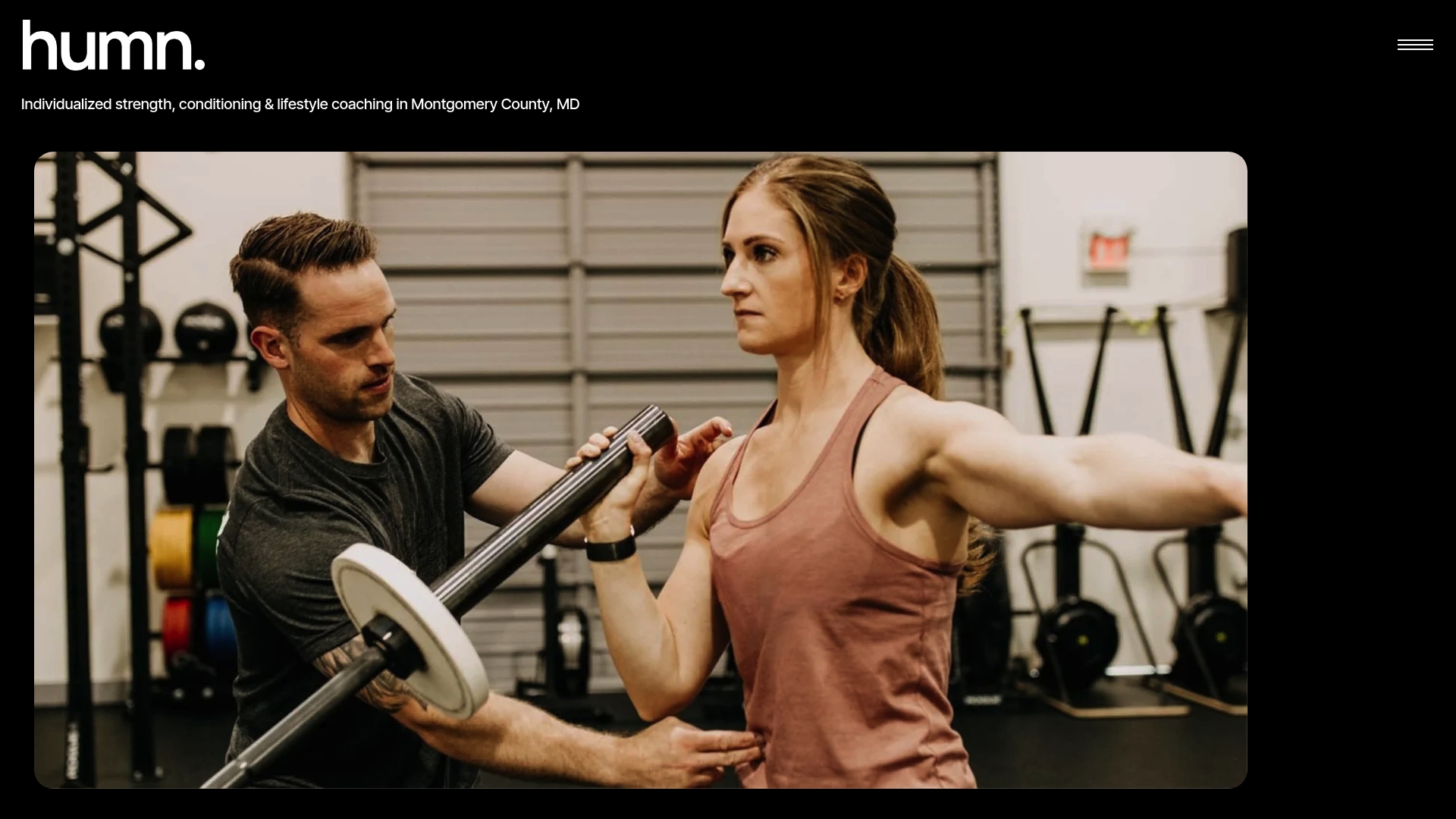
No generic templates. No guessing at load progressions. humn’s four-pillar framework (Resist, Recover, Renew, and Rhythm) means your strength work is supported by recovery and lifestyle coaching, so the results actually stick past the 8-week mark. If you want a clear plan with a coach who tracks your functional wins week by week, start here.
Useful sources and further reading
- Harvard Health: Three moves for functional fitness — Clinical overview of functional fitness for older adults, including fall-risk research and three foundational exercises (split squat, kettlebell high pull, farmer’s walk).
- Cleveland Clinic: What is functional strength training? — Physical therapist perspective on personalization, scalability, and why functional training preserves independence.
- Medical News Today: Functional strength training — benefits and how to do it — Covers core movement patterns, kinetic chain mechanics, and neuromuscular adaptation.
- Springer/BMC Public Health: 2025 systematic review on functional training interventions — Peer-reviewed review finding that interventions of 12 or more weeks produce broad gains in strength, power, and agility in middle-aged and older adults.
- The New York Times: Three functional fitness approaches and programming notes — Practical programming guidance including sets/reps structure, tempo cues, and minimal equipment recommendations.
- humn: What is evidence-based fitness coaching? — Explains the assessment-based, behavior-first methodology behind humn’s functional programming.
No Comments.