


Reverse dieting works best as a transition tool after a long or aggressive cut, not as a metabolism hack. It helps some dieters raise calories without rapid fat regain and reduces the shock of leaving a strict deficit, but the 2025 randomized trial on the method found no statistically significant edge over simply returning to maintenance calories. Treat it as a structured, trackable option for a specific situation, not a required step for everyone finishing a diet.
TL;DR:
- Reverse dieting does not increase metabolic rate beyond natural maintenance levels and mainly helps restore hormone balance and activity levels gradually.
- The 2025 study showed no significant difference in weight regain between reverse dieting and immediate maintenance, especially in small, resistance-trained samples.
- Success depends heavily on consistent food tracking over 6 to 10 weeks, with small weekly calorie increases and careful monitoring of body weight trends.
- It is most appropriate after long, aggressive cuts, and less suitable for shorter or moderate deficits, or individuals unwilling to track food daily.
- Coaching support that considers sleep, stress, and training alongside calorie adjustments can improve adherence and outcomes.
Table of Contents
- What Reverse Dieting Pros and Cons Come Down To
- The Physiology Behind Reverse Dieting, Explained Simply
- Pros: What Reverse Dieting Can Actually Deliver
- Cons: Where Reverse Dieting Falls Short
- How to Run a Conservative Reverse Diet, Step by Step
- What the Research Actually Shows
- Who Should Try It, and Who Should Skip It
- How Coaching Changes the Reverse Dieting Equation
- A Faster Way Off Your Diet, With Fewer Guesses
- Sources
What Reverse Dieting Pros and Cons Come Down To
Reverse dieting is the practice of raising daily calorie intake gradually after a period of restriction, usually by 50 to 100 calories per week, instead of jumping straight back to an estimated maintenance level. The goal is to land at true maintenance calories without the rapid fat regain that often follows a hard diet, while keeping protein high and adding carbohydrates before fat. Most protocols run 4 to 10 weeks, depending on how deep the prior deficit was and how the person responds week to week.
Someone coming off a 20-week cut with a large deficit typically needs the longer end of that range. Someone coming off a short, moderate cut can often shorten it, or skip it altogether and jump straight to maintenance. Duration is a judgment call based on hunger, energy, training performance, and how much weight was lost relative to body size.
A basic reverse diet setup includes:
- Starting calories: exact intake at the end of the cut, not a guess
- Increment size: 50 to 100 kcal added per week, mostly from carbohydrates
- Protein target: held constant, not reduced, throughout the process
- Duration: 4 to 10 weeks, adjusted based on weight trend and hunger signals
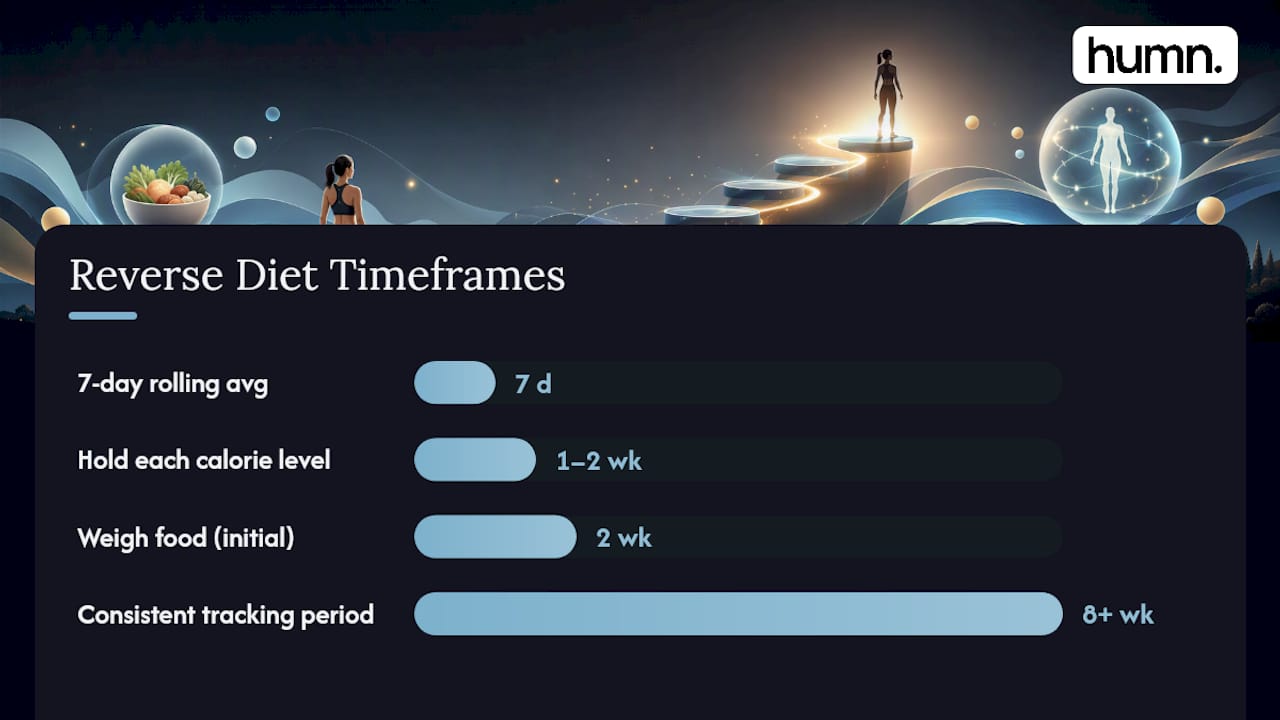
- Tracking method: daily food logging plus a 7-day rolling average of body weight
The macro sequencing matters more than people expect. Precision Nutrition’s protocol recommends adding carbohydrate-focused foods first, things like rice, oats, or fruit, because they’re easy to measure in small increments. Fat gets added more cautiously later, since a tablespoon of oil alone can wipe out an entire week’s planned increase. Protein doesn’t move much at all. It’s the anchor that protects muscle mass while everything else adjusts around it.
None of this requires special foods or supplements. It requires a scale, a food log, and the discipline to move slowly even when the temptation is to add calories faster than planned.
The Physiology Behind Reverse Dieting, Explained Simply
The theory rests on something called adaptive thermogenesis: when you diet for weeks or months, your body responds by slightly lowering resting energy expenditure beyond what you’d predict from weight loss alone. Hunger hormones shift too. Leptin drops, ghrelin rises, and something called NEAT (non-exercise activity thermogenesis, the calories burned through fidgeting, walking, and daily movement that isn’t formal exercise) tends to decline without you noticing. You move less throughout the day. You don’t decide to; your body just quietly dials it back.
Reverse dieting’s core claim is that raising calories slowly, rather than abruptly, gives these systems room to normalize gradually. NEAT can tick back up. Leptin can partially recover. Hunger can settle. In theory, that smoother path reduces the odds of overeating hard and regaining fat quickly.
The honest physiological picture is this: reverse dieting may help these systems recover in a more controlled way, but it doesn’t push your metabolism above where it would naturally land once you’re eating at true maintenance. It’s a management strategy for the transition, not a multiplier on your metabolic rate.
That distinction gets lost in a lot of fitness content. People hear “reverse dieting boosts your metabolism” and picture a permanent increase beyond what their body size and activity level would otherwise support. What’s actually happening, according to Cleveland Clinic’s summary of the evidence, is closer to recovery than enhancement. Your metabolism was suppressed during the deficit. Slowly adding calories lets it climb back toward its natural maintenance point. It doesn’t climb past it.
This matters for expectations. If someone finishes a reverse diet expecting to eat 3,200 calories and stay lean because they “fixed their metabolism,” they’re likely to be disappointed. The realistic outcome is landing at a maintenance number that reflects their actual body size, muscle mass, and activity, recovered from suppression but not inflated beyond it. The mechanistic case for NEAT and leptin rebound is plausible and grounded in real physiology. It’s the leap to “guaranteed metabolic boost” that outpaces what the mechanism supports.
Pros: What Reverse Dieting Can Actually Deliver
The benefits people report aren’t imaginary. They’re just narrower in scope than the marketing around reverse dieting suggests. Here’s what tends to hold up when you separate plausible mechanism from overclaim.
- More training energy. People coming off a long cut often report feeling stronger and less drained in the gym within a couple of weeks of raising calories. Extra carbohydrate around training sessions restores glycogen stores that a deficit tends to deplete, which shows up directly in lifting performance and endurance capacity.
- Lower hunger, better adherence. Adding calories slowly reduces the abrupt hunger spike that hits when someone jumps from a deficit straight to a much higher intake. Gradual increases give appetite regulation time to catch up, which makes the whole process easier to stick to.
- A real maintenance number, not a guess. Instead of estimating maintenance calories with a formula and hoping it’s close, a reverse diet lets someone find their actual maintenance point by testing incrementally and watching the scale respond. That’s more reliable than any calculator.
- A gentler landing after restriction. Coaching guidance frequently frames the real value as behavioral: it prevents the abrupt, unstructured overeating that often follows a strict diet, replacing a stressful free-for-all with a plan that has rules and checkpoints.
Quick fact: the trial behind most current discussion of reverse dieting followed a modest sample of resistance-trained adults for a follow-up period of several weeks, and none of them regained more than their initial 5% weight loss, regardless of which reintroduction method they used. That’s a meaningful data point in reverse dieting’s favor: even without a measurable metabolic edge, structured reintroduction didn’t lead to runaway regain in that group.
The training performance benefit deserves a second look, because it’s one of the more consistent findings across practitioner reports. When someone adds calories while maintaining or increasing training volume, they often see improvements in both strength numbers and physique, not despite the calorie increase but partly because of it. Extra fuel supports the training adaptations that a caloric deficit tends to blunt.

The psychological piece is easy to underrate. Finishing a diet without a plan for what comes next is one of the most common reasons people regain weight fast. A reverse diet gives structure to a period that otherwise feels aimless, and that structure alone changes behavior even before any physiological mechanism kicks in.
Cons: Where Reverse Dieting Falls Short
The gap between reverse dieting’s reputation and its evidence base is the single biggest thing to understand before starting one. Here’s where the approach runs into real limits.
- The best available trial found no significant advantage. The 2025 randomized study compared reverse dieting against an immediate return to maintenance calories and against ad libitum eating. Relative weight regain and weight gain efficiency didn’t differ significantly between groups. Reverse dieting didn’t outperform simpler approaches in that trial.
- The sample was small and specific. Forty-nine resistance-trained adults over a follow-up period of several weeks is a useful preliminary data point, not proof that applies to every dieter, every deficit depth, or every starting body composition.
- Tracking burden is real and often underestimated. A reverse diet only works if someone logs food accurately for the entire duration, frequently 8 weeks or more. Precision drops off fast once motivation fades, and estimating portions instead of measuring them is where most reverses quietly fail.
- Calorie creep undermines the entire premise. Adding 100 calories one week easily turns into 200 the next when hunger is climbing and structure slips, which erases the gradual, controlled aspect that makes the approach different from just eating more.
- It can overweight calories at the expense of everything else. Sleep, stress, and food quality all affect how someone’s body responds to a calorie increase, and a reverse diet that ignores those factors while obsessing over exact kcal numbers misses a large part of the picture.
Pro Tip: If you’ve been dieting hard for months and are considering a reverse, don’t start it the same week you’re also trying to overhaul your sleep schedule or training program. Change one major variable at a time so you can actually tell what’s driving your results.
There’s a medical dimension worth flagging directly. Anyone coming off an extended period of severe caloric restriction, particularly if intake dropped very low or the deficit ran for many months, should treat calorie reintroduction with real caution and loop in a doctor or registered dietitian before increasing intake on their own. Refeeding after prolonged undereating carries physiological risks that a generic online protocol doesn’t account for. This caution applies regardless of whether someone is reversing gradually or jumping to maintenance in one step. The risk comes from the prior restriction, not the reintroduction method.
The evidence gap is the part most content skips. A lot of what’s written about reverse dieting states it with more confidence than the underlying research supports. That doesn’t mean the approach is worthless. It means the case for it rests more on mechanism and coaching experience than on strong trial data, and readers deserve to know that distinction before committing weeks to a strict protocol.
How to Run a Conservative Reverse Diet, Step by Step
Running a reverse diet well is less about the calorie math and more about the discipline to move slowly and track honestly. Here’s a practical sequence.
- Establish your true starting point. Log your actual average intake at the end of your cut for at least 7-day before changing anything. Guessing your starting calories undermines every step after it.
- Set your protein target and hold it. Keep protein at the same level it was during the cut, generally supporting one gram per pound of body weight for most active adults, and don’t let it drop as other calories increase.
- Add 50 to 100 calories per week, mostly from carbohydrates. Small increases from rice, oats, fruit, or potatoes are easy to measure precisely. Save fat increases for later in the process since they add up fast in small volumes.
- Hold each new calorie level for 1 to 2 weeks before adding more. This hold period is what separates a reverse diet from just eating progressively more each week without any feedback loop.
- Track body weight daily and use a 7 day rolling average, not single-day readings, to judge trend. Daily weight swings from water and food volume make single readings unreliable.
- Know what a normal refill looks like versus an overshoot. A jump of 2 to 4 pounds in the first week or two after adding carbohydrates is usually water and glycogen, not fat. A steady upward trend that continues past two weeks at a stable calorie level is the actual signal to slow down.
- Adjust based on the trend, not the day. If the rolling average climbs faster than expected at a given calorie level, hold longer before the next increase rather than cutting calories back immediately.
- Keep training volume consistent or increasing. Reverse dieting works best when the extra fuel is being used, not just stored, so this is not the phase to also cut back on the gym.
Pro Tip: Weigh your food for the first two weeks of any reverse diet, even if you’re experienced at eyeballing portions. Old habits from maintenance eating creep back fast, and small measurement drift compounds over a 6 to 10 week window.
The most common way a reverse diet fails isn’t the math. It’s behavior. People stop weighing food once they feel “recovered,” they eyeball portions that used to be measured, or they skip logging on weekends. Consistent tracking for the full duration, often 8 weeks or longer, is what separates a controlled reverse from an unplanned calorie creep that just looks like a reverse diet in hindsight. Building the habit of consistent tracking matters more here than any specific increment size.
What the Research Actually Shows
The most rigorous evidence available is a single 2025 randomized controlled trial, and it’s worth being precise about what it found and what it didn’t. Researchers put a modest sample of resistance-trained adults through three different reintroduction strategies after a caloric deficit: a structured reverse diet, an immediate return to estimated maintenance calories, and ad libitum eating.
- No significant difference in weight regain. Relative weight regain and weight gain efficiency were statistically similar across all three groups over the 15-week follow-up.
- Nobody exceeded their initial loss. All groups regained some weight, which is expected biologically, but none surpassed their original weight loss during the study window.
- The sample limits how far this generalizes. A cohort of resistance-trained adults following a specific protocol for a follow-up period of several weeks doesn’t necessarily represent how a sedentary adult or someone coming off a much longer, deeper cut would respond.
What this means in practice: the best current trial doesn’t support the claim that reverse dieting outperforms a well-planned direct return to maintenance for preventing regain. That’s a meaningful finding, and it’s one a lot of fitness content glosses over. Beyond this trial, most reverse dieting guidance comes from mechanistic reasoning about adaptive thermogenesis and NEAT, paired with coaching experience across many clients rather than large controlled studies. That’s not nothing. Coaches who’ve guided dozens of people through this transition notice real patterns. But it’s a different tier of evidence than a well-powered RCT, and readers deserve to know which tier they’re standing on before deciding how strictly to follow any given protocol.
Who Should Try It, and Who Should Skip It
Reverse dieting fits some situations far better than others, and matching the tool to the right person matters more than the protocol details.
Good candidates typically include people coming off long or aggressive cuts, lasting several months with a significant deficit, where hunger and fatigue have been building for weeks. Athletes and lifters who need a controlled way to restore performance without derailing physique goals also tend to benefit, as do people who are already comfortable and consistent with food tracking.
Reverse dieting makes less sense for people finishing a short, moderate cut where the deficit wasn’t severe enough to trigger much metabolic suppression in the first place. It’s also a poor fit for anyone unwilling to track food consistently for 6 to 10 weeks, since the entire method depends on accurate data. Anyone with a history of disordered eating patterns around food tracking should approach calorie counting protocols cautiously and ideally with professional guidance.
Alternatives worth considering:
- Immediate return to maintenance, using an estimated number and adjusting based on the weekly weight trend, works well after shorter or milder cuts.
- Dynamic maintenance, letting calories fluctuate naturally within a range rather than tracking every gram, suits people who want less structure long term.
- A planned bulk, moving straight into a deliberate calorie surplus for muscle gain, makes sense for someone who has already recovered energy and hunger levels and is ready to build.
A quick decision checklist: if your cut lasted over 12 weeks, hunger has been intense for weeks, and you’re comfortable logging food, a reverse diet is reasonable. If your cut was short, mild, or you’re not going to track consistently, skip straight to maintenance instead.
How Coaching Changes the Reverse Dieting Equation
At humn, we treat reverse dieting as one tool among several, not a default step everyone needs after a cut. Our habits-first, systems-based approach means we look at sleep, stress, training load, and tracking consistency before deciding whether a structured calorie reintroduction makes sense for a given person, or whether a more dynamic return to maintenance fits their life better.
We tend to recommend a reverse diet for clients coming off longer, deeper cuts who show real signs of fatigue or persistent hunger, and dynamic maintenance for shorter cuts or clients who’d rather not track every gram indefinitely. Either way, coaches handle the tracking oversight and behavior coaching directly, catching calorie creep and adjusting the plan before small drift turns into a stalled result.
A Faster Way Off Your Diet, With Fewer Guesses
Running the math yourself works, but it takes weeks of careful logging and enough experience to tell a normal water fluctuation from an actual overshoot. That’s where most people lose the thread. humn’s personalized nutrition coaching handles that oversight directly: a coach reviews your rolling weight average, adjusts your calorie increments, and catches creep before it turns into unwanted regain.

The bigger advantage is context. A calculator can’t see your sleep, your training load, or your stress levels, but those factors decide whether 75 extra calories a week is the right call or too aggressive. humn’s four-pillar coaching model folds nutrition into the same system as recovery and training, so your reverse diet, or your dynamic maintenance plan, gets adjusted against everything else happening in your life, not just a number on a food log. If you’re finishing a cut and want a coach reviewing your numbers instead of guessing alone, explore lifestyle coaching at humn to see what a guided plan looks like.
Sources
- The effects of reverse dieting on mitigating weight regain after a caloric deficit: a preliminary analysis (PMC)
- Reverse Dieting: Does It Work? (Cleveland Clinic)
- Reverse Dieting: Is It Helpful for Weight Loss? (Healthline)
- The Essential Guide to Reverse Dieting (Precision Nutrition)
This article is general information, not a substitute for advice from a qualified doctor. Consult a qualified healthcare professional about your own circumstances before acting on anything here.
No Comments.