


An umbrella review covering 468 studies and more than 57,500 participants found that only a handful of behavior change techniques consistently increase physical activity: goal setting tied to specific behaviors, social support, clear instruction on how to perform the activity, graded tasks, and self-monitoring. The evidence for these comes from systematic reviews and meta-analyses, not single studies or gym folklore. The rest of this article shows exactly how to build each one into a real fitness plan.
TL;DR:
- Setting specific, measurable behavior goals, like training three times weekly, significantly improves adherence compared to vague objectives.
- Incorporating social support and accountability, such as a training partner or coach check-ins, helps overcome common barriers like motivation dips and scheduling conflicts.
- Scheduling workouts at fixed times, preparing environment cues, and stacking habits increase consistency without relying on willpower or motivation.
- Tracking sessions, performance, and wellbeing weekly or monthly guides adjustments, preventing small obstacles from accumulating into long-term relapse.
- Using evidence-based techniques such as goal setting, instruction, graded tasks, self-monitoring, and action planning creates a sustainable fitness habit system.
Table of Contents
- What Are the Evidence-Backed Behavior Change Techniques for Fitness?
- How to Build a Fitness Program Using These Techniques
- What Motivational Interviewing Tools Actually Work in Fitness Coaching?
- How Do You Build Exercise Habits That Stick Without Relying on Motivation?
- What Should You Track to Know If a Fitness Habit Is Working?
- What Are the Most Common Barriers to Sticking With Exercise?
- Tailoring Behavior Change Techniques by Age, Fitness Level, and Background
- How Apps, Wearables, and Online Communities Support Behavior Change
- How Do You Prevent Relapse and Maintain Fitness Habits Long-Term?
- Why Self-Efficacy and Motivation Type Shape Long-Term Fitness Success
- What Theories Explain Why These Techniques Work?
- How Does humn.'s Coaching Model Apply These Techniques?
- Ready to Put These Techniques Into a Real Coaching Plan?
- Sources
- FAQ
What Are the Evidence-Backed Behavior Change Techniques for Fitness?
Researchers call these tools behavior change techniques, or BCTs, a term borrowed from health psychology that describes the specific, teachable strategies inside any successful intervention. If you have heard “behavior modification” used loosely, BCTs are the precise version of that idea. An umbrella review synthesizing 18 systematic reviews found four techniques showed up again and again as drivers of increased physical activity: goal setting (behavior), social support, instruction on how to perform the behavior, and graded tasks. A separate systematic review and meta-analysis on adults with overweight or obesity flagged goal setting, social incentives, and graded tasks as the most promising levers in digital and in-person interventions alike. The CDC adds self-monitoring to its own list of individual-level strategies worth building into any activity plan.
Here is what each technique actually means, and what it looks like on a real training calendar.
- Goal setting (behavior). This means setting a specific, measurable target for the activity itself, not a vague outcome like “get healthier.” A usable fitness version: “Complete three 30-minute strength sessions per week for the next six weeks.” Vague goals like “exercise more” rarely survive a busy Tuesday.
- Social support. Involving another person, whether a coach, a training partner, or a group, in the process of changing behavior. In practice this ranges from a weekly check-in text with a friend to small-group personal training sessions where a coach notices when you have missed two sessions in a row.
- Instruction on how to perform the behavior. Teaching the actual mechanics, not just assigning the task. A trainer showing correct hip-hinge mechanics before loading a deadlift is textbook instruction; a printed workout sheet with no demonstration usually is not.
- Graded tasks. Breaking a larger goal into smaller, sequential steps that increase in difficulty. A practical example: increase total weekly training sets by roughly 10% every two weeks rather than jumping straight to an ambitious volume that guarantees burnout or injury.
- Self-monitoring. Tracking the behavior itself, whether that is a checkmark on a calendar for “workout completed” or a logged set and rep count. Meta-analytic evidence consistently links tracking with higher exercise frequency compared with no tracking at all.
- Action planning. Deciding in advance the when, where, and how of a behavior. This overlaps heavily with implementation intentions, covered in more detail further down, and it is what turns “I’ll work out this week” into “I train at 6:15 a.m. on Monday, Wednesday, and Friday at the gym two blocks from my office.”
Notice what is missing from this list: willpower, motivation quotes, and 30-day transformation challenges. None of the techniques with the strongest evidence behind them depend on the client feeling inspired on any given morning. They depend on structure. That is good news for anyone who has tried and failed to “just be more disciplined,” because it means the fix is mostly procedural, not personal.
How to Build a Fitness Program Using These Techniques
A fitness plan built on evidence follows a sequence, not a random assortment of tips. Here is the order that turns the techniques above into a program you or a client can actually run.
- Assess first. Before setting any goal, establish a baseline: current activity level, movement competence, injury history, and time availability. A fitness assessment done properly tells you what graded progression should look like instead of guessing.
- Set a behavioral goal, not just an outcome goal. “Lose 15 pounds” is an outcome. “Attend four sessions per week for eight weeks” is a behavior goal, and it is the one that actually predicts whether the outcome happens.
- Write the action plan as an implementation intention. The format is simple: “When [situation], I will [specific behavior].” Example: “When my alarm goes off at 5:45 a.m. on Tuesday, I will put on my running shoes and walk to the gym.” Specificity removes the decision fatigue that kills good intentions.
- Schedule graded tasks on the calendar, not just in a notebook. Block the actual training time in the same calendar as work meetings. Treat the session with equal weight to a client call, because a plan that lives only in your head competes with everything else that day.
- Add a social or accountability layer. This could be a coach who checks in, a training partner, or a small-group class with a fixed roster. Isolation is the single easiest way for a good plan to quietly die.
- Review weekly and adjust. Look at what happened against what was planned, then adjust the next block’s difficulty or schedule instead of scrapping the whole plan.
Pro Tip: Write your implementation intention on a sticky note and put it where the failure usually happens, whether that’s the snooze button, the car dashboard, or the kitchen counter. The cue matters more than the motivation.
Coaches and solo exercisers need different versions of this same blueprint. A solo approach might rely on a habit-tracking app and a shared calendar invite to a workout partner. A coached implementation adds motivational interviewing prompts during check-ins and week-to-week programming adjustments based on how the client actually performed, not how the plan assumed they would perform. A short pre-session checklist for coaches might include: confirm the client’s behavioral goal from last week, ask what got in the way (if anything), review the numbers from self-monitoring, and set one specific action plan for the week ahead. That checklist takes ninety seconds and prevents an entire session from becoming generic small talk. Programs built around this kind of systems-based structure tend to hold up longer than plans assembled from disconnected tips.
What Motivational Interviewing Tools Actually Work in Fitness Coaching?
Motivational interviewing, or MI, is a counseling style built around four processes: engaging the client in conversation, focusing on a specific target behavior, evoking the client’s own reasons for change, and planning the concrete next step. It was developed originally for addiction counseling, but its micro-skills translate cleanly into fitness coaching, where forcing motivation onto a reluctant client almost always backfires.
The core skills fall into four categories: asking open questions instead of yes-or-no ones, reflective listening that mirrors back what a client actually said, affirmations that acknowledge real effort rather than empty praise, and summaries that pull a conversation together before moving to action. A coach who asks “What would make three sessions a week realistic for you?” is doing something fundamentally different from one who says “You need to come three times a week.”
One practical MI tool trainers can use directly is ask-offer-ask, a compact format for correcting a client’s misconception without lecturing them. It works like this:
- Ask what the client already believes or is experiencing (“What’s your take on why the soreness lasted so long?”).
- Offer information gently and without judgment (“One thing that can happen is…”).
- Ask again what the client thinks about that information, inviting them to draw their own conclusion.
Another useful tool is the importance and confidence ruler, where a client rates on a scale of 0 to 10 how important a change feels and how confident they are they can make it happen. A client who scores importance at 8 but confidence at 3 needs a completely different conversation than one who scores both at 6. Confidence gaps usually call for smaller graded tasks; importance gaps call for evoking the client’s own reasons, not the coach’s.
A controlled study of 18 adults found that adding 20-minute, biweekly motivational interviewing sessions to a supervised fitness program significantly improved perceived competence compared with supervised training alone.
That is a small trial, but it points at something coaches see constantly in practice: the exercise prescription is rarely the limiting factor. The conversation around it often is. Community-based programs that train fitness staff to deliver MI-informed coaching with fidelity report stronger completion rates than programs that hand clients a plan and walk away. 1-on-1 coaching structures naturally create the room for this kind of conversation that group-only formats often skip.
How Do You Build Exercise Habits That Stick Without Relying on Motivation?
The behavioral research behind implementation intentions is blunt on this point: specificity beats enthusiasm. Studies on scheduling exact workout times, treating them as fixed appointments rather than flexible intentions, show that removing the daily decision of “when will I fit this in” increases follow-through compared with a vague plan to “exercise sometime this week.” The mechanism is simple. A vague plan requires a decision every single day, and decisions are exactly what run out by 4 p.m. on a hard workday.
Environmental cueing and habit stacking make the appointment easier to keep. These are small changes to your surroundings that reduce the number of choices standing between you and the workout.
- Pack your gym bag the night before and place it by the door you leave through.
- Lay out workout clothes next to your bed so getting dressed for exercise takes no more thought than getting dressed for work.
- Plan your route to include the gym on the way somewhere you are already going, so the workout is not an extra trip.
- Pair a new habit with an existing one, such as always training right after dropping off kids at school.
A workable microcycle for turning intention into automatic habit runs about four to eight weeks. Weeks one and two focus purely on consistency: same days, same times, minimal variation, even if the sessions themselves are undemanding. Weeks three and four introduce graded increases in volume or intensity now that the schedule itself is no longer a struggle. By weeks five through eight, the workout slot has usually become a fixed part of the week’s rhythm, and that is the point to start varying the training itself, since doing the identical session for months invites both plateau and boredom. This is exactly where scheduling around a demanding calendar becomes less about finding extra time and more about protecting a fixed slot.
Pro Tip: If a workout keeps getting bumped by “something came up,” the fix usually is not more discipline. It is usually a bad time slot. Move the appointment to a time nothing else claims, even if that means before the workday starts.
What Should You Track to Know If a Fitness Habit Is Working?
Three categories of data matter, and none of them require a lab. Behavioral metrics come first: sessions completed per week against sessions planned. Performance markers come second: load lifted, reps completed, pace, or time under tension. Wellbeing indicators come third and are often ignored despite being early warning signs: sleep quality, energy levels, and mood on training days versus rest days.
- Log every session, even short ones. A checkbox on a calendar counts. So does a notes’ app entry. The format matters less than the consistency of doing it.
- Review weekly with a five-minute check. Did you hit the planned number of sessions? If not, what specifically got in the way?
- Do a deeper monthly review. Look at trends in performance markers and wellbeing indicators, not just the pass/fail of showing up.
- Translate what you find into an adjustment, not just an observation. If sessions were consistently missed on Thursdays, change the Thursday slot rather than repeating the same failed plan next month. If a graded task felt too easy for three straight weeks, increase it.
- Add objective tracking once the basics are solid. A wearable or app-based heart rate and sleep tracker adds real value once the behavior is stable, but layering data onto an inconsistent habit usually just adds noise.
A paper log works fine for most people. An app adds convenience and occasionally useful trend graphs, but it is not required for the technique to work. What matters is that the tracking happens at all and that it feeds back into a decision the following week.
What Are the Most Common Barriers to Sticking With Exercise?
Most exercise plans do not fail because of a single dramatic setback. They fail from an accumulation of small, predictable obstacles nobody planned for.
- Time pressure. Fix: shrink the session rather than skip it. A 15-minute version of the workout beats zero minutes, and a graded task can flex downward in a pinch.
- Motivation dips. Fix: lean on the accountability layer, not willpower. A quick check-in text to a training partner often does more than another pep talk to yourself.
- Travel. Fix: pre-plan a bodyweight or hotel-gym backup session before the trip starts, not after you arrive and realize there is no equipment.
- Minor injury or soreness. Fix: modify the session rather than canceling it entirely. Training around a tender shoulder with lower-body work keeps the habit alive.
- Social friction, such as a partner or family member who does not support the routine. Fix: involve them directly, even in a small way, or shift the schedule to a time that creates less conflict.
A simple if-then script covers most of these: “If I miss a session, then I will complete a 10-minute version within 24 hours rather than skipping the week entirely.” When a barrier repeats for more than two or three weeks, or involves genuine pain rather than soreness, that is the point to bring in coached support or a health professional rather than troubleshooting alone.
Tailoring Behavior Change Techniques by Age, Fitness Level, and Background
The techniques stay the same across populations; the application shifts. Older adults generally respond well to graded tasks paired with clear instruction, since the risk of injury from poor technique is higher and confidence often needs rebuilding after years of inactivity. Younger adults and beginners tend to benefit most from strong social support structures, because peer accountability often outperforms solo willpower at a stage when the habit has no history to lean on.
Fitness level changes the starting point for goal setting. A sedentary adult’s first behavioral goal might be “walk 15 minutes three times a week,” while an intermediate lifter’s goal setting looks more like structured progressive overload targets. Applying an advanced athlete’s graded-task pace to a true beginner is one of the more common ways well-meaning programs backfire.
Cultural background shapes how social support should be structured. Some clients respond best to family-inclusive activity planning, while others prefer coach-led, individualized accountability with less group visibility. Language and health literacy also affect how instruction should be delivered, since a technique explained through demonstration and repetition often lands better across language barriers than one explained through a written handout alone. None of the core BCTs change. Who delivers them, how, and at what pace does.
How Apps, Wearables, and Online Communities Support Behavior Change
Technology’s real value in fitness behavior change is not motivation. It is friction reduction and data. A habit-tracking app turns self-monitoring into a two-second action instead of a chore, which matters because the technique only works if people actually do it consistently.
Wearables extend this by capturing data passively, such as step counts, heart rate, and sleep duration, without requiring the person to remember to log anything. That passive layer is particularly useful for the wellbeing indicators that tend to get skipped in manual tracking.
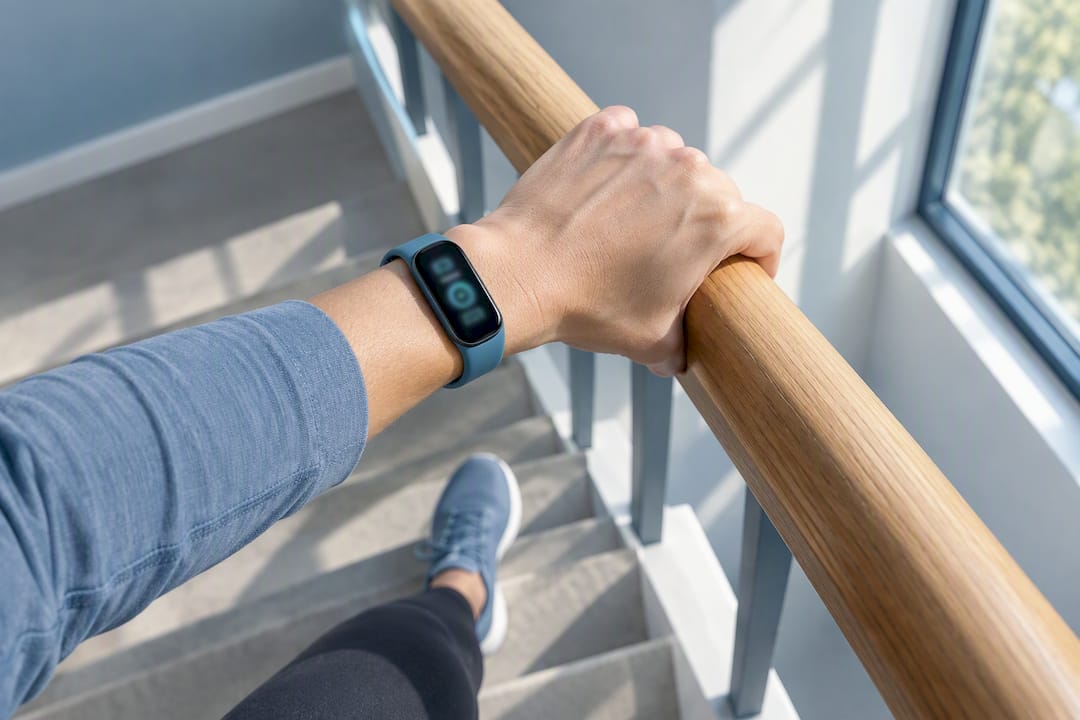
Online communities add a scalable version of social support. A shared leaderboard, a group challenge thread, or a coach-moderated app group can replicate some of the accountability of in-person training for people who cannot access it regularly. The caveat: digital community support tends to work best as a supplement to a real coaching relationship, not a replacement for one, particularly for clients who need instruction on movement technique that a screen cannot fully deliver. Apps and wearables are tools for reinforcing the techniques already covered here, not new techniques in themselves.
How Do You Prevent Relapse and Maintain Fitness Habits Long-Term?
Relapse in exercise adherence rarely looks like a dramatic decision to quit. It looks like one missed week that turns into three, because nobody planned for the missed week to happen. The fix is building a recovery plan into the program from the start, not waiting until motivation collapses to improvise one.
A practical relapse-prevention step is defining, in advance, what counts as a lapse versus a full stop. Missing two sessions in a row is a lapse; treating that lapse as proof the whole plan failed is what turns it into a full stop. Graded tasks help here directly: dropping back to an easier version of the habit for a week is far more sustainable than trying to jump back in at full intensity after time off.
Long-term maintenance tends to depend on shifting the reason for training over time. Early adherence often runs on external structure, scheduling, accountability, tracking, while lasting habits tend to shift toward intrinsic reasons: enjoying the training itself, valuing the identity of being someone who trains, or noticing the mood and energy benefits. Programs that only ever emphasize external outcomes like weight loss numbers tend to see motivation fade once the number plateaus, which is one reason coaching that also builds a genuine shift in mindset tends to outlast programs chasing a single metric.
Why Self-Efficacy and Motivation Type Shape Long-Term Fitness Success
Self-efficacy, meaning a person’s belief that they are capable of performing a specific behavior, predicts adherence more reliably than raw enthusiasm does. Graded tasks build self-efficacy directly: each small, achievable step proves competence and makes the next step feel possible. That is the psychological reason graded tasks show up in nearly every systematic review of effective techniques. Confidence is built through evidence, not encouragement.
Motivation type matters just as much. Intrinsic motivation, training because the activity itself feels satisfying or aligns with a personal value, predicts sustained behavior better than extrinsic motivation driven purely by external rewards like appearance goals or a upcoming event. That does not mean extrinsic goals are useless. A wedding date or a health scare can be exactly what gets someone into a gym for the first time. The practical implication is to let extrinsic goals handle the initial push while friction-reduction and accountability structures carry short-term adherence, and to deliberately build in the conditions, competence, choice, and connection, that let intrinsic motivation take over as the habit matures.
Mindset shifts often happen quietly during this process. A client who starts a program to “fix” their body composition frequently ends up staying for how training makes them feel day to day. Coaches who notice and name that shift out loud tend to reinforce it faster than clients would on their own.
What Theories Explain Why These Techniques Work?
Three frameworks underpin most of the evidence discussed above, and understanding them helps explain why the techniques work rather than just that they do.
The COM-B model holds that behavior happens at the intersection of Capability, Opportunity, and Motivation. A person needs the physical or psychological capability to exercise, the opportunity created by environment and time, and the motivation to act. Most failed fitness plans target motivation alone while ignoring that the person may lack opportunity, such as an unrealistic schedule, or capability, such as movement competence that instruction on how to perform the behavior directly addresses.
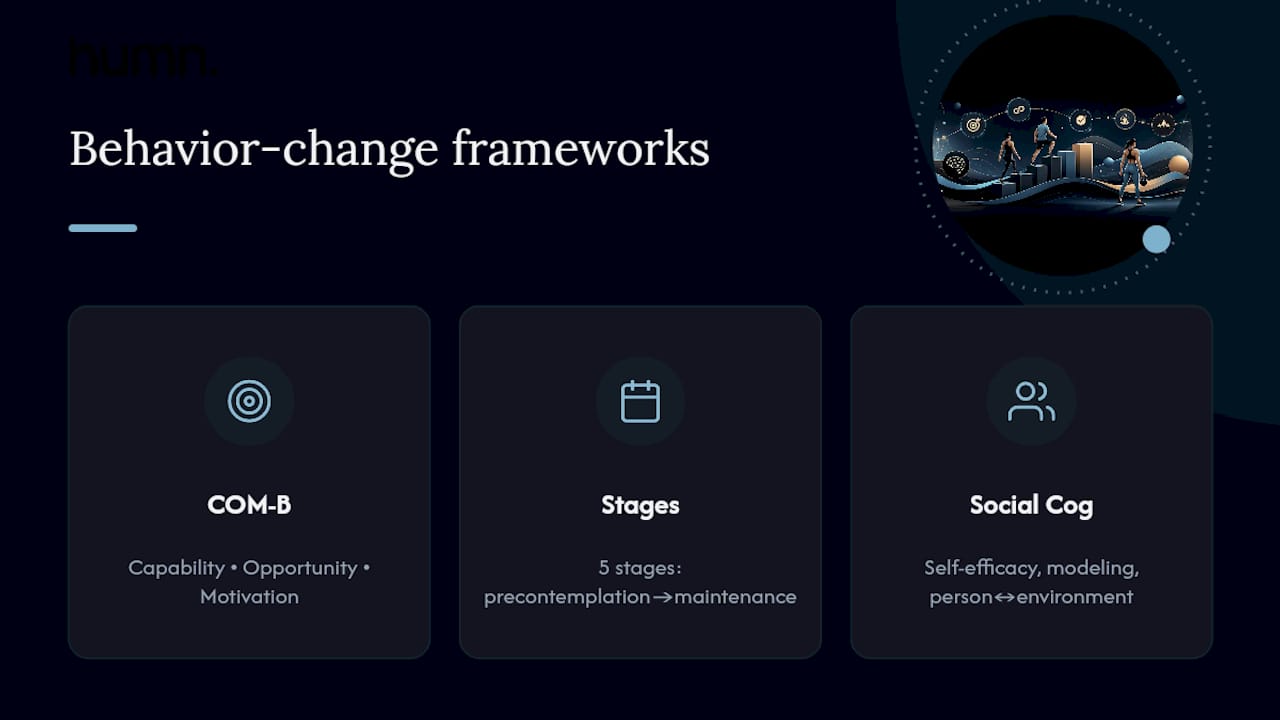
The Transtheoretical Model, sometimes called the stages of change model, describes behavior change as moving through stages: precontemplation, contemplation, preparation, action, and maintenance, with relapse treated as a normal part of the cycle rather than a failure. A client in contemplation needs a different conversation, closer to motivational interviewing’s evoking process, than a client already in the action stage who mainly needs graded tasks and scheduling support.
Social Cognitive Theory centers on the idea that self-efficacy, observational learning, and reciprocal interaction between person, behavior, and environment drive whether a new behavior sticks. It is the theoretical backbone behind why social support and modeling, watching a coach demonstrate a movement or seeing peers succeed, move the needle so consistently in the research.
How Does humn.'s Coaching Model Apply These Techniques?
Most of what the research recommends requires a structure most people cannot build alone indefinitely, which is exactly why coaching models exist. The four-pillar framework, including pillars named Resist, Recover, Renew, and Rhythm, maps onto the techniques covered here almost directly. One pillar, focused on strength and conditioning, is built around graded tasks and behavioral goal setting: specific session targets that increase in a planned, measured way rather than random intensity spikes. Another pillar focuses on scheduling and consistency, functioning as implementation intentions in practice, with fixed session times treated as appointments rather than flexible hopes. Another pillar addresses reducing the physical friction, soreness, fatigue, and poor sleep that quietly kills adherence even when the schedule itself is solid. Another pillar addresses the nutrition and lifestyle layer that determines whether the other pillars are sustainable past a few weeks.
A typical client progression might start with an assessment and a modest behavioral goal in week one, move to graded increases in training volume by week four, and by week eight rely on an established Rhythm slot that no longer requires daily decision-making. Recovery access supports that progression by keeping the physical cost of consistency manageable rather than accumulating into burnout.
— Josh
Ready to Put These Techniques Into a Real Coaching Plan?
Reading about goal setting and graded tasks is one thing. Having a coach build them into your actual week, on your actual calendar, is another. humn. runs on exactly the habits-first model this article describes: small group personal training and 1:1 coaching built around behavioral goal setting, graded progressions, and real accountability rather than a workout sheet and a hope.

New clients typically start with an assessment, a specific behavioral goal for the first block, and a coach who checks in on adherence, not just performance numbers. Recovery access, including sauna and compression, supports the physical side of staying consistent once the schedule is in place. Nutrition habits get their own dedicated support through 1:1 nutrition coaching, since food behavior change follows the same principles as exercise behavior change. If you are in Gaithersburg and want a coach applying these exact techniques to your week rather than a generic program, visit the membership page to see what a first session looks like.
Sources
- Umbrella review: behavior change techniques associated with increased physical activity (2025)
- Effective behavior change techniques to promote physical activity in adults with overweight or obesity: A systematic review and meta-analysis (2021)
- Motivational Interviewing Used in Addition to an Individualized, Supervised Fitness Program Enhances Perceived Competence (2008)
- Strategies for Individual Supports | Physical Activity (CDC)
FAQ
What Are Some Examples of Behavior Change Techniques?
Common examples include goal setting tied to a specific behavior, self-monitoring through logs or apps, social support from a coach or training partner, graded tasks that increase difficulty gradually, and action planning through implementation intentions. An umbrella review of over 57,500 participants found these techniques most consistently linked to increased physical activity.
What Are the Five A’s of Behavior Change?
The Five A’s, Ask, Advise, Assess, Assist, and Arrange, come from clinical counseling models used in areas like smoking cessation and weight management to structure a brief behavior change conversation. In fitness coaching, the same structure appears informally: a coach asks about current behavior, advises on options, assesses readiness and barriers, assists with a concrete plan, and arranges follow-up support.
What Are the Five Stages of Behavioral Change?
The Transtheoretical Model describes five stages: precontemplation, contemplation, preparation, action, and maintenance, with relapse treated as a normal part of the process rather than a failure. Knowing which stage a client is in changes which technique helps most, since someone in contemplation needs different support than someone already in the action stage.
What Are BCTs in Personal Training?
BCTs, or behavior change techniques, are the specific strategies a trainer uses to help a client actually change behavior, not just complete a workout. In personal training, the most evidence-backed ones are goal setting, instruction on technique, graded progression, self-monitoring, and social support, all of which coaches at facilities like humn. build directly into session structure.
How Much Does Coached, Behavior-Change-Focused Fitness Cost?
Pricing for humn.'s membership, small group training, and 1:1 coaching is available directly on the membership page rather than published as a flat rate, since programs are structured around individual goals and coaching cadence.
No Comments.