


A fitness habit loop is defined as the neurological cue-routine-reward cycle your brain uses to automate exercise behavior, making consistent training possible without relying on motivation alone. Popularized by journalist Charles Duhigg and supported by research from organizations like NASM, this three-part framework explains why some people exercise without thinking about it while others struggle every single day. Understanding how the loop works gives you specific levers to pull when your routine breaks down. Motivation fades. A well-built habit loop does not.
What is a fitness habit loop and how does it work?
A fitness habit loop is the cue-routine-reward cycle your brain uses to encode exercise as automatic behavior. Each time the loop runs, the brain’s basal ganglia strengthens the association between the trigger and the action. Over enough repetitions, the behavior requires almost no conscious effort to start.
The brain treats this process as efficiency. When a reliable cue appears, the basal ganglia fires the stored routine without waiting for a deliberate decision. That is why a seasoned runner laces up before they have even thought about whether they feel like running. The decision has already been made at the neurological level.
This is the core reason habit loops matter more than motivation for long-term fitness. Motivation fluctuates with sleep quality, stress, and mood. A habit loop operates independently of all three. Once the loop is stable, the cue does the motivating for you.
What are the components of a fitness habit loop?
Every habit loop contains three parts: a cue, a routine, and a reward. Each component plays a specific role, and removing or weakening any one of them slows or breaks the entire cycle.
The cue
The cue is a consistent trigger that signals your brain it is time to exercise. Effective cues are anchored in context, meaning a specific time, place, or preceding action. Laying your workout clothes on the floor the night before is a physical cue. An alarm set for 6:00 AM every weekday is a time-based cue. Walking past your gym bag on the way to the kitchen is an environmental cue. The more stable and specific the cue, the faster the brain encodes the loop.
Stable, context-specific cues speed up automation because they reduce ambiguity. When the cue shifts, the brain has to re-evaluate whether to act, which reintroduces conscious effort and willpower.
The routine
The routine is the exercise behavior itself. This is the part most people focus on, but it is actually the easiest component to adjust once the cue and reward are solid. The routine can be a 30-minute strength session, a 20-minute walk, or five minutes of mobility work. What matters at the start is that the routine is doable enough that the cue reliably triggers it.
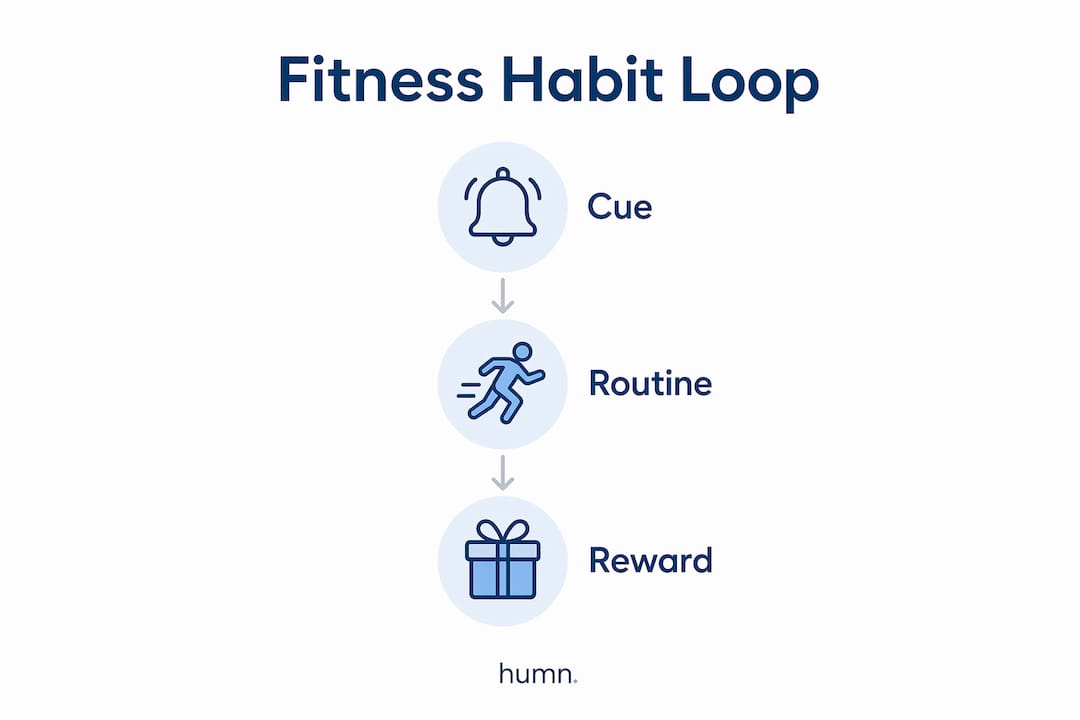
The reward
The reward is the immediate payoff that closes the loop and tells the brain the behavior was worth repeating. Immediate rewards like the mood lift after exercise, a post-workout smoothie, or the satisfaction of marking a habit tracker are far more effective than delayed outcomes like weight loss or improved endurance. The brain stores habits better when the payoff arrives right after the routine ends.
Common examples of each component:
- Cue: Alarm at 6:30 AM, workout clothes already set out, coffee brewing before a morning walk
- Routine: 25-minute strength circuit, 15-minute run, 10-minute yoga flow
- Reward: Post-workout playlist, a favorite breakfast, logging a completed session in a habit app
Pro Tip: Design your reward before you design your routine. Knowing exactly what you get after the workout makes it far easier to start.
How long does it take to build a fitness habit loop?
The popular claim that habits form in 21 days is a myth. Research by Phillippa Lally and colleagues found that new behaviors reach automaticity in an average of 66 days, with a range of 18 to 254 days depending on the complexity of the behavior. That range matters. It means some people build a walking habit in three weeks while others need eight months to automate a structured gym routine.
Exercise habits sit at the complex end of that spectrum. They require physical effort, scheduling, and often travel to a location. Simpler habits, like drinking a glass of water after waking up, automate much faster because they demand less from the body and the calendar. Planning for an 8–12 week window of consistent repetition is realistic for most fitness routines.
Three factors determine where you land in that 18–254 day range.
Cue stability is the biggest driver. A cue that fires at the same time and place every day builds the loop faster than one that shifts around. Reward timing is the second factor. Rewards that arrive within minutes of finishing the routine reinforce the loop more powerfully than rewards that come hours or days later. Frequency is the third. Doing the routine five days a week builds the loop faster than doing it twice a week, even if the twice-a-week sessions are longer and harder. Consistency beats intensity every time when habit formation is the goal.
Pro Tip: Track loop execution, not motivation. Ask yourself: “Did the cue fire and did I do the routine?” That question tells you more about habit progress than how you felt going in.
How can you design your fitness habit loop for lasting success?
Building an effective loop requires deliberate choices at each of the three components. The design process is not complicated, but it does require specificity.
-
Choose a stable, reliable cue. Pick a cue anchored to something that already happens every day. Waking up, finishing lunch, or arriving home from work are strong anchors. Vague cues like “when I feel like it” or “sometime in the afternoon” are not cues at all.
-
Start with a smaller routine than you think you need. The goal in the first four weeks is to run the loop, not to maximize the workout. A 10-minute session that happens every day builds the habit faster than a 60-minute session that happens twice a week.
-
Use implementation intentions. An if-then plan like “If it is 7:00 AM on a weekday, then I will put on my shoes and go to the gym” removes the decision from the moment. Research confirms that specifying when and where you will exercise significantly improves follow-through.
-
Engineer an immediate reward. Choose something you genuinely enjoy and reserve it exclusively for after your workout. A specific podcast, a favorite coffee, or a five-minute sit in silence can all work. The reward must feel worth it in the moment, not just in theory.
-
Use habit stacking. Attach your new fitness routine to an existing habit. “After I pour my morning coffee, I do 10 minutes of movement” uses the existing coffee habit as the cue. This is one of the fastest ways to create a stable trigger without building a new cue from scratch.
-
Modify the environment. Put your gym bag by the door. Keep resistance bands visible in the living room. Remove friction from the routine and add friction to competing behaviors. Your environment shapes your defaults more than your intentions do.
Pro Tip: Run the loop for at least 30 days before judging whether it is working. The cue-to-routine association needs repetition before it feels automatic.
Tracking progress by loop execution rather than by motivation levels also matters here. Measuring whether the loop ran, not how inspired you felt, gives you accurate data on habit formation. Occasional missed days do not reset the process as long as you recommit quickly.
What common challenges disrupt fitness habit loops?
Several predictable obstacles slow or break habit loops before they become automatic. Knowing them in advance makes them easier to manage.
- Weak or shifting cues. A cue that changes location, time, or context forces the brain to re-evaluate the behavior each time. This reintroduces decision fatigue and makes the routine feel like work.
- Delayed rewards. Telling yourself the reward is “getting fit eventually” does not close the loop. The brain needs a payoff within minutes, not months.
- Competing old habits. Existing habits have deeper neural grooves. If your old post-work routine is sitting on the couch, that behavior will dominate until the new loop is strong enough to compete.
- Stress and fatigue. High stress pushes the brain toward familiar, low-effort behaviors. New habits are the first to drop when cognitive resources are depleted.
- Environmental misalignment. If your environment makes the old behavior easy and the new behavior hard, the environment wins almost every time.
“Breaking old habits works best when you keep the same cue and reward but change the routine. The cue-reward pairing drives the brain’s expectation, so swapping only the routine uses that expectation in your favor rather than fighting it.”
The most practical fix for most of these challenges is environmental redesign. Make the cue impossible to miss, make the routine easy to start, and make the reward immediate and specific. When a loop breaks, diagnose which component failed rather than blaming motivation.
Key Takeaways
A fitness habit loop automates exercise behavior through a cue-routine-reward cycle, making consistency possible without depending on motivation or willpower.
| Point | Details |
|---|---|
| Core structure | Every fitness habit loop runs on three components: cue, routine, and reward. |
| Formation timeline | Automaticity takes an average of 66 days, ranging from 18 to 254 days for complex behaviors like exercise. |
| Cue stability matters most | A consistent, context-specific cue is the single biggest driver of how fast a habit loop forms. |
| Reward must be immediate | Post-routine rewards that arrive within minutes reinforce the loop far better than delayed outcomes. |
| Track execution, not motivation | Measuring whether the loop ran, not how motivated you felt, gives accurate data on habit progress. |
What I have learned from building fitness habits that actually stick
The most common mistake I see is treating motivation as the foundation of a fitness routine. People wait to feel ready, inspired, or energized before they act. That approach works for a week or two, then collapses the moment life gets difficult.
What actually works is boring by comparison. Pick a cue so specific it almost feels rigid. Set the same alarm, put your shoes in the same spot, follow the same sequence every time. The rigidity is the point. The brain needs repetition in a stable context to encode the behavior as automatic. Variety feels good but slows the process.
The other thing I have learned is that the reward cannot be hypothetical. “I will feel better in three months” is not a reward. It is a projection. The reward has to land right after the routine ends, and it has to feel genuinely satisfying in that moment. When I started treating a specific post-workout ritual as non-negotiable, my consistency improved more than it did from any change to the workout itself.
Slipping a day or two does not erase progress. What matters is how fast you return to the loop. The habit loop framework gives you a clear diagnostic: which component broke down? Fix that one thing and restart. That is a far more useful question than “why don’t I have more discipline?”
— Josh
Building your habit loop with the right support
Designing a fitness habit loop that holds up under real life conditions is easier with a coach who understands behavior change, not just exercise programming.

At humn in Gaithersburg, MD, coaches work with you to identify stable cues that fit your actual schedule, build routines that match your current capacity, and engineer rewards that close the loop effectively. The approach goes beyond workouts to address the behavioral patterns that determine whether a fitness routine lasts six weeks or six years. If you want a structured, personalized approach to building lasting fitness habits, humn’s 1-on-1 coaching program is built exactly for that. You can also explore premium coaching options designed for adults who need a system that works around a demanding life.
FAQ
What is the cue-routine-reward cycle in fitness?
The cue-routine-reward cycle is a three-part neurological loop that automates exercise behavior. A trigger fires the routine, and an immediate reward reinforces the pattern so the brain repeats it.
How long does it take to form a fitness habit?
Research shows the average is about 66 days, with a range of 18 to 254 days depending on the complexity of the behavior and the consistency of the cue.
Why does motivation fail for building fitness habits?
Motivation fluctuates with stress, sleep, and mood. A habit loop operates independently of motivation because the basal ganglia automates the cue-response sequence once the loop is established.
What is the fastest way to build a fitness habit loop?
Choose a stable, context-specific cue, start with a small and repeatable routine, and attach an immediate reward. Running the loop daily for at least 30 days builds the cue-to-routine association faster than longer, less frequent sessions.
Can you break a bad fitness habit using the habit loop?
Yes. The most effective method is to keep the same cue and reward but replace the routine. The brain’s existing cue-reward expectation works in your favor when only the middle component changes.
No Comments.