

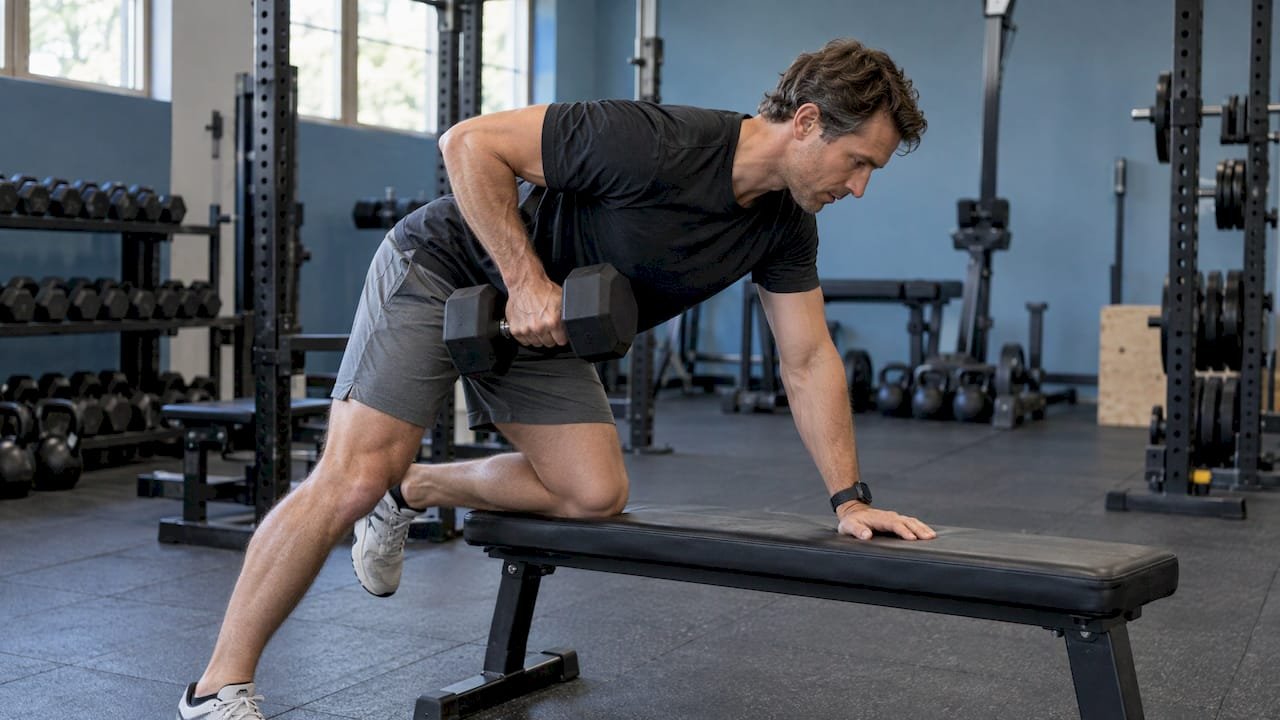
Unilateral training means working one arm or one leg at a time: lunges, single-leg squats, step-ups, one-arm rows. Its main benefits are that it shows you which side is weaker, helps even out strength between sides, demands more balance and core control than two-limbed lifts, and builds strength and power that carry over to running, jumping and everyday movement. For a busy adult who trains two or three times a week, that makes it one of the most efficient upgrades to a routine. The catch is that it only pays off when it is programmed around your weaker side, and that is where good coaching earns its place.
Below, we go through what the evidence supports, where the benefits are strongest, and how to fit single-limb work into a week that already has too much in it.
TL;DR
- Unilateral exercises are single-leg or single-arm movements, such as lunges, single-leg squats and box step-ups.
- They expose and help correct side-to-side gaps. Starting with the weaker limb, or giving it extra volume, appears more effective than non-individualized single-limb work.
- They are most useful for jumping, sprinting and single-leg strength, because training transfers best to the pattern you practice.
- Two to three sessions a week is a sound frequency for most adults, with unilateral work sitting beside your main lifts, not replacing them.
Table of Contents
- What unilateral training is, and how single-leg work fits
- Benefit 1: It shows you, and helps close, strength gaps
- Benefit 2: More balance, stability and core work per rep
- Benefit 3: Strength and power that transfer
- Benefit 4: The cross-education bonus
- What it does not do
- How to add unilateral work to your week
- Where coaching changes the result
- Train with a coach who watches both sides
- FAQ
- Sources
What unilateral training is, and how single-leg work fits
A unilateral exercise is a weight-bearing movement that mainly or completely involves one limb at a time. A bilateral exercise, such as a back squat or deadlift, uses both limbs evenly and at the same time. Single-leg training is simply the lower-body half of the unilateral family: split squats, Bulgarian split squats, single-leg Romanian deadlifts, step-ups. Single-arm work covers one-arm rows, presses and carries.
It is not an exotic idea. The American Council on Exercise points out that gait is naturally unilateral: every step of walking or running shifts your body weight from one leg to the other. Training one side at a time practices the pattern you use all day.

Benefit 1: It shows you, and helps close, strength gaps
Most people have a stronger side. When you only do bilateral lifts, the stronger side can quietly do more of the work. USA Weightlifting notes that when lifters rely only on squats and deadlifts, hips shifting in the squat or knee pain can go unnoticed while the body compensates, which can lead to overuse problems. Adding unilateral work can improve these imbalances.
The best recent evidence is specific about how to do it. A 2026 systematic review of 11 studies and 297 athletes found that reductions in asymmetry between limbs were more consistent in asymmetry-focused and unilateral training groups than in general or bilateral groups. It also found that starting each exercise with the weaker limb, or giving it more volume, appeared more effective than doing the same work on both sides.
Two practical takeaways follow:
- Do the weaker side first, while you are fresh, and match that rep count on the stronger side rather than exceeding it.
- Treat a visible difference between sides as information, not a flaw. A single-leg movement that wobbles on one side tells you where to spend your time.
A caution on expectations: a gap between sides is common and not automatically a problem. If one side hurts, or a difference is large or new, that is a conversation for a physician or physical therapist before you load it.
Benefit 2: More balance, stability and core work per rep
When one leg generates force, other muscles are recruited to stabilize the body. Standing on one foot forces the hip abductors and external rotators to resist movement, and one-arm presses, pulls and carries ask the deep trunk stabilizers to keep you from twisting or leaning. The National Council on Strength & Fitness gives a good example: a forward lunge with a dumbbell held overhead challenges stability at the shoulder, trunk and hip at once.
There is also direct evidence for single-limb stance. In a randomized trial of 31 young adults with chronic ankle instability, a four-week supervised program emphasizing dynamic stabilization in single-limb stance improved self-reported function and both static and dynamic postural control.
It helps to stay precise here. A 2023 meta-analysis of 28 papers found that unilateral training did not produce a statistically significant balance advantage over bilateral training in its pooled data. So the honest framing is that single-limb work trains stability demands directly, because the base of support is smaller, not that it magically outperforms everything else on a balance test. If you want to understand why stability and trunk control matter as we age, this guide to balance and postural control training covers the same demands.
If your ankles or hips limit how well you can balance on one leg, work on them first or alongside. Our ankle mobility drills and hip mobility routine take about a dozen minutes and make single-leg positions much easier to own.
Benefit 3: Strength and power that transfer
The principle of specificity says you get better at what you practice. The 2023 meta-analysis of 28 papers found that unilateral training was more effective than bilateral training for jumping and sprinting, with a jumping effect size of 0.61. Its conclusion: unilateral training has a greater effect on unilateral power patterns, while bilateral training has a greater effect on bilateral ones.
That matters because most of life and sport is single-limb at the moment of force: sprinting, cutting, climbing stairs, stepping off a curb, carrying a bag on one side.
A few more findings worth knowing:
- In a 12-week study of 43 recreationally active women, both groups improved their one-leg 1RM similarly, but the unilateral group gained more single-leg isometric strength, 21.4% versus 10.3%. The authors concluded that unilateral training specifically potentiates single-limb strength gains.
- A 2026 meta-analysis in team-sport athletes found unilateral training enhanced unilateral strength and jumping while producing effects comparable to bilateral training on bilateral strength, agility and sprinting.
- In a smaller 2019 study of 15 moderately trained people, single-leg jump performance improved only after unilateral plyometric training.
The takeaway for a working adult: you do not have to choose. Bilateral lifts build general strength efficiently, and unilateral lifts sharpen the single-limb strength that running, hiking, tennis or chasing kids actually uses. If you run, our weekly strength plan for runners shows where single-leg work fits.
Benefit 4: The cross-education bonus
Here is a lesser-known effect. ACE describes the contralateral strength-training effect, also called cross-education: unilateral training can spill neural drive over to the untrained side, so a right-leg split squat may build some strength in the left leg as well. ACE’s 2026 update adds that the effect is greatest in lower-body muscles and with eccentric, or lengthening, actions.
The practical meaning: when you spend extra sets on a weaker side, some of that work is not wasted on the stronger one. It also gives a coach a sensible way to keep training around a sore or temporarily limited limb, within what a clinician has cleared.
What it does not do
Unilateral work is a tool, not a replacement for your main lifts. In the 2016 study above, neither mode was a decisive factor for muscle size or overall bilateral strength in untrained women. If your goal is a heavier deadlift or squat, you still need to practice those lifts. If you are new to lifting, build the basics first with our habit-first plan for compound lifts, then layer single-limb work on top.
How to add unilateral work to your week
Here is a routine that fits two to three sessions a week. The American College of Sports Medicine’s position stand on resistance training for healthy adults recommends both single- and multiple-joint exercises, 2 to 3 days a week for novice and intermediate lifters, and loads of 8 to 12 repetitions for novices, raising load by small steps when the current load gets easy.
- Warm up for the positions you will use. Single-leg work asks more of your hips, ankles and shoulders. A 12-minute warm-up before lifting covers it. Where it goes wrong: skipping it because the first set “is just bodyweight.”
- Pick one lower-body and one upper-body unilateral move per session. For example, a split squat or step-up, and a one-arm row or half-kneeling press. Keep the rest of the session on your main lifts.
- Start with the weaker side. Do your target reps there, then match them on the stronger side. If you want extra volume, add it on the weaker side only. Where it goes wrong: always starting with the dominant side and unknowingly doing the best sets there.
- Choose a load you can control. Slow the lowering phase and keep your pelvis and ribs steady. If your torso twists or your knee collapses inward, the weight is too heavy for now.
- Progress in small steps. Add a rep or a small amount of load only when the last set was clean on both sides. Note which side finishes first.
- Track it. Write down reps and load for each side. A shrinking gap over several weeks is real progress, and it is easy to miss if you only record one number per exercise.
If you have knee pain, a history of injury or a joint that has been giving you trouble, talk with your physician or physical therapist before adding loaded single-leg work. Our guides to strength training with bad knees and to restarting fitness after an injury explain how to build back gradually, and if you are lifting for the glutes, see how the barbell hip thrust compares with the glute bridge.
A sample week
| Day | Main lift | Unilateral pairing |
|---|---|---|
| Day 1 | Squat or leg press pattern | Split squat, then one-arm row |
| Day 2 | Hinge pattern (deadlift variation) | Single-leg Romanian deadlift, then half-kneeling press |
| Day 3 (optional) | Full-body circuit | Step-ups and suitcase carries |
This is a template, not a prescription. The right split depends on your history, your schedule and which side needs more attention.
Where coaching changes the result
The evidence points to one thing that matters more than the exercise list: individualization. The research favors starting with the weaker limb and giving it more work, which means someone has to notice which side is weaker, by how much, and whether that changes over time. At humn., our small-group personal training and 1-on-1 coaching are built around dedicated coaches and structured progress tracking, so the side-to-side comparison does not depend on your memory of last week’s sets. Our approach is habits-first: the best program is the one you can repeat on a packed calendar, and that includes sleep, stress and nutrition alongside the lifts.
Our view on single-limb training
We like unilateral work because it is honest. A barbell lets a strong side cover for a weak one, and a split squat does not. When a member’s left and right sides look different, we would rather know in week two than in month six.
The way we use it follows our four pillars: Resist, Recover, Renew and Rhythm. Unilateral lifts are part of Resist, but they only work if the rest of the system supports them: recovery that lets you train again, sleep and stress habits that keep you consistent, and a rhythm you can hold through a heavy work month.
Our coaching is individualized and habit-driven, with structured progress tracking and long-term support rather than short-term transformations. For single-limb training that means we watch both sides, adjust the load to the weaker one, and keep the plan simple enough that you will do it.
Josh
Train with a coach who watches both sides
If you are in Gaithersburg and want unilateral work built into a plan that also covers recovery, nutrition and habits, our membership brings small-group personal training and coaching and guidance together in one place. Recovery services, including sauna, compression, red light therapy and acupuncture, are on our recovery page, and you can see how small groups help a routine stick on our small-group training page.
FAQ
Do unilateral exercises fix muscle imbalance?
They can help. Working one side at a time lets you give the weaker side extra attention, and a 2026 review found that starting with the weaker limb or increasing its volume appeared more effective than non-individualized work. Persistent pain or a large difference between sides is worth raising with a physician or physical therapist.
Is single-leg training better than squats?
They do different jobs. Single-leg work shows stronger transfer to jumping, sprinting and one-leg strength, while bilateral lifts remain the efficient way to build overall strength. Most adults do best with both in the same week.
How often should I do unilateral exercises?
Two to three strength sessions a week is a standard frequency for novice and intermediate lifters, and one or two unilateral movements per session is a manageable dose. Add reps or load gradually, and only when both sides move cleanly.
Are unilateral exercises good for balance and the core?
Yes, they place more demand on the hips and trunk stabilizers because you have a smaller base of support. ACE notes that other muscles are recruited to stabilize the body when one leg produces force.
Can training one limb help the other?
Often a little. This is called cross-education, and it is strongest in the lower body. It is a bonus on top of training both sides, not a reason to skip the stronger one.
Sources
- The Benefits of Unilateral Training, ACE expert article
- The Benefits of Unilateral Training, ACE Certified May 2020
- Unilateral Training for Strength, Hypertrophy, and Performance, Personal Trainer Today
- Are Asymmetry-Focused Training Interventions More Effective, PMC
- How Often Should Weightlifters Do Unilateral Work, USA Weightlifting
- Unilateral-Based Training, NCSF
- Balance Training Improves Function and Postural Control, Medicine & Science in Sports & Exercise
- Effect of unilateral training and bilateral training, PMC
- Neuromuscular Adaptations to Unilateral vs. Bilateral Strength Training, JSCR
- Effects of unilateral and bilateral training in team sports athletes, Biology of Sport
- Comparison Between Unilateral and Bilateral Plyometric Training, JSCR
- Progression Models in Resistance Training for Healthy Adults, Medicine & Science in Sports & Exercise
No Comments.