

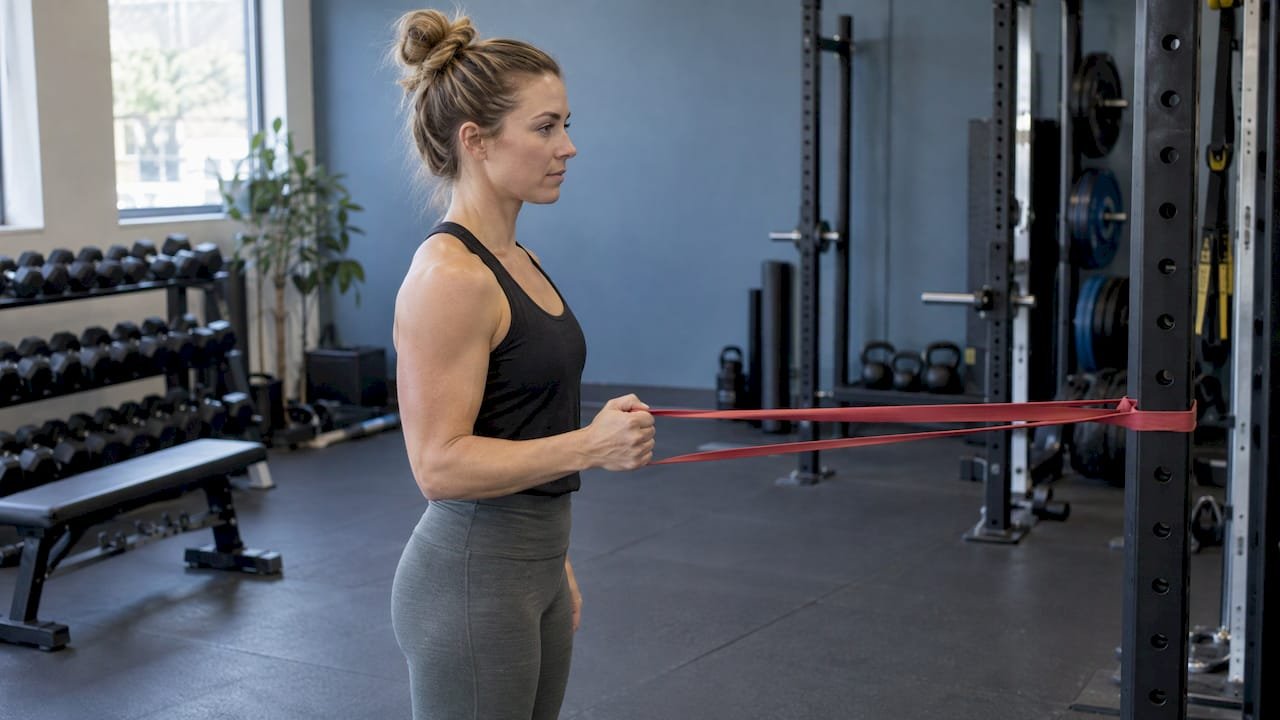
The best shoulder stability exercises train two things together: the rotator cuff, which centers the ball in the socket, and the muscles around the shoulder blade, which give your arm a steady base. Think band external rotations, shoulder blade squeezes, rows, pull-aparts and prone raises. Do them with light load, slow tempo and clean form, a few times a week.
Below you will find what each exercise does, how to perform it, a routine that takes about 10 minutes, and the signs that mean you should stop and get the shoulder looked at.
TL;DR
- Stable shoulders need two things: a strong rotator cuff and a controlled shoulder blade (scapula).
- Use light resistance, higher repetitions and slow movement. Quality beats load.
- A short routine of band rotations, rows, pull-aparts and prone raises covers the essentials in about 10 minutes.
- Most home programs run 3 sets of 10 repetitions, several days a week. Progress by adding repetitions or a little resistance.
- Sharp or worsening pain, weakness, numbness or night pain means stop and see a clinician.
Table of Contents
- What shoulder stability actually means
- Rotator cuff strengthening: the core moves
- Scapular stability exercises: the shoulder blade base
- A 10-minute shoulder stability routine
- How often to train and how to progress
- Pain rules: when to modify, stop or get checked
- Perspective: stability is a habit, not a one-off fix
- Train your shoulders with a coach in Gaithersburg
- FAQ
- Sources
What shoulder stability actually means
The shoulder is the most mobile joint in your body. That freedom comes at a cost: the socket is shallow, so muscles and tendons do much of the work that bone does at the hip. When those muscles are weak or poorly timed, the arm moves less cleanly, and you may feel pinching, aching or a sense that the joint is not quite secure.
Stability exercises are used in physical therapy to strengthen and stabilize the shoulder, manage pain and restore functional use of the arm. They fall into two groups.
Rotator cuff work (glenohumeral stability). Four small muscles and their tendons hold the arm in the shoulder joint and help it move in a coordinated, pain-free way. Research reviews describe the cuff as a substantial dynamic stabilizer that compresses and centers the humeral head in the socket.
Scapular work. The shoulder blade is the base of support for the shoulder joint and every movement of the upper extremity. The same UCSF protocol notes that poor scapular stabilization can contribute to impingement, instability, neck strain and muscle strains. The blade also has to move well: as you raise your arm, it rotates upward roughly 1 degree for every 2 degrees of arm elevation until about 120 degrees, then about 1 for 1, according to a widely cited review.
You do not have to choose between the two. In a randomized trial of people with shoulder pain, adding glenohumeral stabilization exercises to scapular work produced better stability scores and less pain than scapular stabilization alone. A good routine trains both.

Rotator cuff strengthening: the core moves
The guiding rule from MedlinePlus is simple: use smaller weights and higher repetitions. The cuff is a group of small stabilizers, not a set of prime movers, so heavy loading is not the point.
Band external rotation
Anchor a light band at elbow height. Stand sideways to the anchor with the band in the hand farthest from it. Keep your elbow bent to 90 degrees and tucked against your side, with a small towel between elbow and ribs if that helps. Rotate your forearm outward, pause, and return slowly. This is the movement Utah’s orthopedic department describes as rotation against a band with the elbow bent at the side, slowly returning to the start.
Cues: keep the wrist straight, do not let the elbow drift away from your body, and take about three seconds on the way back. The return is where much of the control is built.
Band internal rotation
Turn to face the other way so the band pulls your hand outward, then rotate the forearm across your belly, again with the elbow glued to your side. Same tempo, same light resistance.
Side-lying external rotation
Lie on your side with a light dumbbell, elbow bent and tucked, and lift the forearm toward the ceiling without rolling your torso. Many people find this easier to feel than the band version. A 1 to 3 pound weight is plenty.
What the evidence says about choosing
A 2022 systematic review of rotator cuff tendinopathy found that eccentric, conventional, scapular and cuff strengthening, and both high-load and low-load training all helped with pain and function, with no single exercise proving superior. The practical takeaway: pick movements you can do consistently with good form, and keep doing them.
Scapular stability exercises: the shoulder blade base
The goal here is to give the blade a stable, mobile platform, mostly through the lower trapezius, middle trapezius and serratus anterior. A systematic review looking at muscle activation ratios found that for the lower trapezius, prone flexion, high scapular retraction and prone external rotation at 90 degrees of abduction worked best, while for the serratus anterior, diagonal patterns and scapular protraction did.
Scapular retraction (shoulder blade squeeze)
The UCSF protocol gives clear cues: relax the head and neck, stand tall, squeeze the shoulders back, avoid shrugging and keep the abs tight. Its program is a 10-second hold, 10 repeats, three times a day, intended to build the strength of the scapular stabilizers. That is a rehab-style dose. For general training, one set of 8 to 10 holds of five seconds works as a warm-up.
Banded pull-aparts and rows
Hold a light band at chest height with straight arms and pull it apart until your hands are in line with your shoulders. Keep the band at chest height without shrugging. For rows, keep your shoulders relaxed and away from your ears. If you are new to training with elastic resistance, starting with resistance bands gives you a gentle, adjustable load for upper-back and rear-shoulder work that supports scapular alignment.
Prone Y and T raises
Lie face down on a bench or the floor. Raise your arms in a Y shape with thumbs up, leading with the shoulder blades moving down and back, not with a neck crank. Then repeat out to the side in a T. Use no weight at first. A Denver shoulder surgeon’s scapular protocol lists prone Y’s at 10 to 12 repetitions for 2 sets among its exercises.
Wall slides with a serratus punch
Place your forearms on a wall and slide them up as you reach forward and slightly press the wall away at the top. You should feel the muscles along the side of your ribcage working. The same Denver protocol includes wall slides with a serratus punch at 10 to 15 repetitions for 2 sets.

A 10-minute shoulder stability routine
This is a general fitness sequence, not a rehab prescription. Move slowly, stop each set with two or three clean repetitions left, and keep pain out of it.
| Order | Exercise | Dose | Main cue |
|---|---|---|---|
| 1 | Shoulder blade squeeze | 8 holds of 5 seconds | Back and down, no shrug |
| 2 | Band external rotation | 2 sets of 10 to 12 per side | Elbow stays at your side |
| 3 | Band internal rotation | 2 sets of 10 to 12 per side | Slow return |
| 4 | Band pull-apart | 2 sets of 12 to 15 | Chest height, relaxed neck |
| 5 | Prone Y raise | 2 sets of 10 | Lead with the shoulder blades |
| 6 | Wall slide with serratus punch | 2 sets of 10 | Ribs down, reach long |
The timing is the same idea climbers use: one climbing coach suggests an 8 to 12 minute shoulder routine two to four times per week built from scapular control, cuff strength and dynamic stability. The aim of this kind of prehab is to prime the shoulder girdle, not exhaust it. Do it before lifting as a warm-up, or on its own on days you are not training upper body.
If you spend long days at a desk, pairing it with short posture microbreaks keeps the upper back from stiffening between sessions. Lifters who press or hang from a bar may also want to add mobility work that transfers to the bar.
How often to train and how to progress
For home programs, Connecticut Children’s Sports Medicine recommends 3 sets of 10 repetitions unless you are told otherwise, with shoulder strengthening done 1 to 2 times per day about 5 times per week. That is a rehab-style frequency. If you are training healthy shoulders alongside a lifting program, two to four short sessions a week is a sensible range, in line with the climbing example above.
When an exercise becomes easy, UCSF Sports Medicine suggests increasing repetitions until the muscle fatigues. A practical progression ladder:
- Add repetitions until you reach 15 per set with good form.
- Slow the lowering phase to three or four seconds.
- Move to a slightly stronger band or a 1 pound heavier dumbbell.
- Change the position, for example from standing to a split stance or from the floor to an incline bench.
Change one variable at a time, and keep the stable base steady before you add load or speed.
Pain rules: when to modify, stop or get checked
Mild effort and muscle fatigue are normal. Sharp, pinching or worsening pain is not. NHS Ayrshire and Arran’s patient guidance says pain during exercise should ideally stay below 5 out of 10, and symptoms should settle back to your pre-exercise baseline within 30 minutes. If that is not happening, reduce the range, the load or the number of sets.
Book an evaluation with a physician or physical therapist if you notice any of these, as outlined by orthopedic surgeon Kevin Kruse:
- Pain lasting more than a few days without improvement
- Difficulty with everyday activities
- Weakness or changes in sensation
- Night pain that disrupts sleep
He also advises against pushing through sharp or worsening pain. If your shoulder has actually dislocated or feels like it slips out, get it assessed before starting a program, since the right exercises depend on what happened and your clinician sets the plan. After an acute dislocation has been assessed and reduced, NICE guidance recommends early mobilization as soon as pain allows.
When a shoulder limits what you can do, you can still train the rest of you. NHS Ayrshire and Arran notes that aerobic exercise helps keep joints and tendons healthy and that you can exercise another part of the body when shoulder work is limited. Our own approach to this is covered in training around joint pain.
Perspective: stability is a habit, not a one-off fix
We see the same pattern with shoulders again and again. Someone adds a few rotator cuff drills after a twinge, does them for two weeks, and then drops them as soon as the shoulder feels fine. Six months later, the twinge is back.
At humn., we treat shoulder stability as one part of how a person moves, not a separate project. Our coaching is built on four pillars: Resist, Recover, Renew and Rhythm. Stability work belongs under Resist, but how well you sleep, how much stress you carry and how you recover between sessions decide whether the work sticks.
That is why our programming is habits-first. A coach who knows you can adjust the angle of a row, swap a press for a landmine variation, or slow the tempo when your shoulder is having a bad week, rather than handing you a generic sheet. Progress tracking keeps the small, boring work visible, which is what keeps people doing it.
Recovery matters just as much. Sauna, compression and red light therapy sit alongside training in our facility, and acupuncture is available as an add-on for members who want it. If you are curious how we think about it, our guide on acupuncture for shoulder pain explains the approach.
Josh
Train your shoulders with a coach in Gaithersburg
If you would rather not build and manage a routine alone, humn. in Gaithersburg, MD combines small-group personal training, 1-on-1 coaching and recovery access under one roof. Your coach builds shoulder stability into your strength sessions and adapts it to how you are moving that week.
See how membership works, or explore the recovery options available to members.
FAQ
What is the best exercise for shoulder stability?
No single exercise wins. Research on rotator cuff problems found that several approaches helped and none was clearly superior. A combination of band external rotation for the cuff and a row or pull-apart for the shoulder blade covers the basics.
How long does it take to improve shoulder stability?
It varies with your starting point and any injury, so no honest timeline fits everyone. Consistent sessions several times a week for a few weeks often make the movement feel more controlled. If symptoms are not improving after a few days, have the shoulder evaluated.
Are scapular stability exercises different from rotator cuff exercises?
Yes, they target different muscles. Cuff exercises such as band rotations work the small muscles that center the arm bone in the socket. Scapular exercises such as rows, pull-aparts and prone raises train the muscles that position the shoulder blade. A well-rounded routine uses both.
Can I do shoulder stability exercises every day?
Light, low-load versions can be done often. One home program recommends strengthening one to two times per day about five days a week. If you notice soreness that lingers or pain that climbs, cut back the frequency and ask a clinician to review your technique.
Sources
- 13 Shoulder Stability Exercises, Verywell Health
- Rotator cuff exercises, MedlinePlus
- Current Concepts in the Scientific and Clinical Rationale Behind Exercises for the Glenohumeral and Scapulothoracic Musculature
- UCSF Sports Rehabilitation Scapular Stabilization Protocol
- Effect of glenohumeral stabilization exercises combined with scapular stabilization, PubMed
- Home Exercise Program for Rotator Cuff Strengthening, University of Utah
- Exercise for rotator cuff tendinopathy, PMC
- Systematic review of exercises that produce optimal muscle ratios, PMC
- 7 Scapular Stabilization Exercises, Hinge Health
- Resistance Bands for Osteoporosis: A Safe Way to Start
- Scapular dyskinesia rehabilitation protocol, Denver Shoulder Surgeon
- Shoulder Stability Routine for Climbers, Max Climbing
- Scapular strengthening home exercise program, Connecticut Children’s
- Rotator Cuff Injury protocol, UCSF Sports Medicine
- Shoulder Exercises: Weak and Painful, NHS Ayrshire and Arran
- What Type of Shoulder Pain After a Workout Is Normal, Kevin Kruse MD
- Instability disorders, NICE CKS
No Comments.