

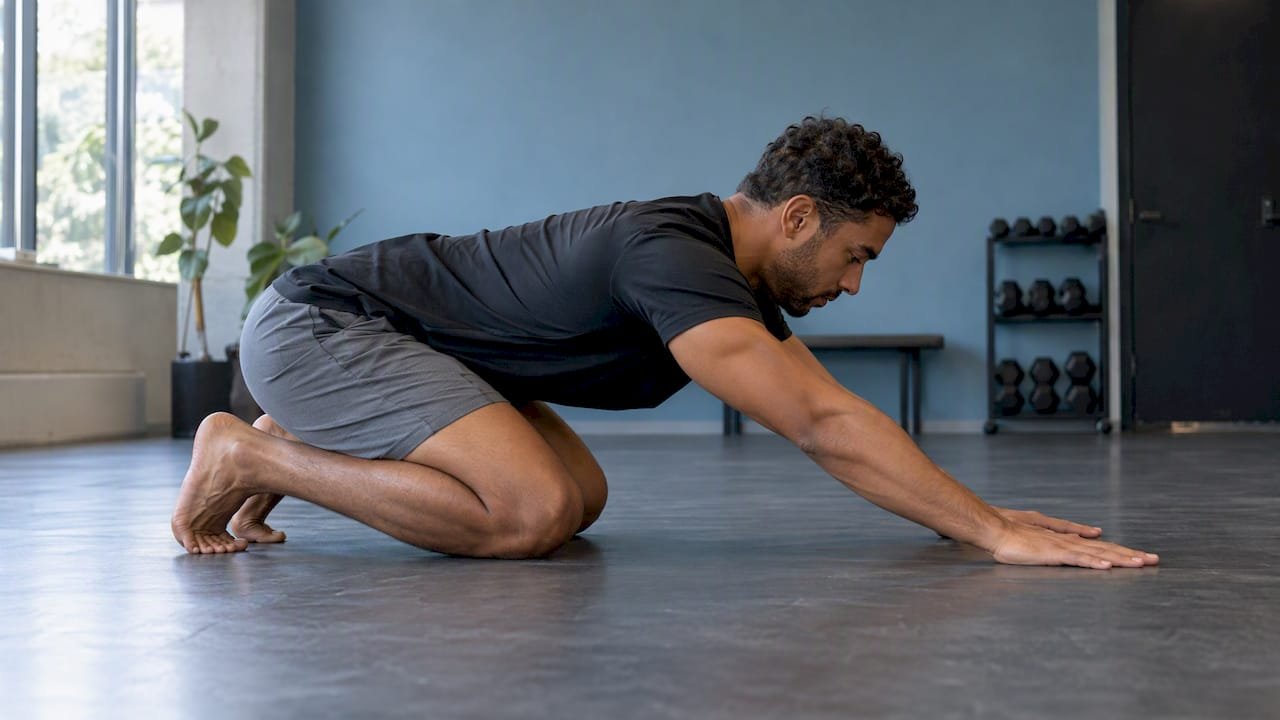
The ankle mobility exercises that help most are the ones that restore dorsiflexion, the ability to drive your knee forward over a flat foot. That means calf stretches with the knee straight and bent, a band-assisted joint mobilization, some soft-tissue work on the calf, and loaded drills like a heel-elevated squat. Do them three to five days a week, warm up first, and stop if anything hurts. Below you will find a quick test to see where you stand, seven drills with sets and holds, how to use them for squats, and the signs that mean you should see a clinician instead of pushing on.
TL;DR
- Test first: the knee-to-wall test shows whether one ankle is stiffer than the other, and gives you something to retest in a few weeks.
- Stretch both ways: work the calf with a straight knee and a bent knee, because the soleus (the deeper calf muscle) matters more when the knee bends, as in a squat.
- Add joint work: a band-assisted mobilization targets the ankle joint itself, not only the muscle.
- Practice often and gently: a 3 to 5 day weekly rhythm is a sensible base, and pain means stop and get it checked.
Table of Contents
- Why ankle mobility matters beyond the ankle
- A two-minute check: the knee-to-wall test
- How to warm up first
- Seven ankle mobility exercises
- Using ankle mobility for better squats
- A sample weekly routine
- How often, and how long until it changes
- When to stop and get your ankle checked
- Our perspective: mobility is a habit, not a hack
- Want a coach to build this into your training?
- Frequently asked questions
- Sources
Why ankle mobility matters beyond the ankle
Dorsiflexion is the motion of the top of your foot moving toward your shin. You use it every time you squat, climb stairs, walk downhill or land from a jump. When the ankle runs out of range, something else above it has to make up the difference, usually the knee, hip or low back.
The American Council on Exercise (ACE) links limited dorsiflexion to increased knee valgus, lower quadriceps activity and higher soleus activity during two-legged squats. The same ACE piece says restricted dorsiflexion during jump landings increases ground reaction forces, reduces knee flexion and raises the risk of ACL injury. That is a lot of consequence for a joint most people never think about.
A related ACE article notes that lifting your heels during a squat is a key sign of limited dorsiflexion, and that leaving it alone puts excess strain on the connective tissue around the ankle. If your heels peel off the floor at the bottom of a squat, this article is for you.
A two-minute check: the knee-to-wall test
Before you pick drills, find out which side is tighter and by how much.
- Take your shoes off and stand facing a wall. Place one foot flat on the floor, with the big toe about a thumb’s width from the wall.
- Keep the heel down and the foot pointing straight ahead. Bend the front knee and try to touch the wall with it.
- If you touch easily, slide the foot back a little and try again. If you can’t touch, move closer.
- Note the distance from toe to wall at your best attempt, then repeat on the other side.
You are looking for two things: whether the heel stayed down, and whether the left and right sides match. A big gap between sides is a useful signal on its own. Write the numbers down and retest after four weeks.
Other signs of a restricted ankle show up in daily movement. The knee caves in when you squat, your heels lift, your feet turn out to find depth, or you feel a pinch at the front of the ankle in a deep bend. If the test or the signs point to a stiff ankle on one side only, especially after an old sprain, take that seriously and read the section on when to get it checked.
How to warm up first
Cold tissue does not like being stretched hard. The American Academy of Orthopaedic Surgeons (AAOS) says to warm up with 5 to 10 minutes of low-impact activity such as walking or cycling before ankle mobility and strengthening exercises. A brisk walk around the block does the job.
If you already have a pre-training routine, the same principle applies there. A good golf warmup routine shows how a few minutes of easy preparation can come before any sport, and the same idea fits before ankle drills.
Seven ankle mobility exercises
A general rule from ACE is that beginners complete 2 to 3 sets of 8 to 12 repetitions for mobility and stability exercises. Use that as your default for the movement-based drills, and use timed holds for the stretches.
1. Ankle range-of-motion and circles
Sit with your leg out in front of you. Point the foot up toward your shin, then down. Then draw slow, large circles with the whole foot, moving from the ankle rather than the toes. A National Health Service hospital leaflet lists pointing the foot up and down, moving the toes apart with heels together, and ankle circles as starting movements, and says they should not cause too much pain.
Do 10 circles each way per foot. This is a warm-up and a way to find stiff spots, not the main event.
2. Straight-knee calf stretch
Stand facing a wall with one leg back, heel down and toes pointing forward. Keep the back knee straight and lean forward until you feel a stretch in the upper calf. The same leaflet describes calf stretches held for up to 30 seconds and repeated 3 times. Do that on each side.
A towel works too: sit with your leg out, loop a towel around the ball of the foot, and gently pull your toes toward you with the knee straight.
3. Bent-knee calf stretch for the soleus
From the same position, bend both knees slightly while keeping the back heel on the floor. The stretch moves lower in the calf, closer to the Achilles tendon.
This version matters for squats. A Strength & Conditioning Journal article reports that the soleus may be a likely cause of myofascial restriction, and that improving its flexibility is likely more valuable when the knee is flexed. The same article notes that during the weight-acceptance phase of a landing, dorsiflexion happens along with knee flexion, which is why soleus flexibility can matter more than gastrocnemius flexibility there.
Hold 30 seconds, 3 rounds per side. In a 4-week intervention in the same article, 2 minutes of plantar-flexor static stretching, 3 times a week significantly increased ankle dorsiflexion range of motion. So if you want a practical target, build up to about 2 minutes of total stretch time per side, three days a week.
4. Band-assisted ankle mobilization
Stretching the calf alone does not always fix the problem. ACE stresses that ankle mobility should not be treated only as a muscle issue, because the joint itself, specifically the talus gliding within the ankle mortise, has to move well too. It says self-mobilization with an elastic band can help improve joint articulation and give the bone room for dorsiflexion by pulling the talus backward.
Here is how to do it:
- Anchor a resistance band to something sturdy at ankle height.
- Step into the loop so it sits across the front of your ankle, just below the shin crease. Step far enough away that the band pulls the ankle backward.
- Use a staggered stance, with the working foot flat in front.
- Drive your knee forward over your toes through a pain-free range, then return.
A Strength & Conditioning Journal article on this kind of self-mobilization suggests 2 to 3 sets of 30 to 60 seconds of oscillations. Keep the heel down and the movement smooth. If you feel a sharp pinch in the front of the ankle, back off the range or reposition the band.
5. Calf soft-tissue work
Rolling the calf with a foam roller or a handheld roller can give you a short-term gain in range before you stretch or squat. A 2017 Strength & Conditioning Journal article cites research where self-massage with a roller massager acutely increased dorsiflexion range of motion, using 3 sets of 30 seconds moving from the knee toward the ankle.

Treat this as a primer, not a cure. Roll, then follow it right away with the drills above so your body can use the extra range.
6. Quadruped sit-back
Start on hands and knees with your toes curled under. Slowly shift your hips back toward your heels, keeping your toes on the floor, and feel the ankles and the front of the shin open up. Go only as far as is comfortable, pause for a second, then return. Do 8 to 12 reps, 2 sets. Because the position is supported by your hands, it is easy to control the depth.
7. Heel-elevated squat and supported deep squat
Once the ankle has a little more room, put it to work. Stand with your heels on small plates or a low wedge, and squat to a depth you can control, holding a doorframe or a light counterweight in front if you need it. Pause at the bottom for a few seconds and breathe.
Then, over several weeks, lower the heel lift. ACE recommends that you master a full-range bodyweight squat before gradually adding resistance, and the same article suggests a squat stretch with the elbows pushing the knees gently outward to build deep squat form and adductor flexibility.
Using ankle mobility for better squats
If squats are your reason for being here, the order matters.
- Before squatting: two rounds of the bent-knee calf stretch and a minute of band mobilization per side.
- During the warm-up sets: bodyweight or goblet squats with a pause at the bottom, watching whether the heels stay planted.
- For working sets: if your heels still lift, use a temporary lift under them or squat in shoes with a raised heel, and keep working on the drills outside the session.
A raised heel does not mean you are cheating. It lowers the dorsiflexion demand so you can train the squat pattern while the ankle catches up. Think of it as scaffolding, then reduce it as your wall-test distance improves.
Also check the cues you give yourself. If your knees collapse inward at the bottom, the ankle may be one cause, but so may hip strength. If your hips feel locked as well, pair this routine with our hip mobility drills. ACE notes that joints alternate between needing stability and mobility, and that immobile hips can make the lumbar spine or the knee compensate. The ankle, hip and upper back work as a chain.
For a compact lifter-focused routine, see our mobility work for lifters, and if you are new to barbell patterns, our plan for learning compound lifts first shows how to introduce them without rushing.
A sample weekly routine
This takes about 10 to 12 minutes and fits before a workout or in the evening.
| Order | Drill | Dose |
|---|---|---|
| 1 | Ankle circles and up-down | 10 each way, each foot |
| 2 | Calf roll | 30 seconds, 3 rounds per side |
| 3 | Straight-knee calf stretch | 30 seconds, 3 rounds per side |
| 4 | Bent-knee calf stretch | 30 seconds, 3 rounds per side |
| 5 | Band-assisted mobilization | 30 to 60 seconds, 2 to 3 sets per side |
| 6 | Quadruped sit-back | 8 to 12 reps, 2 sets |
| 7 | Heel-elevated squat with pause | 2 to 3 sets of 8 reps |
How often, and how long until it changes
The AAOS suggests a general conditioning program be done 3 to 5 days per week to maintain ankle strength and range of motion. That is a good frame: short and frequent beats long and rare. The hospital leaflet mentioned earlier recommends practicing its gentle range-of-motion exercises up to five times a day when they are used for recovery, which gives you a sense of how little each dose needs to be.
On timing, the 4-week stretching study above is the best anchor we have: measurable gains in range came within a month of regular work. Individual results differ with age, injury history and how stiff you started, so retest with the wall test at four weeks rather than guessing.
On easier rest days, gentle movement helps. Some of the active recovery techniques athletes use, such as light walking or easy cycling, pair well with a short mobility session.
Some mild soreness can happen when you start. NHS inform says ankle exercises may slightly increase symptoms at first but should get easier over time, with regular practice improving movement. That is different from sharp or worsening pain, covered next.

When to stop and get your ankle checked
The AAOS is direct: stop the exercises and talk to a doctor or physical therapist if you feel pain during the program. It also says a conditioning program after an injury or surgery should be done under a doctor’s supervision.
In practice, that means:
- Recent sprain, fracture or surgery: ask your surgeon or physical therapist which exercises match your rehab stage before you add anything from this article.
- Sharp pain at the front of the ankle during dorsiflexion: stop the drill and have an orthopedist or physical therapist look at it.
- One ankle much stiffer than the other with no clear reason: a physical therapist can check the joint and the surrounding tissue.
- Swelling, instability or giving way: book an assessment before training on it.
If you are working around a joint that bothers you, our 0 to 3 pain rule explains how to decide whether a movement is acceptable, and our guide to restarting fitness after injury lays out a gradual four-week return. Knees often complain first when ankles are stiff, so strength training with bad knees is a useful companion read.
Our perspective: mobility is a habit, not a hack
Most people who come to us with stiff ankles have tried the stretch they saw online, held it for a week and quit. We don’t blame them. A single drill is easy to forget, and nobody checks whether it worked.
At humn., we think of mobility as one piece of how a person moves, sleeps, recovers and lives. Our four pillars, Resist, Recover, Renew and Rhythm, exist because ankle range rarely improves in isolation. It improves when someone sees how you squat, picks the two drills that matter for you, builds them into the first five minutes of every session, and tracks the change. That is how we coach in a small-group setting, where your coach can see your heels lift and adjust the plan on the spot.
We also believe in recovery as part of the same system. Heat, compression and other recovery tools can make it easier to show up for the next session, and consistency is what moves a wall-test number. Our aim is not a short-term transformation. It is a body that squats, climbs and lands well for years, with a coach alongside you who knows your history.
— Josh
Want a coach to build this into your training?
If you’re in Gaithersburg and want your ankle work built into a plan, we can do that. Our membership combines small-group personal training and one-on-one coaching, and our recovery space offers sauna, compression, red light therapy and acupuncture. Your coach will assess how you squat, choose the drills that fit, and track your progress over time.
If you’d like to see how it works in person, start on the membership page and get in touch with our team.
Frequently asked questions
How long does it take to improve ankle mobility?
Many people notice changes within about four weeks of regular work. In one cited intervention, 2 minutes of calf stretching three times a week raised dorsiflexion range in four weeks. Your timeline depends on your starting point and any past injury, so retest with the wall test.
How do I loosen up stiff ankles?
Start with a short walk, then do ankle circles, calf stretches with the knee straight and bent, and a band-assisted mobilization. Keep all of it pain-free and do it several days a week. If stiffness follows an injury, ask a physical therapist first.
Should I stretch the calf or mobilize the joint?
Both. ACE says ankle mobility is not only a muscle problem, since the talus must also glide properly in the joint. Pair calf stretches, especially the bent-knee version, with a band-assisted mobilization.
Can ankle mobility exercises help my squat?
Yes, they can help you keep your heels down and your chest up. Use them before squatting, and temporarily raise your heels on small plates while your range improves. Lower the lift gradually as your wall-test distance improves.
Sources
- A Systematic Approach to Improving Ankle Mobility, ACE (2015)
- Controlled Articular Rotations, ACE (2024)
- How to Improve Lower-body Mobility and Stability, ACE
- Strength Exercises That Can Change Your Life, ACE
- Foot and Ankle Conditioning Program, AAOS OrthoInfo
- Ankle exercises, University Hospitals Sussex NHS
- Exercises to help with ankle pain, NHS inform
- Restricted Ankle Dorsiflexion: Self-Mobilization, Strength & Conditioning Journal (2012)
- Practical Approach to Problem-Solving Movement Tasks, Strength & Conditioning Journal (2017)
No Comments.