

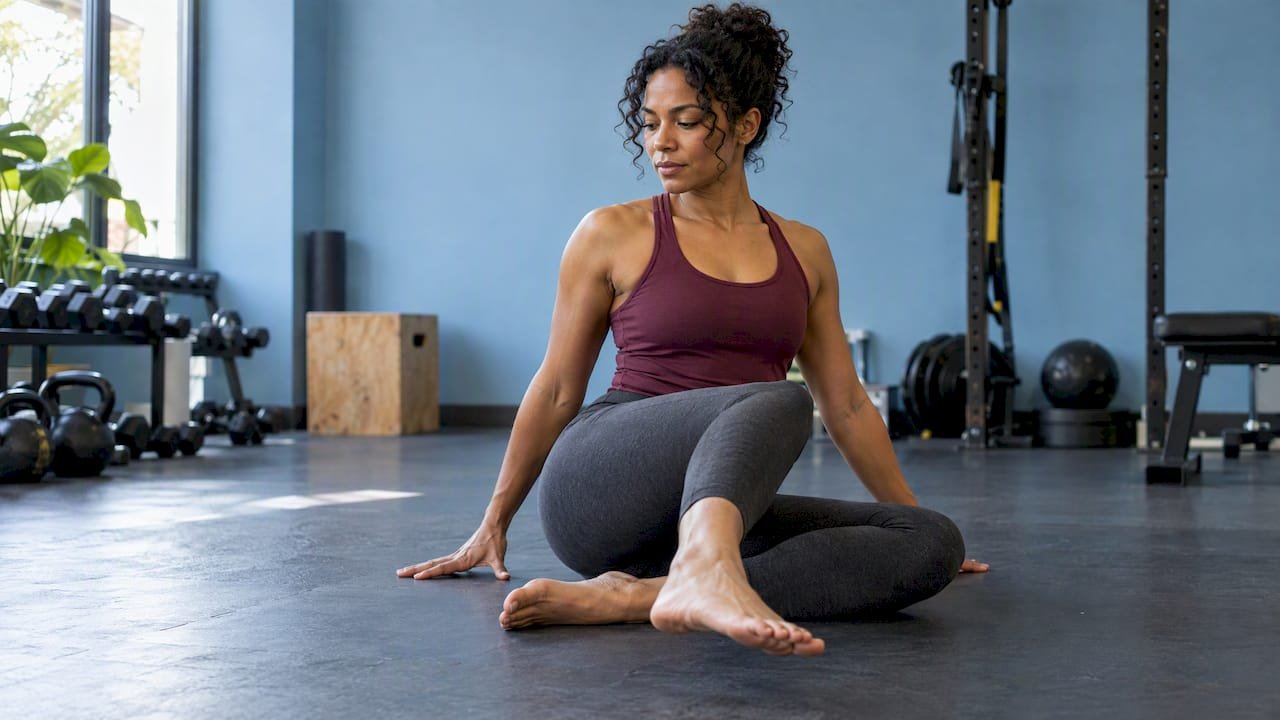
The best hip mobility drills work on the direction your hips are actually stuck in, stay pain-free, and are paired with strength in the new range. Below is a routine of eight drills you can finish in about 12 minutes, plus a quick self-test to find your limiter, a desk version for workdays, and the signs that mean you should see a clinician instead of stretching harder.
TL;DR
- Test internal and external rotation first. Many people stretch what feels good (usually external rotation) and ignore the direction that is really limiting them.
- Keep hip flexor stretches short, roughly 30 to 90 seconds per side, and add a posterior pelvic tilt.
- Finish every session with loaded work through a full range of motion, such as goblet squats, so the new range turns into strength.
- Dull stretch sensation is normal. Sharp, pinching or joint-line pain means stop, and knee pain that will not go away can start in the hip.
- Moving a little every hour at a desk beats one long stretch session on the weekend.
Table of Contents
- Start by finding which direction is stuck
- The 12-minute hip mobility routine
- How often, and how long to hold
- Hip mobility for squats
- Desk version for long workdays
- When to stop and get checked
- Our perspective on hip mobility
- If you want a coach watching your hips
- FAQ
- Sources
Start by finding which direction is stuck
Most lists of hip drills hand you the same five stretches in the same order. That works if your hips are tight in every direction, which is rare. A two-minute test tells you where to spend your time.
The seated rotation check. Sit on a sturdy bench or box with your hips and knees at 90 degrees and your feet off the floor or lightly resting. Keep your trunk tall. Swing one foot inward toward the opposite side (that is external rotation of the hip) and note how far it goes. Then swing it outward, away from your midline (internal rotation). Compare left to right and compare the two directions.
What you are looking for:
- A big difference between sides. The stiffer side gets extra sets.
- Much less internal than external rotation. This is common, and it matters. Physical therapists who coach squatting point out that internal rotation is frequently the real missing link for squat depth, while many people over-emphasize external rotation (think pigeon pose) because it feels productive.
- Pinching at the front of the hip. Do not push into it. That is a reason to get assessed, covered in the section on when to stop.
There is also a research reason to care about range. A systematic review of athletes found strong evidence that total hip rotation (internal plus external, measured at 90 degrees) under 85 degrees is a consistent risk factor for groin pain. You cannot diagnose yourself from a bench test, and the review looked at athletes, but a very small total range is a good reason to prioritize this work and to mention it to a clinician if you also have groin symptoms.
The 12-minute hip mobility routine
Run through these in order. The first few drills target range, the middle ones prepare the hip to control that range, and the last two make it stick.
| # | Drill | Dose | What it targets |
|---|---|---|---|
| 1 | 90/90 rotations | 2 sets of 5 slow reps per side | Internal and external rotation |
| 2 | Half-kneeling hip flexor stretch with pelvic tilt | 2 holds of 45 seconds per side | Front of the hip |
| 3 | Lateral squat shifts (Cossack) | 2 sets of 6 per side | Adductors, hip rotation |
| 4 | Deep squat prying | 2 minutes total | Squat depth, hip flexion |
| 5 | Leg swings, front to back and side to side | 10 per direction | Dynamic range |
| 6 | Glute bridge with a pause | 2 sets of 10, 3-second hold | Hip extension strength |
| 7 | Tempo goblet squat | 2 sets of 6, 3 seconds down | Loaded depth |
| 8 | Controlled hip circles on all fours | 5 per direction per side | Joint control |
1. 90/90 rotations
Sit on the floor with your front shin and back shin each bent to roughly 90 degrees. Sit tall. Lean slightly over the front shin, then lift the front foot’s heel a little off the floor by turning the hip, not by leaning. The idea is active control: you press into the floor, then lift against it, which teaches the hip to own the range rather than just hang in it. If sitting tall is impossible, put a folded towel or a block under your hips.
If your seated test showed weak internal rotation, spend most of your time on the back leg of the 90/90 position, because that leg is the one being rotated inward.
2. Half-kneeling hip flexor stretch with a pelvic tilt
Kneel on a pad with one foot forward. Squeeze the glute of the back leg and tuck your tailbone under, as if you were pulling your belt buckle toward your chin. You should feel the stretch at the front of the back hip, not in your lower back. Then shift forward a very small amount.
Two details come from research. A meta-analysis on hip flexor stretching suggests short holds of about 30 to 90 seconds are effective and safe, while very long totals (270 to 480 seconds) may impair performance. It also notes that techniques using a posterior pelvic tilt are often more effective than a plain hip extension stretch. So no need to hang out in a lunge for five minutes. Hold 45 seconds, breathe, move on.
3. Lateral squat shifts (Cossack)
Stand with your feet wide and toes slightly out. Shift your weight onto one leg and sit back and down into that hip while the other leg straightens with the toes pointing up. Come back to the middle and switch. Hold a doorframe or a light weight in front of you for balance if needed. This opens the inner thigh and teaches the hip to rotate under load.

4. Deep squat prying
Hold a light kettlebell or dumbbell at your chest and sink into the deepest squat you can control. Let your elbows push gently on the inside of your knees. Shift side to side, pause where it feels stiff, and breathe slowly. Stay about two minutes in total, standing up whenever you need a break. If your heels lift, put a thin plate under them for now.
5. Leg swings
Hold a wall and swing one leg forward and back in a relaxed arc, then side to side across your body. Start small and let the range grow with each swing. This is a warm-up for the joint, not a stretch, so keep it fluid and stop before it turns into a kick.
6. Glute bridge with a pause
Lie on your back with knees bent, feet flat. Drive through your heels, lift your hips until your body forms a line from shoulder to knee, and hold for three seconds. The bridge builds the hip extension that your hip flexor stretch just made available. A band around the knees makes the glutes work harder if the basic version feels too easy.
7. Tempo goblet squat
Hold a weight at your chest. Lower for a slow three-second count to your comfortable full depth, pause for a beat, then stand. This is the most important drill in the list. A randomized trial comparing resistance training through a full range of motion with static stretching in healthy, active adults found that loaded work through the full range can improve flexibility about as well as stretching, while building strength at the same time. For a busy person, that is a very efficient trade.
8. Controlled hip circles
On hands and knees, lift one knee slightly and draw the largest slow circle you can without moving your spine. Imagine you are drawing the circle with your knee on a wall behind you. Five in each direction. This finishes the routine by showing you where the hip still catches.
How often, and how long to hold
For most adults, three to five short sessions a week beat one long session. Two things keep the routine productive:
- Short holds. Remember the 30 to 90 second window for the hip flexors. For the other positions, use the slow reps above, not endless static holds.
- Loading. If you only stretch, the range often slips back. That is why drills 6 and 7 are not optional extras.
This also fits with how you already train. US federal guidance recommends adults get at least 150 minutes of moderate aerobic activity a week plus muscle-strengthening work on at least two days. Your strength days are the best place to slot the routine in, either as a warm-up or as a finisher. If you are short on time overall, our piece on time-efficient strength training for busy adults shows how two or three sessions can carry the load, and our five mobility drills for lifters is a shorter option for the days you only have ten minutes.
Hip mobility for squats
If squat depth is your reason for being here, three adjustments help more than extra stretching:
- Check rotation first. If internal rotation is the limiter, 90/90 work on the back leg and tempo squats will help more than pigeon pose.
- Change your stance. A slightly wider stance with toes turned out 15 to 30 degrees suits many people’s hip sockets better. Test a few positions and pick the one where you can sit deepest without pinching.
- Use the depth you own. Squat to the deepest point you control, with a pause at the bottom. Over a few weeks, that point tends to move.
If you also deal with sore knees under the bar, our guide to strength training with bad knees walks through practical adjustments.
Desk version for long workdays
Hours in a chair keep the hips in a bent position, which is why the front of the hip often feels tight after a day of meetings. The aim is not a big stretch session. It is a few small breaks that interrupt the position. The same meta-analysis on hip flexor stretching notes that sedentary behavior is a common problem and that tight hip flexors can contribute to low back pain, so this is a reasonable thing to build into the day.
Try this set once or twice during the workday, about three minutes each time:
- Standing hip flexor tilt (45 seconds per side). Stand with one foot slightly behind you, squeeze the back glute, tuck the pelvis, and lean forward a little. A desk or wall helps with balance.
- Seated figure four (30 seconds per side). Sit tall, cross an ankle over the opposite knee, and hinge forward from the hips until you feel the outside of the hip. Keep the spine long.
- Sit-to-stand squats (10 reps). Stand up from your chair without using your hands, slowly. Add a pause at the bottom of each rep.
- Standing leg swings (10 each way). Hold the back of the chair.
Set a timer for every 60 to 90 minutes. Stand and walk for two minutes between sets if you can. It is boring advice, and it works because you actually do it.
When to stop and get checked
Mobility work should be pain-free. Clinical guidance for physical therapists draws a line: dull soreness as a muscle lengthens is normal, but sharp, pinching or localized joint pain means you should stop and have it evaluated, not push through.
See a physical therapist or physician if:
- A drill causes a pinch at the front of the hip or deep in the groin.
- You have groin pain that returns with activity. Limited rotation is associated with groin pain in athletes, so it deserves a proper exam.
- You have knee pain that does not improve with knee-focused care. Hip problems can feel like knee problems: in a case series of hip arthritis, up to 47% of hip osteoarthritis patients felt pain radiating below the knee, and the authors recommend evaluating the hip when knee pain persists despite knee-specific treatment.
If you are training around a known issue, our 0 to 3 pain rule for training around joint pain gives a clear way to decide what to keep and what to modify. If you are coming back after an injury, the four-week plan to restart fitness after injury is a safer path than jumping back in.
Our perspective on hip mobility
We coach adults in Gaithersburg who sit for most of the day and lift a few times a week, and the hips come up constantly. Here is how we think about it.
Mobility is rarely a standalone problem. Stiff hips are usually a pattern: long hours in a chair, little loaded movement through the hips, poor sleep and stress that keep muscles guarded. Stretching without addressing those pieces gives a nice feeling for an hour. So we start with the person, not the stretch. We look at how someone moves, what their week looks like, and what they can realistically repeat.

We also prefer drills that earn their keep. A hip drill that ends in a loaded squat, a split squat or a hinge builds usable range, and your coach can watch it in real time. And we treat pain as information. Our approach is habits-first: a short routine you do four times a week will do more than a heroic 40-minute session you do once.
Recovery matters too. Muscle guarding calms down when you sleep and manage stress better, which is why we pair coaching with recovery work rather than treating them as separate topics. For more on that, read why recovery is a fitness pillar.
— Josh
If you want a coach watching your hips
Self-guided drills have a ceiling. It is hard to see your own hips shift in a squat, and hard to know whether the pinch you feel is normal. At humn. in Gaithersburg, small-group personal training and 1-on-1 coaching put a coach beside you, and recovery options such as sauna, compression, red light therapy and acupuncture sit under the same roof. Details on how membership works are on our membership page, and you can see the recovery services separately.
FAQ
Can hip mobility be improved?
For most healthy adults, yes. Range often improves over several weeks of consistent practice, especially when stretching or rotation drills are combined with loaded work through the full range of motion. Bone structure sets some limits, so if you hit a hard stop or pinch, get it assessed rather than forcing it.
How long should I hold a hip flexor stretch?
About 30 to 90 seconds per side is supported by research on hip flexor stretching, and a posterior pelvic tilt tends to make the stretch more effective. Longer total stretching time has not been shown to help and may reduce performance right before you lift.
Can tight hips cause knee pain?
They can contribute to how the knee tracks, and hip problems can also refer pain to the knee. In one case series, many patients with hip arthritis felt pain below the knee. If knee pain persists despite knee-focused treatment, ask a clinician to check your hip.
What are good exercises for internal hip rotation?
The back leg in a 90/90 position, 90/90 rotations with active lifts, and tempo goblet squats in a comfortable stance are good places to start. Keep them pain-free, and test your seated rotation every couple of weeks to see whether the range is changing.
Should I do hip drills before or after lifting?
A few dynamic drills such as leg swings and bridges work well before lifting. Save longer holds for after training or for a separate session, since long static stretching right before heavy work may not help performance.
Sources
- Is lower hip range of motion a risk factor for groin pain in athletes? A systematic review
- Don’t forget the hip! Hip arthritis masquerading as knee pain
- The Influence of Stretching the Hip Flexor Muscles on Performance Parameters: A Systematic Review with Meta-Analysis
- Guidance on pain-free mobility work (PMC7863596)
- Comparison of resistance training vs static stretching on flexibility and maximal strength: a randomized controlled trial
- Best Exercises to Improve Hip Mobility for Squats
- What’s your move? Physical activity guidelines fact sheet for adults
No Comments.