

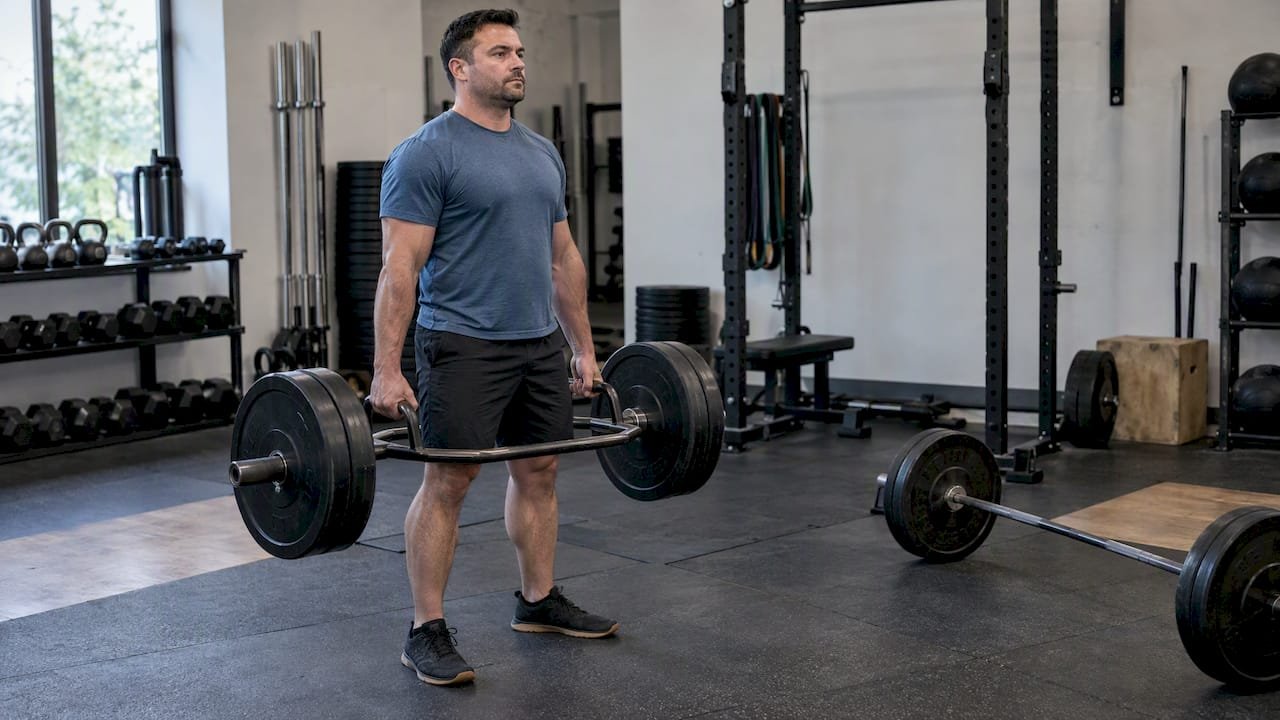
The trap bar (also called a hex bar) is usually the better default if you want a strong lower body, athletic power and a lower learning curve. The straight bar is the better choice if you want to get better at the barbell deadlift itself, or you compete in a sport that tests it. Most lifters who train for the long haul end up using both, for different jobs.
The rest of this guide covers what each bar changes in your body, what the research does and doesn’t show, and how to choose for your goals.
TL;DR
- The trap bar puts you inside the frame, so the load sits closer to your center of mass. It tends to feel more upright, more quad-driven and easier to learn.
- The straight bar keeps the load in front of your shins. It demands more hip hinge and more from the hamstrings and lower back.
- Research shows higher peak power and velocity with the trap bar. Max-load results are mixed, so a heavier trap bar lift does not mean an easier one.
- Pick the trap bar for general strength, power, beginners and cranky backs. Pick the straight bar for barbell skill and powerlifting.
- Check what your bar weighs. Trap bars are not all 45 lb.
Table of Contents
- What actually differs between the two bars
- Muscles worked: quads versus hamstrings and back
- Power, speed and how much you can lift
- Back stress and joint-friendly training
- Technique cues that apply to both bars
- Do all bars weigh 45 pounds?
- What about women and different body types?
- How to choose: a decision guide
- A simple way to program it
- Our perspective at humn.
- Get coached on the bar that fits you
- FAQ
- Sources
What actually differs between the two bars
A straight bar sits in front of you. To pull it, your shins have to stay out of the way, so your hips go back, your torso leans forward, and the bar travels up your legs. A trap bar surrounds you. You stand in the middle of a hexagonal frame and grip handles at your sides, so the weight hangs around your body instead of ahead of it.
That one change ripples through the whole lift:
| Straight bar deadlift | Trap bar deadlift | |
|---|---|---|
| Where the load sits | In front of the body | Around the body, roughly in line with your center of mass |
| Torso angle | More bent over | More upright |
| Knee travel | Less forward knee travel | More forward knee travel |
| Grip | Overhand or mixed, straight bar | Neutral (palms facing in) |
| Main muscle emphasis | Hamstrings, glutes, spinal erectors | Quads plus glutes and hamstrings |
| Skill demand | Higher | Lower |
| Best for | Barbell skill, powerlifting, hip-dominant strength | Power, general strength, beginners, tight hips |
The Strength and Conditioning Journal technique article from the National Strength and Conditioning Association notes the trap bar first appeared in the strength and conditioning literature in 1987, with a diamond-shaped frame that has been adapted over the years. It is not a gimmick. It is a well-studied tool.
Muscles worked: quads versus hamstrings and back
The common summary is that the straight bar is hip-dominant and the trap bar is a hybrid between a squat and a deadlift. The research backs that up in broad strokes.
In a biomechanical analysis of straight and hexagonal bar deadlifts, 19 male powerlifters lifted with both bars across a range of submaximal loads. The comparison looked at joint motion and forces, and the trap bar pattern showed a different balance between hip and knee loading than the straight bar. A separate study on muscle activation and power compared the same two bars. The research summary we reviewed reports greater quad activation with the trap bar and higher hamstring and spinal erector activity with the straight bar, especially on the lowering phase.
What that means in the gym:
- Trap bar: you will feel your quads and glutes drive the floor away. It is a strong choice for leg strength without the heavy hinge.
- Straight bar: you will feel your hamstrings, glutes and the muscles along your spine work hard to keep the bar close and finish the lift.
Neither is “more real.” Some coaches argue the trap bar is not a true hinge. That is partly right: the NSCA material notes the trap bar lacks the same degree of terminal hip extension challenge as the conventional version. But it still loads the hips heavily. If you want to train a hard hinge, use a straight bar, a Romanian deadlift or a hip thrust. Our comparison of the barbell hip thrust and glute bridge covers glute work that pairs well with either bar.
Power, speed and how much you can lift
This is where the trap bar earns its reputation. The research summary we used reports higher peak power, velocity and force with the trap bar than with the straight bar. For anyone who cares about jumping, sprinting or generally moving fast, that is a real advantage. Many athletes use it for exactly that reason, not as a beginner crutch.
Max load is less clear. Swinton and colleagues found lifters moved heavier loads with the trap bar (265 ± 41 kg versus 245 ± 39 kg), while Camara and colleagues reported no significant difference in one-rep max. So the safest statement is that the trap bar often lets you lift the same or more, and it depends on the lifter.

The mistake is to read a bigger number as an easier lift. As the NSCA technique article frames it, the trap bar mostly offers a better mechanical position. You still have to brace, drive through the floor and keep your hips from shooting up ahead of your shoulders.
Do not compare your numbers across bars. A 315 lb trap bar pull and a 315 lb straight bar pull are different lifts. Log them separately.
Back stress and joint-friendly training
If your back is the reason you are reading this, the trap bar has a good case. The NSCA technique article describes the design as keeping the load aligned with your center of mass, which lowers peak moments at the lumbar spine, hip and ankle compared with a conventional pull. It also allows a more vertical bar path, since the bar does not have to travel around the knees.
That makes the trap bar easier to teach to beginners, to people with limited hip mobility, and to many people who have had back trouble. The high handles, which sit a few inches above the low ones, shorten the range of motion further. If you cannot reach a straight bar without rounding your back, the high handles are an easy fix.
Two cautions:
- “Lower stress” is not “no stress.” Sloppy trap bar pulls with a rounded back still cost you.
- If you have current back pain, numbness, pain that travels down a leg, or a diagnosed disc or spine problem, get cleared by a physician or physical therapist before you pull heavy from the floor with any bar. Our guide to lower back pain strength training explains how we think about loading a sensitive back, and strength training with bad knees does the same for knees.
Technique cues that apply to both bars
The bars differ, but the setup logic is shared.
- Set your feet. Hip-width or slightly narrower, in the center of the frame for the trap bar, under the bar for the straight bar.
- Grip first, then hips. Reach down, find the handles or bar, then lower your hips until your shins touch the bar or the handles feel natural.
- Take the slack out. Pull gently until you feel tension, with a flat, braced torso.
- Push the floor away. The NSCA article recommends coaching the movement as driving through the floor, not yanking with your arms.
- Keep hips and shoulders rising together. If your hips rise first, the lift turns into a stiff-legged pull and the low back takes over.
- Stand tall, then lower with control. Do not lean back at the top.
For the straight bar, add a cue to keep the bar dragging up your legs. For the trap bar, keep your chest proud and avoid letting your knees collapse in.
If you do not have an easy pull from the floor, mobility is often the limiter. A short routine such as the mobility drills for lifters can help your setup positions in 10 to 15 minutes.
Do all bars weigh 45 pounds?
No. A standard Olympic barbell is almost always 45 lb (20 kg), but trap bars vary a lot by manufacturer. Rogue’s TB-1 Trap Bar 2.0 uses an updated sleeve construction that cut the starting weight by more than 25 percent from the original. Other models run lighter or heavier. REP Fitness describes its hex bar as a hexagonal frame with dual handles at standard and raised heights.
Before you log a max, ask what the bar in your gym weighs. Five or ten pounds off in your training log will quietly distort your progress charts for months. Weigh it, or find the number stamped on the bar or in the manufacturer specs, and write it down.
What about women and different body types?
Most older studies used male lifters. A 2024 biomechanical comparison looked at conventional, sumo and hex-bar deadlifts among resistance-trained women, which is a welcome addition. Body proportions matter more than sex here. Long-legged, short-torso lifters often find the straight bar pull friendly. Lifters with long torsos and short arms often find the straight bar harder to reach and the trap bar easier.
The practical test is simple: try both, film a set from the side, and see where your back position is better and where the bar feels most natural.
How to choose: a decision guide
Choose the trap bar if:
- You are new to lifting and want to learn a strong pull quickly. Our beginner compound lift plan fits it in naturally.
- You want power, speed and leg strength.
- You have limited hip mobility, a long torso, or a history of back irritation (after clearance from your clinician).
- Your time is short and you want a big return from a few lifts. A busy professional can get a lot from one heavy trap bar day a week.
Choose the straight bar if:
- You compete in powerlifting or any event that tests the barbell deadlift.
- You want to train a harder hinge and build the hamstrings and spinal erectors.
- You are comfortable with technique and want the specific skill.
Use both if:
- You want complete lower body training. A common pattern is the trap bar for heavy and fast work, and the straight bar or a Romanian deadlift for hinge volume.
T3’s breakdown reaches a similar conclusion: the best choice depends on your goals, with the trap bar often winning for lower barrier to entry and the conventional bar remaining the classic test of maximal strength.
A simple way to program it
Here is a straightforward weekly template for an adult training three days a week. Adjust it with a coach.
- Day 1: trap bar deadlift, 3 to 5 sets of 3 to 6 reps with crisp form and a stop between reps if needed.
- Day 2: squat or split squat variation, plus upper body pulling.
- Day 3: Romanian deadlift or straight bar deadlift at a moderate load, 2 to 4 sets of 5 to 8 reps.
Keep a rep or two in reserve on most sets, add load in small steps, and track every session. Progressive strength training is the habit that matters more than the bar.
Our perspective at humn.
At humn., we do not treat this as a bar war. We ask what the member needs the lift to do. For most of the busy adults we coach in Gaithersburg, the answer is to build a strong lower body, keep their backs feeling good and stay consistent for years. The trap bar is often how we start that conversation, because it lets a new lifter pull heavy with a confident position.
We also do not stop there. When a member has the positioning and wants to build hinge strength, we bring in straight bar variations and tempo work. The bar is a tool. The system around it is what produces results: sleep, stress, nutrition, recovery and a plan that fits the week you actually have. That is why our coaching is built on four pillars (Resist, Recover, Renew and Rhythm) rather than a list of exercises.
One more habit we push: film your pulls and track what you do. A bar swap with no log tells you nothing.
— Josh
Get coached on the bar that fits you
If you would like someone to look at your setup, choose the right bar and build the plan around your schedule, our small-group personal training and coaching are offered through humn. membership. If you are still weighing a coach versus a trainer, read personal trainer for beginners first. Recovery access, including sauna, compression and red light therapy, is on our recovery page for the days after heavy pulls.
FAQ
Is a trap bar easier than a regular bar?
Usually it feels easier to learn and to position, and many lifters move the same or more weight with it. That does not mean the work is easier. The advantage is mechanical, and you still have to brace and drive through the floor.
Is it worth getting a trap bar?
If you train at home and want a lower-skill deadlift, a trap bar is a solid purchase, especially with high and low handles. It also works for carries and shrugs. If you only want to train the barbell deadlift for competition, a straight bar will serve you better.
Are trap bars usually 45 lb?
No. Standard Olympic barbells are almost universally 45 lb, but trap bars vary by manufacturer, with some models noticeably lighter. Confirm the weight of your bar before you record a one-rep max.
Why would you use a trap bar?
For power, leg strength and a more upright, joint-friendly pull. The research shows higher peak power and velocity with the trap bar, and the design reduces moments at the lower back compared with a conventional pull. It is also easier to teach to beginners.
Sources
- A Biomechanical Analysis of Straight and Hexagonal Barbell Deadlifts Using Submaximal Loads (PubMed)
- An Examination of Muscle Activation and Power Characteristics With Straight and Hexagonal Barbells (PubMed)
- A Biomechanical Comparison Between Conventional, Sumo, and Hex-Bar Deadlifts Among Resistance Trained Women (PubMed)
- Exercise Technique: Applying the Hexagonal Bar to Strength and Power Training (NSCA)
- Trap bar deadlift vs conventional deadlift (T3)
- Rogue TB-1 Trap Bar 2.0
- REP Fitness Trap Bar
No Comments.