

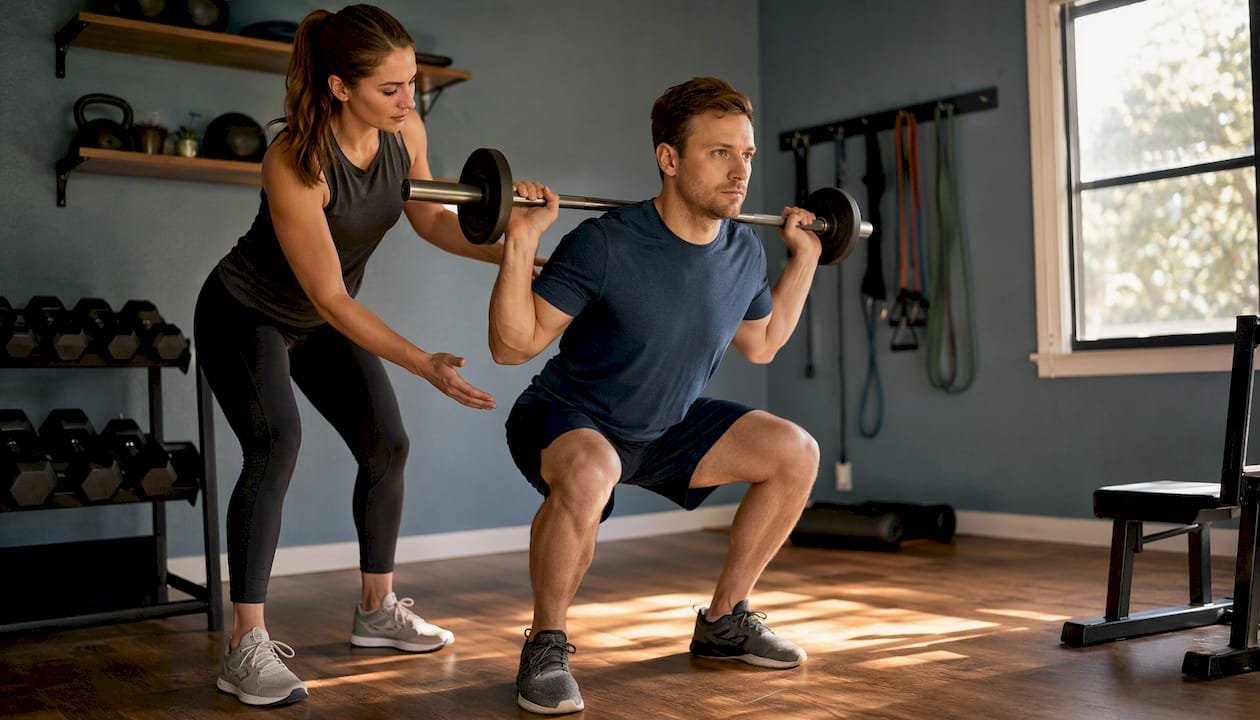
Yes, most beginners should hire a certified personal trainer for at least a short block of sessions. The reason is straightforward: the first few weeks of training are when technique errors and bad habits form, and those are far easier to prevent than to undo later. NASM and the NSCA both ground beginner programming in stabilization, foundational movement patterns, and progressive overload built on competency, not intensity. A qualified coach applies exactly that framework from day one.
The three starter options that make the most sense for most adults new to fitness:
- Short-term 1:1 coaching: Best for baseline assessment, movement screening, and technique instruction, offered in a focused and finite timeframe.
- Small-group foundations classes: Lower cost per session, built-in social accountability, and still enough coaching attention for beginners who move reasonably well.
- Guided online coaching: Works for adults with unpredictable schedules, provided the program includes periodic live form checks rather than just app-delivered workouts.
Most beginner programs follow a 4–12 week framework designed to build movement mastery through repetition before adding load. Initial fitness assessments commonly run about 60 minutes. That first hour is not a workout. It is a diagnostic, and it is worth every minute.
Table of Contents
- Should a beginner hire a personal trainer?
- What delivery type fits a beginner best?
- How do you find and verify a qualified trainer?
- What happens in your first personal training session?
- How much does personal training cost for beginners?
- How do you choose the right trainer for you?
- What should the first 4–12 weeks actually look like?
- How humn. works with beginners
- What are your next steps after choosing a trainer?
- Key Takeaways
- The part most beginner guides skip
- Ready to start training at humn.?
- Useful sources
Should a beginner hire a personal trainer?
The clearest signal that you need a trainer is not your fitness level. It is whether you know what you do not know. Most beginners overestimate their movement quality and underestimate how quickly poor mechanics compound into pain or plateau.
Where a trainer makes a measurable difference:
- Technique from the start. Squats, hinges, pushes, and pulls are patterns you will repeat thousands of times. Learning them correctly in week one is worth more than any program tweak later.
- Individualized progression. A good coach adjusts load, volume, and intensity based on how you actually move, not a generic template.
- Accountability. Showing up is the hardest part of any new habit. A scheduled appointment with a real person changes the math on skipping.
- Injury prevention. Prior injury, chronic pain, or severe deconditioning all raise the stakes for unsupervised training. A trainer who understands corrective strategies can work around limitations rather than through them.
- Habit formation. The NSCA frames early personal training as primarily educational. The first sessions are about building consistent behavior, not chasing performance.
A trainer is especially worth it if you have a history of starting and stopping, if you have any joint pain or past injuries, or if you genuinely do not know where to begin.
When you might not need one right away: An experienced exerciser returning after a short break with a clear plan can often self-direct. Budget-limited beginners who can follow a well-structured program and book two or three check-in sessions for form review are also reasonable candidates for a hybrid approach.

Pro Tip: A 4-session trial block is the lowest-risk entry point. You get a movement assessment, technique coaching on the foundational patterns, and a simple home plan, without committing to a long-term package. If the coach is a good fit, you extend. If not, you move on with better information.
The mindset you bring into those first sessions matters as much as the program itself. Coaches who understand that tend to produce clients who actually stick around.
What delivery type fits a beginner best?
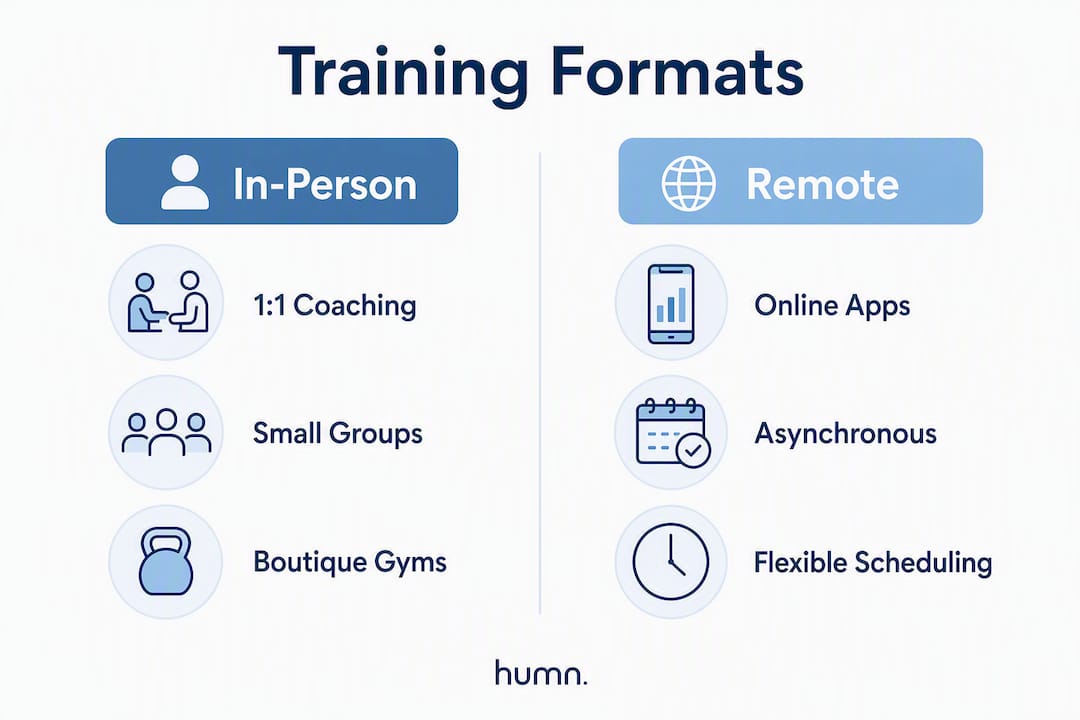
Format matters more than most beginners realize. The right delivery type depends on your budget, your anxiety level in a gym setting, and how much direct coaching feedback you need.
Private 1:1 coaching
You get the trainer’s full attention for every set, every rep. Corrections happen in real time. The intake process is thorough, and the program is built entirely around your movement patterns and goals. The tradeoff is cost: private sessions in the U.S. typically run higher per session than any other format. For beginners with prior injuries, significant deconditioning, or high gym anxiety, that cost is usually justified.
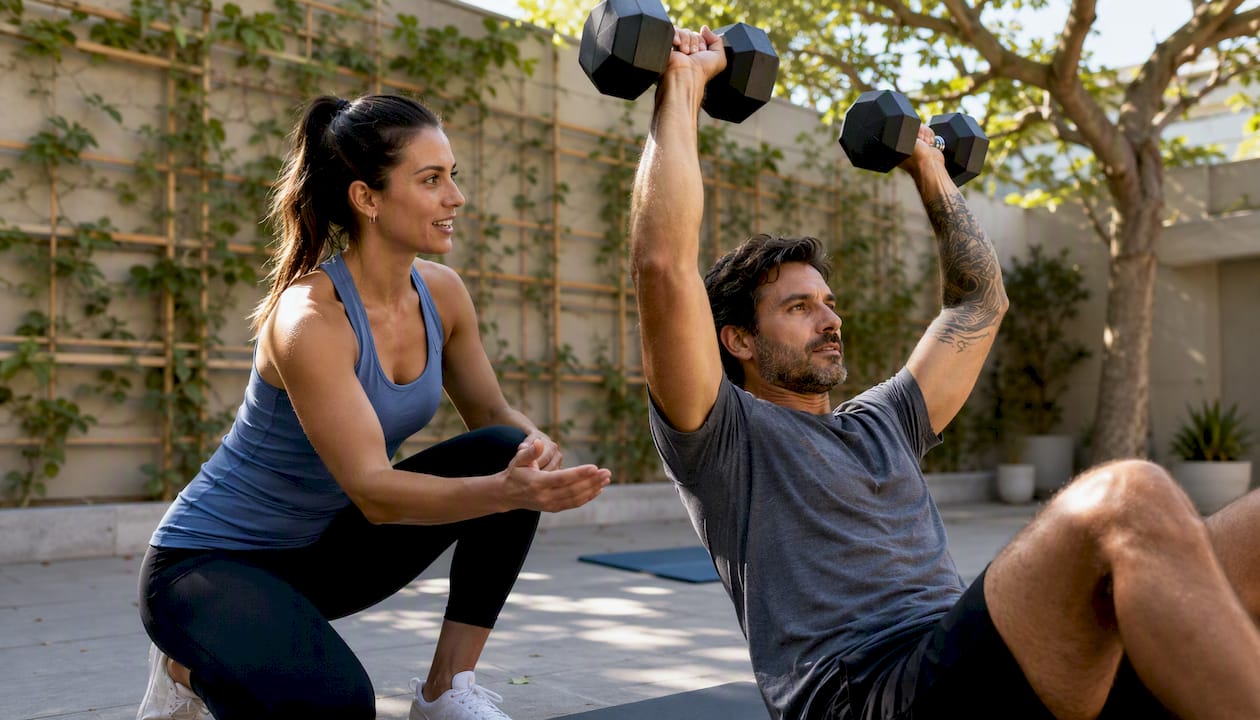
Private coaching in a boutique setting also removes the social comparison element that derails a lot of new exercisers before they find their footing.
Small-group training (2–6 people)
This is where cost and coaching quality intersect most favorably for beginners. Groups small enough for the coach to watch your form on every set, but shared enough to bring the per-session price down. The social element also helps: knowing two other people are showing up on Tuesday morning is a surprisingly effective accountability mechanism. Boutique and private settings reduce gym anxiety and help beginners focus on technique rather than comparison.
Online coaching
Asynchronous app-based programs are cheap and flexible, but they are also the format most likely to let technique problems go unaddressed. The better online coaching models include weekly video check-ins or periodic live form reviews. For adults with genuinely unpredictable schedules, a hybrid model, online programming with monthly in-person assessments, often works better than either extreme.
| Delivery Type | Coaching Attention | Relative Cost | Privacy | Habit Support | Onboarding Assessment |
|---|---|---|---|---|---|
| Private 1:1 | High | Higher | High | Strong | Full movement screen |
| Small-group (2–6) | Moderate-high | Moderate | Moderate | Strong | Group intake + individual check |
| Online (async) | Low | Lower | High | Variable | Self-reported or app-based |
| Hybrid (online + periodic live) | Moderate | Moderate | High | Moderate | Periodic live check-ins |
For most beginners, small-group training in a boutique environment or a short block of private sessions offers the best combination of coaching quality, accountability, and realistic cost.
How do you find and verify a qualified trainer?
The fitness industry has no universal licensing requirement in the United States, which means the credential gap between a well-trained coach and someone with a weekend certificate is real. Here is how to close that gap before you book.
Where to look
- Professional directories — maintained by certifying bodies (NASM, ACE, NSCA, ISSA all have trainer-finder tools).
Credentials to verify
- Recognized certification: NASM, ACE, NSCA, or ISSA are the most widely recognized in the U.S. Each requires a written exam, continuing education, and CPR/AED certification.
- CPR/AED current certification: Non-negotiable. Ask directly.
- Liability insurance: Especially relevant for independent trainers working outside a facility.
- Beginner-specific experience: Ask how many beginner clients they currently work with and what their onboarding process looks like.
- Continuing education: Coaches who invest in specializations (corrective exercise, nutrition coaching, behavior change) tend to produce better outcomes for beginners.
Red flags to walk away from
- No intake assessment or health history review before the first session.
- Vague or undisclosed pricing, or pressure to buy a large package before you have trained together.
- Promises of specific results in unrealistically short timeframes.
- No measurable progress tracking or re-assessment built into the program.
- A coach who cannot explain their programming rationale in plain language.
Pro Tip: Before your first paid session, ask for a 15-minute phone or video consult. A prepared coach will ask about your goals, health history, and constraints. One who jumps straight to pricing without asking a single question about you is telling you something important.
ISSA guidance notes that top coaches review client notes before every session and keep progressions and regressions ready in advance. That level of preparation is visible from the first interaction.
What happens in your first personal training session?
Most beginners expect a workout. What they actually get, with a good trainer, is a diagnostic interview combined with a movement screen. That is not a disappointment. It is the whole point.
A well-structured first session typically runs about an hour and follows a thorough sequence:
- Health history and intake (10–15 minutes). The PAR-Q (Physical Activity Readiness Questionnaire) or a similar health screening form. Discussion of medications, injuries, sleep, stress, and lifestyle constraints. This is where a good coach listens more than they talk.
- Posture and mobility screen (10–15 minutes). Static posture assessment, basic joint mobility checks, and observation of how you carry yourself before any load is added.
- Movement assessment (15–20 minutes). Foundational patterns: squat, hinge, push, pull. The trainer is watching for compensation patterns, asymmetries, and movement quality, not how much you can lift.
- Teach-and-practice segment (10–15 minutes). One or two corrected movements, practiced with coaching cues. According to The PTDC, keeping the first workout to a warm-up plus a set of foundational exercises is often sufficient. Simple and short is the right call.
- Next steps conversation (5 minutes). Goal alignment, session frequency, and what to expect in the first few weeks.
What the trainer is evaluating and what you are feeling are often different things. You may feel like nothing happened. The trainer has built a map of your movement quality, identified key corrections, and confirmed whether the program fits you.
For a deeper look at the assessment tools trainers use, the screens above are standard entry points, not the full picture.
The NSCA frames this first session as primarily educational: beginners should expect discussion of lifestyle habits and consistency, not just sets and reps. That framing is worth holding onto when you leave wondering if you “did enough.”
How much does personal training cost for beginners?
Pricing in the U.S. personal training market varies widely, and the per-session number alone is a poor way to evaluate value. Here is how the models break down.
Common pricing structures:
- Per-session drop-in rates: Typically higher per session, with no commitment. Useful for occasional check-ins but not ideal for building a consistent habit.
- Session packs (4, 8, or 12 sessions): Usually discounted from the drop-in rate. A 4-session trial pack is the most practical entry point for beginners evaluating fit.
- Monthly memberships: Fixed monthly cost covering a set number of sessions per week. Often the best value for clients who commit to a regular schedule.
- Small-group pricing: Significantly lower per session than private training, with similar programming quality in well-run facilities.
- Online coaching subscriptions: Monthly fee covering program delivery, check-ins, and messaging access. Ranges widely based on coach experience and included services.
What drives the price up or down:
- Coach experience, specializations, and certification level.
- Location: urban markets and boutique facilities run higher than suburban big-box gyms.
- Session length (45 minutes vs. 60 minutes vs. 90-minute integrated sessions).
- Included services: nutrition guidance, recovery access, and habit coaching add value that pure session-count comparisons miss.
A simple budgeting comparison: A 4-session trial pack at a boutique studio costs more upfront than a single drop-in session, but it gives you enough time to complete a proper assessment, learn the foundational movement patterns, and evaluate whether the coach is the right fit. Buying one session and judging from that is like test-driving a car around the block.
Price transparency checklist before you commit:
- What is included in each session (programming, nutrition, recovery)?
- Is the initial assessment a separate fee?
- What is the cancellation and rescheduling policy?
- Are there auto-renewal terms on packages or memberships?
- Does the price change after an introductory period?
Quality coaching early in your training life prevents injuries and wasted months on programs that do not fit. The cheapest option is rarely the most cost-effective one over a 12-month horizon.
How do you choose the right trainer for you?
The discovery call or free consultation is your interview, not theirs. Use it.
Questions to ask every trainer you consider
- What does your onboarding process look like for a complete beginner?
- How do you assess movement quality before building a program?
- What certifications do you hold, and when did you last complete continuing education?
- How do you track progress, and when do you reassess?
- What does a typical 4-week beginner program look like with you?
- How do you handle it when a client is not progressing as expected?
- What is your communication style between sessions?
Trust signals that matter
- Clear, written pricing with no hidden fees.
- Specific examples of beginner clients they have worked with and what those clients achieved.
- A defined re-assessment schedule (typically every 4–6 weeks).
- Progress tracking that goes beyond the scale: movement quality, consistency, energy, and sleep.
- Client retention: a trainer whose clients stay for 6–12 months is doing something right.
Red flags in the consultation itself
- They talk more than they listen.
- They cannot explain their programming rationale without jargon.
- They pressure you to sign a long-term package before you have trained together.
- They promise specific aesthetic results on a fixed timeline.
- No mention of assessment, health history, or lifestyle factors.
Run a 15–20 minute trial consult with at least two trainers before deciding. The difference in how they approach that conversation will tell you more than any credential on the wall.
What should the first 4–12 weeks actually look like?
The most common mistake beginners make is treating the first month like a performance test. It is not. NASM’s OPT model places all novice clients in Phase 1: Stabilization Endurance, which prioritizes movement preparation, self-myofascial release, and higher-rep stability work before any meaningful load is added.
Rick Richey of NASM calls the alternative the “intensity trap”: pushing beginners too hard too soon leads to injury, discouragement, and dropout. The fix is progressing by competency, not by calendar.
Foundations-first priorities for weeks 1–12:
- Stabilization and posture. Before you load a squat, you need to own the pattern with bodyweight.
- Movement pattern mastery. Squat, hinge, push, pull, and carry. These are the building blocks of every program you will ever follow.
- Breathing mechanics. Proper bracing and breathing under light load prevents a surprising number of lower-back complaints.
- Habit anchoring. Consistency in the first 28 days matters more than any single session. Three sessions per week, same days, same time, is a more powerful intervention than the perfect program delivered inconsistently.
A practical framing for the first month: three weeks of habit anchoring, three focused technique sessions per week (or two if three is not sustainable), and three formal check-ins across the first four weeks. Adjust based on individual recovery and schedule.
Sample beginner week (2–3 sessions):
- Warm-up and mobility (10 minutes): Foam rolling, hip openers, thoracic rotation.
- Technique-focused strength work (25–30 minutes): Goblet squat, Romanian deadlift, push-up, seated row. One to two sets, quality over quantity.
- Light conditioning (10 minutes): Walking, cycling, or low-impact movement. Not a sprint.
- At-home practice: One mobility drill and one breathing exercise, five minutes each.
Pro Tip: Keep volume intentionally low in week one. One set of 6–8 foundational exercises is enough to observe movement quality, identify compensation patterns, and reduce delayed onset muscle soreness (DOMS). A beginner who is not destroyed after session one is far more likely to show up for session two.
For a safe and effective approach to early programming, the principle is the same regardless of fitness level: master the pattern before you load it.
How humn. works with beginners
humn. is a boutique fitness and lifestyle coaching facility in Gaithersburg, MD, built specifically for adults who want more than a gym membership. The approach is foundations-first and whole-person from the first visit.
What a beginner’s onboarding at humn. looks like:
- Movement assessment — A structured screen of foundational patterns, posture, and mobility, consistent with NASM and NSCA assessment standards.
The four-pillar framework, Resist, Recover, Renew, and Rhythm, means that sleep, stress, and nutrition are part of the coaching conversation from day one, not afterthoughts added when progress stalls.
The private, Nordic-inspired setting removes the comparison and intimidation that derail so many beginners at conventional gyms. Small-group sessions stay small enough for real coaching attention. And the habit-first coaching model, which integrates whole-person fitness approaches, means clients are building a life practice, not just logging workouts.
What are your next steps after choosing a trainer?
Deciding to hire a trainer is step one. Here is how to move from decision to momentum.
Immediate next steps
- Book a 60-minute assessment or a 4-session trial. Do not start with a single drop-in session. You need enough time for a proper intake, a movement screen, and at least two coached sessions to evaluate fit.
- Prepare your health history answers. Prior injuries, current medications, sleep quality, stress level, and any movement limitations. The more specific you are, the more useful the assessment.
- Set one measurable short-term goal. Not “get fit.” Something like: three consistent sessions per week for four weeks, or two specific mobility improvements by the end of the first month.
How to evaluate fit in the first two sessions
- Does the coach give clear, specific cues, or vague encouragement?
- Do they adjust the session based on what they observe, or follow a script?
- Do you leave with a clear understanding of what you are working on and why?
- Is there a follow-up communication within 24 hours of your first session?
A simple 30/60/90-day roadmap
| Milestone | What to expect |
|---|---|
| 30 days | Three consistent sessions per week established. Two or three movement patterns corrected. First re-assessment scheduled. |
| 60 days | Noticeable improvement in movement quality. Energy and sleep often improve before strength does. Program adjusted based on re-assessment. |
| 90 days | Measurable strength gains on foundational patterns. Habit is largely automatic. Conversation shifts from foundations to progressive overload. |
Trainer test rating (use after sessions 1 and 2):
- Technique coaching: Did they correct your form with specific, useful cues?
- Personalization: Did the session reflect your assessment findings?
- Communication: Did they explain the “why” behind each exercise?
- Follow-up: Did you hear from them after the session?
Score each on a simple 1–3 scale. A trainer who scores low on personalization and follow-up in the first two sessions rarely improves. Your first personal training session sets the tone for everything that follows.
Key Takeaways
Beginners who start with a certified trainer, prioritize foundational movement quality, and choose a format that matches their budget and schedule are more likely to build lasting fitness habits than those who go it alone.
| Point | Details |
|---|---|
| Start with an assessment | Book a 60-minute intake session before committing to a long package. |
| Foundations before intensity | The first 4–12 weeks should prioritize movement patterns, not maximum effort. |
| Match format to your constraints | Small-group training balances coaching quality and cost for most beginners. |
| Use a 4-session trial | A short trial block is the lowest-risk way to evaluate trainer fit before committing. |
| humn. for Gaithersburg beginners | humn. offers 1:1 onboarding, small-group training, and integrated recovery in a private boutique setting. |
The part most beginner guides skip
Most articles about finding a personal trainer treat the decision like a product purchase: compare certifications, check the price, pick the best option. That framing misses the actual variable that determines whether a beginner succeeds.
The real question is not “Is this trainer qualified?” It is “Will this trainer help me build a practice I can sustain for years?”
Certifications matter. NASM, NSCA, ACE, and ISSA all set real standards, and you should not work with a coach who lacks one. But two coaches with identical credentials can produce wildly different outcomes for the same beginner. The difference is almost always in how they handle the first four weeks: whether they slow down to assess properly, whether they explain the reasoning behind the program, and whether they treat habit formation as part of their job or as the client’s problem to solve.
The intensity trap is real and it is not just a programming error. It is a coaching philosophy error. A trainer who pushes a beginner hard in week one because “that’s what clients expect” is optimizing for the feeling of a workout, not for the outcome of a training life. Those are different things.
The other thing worth saying plainly: gym anxiety is not a personality flaw. Boutique and small-group environments exist precisely because the conventional gym floor is a genuinely difficult place to learn. If you have avoided training because the environment felt wrong, that is useful information about what format you need, not evidence that you are not a “gym person.”
The best coaching relationship for a beginner looks less like a service transaction and more like a skilled guide who helps you understand your own body. That takes time, and it starts with a coach who asks more questions than they answer in the first session.
Ready to start training at humn.?
Beginners in Gaithersburg, MD who want a structured, low-pressure entry into fitness have a concrete option at humn. The difference from a conventional gym is not just the setting. It is the process: every new member starts with a full intake and movement assessment, gets a personalized 4-week foundations plan, and has access to recovery services from day one.
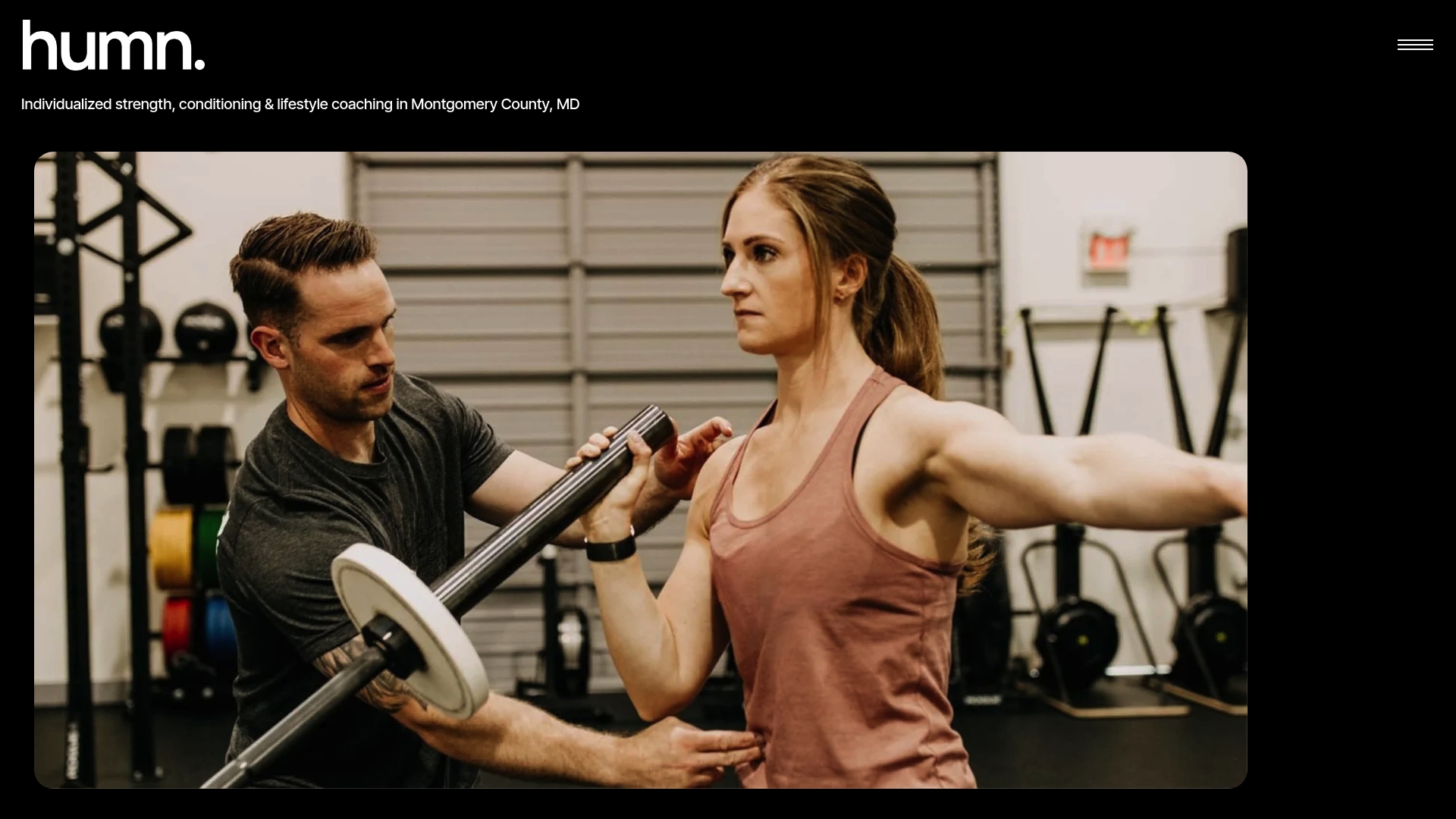
The 1:1 coaching and small-group training options at humn. are built specifically for adults who want coaching, not just access. Sessions stay small. Coaches are certified and experienced with beginners. And the habit-first framework means your sleep, stress, and nutrition are part of the conversation from the start, not added later when progress stalls.
The first step is a conversation. Visit livehumn.com/membership to see current options, or reach out to schedule a complimentary phone chat and a 60-minute assessment-based first visit. No long-term commitment required to start.
Useful sources
The following sources informed this article and are worth reading directly if you want to go deeper on any section.
- NASM (National Academy of Sports Medicine): The primary source for the OPT model, Phase 1 Stabilization Endurance programming, and the intensity trap principle. Relevant to the beginner training plan and first-session sections.
- NASM Blog: Phase 1 and the New Novice Client: Detailed breakdown of Phase 1 variable ranges, movement preparation, and self-myofascial release for beginners.
- NSCA (National Strength and Conditioning Association): Supports the educational framing of early personal training sessions and lifestyle habit integration.
- ACE Fitness Certifications: Background on ACE certification standards, useful when evaluating trainer credentials.
- The PTDC: First Day as a Personal Trainer: Practical guidance on session structure, the one-set-of-6–8-exercises principle, and what prepared coaches do before a first session.
- ISSA: First Day as a Personal Trainer: Covers warm-up as assessment, backup progressions, and post-session follow-up communication.
- humn. First Personal Training Session Guide: humn.'s own overview of what to expect in an initial session, including intake, movement screen, and next steps.
- humn. Fitness Assessments Guide: Detailed account of the assessment tools and movement screens trainers use with new clients.
No Comments.