

You can reliably add short, movement-focused mindfulness anchors to any workout to improve focus, lower perceived exertion, and build long-term consistency. A Frontiers (2023) study found that combining mindfulness with moderate-to-vigorous physical activity produced lower average RPE than physical activity alone, even when heart rate and blood pressure stayed the same. That gap between how hard you feel you’re working and what your body is actually doing? That’s where mindful exercise practices earn their keep.
Try this right now (60 seconds, no equipment):
- Stand or sit. Take one slow breath in through your nose for 4 counts.
- On your next rep, lift, or step, exhale fully and notice the muscle doing the work.
- When your mind drifts to your phone, your to-do list, or the person next to you, simply notice it and return your attention to the next breath.
- Repeat for 3–5 reps or 60 seconds.
That’s it. That’s the foundation. You’ll likely notice sharper focus within a single session. Lower perceived effort tends to follow within a few weeks of consistent practice. What it won’t reliably change right away: your heart rate, VO2 max, or blood pressure. The physiological markers stay roughly the same. The experience of effort shifts first.
Pro Tip: Don’t wait for a “mindful mood” to try this. Attach the breath anchor to something you already do, like the first set of your warm-up, so it becomes automatic rather than optional.
Table of Contents
- Why mindfulness changes how hard exercise feels
- What mindful exercise actually looks like by workout type
- Short pre- and post-workout practices that actually fit your schedule
- How to start and scale over four weeks
- Common mistakes and how to fix them before next session
- What the research actually shows (and what it doesn’t)
- humn.'s 6-week coach-backed plan for building the habit
- Key Takeaways
- The part most fitness advice gets wrong about mindfulness
- humn. helps you make mindfulness a training habit, not a one-off experiment
- Useful sources for deeper reading
Why mindfulness changes how hard exercise feels
The most practical benefit of mindfulness in workouts isn’t relaxation. It’s RPE calibration. When you train attention on breath or movement rhythm, you shift from dissociative thinking (planning dinner, replaying a meeting) to associative attention, which means you’re actually tracking what your body is doing. That shift changes the subjective experience of effort without requiring you to slow down or work less hard.
The Frontiers study used a within-subjects, counter-balanced design with 29 participants and found that average RPE was significantly lower in the combined mindfulness-plus-activity condition compared to activity alone, while physiological markers remained comparable across conditions. Lower perceived exertion for the same workload has a direct downstream effect: you’re more likely to finish the session, come back tomorrow, and eventually push harder.
Beyond RPE, the core benefits exercisers report from mindful exercise practices include:
- Sharper focus during sets: Attention anchors reduce the mental noise that leads to sloppy form and missed cues.
- Better body awareness: Noticing how a knee tracks, where tension lives, or when fatigue is creeping into your lower back helps you self-correct before injury happens.
- Improved recovery: A post-workout body scan activates the parasympathetic nervous system faster than scrolling your phone on the bench.
- Stronger adherence: Mindful.org guidance notes that unplugging distractions and using movement rhythm as an anchor makes exercise feel more sustainable, not more effortful.
- Emotion regulation: The Frontiers data showed a significantly greater increase in mindfulness of mental events in the combined condition, which supports better management of frustration, boredom, and workout anxiety.
The mechanism is straightforward: attention training builds interoception (your ability to read internal signals), which makes you a better judge of effort, fatigue, and form. That’s a skill with compounding returns.
What mindful exercise actually looks like by workout type
Mindfulness doesn’t look the same on a barbell as it does on a trail run. Here’s how to apply it across modalities.
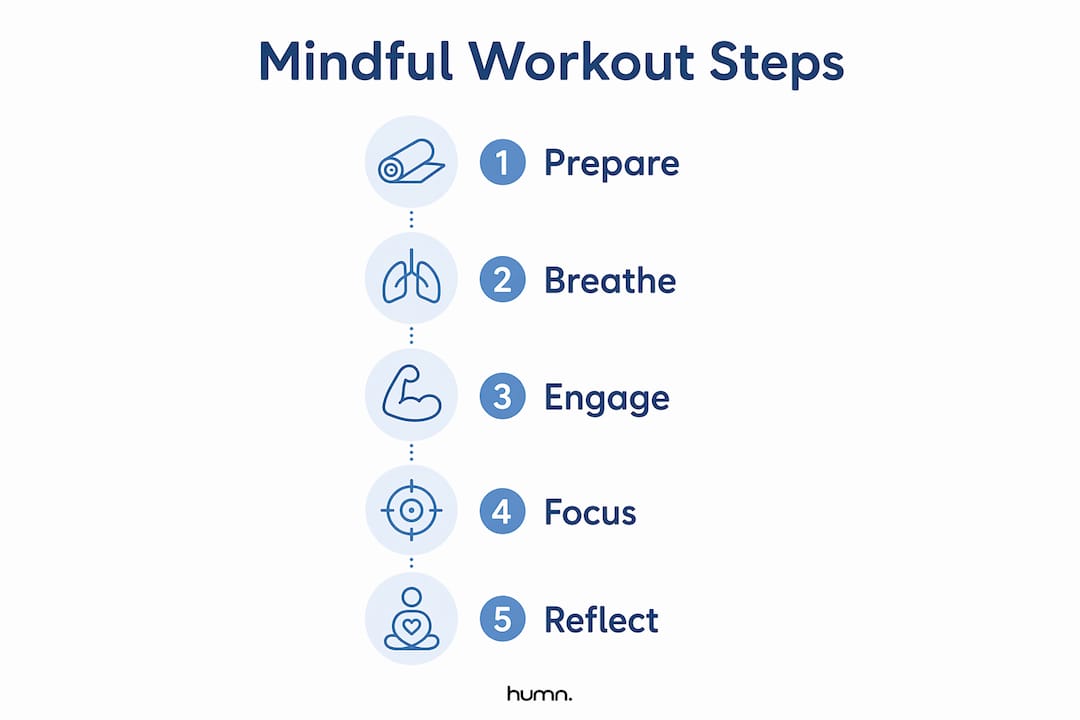
Strength training
Focus on single-rep attention. Before you unrack the bar or pick up the dumbbell, take one breath in. Exhale on exertion. Notice the primary muscle contracting. The mind-muscle connection isn’t mystical — it’s directed attention, and research consistently links it to better motor unit recruitment and cleaner movement patterns.
Example script for one set: “Inhale and brace. Exhale, press. Notice the chest. Inhale, lower with control. One breath per rep.”
Cardio (running, cycling, rowing)
Use breath-step or breath-pedal rhythm as your anchor. One breath in for two steps, one breath out for two steps. When your mind wanders, the rhythm is always there to return to. Mindful.org specifically recommends pedal rotation and footfall as movement anchors for this reason.

Example script for one interval: “Feel the foot land. Count the breath. Notice the pace, not the clock.”
Mobility and yoga
Sensory scanning works best here. Move to the edge of a stretch and pause. Notice where tension lives without immediately trying to push through it. Pilates principles of breath control and precision map directly onto this: you’re not just stretching, you’re gathering information about your body.
HIIT
Short anchor phrases are your best tool when intensity spikes. Try: “This is hard and I’m okay” or “Notice, breathe, stay.” These cue associative attention without demanding complex focus during a 40-second all-out effort.
Your reusable cue library:
- “Inhale load, exhale press”
- “One breath per two steps”
- “Notice knee tracking”
- “Feel the floor, not the clock”
- “This is hard and I’m okay”
- “Inhale, brace, move”
Pro Tip: Mind-wandering isn’t failure. The moment you notice your mind has drifted is the training rep. Notice it, name it (“thinking”), and return to the anchor. Every return builds the attention muscle.
Short pre- and post-workout practices that actually fit your schedule
You don’t need a meditation cushion or a quiet room. These templates work in a gym corner, a parking lot, or a group fitness studio.
Pre-workout (choose one)
60-second breath anchor:
Sit or stand. Close your eyes or soften your gaze. Breathe in for 4 counts, hold for 2, out for 6. Set one intention: “Today I’m focusing on my form in the squat” or “I’m here to move, not to perform.” Open your eyes. Start your warm-up.

2-minute body-scan focus:
Starting at your feet, slowly move attention upward through your body. Notice tightness, stiffness, or areas that feel ready to move. A CDPHP Fitness Connect body-scan guide notes this can be done in limited space and time, making it practical for any setting. Flag two or three areas to monitor during the session.
Post-workout (choose one)
60-second gratitude and assess check:
Name one thing your body did well today. Then scan: where do you feel worked? Where do you feel tight or off? Log it in two words in your training notes.
2-minute progressive relaxation:
Lie down or sit. Starting with your feet, tense each muscle group for 5 seconds, then release. Move upward: calves, quads, glutes, core, shoulders, hands. Finish with three slow breaths. This pairs well with humn.'s recovery sessions and cooldown work.
| Practice | Duration | Best setting | What it targets |
|---|---|---|---|
| Breath anchor | 60 seconds | Any | Focus, intention |
| Body-scan focus | 2 minutes | Quiet corner, car | Tightness awareness, injury prevention |
| Gratitude/assess check | 60 seconds | Post-session bench | Mood, training log |
| Progressive relaxation | 2 minutes | Floor, mat | Parasympathetic recovery |
Modifying for group classes or busy gyms: Keep your eyes open and use a soft gaze. Shorten the breath anchor to 30 seconds. Skip the progressive relaxation and substitute three slow exhales at the end of your cooldown stretch.
How to start and scale over four weeks
The goal in week one isn’t transformation. It’s attachment: linking a new behavior to something you already do.
- Week 1: Attach the anchor. Add the 60-second breath anchor before every warm-up. That’s the only change. Log your RPE at the end of each session on a 1–10 scale.
- Week 2: Add in-workout cues. Pick one cue from the library above and use it during your first working set of each session. Notice how many times your mind wanders per set. Write down the number.
- Week 3: Extend to cooldown. Add the 60-second gratitude/assess check after your last set. You now have a full pre/in/post structure. Note any changes in your RPE scores or how you feel mid-session.
- Week 4: Calibrate and decide. Review your RPE logs. If perceived effort has shifted, your attention anchors are working. If not, try switching the anchor type (breath to movement rhythm, or vice versa). Decide whether to add guided audio or bring the plan to a coach.
Simple tracking metrics to watch:
- RPE score per session (log immediately after)
- Number of mind-wandering notices per set (rough count is fine)
- Form cues you caught and corrected
- Post-session mood (one word is enough)
A practical note on low-dose pre-exercise media: an MDPI 2025 study on a four-week video-delivered mindfulness intervention before rowing found no significant group differences in psychophysiological variables. Passive video formats before exercise are less reliable than in-movement guided attention for producing measurable change. If a mindfulness app or YouTube video feels helpful, use it, but don’t count on it to do the work that in-workout anchors do.
Behavior-based fitness programs follow the same logic: attach new habits to existing structure rather than scheduling separate sessions.
Common mistakes and how to fix them before next session
Most exercisers who try mindfulness in workouts and quit do so because of one of four predictable problems.
- Forcing perfect focus. Expecting zero mind-wandering during a heavy set is like expecting zero traffic on I-95. The practice is the return, not the stillness. Fix: count returns, not lapses.
- Using distracting tech. Scrolling between sets, watching a show during cardio, or checking notifications mid-interval actively competes with attention anchors. Mindful.org recommends unplugging from phones and TV to improve the effect. Fix: leave the phone in your bag for one working block per session.
- Expecting immediate physiological changes. Heart rate won’t drop. VO2 won’t spike. What changes first is the experience of effort. Fix: track RPE, not performance metrics, for the first four weeks.
- Practicing only when motivated. Mindfulness as a workout add-on fails when it’s treated as optional. Acceptance of discomfort is part of the practice. Fix: attach it to a mandatory part of the session (warm-up, first set) so motivation isn’t a prerequisite.
Mid-session troubleshooting checklist:
- Is the anchor too complex? Simplify to one breath cue.
- Is the intensity too high to focus? Use a short phrase instead of a breath count.
- Are you frustrated? Name it: “frustration.” Return to the anchor.
- Is there physical pain? Stop the technique. Address the pain first.
Pro Tip: If anxiety or confusion increases during mindfulness practice, that’s a signal to slow down or work with a coach or clinician. Mindfulness during exercise should feel grounding, not destabilizing.
What the research actually shows (and what it doesn’t)
The evidence for mindful exercise practices is promising but specific. Here’s what holds up and where the limits are.
What studies support:
- Lower RPE during combined mindfulness and physical activity compared to activity alone, in a 29-person within-subjects trial.
- Greater increases in mindfulness of mental events in the combined condition versus activity only.
- Mindfulness training independent of exercise may increase adoption and maintenance of moderate-to-vigorous physical activity, per multiple trials cited in the Frontiers paper.
What the evidence doesn’t reliably support (yet):
- Immediate changes in heart rate, systolic blood pressure, or VO2 from a single mindful session.
- Consistent performance improvements from low-dose, passive pre-exercise media formats.
- Large-sample, long-term RCTs on in-workout mindfulness for athletic performance.
Key finding: In the Frontiers (2023) counter-balanced study, average RPE was significantly lower in the combined mindfulness-plus-activity condition than in activity alone, while heart rate and systolic blood pressure remained comparable across conditions.
| Study | Design | N | Primary outcome | Practical takeaway |
|---|---|---|---|---|
| Frontiers 2023 (PAMIND) | Within-subjects, counter-balanced | 29 | Lower RPE in combined condition; HR/SBP similar | Use mindfulness to manage perceived effort, not to change physiology |
| MDPI 2025 (rowing) | Four-week low-dose video intervention | Not specified | No significant group-by-session interaction for psychophysiological variables | Passive pre-exercise media is less reliable than in-movement anchors |
The bottom line: mindfulness during exercise reliably shifts how effort feels. That’s not a small thing. RPE influences whether you finish a session, how hard you push, and whether you come back. The mindset habits that support consistency often start exactly here.
humn.'s 6-week coach-backed plan for building the habit
This plan anchors mindfulness to humn.'s four-pillar framework: Resist (strength work), Recover (rest and repair), Renew (mindset and lifestyle), and Rhythm (consistency and habit). Each phase has specific session prompts a coach can use with clients or that you can use solo.
- Weeks 1–2 (Resist + Renew): Before every strength session, use the 60-second breath anchor. During working sets, apply one cue from the library (“inhale load, exhale press”). Coach prompt: “Before you unrack, take one breath and name the muscle you’re about to use.”
- Weeks 3–4 (Recover + Rhythm): Add the 2-minute body-scan focus before cardio or mobility work. After each session, complete the 60-second gratitude/assess check. Coach prompt: “What did you notice today that you wouldn’t have caught last month?”
- Weeks 5–6 (Full integration): Run the full pre/in/post structure across all session types. Log RPE and one form observation per session. Coach prompt: “Your RPE log is your data. What’s it telling you about your pacing?”
Coach cues and scripting for trainers:
- Use acceptance language during hard intervals: “Notice the discomfort. You don’t have to like it. Stay with the breath.”
- Progress anchors from breath-count to movement-phase to full-body scan as the client’s attention skill develops.
- Log sheet prompt: RPE, one form cue caught, one word for post-session mood.
Who benefits most from coached integration:
- Busy professionals who need pacing support and a structured habit framework.
- Athletes working on effort calibration and avoiding overtraining.
- Clients returning from injury who need to rebuild body awareness before pushing load.
For those who want individual support, humn.'s 1-on-1 coaching is built around exactly this kind of behavior-first integration.
Key Takeaways
Mindfulness during exercise reliably lowers perceived exertion without changing heart rate or blood pressure, making it one of the most practical tools for improving adherence and pacing.
| Point | Details |
|---|---|
| Start with a 60-second anchor | Attach a breath anchor to your warm-up before your next session — no extra time required. |
| Track RPE, not physiology | Log perceived effort on a 1–10 scale; that’s where mindfulness shows up first, per the Frontiers (2023) study. |
| Use modality-specific cues | Match the anchor to the workout: breath-per-rep for strength, breath-step rhythm for cardio, sensory scanning for mobility. |
| Avoid passive pre-exercise media | Low-dose video formats showed no significant psychophysiological effect in the MDPI 2025 rowing study; in-movement anchors work better. |
| humn.'s 6-week plan | humn.'s coach-backed program ties mindfulness to the Resist, Recover, Renew, and Rhythm pillars for sustainable habit formation. |
The part most fitness advice gets wrong about mindfulness
Most articles frame mindfulness as something you add to your workout, like a supplement or a warm-up stretch. That framing is why most people drop it within two weeks. The practice isn’t an addition. It’s a redirect of attention that was already going somewhere, usually to your phone, your playlist, or your internal monologue about whether you’re doing enough.
What I’ve seen work consistently with clients at humn. is treating the first mindful rep not as a meditation session but as a quality check. You’re not trying to feel zen. You’re trying to notice whether your knee is caving, whether your breath is held, whether you’re grinding through a set on autopilot. That noticing is the skill. And it maps directly onto humn.'s four pillars: Resist (are you moving with intention?), Recover (are you actually resting?), Renew (are you building habits that last?), Rhythm (are you showing up consistently?).
The 60-second starter in this article is worth trying today. Bring the result to your next training session or share it with a coach. Consistency beats perfection here, just as it does everywhere else in training.
humn. helps you make mindfulness a training habit, not a one-off experiment
Knowing the techniques is one thing. Building them into a program that actually sticks is another. humn., based in Gaithersburg, MD, offers personal training and small-group coaching built on a habits-first, behavior-based framework that integrates mindfulness anchors directly into your training sessions, not as an add-on, but as part of how your program is designed.
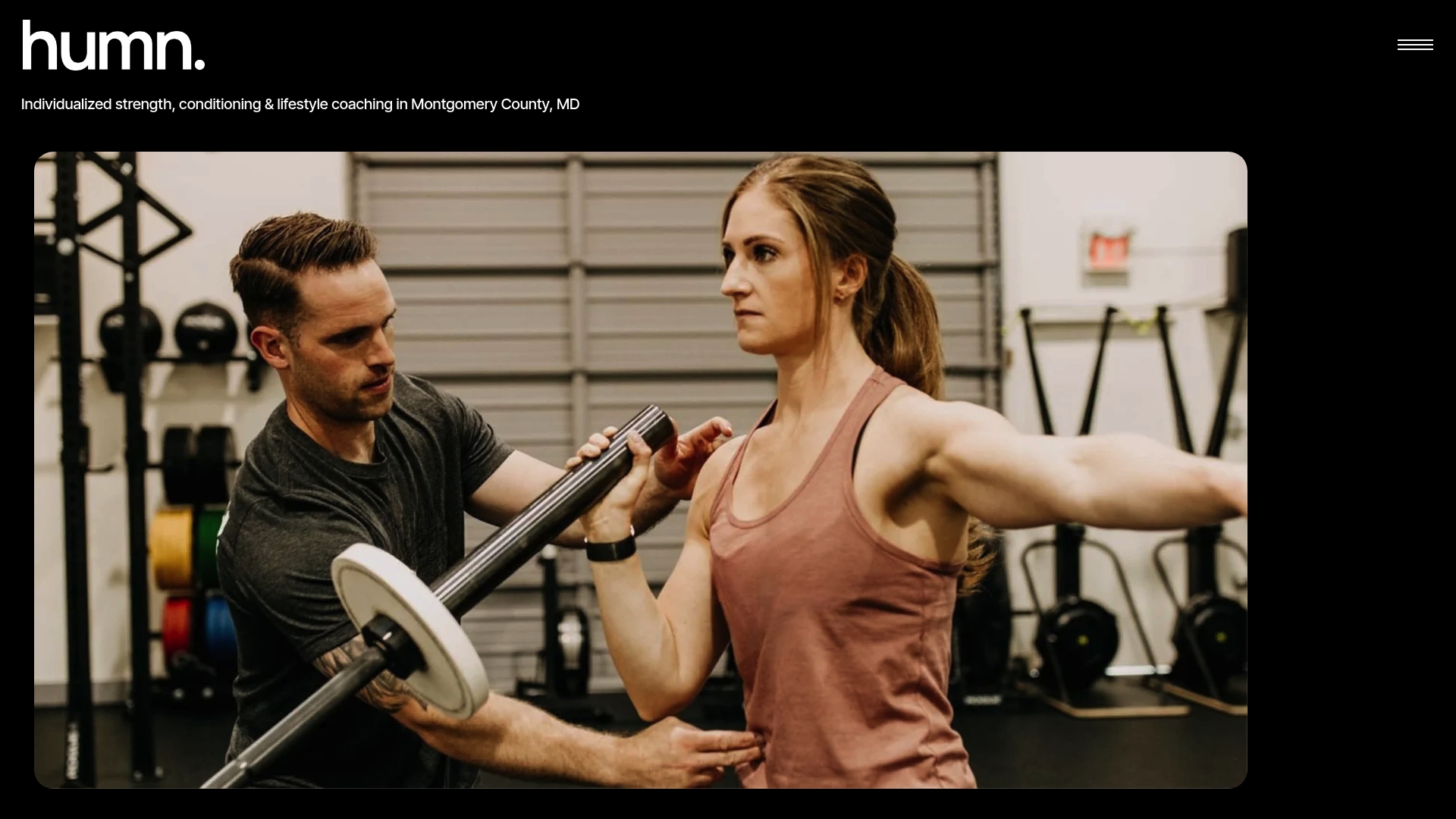
1-on-1 coaching fits clients who need individual pacing work, injury-aware body-scan integration, or a structured 6-week plan with weekly coach check-ins. Small-group personal training works well for exercisers who want accountability and coached cues during live sessions. Recovery access supports the post-workout body-scan and parasympathetic cooldown practices covered in this article.
If you’re a busy professional, an athlete working on effort calibration, or someone returning from injury, coached mindfulness integration at humn. gives you a repeatable system rather than a technique you’ll forget by next week. Book a consult to bring the 6-week plan to your first session and start with a coach who can adjust the anchors to your actual training.
Useful sources for deeper reading
- Frontiers (2023): Effects of mindful physical activity on perceived exercise exertion — The primary within-subjects study (N=29) showing lower RPE in combined mindfulness-plus-activity conditions. Read this if you want the methodology and full data.
- PubMed abstract — same Frontiers study — Faster access to the abstract and citation data for sharing with a coach or clinician.
- Mindful.org: How to meditate through exercise — Practical technique guide covering breath anchors, movement rhythm, and unplugging recommendations. Good starting point for beginners.
- MDPI (2025): Low-dose mindfulness intervention and rowing performance — The study that found no significant psychophysiological group effects from passive pre-exercise video mindfulness. Read this for a realistic picture of what low-dose formats can and can’t do.
- CDPHP Fitness Connect: Incorporating mindfulness into your routine — A practical body-scan guide with timed templates you can copy directly into your training notes.
- JogBee: Incorporating mindfulness into your active routine — Movement-focused cues translated for runners and outdoor exercisers; useful if you train primarily outside.
- Wellness Indiana: Mindful Moments Challenge — Acceptance-based framing and coach prompts for building consistency through discomfort.
Recommended
- The Role of Mindset in Fitness Success: 2026 Guide – humn.
- What Is a Fitness Habit Loop? Your Science-Backed Guide – humn.
- HUMN – Personal Training in Individualized strength, conditioning & lifestyle coaching in Montgomery County, MD
- Examples of Behavior-Based Fitness Programs That Actually Work – humn.
No Comments.