

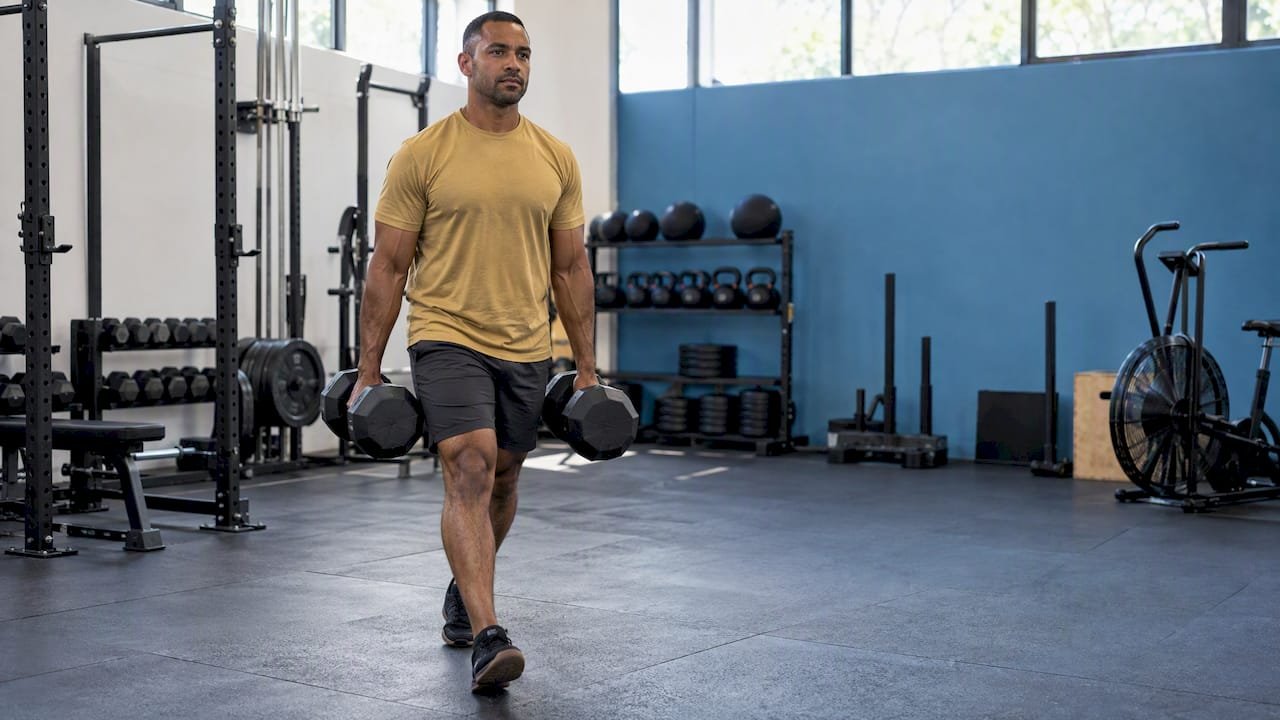
The farmer’s carry is one of the simplest strength exercises there is: pick up something heavy in each hand and walk. The benefits are real. It builds grip strength, trains your trunk and hips to hold posture under load, and carries over to everyday jobs like hauling groceries in from the car. This guide covers what the exercise does, which muscles it works, how heavy to go, how often to do it and how to adjust it if you are starting from zero or coming back from an injury.
TL;DR
- The farmer’s carry improves grip strength and muscular endurance, and it trains your core and hips to keep you upright under load.
- It transfers to daily life: groceries, luggage, kids, laundry baskets.
- A practical starting point is 2 to 4 rounds of short, hard carries, two or three times a week, with a load you can hold with good posture.
- Keep breathing, keep your torso tall and lower the weights under control instead of dropping them.
- If you have a recent back, shoulder, wrist or hand injury, or a heart condition, get clearance from a clinician before going heavy.
Table of Contents
- What a farmer’s carry is
- The main farmer’s carry benefits
- Muscles worked
- How to do a farmer’s carry with good form
- How heavy should a farmer’s carry be?
- How long, how often
- Variations for every level
- Safety: who should be careful
- Who gets the most from carries
- Perspective: why we program carries the way we do
- Want a coach to set your carries up?
- A simple 4-week way to start
- FAQ
- Sources
What a farmer’s carry is
A farmer’s carry (also called a farmer’s walk) is a loaded walk. You hold a weight in each hand, at your sides, and walk for distance or time. Dumbbells, kettlebells, trap bars and farmer’s handles all work. There is no complicated technique to learn, which is part of why it appears in so many strength programs, from beginner plans to athletic training.
It looks easy until the weights get heavy. Then your hands, forearms, upper back, trunk and hips all have to work at once to keep you from folding, leaning or twisting.
The main farmer’s carry benefits
Stronger grip
Grip is usually the first thing to fail on a carry, so it gets trained directly. According to Healthline’s overview of the farmer’s walk, regular carries can improve muscle strength and power, particularly grip strength, along with cardiovascular health and endurance. The National Strength and Conditioning Association (NSCA) also lists grip strength, anaerobic endurance and back endurance among the qualities loaded carries may improve.
Why it matters outside the gym: a stronger grip makes deadlifts, rows and pull-ups easier to progress, and it makes ordinary carrying feel less like a chore.
A trunk and hips that hold posture
The carry is not only a grip drill. The same NSCA document explains that loaded carries train the trunk and hip musculature to maintain posture while you move. That is a different job from a crunch or a plank. You are resisting the pull of the weights while your legs are alternating, which is much closer to how your core works in real life.
Real-world strength
The farmer’s walk is a functional exercise, meaning it directly mirrors daily activity. Healthline gives the example of carrying groceries in from the car. For most adults, that is the whole point: you are training a movement pattern you already use.
Conditioning without a treadmill
Because carries can be done for longer efforts, they raise your heart rate and challenge endurance as well as strength. Healthline notes cardiovascular health and endurance among the potential gains. If you want a more structured plan for building your aerobic engine alongside lifting, our guide for lifters on building an aerobic base while keeping strength shows how 2 to 3 sessions a week fit in.
Efficiency
One exercise, a few minutes, many jobs: grip, upper back, trunk, hips and legs all get trained. For busy people, that is a real advantage. It is a good “finisher” after squats or deadlifts, or a standalone piece in a short session.
Muscles worked
The carry is a whole-body exercise, but some muscles show up more clearly than others:
| Area | What it does during the carry |
|---|---|
| Forearms and hands | Hold the weight and fight to keep it from slipping |
| Upper back and traps | Keep your shoulders from being dragged forward and down |
| Abdominals and trunk | Keep your ribcage stacked over your pelvis |
| Hips and glutes | Stabilize each step, particularly when one foot is off the floor |
| Legs | Do the walking under added load |
Research cited by the NSCA looked at when muscles fire within a stride. During farmer’s walks, the abdominals and rectus femoris peak in the stance phase, while the lats and the thoracic and lumbar erector spinae peak in the swing phase. In plain terms, your front and back trunk muscles take turns working as you step, which is why the carry trains stability instead of just strength.
How to do a farmer’s carry with good form
- Set up. Stand between two weights with your feet about hip-width apart. Hinge at the hips, keep your back flat and pick the weights up like a deadlift.
- Stand tall. Brace your core, keep your chest open and let your arms hang at your sides.
- Walk. Take short, controlled steps while keeping your trunk stable, as described in this GP-written form guide.
- Avoid leaning. The same guide advises keeping an upright torso and avoiding lateral spine bending. If one side of your body is sagging, the weight is too heavy or the grip needs a reset.
- Finish cleanly. Lower the weights to the floor under control rather than dropping them.
- Breathe. Breathe normally. Holding your breath can spike blood pressure and is unnecessary unless you are working near your maximum, according to the same guide.
That last point matters for people with blood pressure concerns. If that is you, read our guide to strength training with high blood pressure before loading up. If you are also exercising during a weight-loss medication program, this explanation of exercising safely during a GLP-1 program covers form, controlled breathing and injury prevention.
How heavy should a farmer’s carry be?
There is no single answer, but there are useful reference points.
Bodyweight-based targets. The NSCA document lists recommendations for bilateral (both hands) farmer’s walks of 50% of bodyweight for rehabilitation, 100% for general fitness and 200% for elite sports performance, carried for 30 seconds. Those percentages are total load, so a 180 lb adult aiming for general fitness would work toward 180 lb combined, roughly 90 lb in each hand. Most people should treat that as a long-term target, not a first-week goal.

A beginner starting point. The UK GP guide suggests beginners can start with 8 to 12 kg dumbbells (about 18 to 26 lb) and reduce the load if posture degrades. Posture is the real limiter: if you start leaning, shrugging up to your ears or taking choppy steps, the weight is too heavy for now.
A practical test. You should finish a set feeling that your grip was challenged, not that your back took over. If your lower back is doing the work, drop the load and fix your setup first.
How long, how often
Distance and time
There is no magic distance. A common approach from strength coaches is to walk until your grip starts to fatigue. The NSCA piece, citing Butcher and colleagues, suggests 2 to 4 rounds of 10 to 20 seconds with a challenging weight. That is short, and it is meant to be: heavier loads with crisp form beat long, sloppy walks.
If you want a simple rule for a gym with limited space, pick a path of 30 to 50 feet and walk it there and back, resting between rounds until your grip recovers.
Weekly frequency
The GP guide recommends carries twice a week and says three times can speed results without overtaxing recovery. Two to three sessions is a sensible window for most adults. For how carries fit into your overall week, see our piece on how many workouts per week to stick to.
What about every day?
Light, short carries every day are not going to hurt most healthy people, but daily heavy carries leave your grip, forearms and lower back little time to recover. We would rather you do two or three well-loaded sessions and spend the other days walking, lifting different patterns or recovering. If your hands, wrists or elbows ache the next morning, you are doing too much too soon.
Variations for every level
The NSCA material gives a clear progression. A deconditioned person or someone returning from injury can start with equal weight in each hand, then progress to suitcase carries and advanced variations such as waiter’s walks, rack carries or bottoms-up walks. It also notes that a designated hold can replace walking.
- Standard (two-hand) carry: the place to start for nearly everyone.
- Suitcase carry: one weight, one side. It raises the demand on your obliques, because they have to stop you from tipping toward the load, per the GP guide.
- Rack carry: weights held at shoulder height. It emphasizes the upper back and breathing.
- Overhead carry: a harder challenge for shoulder and core stability. Wait until your shoulders are healthy and mobile.
- Waiter’s walk and bottoms-up walk: advanced single-arm options that demand fine control.
- Static hold: stand in place with the weights. Useful in tight spaces or when walking is uncomfortable.
If your shoulders feel tight, our five mobility drills for lifters take 10 to 15 minutes and help positions like the rack carry feel better.
Safety: who should be careful
Carries are friendly to beginners, but a few situations call for a professional first.
- Recent back, shoulder, wrist or hand injury: the GP guide recommends seeing a physiotherapist before loading these areas. Our guides on restarting fitness after injury and training around joint pain lay out a gradual way back.
- Cardiac condition: the same guide advises getting GP clearance before heavy carries.
- High blood pressure or dizziness: rhythmic breathing is the default. NSCA-CPT exam guidance explains that breath-holding is not always wrong, but rhythmic breathing is the standard recommendation for the general population and for people with hypertension or dizziness.
- Back pain: carries can fit in, but load and posture matter more than ever. Start with our lower back pain strength training guide.
- Knee problems: keep steps short and loads modest. See strength training with bad knees.
Who gets the most from carries
Desk-bound professionals often have good legs but a weak grip and a trunk that slumps by 3 p.m. Carries address both. Runners benefit from the hip and trunk stability, which is why we include loaded carries in thinking about strength training for runners. Adults over 40 gain from the combination of grip, posture and everyday strength, and our strength training for women over 40 guide shows how to build a week around it.
Perspective: why we program carries the way we do
At humn., we treat the farmer’s carry as a skill and a diagnostic. A carry shows us things a mirror or a machine cannot: whether someone leaks to one side, whether their breathing falls apart under load, whether their grip or their trunk gives out first. That tells a coach where to focus.

We also resist the temptation to make it a test of toughness. Our approach is habits-first and whole-person: strength is one pillar, and it only works if sleep, stress, nutrition and recovery are working too. So a carry day at humn. is rarely about the heaviest weight possible. It is about the heaviest weight that keeps your posture honest, repeated consistently over months.
If you take one thing from this article, make it this: pick a weight you can carry well, walk with a tall torso, breathe, and add load slowly. The members who progress are the ones who show up twice a week for a year, not the ones who max out in week one.
— Josh
Want a coach to set your carries up?
If you would rather not guess at loads, form and progressions, this is what we do. At humn. in Gaithersburg, MD, you train in small groups with a dedicated coach, with recovery and lifestyle coaching under the same roof. We check your technique, choose loads that suit your body and build carries into a plan that fits your schedule. See how membership at humn. works, or read about personal training and why it works if you are new to coaching.
A simple 4-week way to start
Here is a plan you can adapt. Pick a weight that lets you keep a tall torso for the whole walk.
| Week | Sessions | Work per session | Focus |
|---|---|---|---|
| 1 | 2 | 2 rounds of 10 to 20 seconds, light to moderate | Posture and breathing |
| 2 | 2 | 3 rounds of 10 to 20 seconds | Smooth steps, controlled lowering |
| 3 | 2 to 3 | 3 to 4 rounds, a little heavier | Grip endurance |
| 4 | 2 to 3 | 3 to 4 rounds, add one suitcase set per side | Trunk control on one side |
The round counts follow the 2 to 4 round range in the NSCA material. Rest until your grip feels ready again, then go. If your form breaks down, lower the weight next time instead of pushing through.
FAQ
How long should you do a farmer’s carry?
For strength, think short and heavy: the NSCA material cites 2 to 4 rounds of 10 to 20 seconds with a challenging weight. For general conditioning, you can walk longer with a lighter load, stopping when your posture or grip starts to fail.
Does the farmer’s carry actually work?
Yes, for the things it targets. It can improve grip strength, muscular endurance and trunk and hip stability, and it mirrors everyday tasks like carrying groceries. It will not replace squats, presses or rows, but it complements them well.
What happens if you do farmer’s walks every day?
Light, brief carries are usually tolerable, but daily heavy loads give your grip, forearms and back little time to recover. Most people do better with two or three sessions a week. If you notice lingering soreness in your hands, elbows or lower back, cut back.
How heavy should you farmer’s carry?
The NSCA cites about 50% of bodyweight (total) for rehabilitation and 100% for general fitness, held for 30 seconds. Beginners can start well below that, with weights that let them keep a tall posture and short, controlled steps.
Sources
- What Are the Benefits of the Farmer’s Walk Exercise?, Healthline
- Increase Hip and Trunk Stability With Loaded Carries, NSCA
- Farmers Carry Exercise: A UK GP Guide to Benefits, Form and Safety
- Safety Guidelines, Breathing, and Teaching, NSCA-CPT study guide
- How to Exercise Safely During a GLP-1 Program
No Comments.