

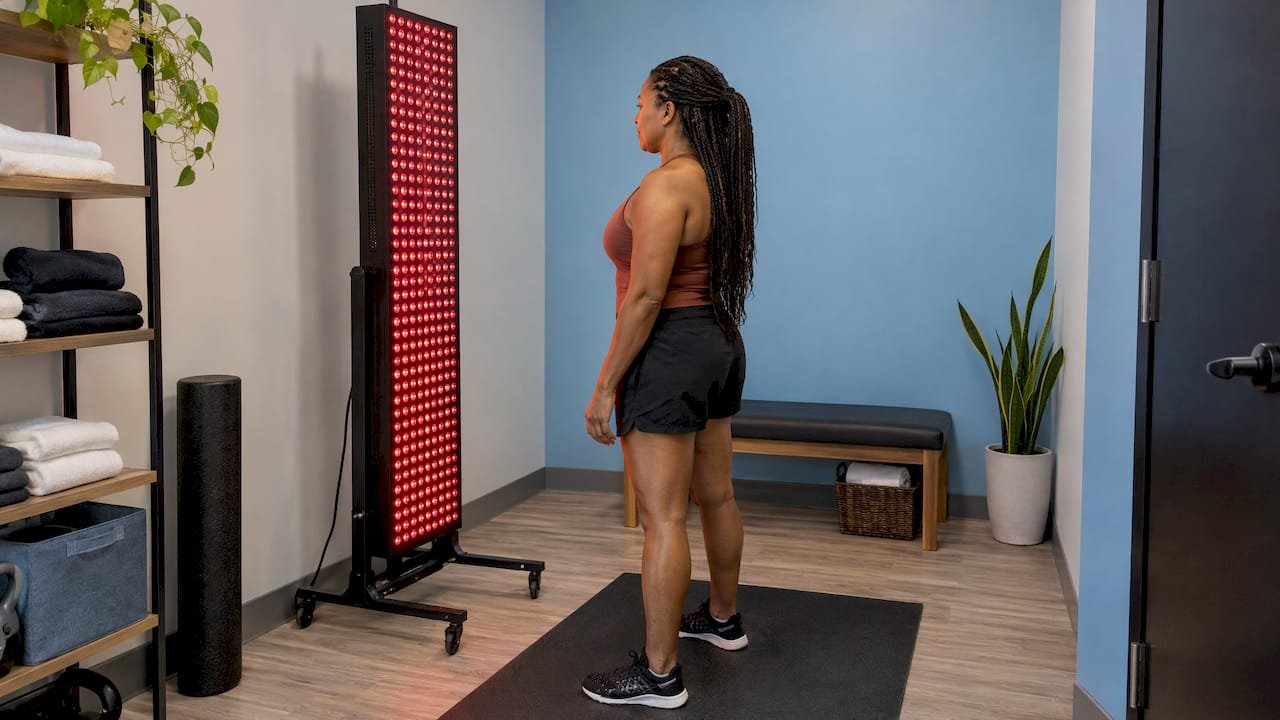
Red light therapy can take some of the sting out of delayed onset muscle soreness (DOMS), the deep ache that peaks a day or two after a hard session. Recent reviews of controlled trials point to the clearest benefit in the first 24 to 48 hours. It works best as one part of a recovery routine built on sleep, food and sensible training load, not as a stand-alone fix. This guide covers what the studies found, when to use it around a workout, what it costs, and how to fit it into a week that already has too much in it.
TL;DR
- DOMS usually shows up 24 to 72 hours after unfamiliar or hard exercise. Red light (photobiomodulation) is one of the recovery tools studied for it.
- A 2026 network meta-analysis of 35 studies found lower soreness at 24 and 48 hours, along with lower creatine kinase, a blood marker of muscle stress.
- Timing matters. The best-supported window is the first 48 hours, and sessions before or soon after training are the ones studied.
- Sleep, food, hydration and a sane training load still do the heavy lifting. Red light sits on top of them.
- At humn. in Gaithersburg, red light therapy is part of our recovery services, alongside sauna, compression and acupuncture.
Table of Contents
- What DOMS is, and why it shows up late
- How red light might help sore muscles
- What the studies found
- The 48-hour window
- When to use red light around a workout
- Safety: using red light well
- What a session costs in the US
- The basics still come first
- A sample week for a busy professional
- Make recovery part of your membership
- FAQ
- Sources
What DOMS is, and why it shows up late
DOMS is localized muscle tenderness, stiffness and pain. A 2025 review in PMC describes it as typically arising 24 to 72 hours after eccentric or high-intensity exercise, with temporary dips in strength, range of motion and performance. Eccentric work means the muscle lengthens under load: lowering a weight, running downhill, the slow part of a squat.
The working explanation is microtrauma. Hard or unaccustomed work creates tiny stresses in muscle fibers and connective tissue, which sets off localized inflammation. A November 2025 scoping review adds that DOMS can be told apart from an acute muscle strain by how it looks on imaging and how recovery unfolds. In plain terms: DOMS is a broad, achy tenderness that builds over a day or two and fades. A sharp pain during a lift, or a sudden pop, is something else and deserves a visit to your doctor.
For a busy professional, the cost is practical. You may have trained on Tuesday, but on Thursday you are stiff at your desk, short on sleep and dreading Friday’s session. That is why recovery tools get so much attention.

How red light might help sore muscles
Red and near-infrared light is delivered by LED or laser devices. Researchers call it photobiomodulation (PBM) or photomodulation therapy (PMT). The proposed mechanisms, as summarized in the same PMC review, include better circulation, reduced inflammation, support for tissue regeneration and a boost to ATP production, the energy currency of cells.
Lance Dalleck, PhD, writing for the American Council on Exercise, explains why this matters after a workout. Exercise damages the muscle membrane and contractile proteins, which impairs glucose transport and glycogen replenishment. Improved circulation and mitochondrial activity are the two main responses to red light, and both line up with what a damaged muscle needs.
What the studies found
The evidence base has grown quickly. Here are the main reviews, in plain numbers.
| Review | What it pooled | What it found |
|---|---|---|
| Li et al., October 2026 | Network meta-analysis of 35 studies | Lower DOMS scores versus control or placebo at 24 h (MD −18.20) and 48 h (MD −19.46), with lower creatine kinase at both points |
| Tsou et al., July 2025 | 14 controlled studies, wavelengths 660 to 950 nm | Less pain at 72 h (SMD −0.55) and 96 h (SMD −0.56); better muscle strength at 24 h (SMD 0.97) and 48 h (SMD 0.99) |
| Chen et al., June 2025 | Bayesian network meta-analysis | Better than placebo for DOMS at 24 h (−3.91) and 48 h (−5.24) |
| Canez et al., 2025 | 19 studies, 672 participants | Red light applied before exercise reduced soreness (MD −12.27 points) and raised muscle performance at 24 h |
The authors of the Tsou review concluded that PMT may be effective for managing DOMS. A meta-analysis of 24 randomized trials on low-level laser therapy also found better lower-limb strength at 24, 48 and 96 hours, plus lower soreness and lower blood markers of muscle damage.
How to read those numbers
Two points keep the numbers in perspective. First, the scales differ. Some studies score soreness on a 0 to 100 scale, others on 0 to 10, so the figures are not comparable across rows. The takeaway is direction and timing, not a single magic number. Second, the Li authors note that less soreness does not by itself prove the muscle has repaired faster. Pain relief may involve how nerves signal and how the tissue feels locally, and expectations also shape how sore you feel. That is a useful reminder for training: if soreness drops, still respect the load you put on that muscle over the next few days.
The 48-hour window
The Chen analysis found the benefit for PBM sits in the first 48 hours. Past that point, no physical therapy modality it examined stood out from placebo. That fits how DOMS behaves, since it tends to peak between one and three days after the session and then fade on its own.
The practical reading is that red light is most useful when you want to feel better during that early stretch: the morning after a leg day, or before a second hard session later in the week. It is less about rescuing a week-old ache.
When to use red light around a workout
Both pre-exercise and post-exercise use appear in the research. The Canez meta-analysis looked at light applied before exercise. The low-level laser meta-analysis recommends use before or after competition so athletes can regain capacity sooner. For a full walk-through of the timing options, see red light before or after a workout, or our own guide on red light before a workout.
A simple way to choose:
- Before a session you expect to be hard. Many of the trials used pre-exercise light, so this is the best-studied slot, especially if you are trying something new such as heavier eccentric work.
- Soon after a session. Post-workout use fits naturally into a recovery block, and it is easy to do right after you train when you are already on site.
- The next morning. If DOMS has arrived, a session within the 24 to 48 hour window lines up with when the reviews saw the clearest effect.
There is no universally agreed schedule. Dalleck notes there are no specific guidelines yet for frequency, intensity, time and type, so a purposeful trial-and-error approach makes sense. Keep notes: which muscles, how long after training, how you felt at 24 and 48 hours. Our page on red light therapy dosage goes deeper on how long, how often and how strong.
Why device and dose matter
Studies used wavelengths from 660 to 950 nm applied to one to six points on the affected muscles. Dose follows a biphasic pattern: too little does little, and too much can blunt the effect. A July 2026 review notes that effects depend on dose, wavelength, timing, the muscle treated, training status and sex. A result from one panel in one study does not automatically carry over to another. Dalleck also points out that many home and gym devices are less powerful than research-grade equipment. If you are trying red light for DOMS, consistency of setup, same device, same distance, same time after training, makes your own notes far more useful.
Safety: using red light well
Red light therapy is generally considered low risk when used as directed. The side effects reported are usually mild, such as temporary warmth or skin redness. Use the eye protection that comes with the device, and keep sessions to the time and distance you have been given. If you are pregnant or take medication that makes your skin sensitive to light, check with your doctor first. Dalleck also advises consulting your medical team before adding red light to a recovery plan if you have a medical condition.
If your soreness is sharp, one-sided, comes with swelling, or does not ease after several days, see your doctor. That is not DOMS. For more on skin tone, dose and safety, see our guide to red light therapy risks.
What a session costs in the US
Prices vary by setting and body area. Brown University Health puts sessions at $25 to $200 depending on the area treated, and notes red light therapy is not usually covered by insurance. A CareCredit analysis of the 2024 Synchrony Average Procedural Cost Study reported a national average of $55 per session, a range of $43 to $106, and a Maryland average of $64. Those are published figures for 2024 and 2025, and local prices move, so treat them as a ballpark. Our breakdown of red light therapy cost compares clinic and at-home pricing.

The real question for a regular trainer is not the price of one session. It is whether you will actually go often enough, and at the right time after training, for it to matter. That is a scheduling problem more than a money problem.
The basics still come first
A Medical Xpress report from April 2026 describes strong, consistent evidence for quality sleep, good nutrition, hydration and adequate rest between sessions, with red light evidence described as emerging. A narrative review states that sleep is essential for recovery, that athletes often struggle to reach the recommended 7 to 9 hours, and that more sleep can improve sprint time, reaction time and aerobic capacity. The same review says training load has to be planned across weeks and months, because too little recovery risks overreaching.
That is good news. It means the highest-return moves are free and within your control:
- Protect 7 to 9 hours of sleep, especially the night after a hard session. Our guide to sleep and muscle recovery lays out the habits.
- Eat enough protein and total food, and drink water through the day.
- Space hard sessions for the same muscle groups so you are not training on top of peak soreness.
- Finish workouts with a short cool down routine.
- Build the week around a 24-hour recovery plan so red light becomes a deliberate step, not a random add-on.
Red light is then a way to fine-tune a routine that is already working.
A sample week for a busy professional
Here is how this can look for someone training three times a week around a full calendar.
- Monday, heavy lower body. Red light before or soon after the session. Sleep target of 7 to 9 hours that night.
- Tuesday morning. Expect tightness. A short red light session in the 24-hour window, a walk, protein at every meal.
- Wednesday. DOMS is typically at its peak around now, so a lighter upper-body or mobility day makes sense. Another recovery session if you are still tender.
- Thursday. Soreness should be fading. Note how you feel before deciding on Friday’s load.
- Friday. Second hard session, with red light beforehand if you want to test the pre-exercise slot.
The point is the pattern: light, food and sleep arranged around training, then adjusted using your own notes. If you are new to a movement, start lighter. DOMS is strongest when exercise is unaccustomed.
What we think at humn.
We do not treat red light as a magic switch. It is one piece of a recovery system, and recovery is one piece of how you build strength that lasts.
That is why humn. is built around four pillars: Resist, Recover, Renew and Rhythm. Strength training, recovery access and lifestyle coaching live under one roof, so soreness gets handled with a plan rather than a guess. Red light therapy, sauna, compression and acupuncture are available as part of recovery, and your coach can help you connect them to your training, your sleep, your stress and your nutrition.
What busy people need is not another gadget. They need a rhythm they can keep: training that fits the calendar, recovery that follows the hard sessions, and habits that hold up in a heavy work week. Our approach is habit-first and behavior-based, with structured progress tracking and long-term support, so you can see whether what you are doing is working for you.
If you are sore after every session and not sure whether it is the program, the sleep or the recovery, that is exactly the kind of question a coach can untangle with you.
Josh
Make recovery part of your membership
If you train in or around Gaithersburg and want recovery built into your week, humn. is a boutique coaching facility where small-group personal training, 1-on-1 coaching and recovery services work together. Red light therapy, sauna, compression and acupuncture are available through our recovery services, and your coach helps you decide what fits your training and your schedule.
To see how training, recovery and coaching come together, explore humn. membership. If nutrition is the missing piece of your recovery, our 1:1 nutrition coaching covers eating habits alongside your training.
FAQ
Does red light therapy help with sore muscles?
Reviews of controlled trials say it can. A 2026 network meta-analysis of 35 studies found lower DOMS scores at 24 and 48 hours versus control or placebo, and a 2025 meta-analysis found less pain and better strength in the days after hard exercise. Results depend on the device, dose and timing, so most people do best by keeping a consistent routine and tracking how they feel.
How soon should I use red light after a hard workout?
The clearest benefit in the research falls within the first 48 hours. That covers a session soon after training and one the next morning when soreness arrives. Studies also tested light before exercise, so using it ahead of a hard session is a reasonable option too.
How much does a red light therapy session cost?
Published US figures vary. Brown University Health lists $25 to $200 per session depending on the area treated, and a 2024 cost study cited by CareCredit gave a national average of $55 and a Maryland average of $64. Insurance usually does not cover it. Prices change, so check current local rates.
Is red light therapy safe?
It is generally low risk when used as directed. Reported effects are usually mild, like warmth or redness. Use eye protection, and talk with your doctor first if you are pregnant, take medication that increases light sensitivity, or have a medical condition. Sharp or persistent pain is not DOMS and needs a medical check.
Sources
- Effects of Photomodulation Therapy for Delayed Onset Muscle Soreness (PMC)
- Effects of Photomodulation Therapy for DOMS, systematic review (MDPI)
- Advances in Non-Pharmacological Strategies for DOMS (PMC)
- Red Light Therapy and Post-exercise Recovery (ACE Fitness)
- Effects of different recovery and regeneration modalities (PMC)
- Differences in the Effectiveness of Different Physical Therapy Modalities (PMC)
- Effects of photobiomodulation, intermittent pneumatic compression and related modalities (PubMed)
- Effects of Low-Level Laser Therapy on Muscular Performance (PMC)
- Photobiomodulation (Red and Near-Infrared Light Therapy) review (Quality in Sport)
- Red Light Therapy: Benefits, Safety and Things to Know (Brown University Health)
- What Is Light Therapy? Types, Pricing and How it Works (CareCredit)
- Biohacks or basics? What actually works in exercise recovery (Medical Xpress)
- Fundamentals or Icing on Top of the Cake? (PMC)
- Red Light Therapy Before or After a Workout: Which Is Better?
No Comments.