

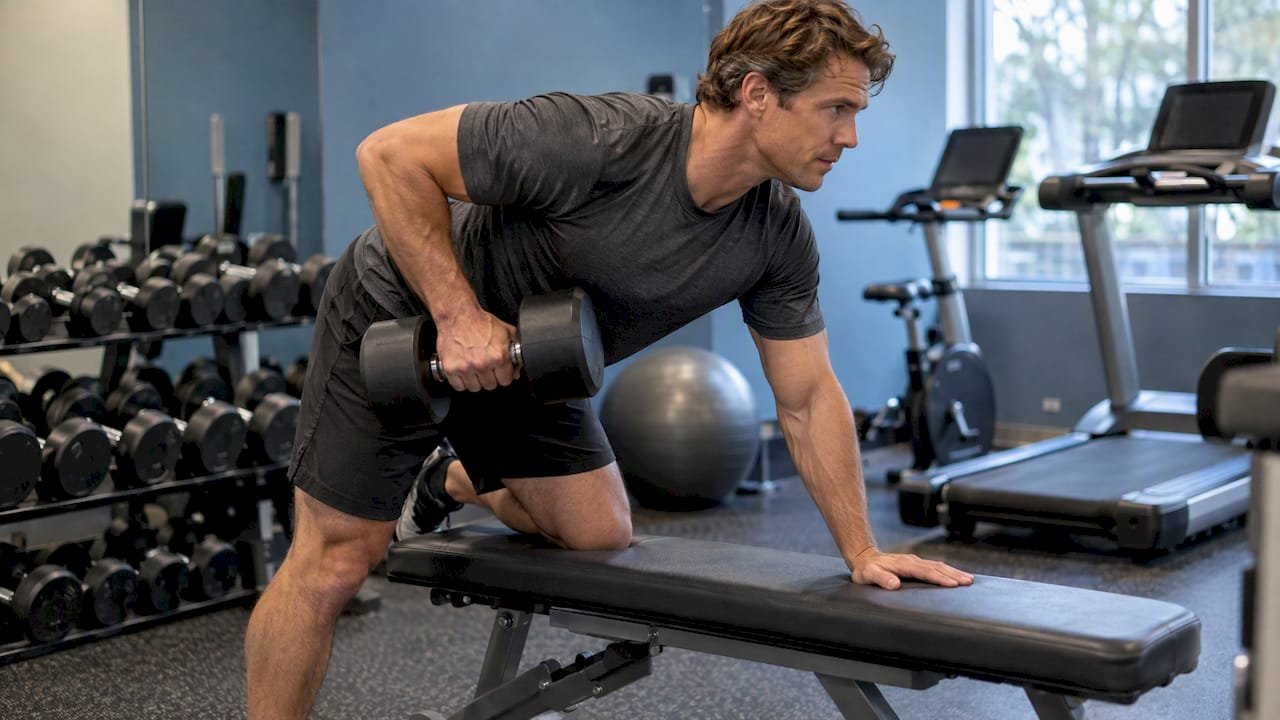
A good hotel gym workout needs three things: a pair of dumbbells, a bench or a wall, and 30 to 40 minutes. Pick one squat, one hinge, one push, one pull and one carry or core move. Do 2 to 3 sets of each, and repeat the session two or three times during the trip. That meets the CDC’s baseline of muscle-strengthening on at least 2 days a week, even when the room is a closet with a treadmill.
Below you’ll find three full-body sessions you can run with almost nothing, ways to adjust when the equipment is thin, and a plan for the trip itself.
TL;DR
- Train all major muscle groups at least 2 days a week. The CDC says 1 set of 8 to 12 reps counts, and 2 to 3 sets add more benefit.
- Build every session from five patterns: squat, hinge, push, pull, core. Any dumbbell rack covers all five.
- When the weights are light, slow the tempo, work one limb at a time, shorten rest and go to 15+ reps.
- The best plan is the one you’ll do. Two short sessions on the road beat a perfect plan you skip.
- Check the gym before you book or when you check in. Many hotels now offer yoga kits, apps or local studio passes.
Table of Contents
- What a hotel gym actually gives you
- The rules that make a thin gym work
- Three hotel gym workouts you can run this week
- If the gym has a cable machine, a rack or only cardio
- Make it fit the trip
- Our perspective
- Keeping the habit when you’re home
- Train with a coach at humn.
- FAQ
- Sources
What a hotel gym actually gives you
Hotel gyms vary a lot. Some have a full rack of dumbbells up to 50 pounds, a cable column and a bench. Others have a treadmill, an elliptical and a set of dumbbells that stops at 25 pounds. Hotels are investing here: nearly all of Hilton’s 5,400 U.S. hotels now have a Peloton bike, and business-travel coverage in WWD describes hotels moving past basic treadmills toward in-room fitness apps, yoga equipment and partnerships with local studios. Strength equipment is still the weak spot.
So plan for the minimum. Before you pack, look at the hotel’s amenities page or call the front desk and ask three questions:
- What is the heaviest dumbbell?
- Is there an adjustable bench, a cable machine or a squat rack?
- Is the gym open early, and is it 24-hour with a key card?
Also ask whether the hotel offers yoga mats, bands, an app or a studio partnership. Travelers often don’t think to ask, and some boutique and higher-end properties include these at no cost.
The rules that make a thin gym work
You don’t need a heavy barbell to train well. The ACSM’s 2026 resistance training update says the most meaningful gain comes from moving from no resistance training to any resistance training. It also says that bodyweight and resistance-band work are effective, and that advanced techniques like training to momentary failure aren’t needed for general health and fitness.
That shapes the plan:
- Cover the whole body. Legs, hips, back, chest, abdomen, shoulders and arms, as the CDC lists them.
- Use 8 to 12 reps as your default. If the weights are too light for that range to feel hard, move to the tricks below.
- Keep it short. Two or three sets per exercise is enough. Our own guide to time-efficient strength training explains why 2 to 3 focused sessions a week beat long, irregular ones.
When the dumbbells are too light
Practitioners compensate for limited loads with intensity techniques. These are the ones that work in a hotel room:
- Slow the tempo. Take three seconds to lower the weight, pause for one, lift in one, and squeeze for one. A 25-pound dumbbell feels much heavier.
- Go single-limb. Single-leg Romanian deadlifts, split squats and one-arm rows double the load on each side without adding weight.
- Cut rest. Drop it to 30 to 45 seconds between sets.
- Go high-rep. Sets of 15 or more with light dumbbells or bodyweight build muscular endurance when you can’t load heavy.
You may have heard of the 6-12-25 method, which stacks 6 heavy, 12 moderate and 25 light reps in a giant set. It can be a fun finisher when you have a single dumbbell, but it isn’t required. Keep the basics first.
Three hotel gym workouts you can run this week
Each session takes 30 to 40 minutes. Do a 5-minute warm-up first: easy bike or walk, then 10 bodyweight squats, 10 hip hinges, 10 arm circles and a short plank.

If you’re away for a week, run A on day one, B on day three and C on day five, or repeat A and B only. Two sessions meet the CDC guideline.
Workout A: dumbbells and a bench
| Exercise | Sets x reps | Notes |
|---|---|---|
| Goblet squat | 3 x 10 | Hold one dumbbell at your chest; 3-second lowering |
| Dumbbell bench press | 3 x 10 | Use an incline if the bench adjusts |
| One-arm dumbbell row | 3 x 10 per side | Brace a hand on the bench |
| Dumbbell Romanian deadlift | 3 x 12 | Soft knees, flat back, slow lowering |
| Seated or standing overhead press | 2 x 12 | Stop two reps short of failure |
| Plank | 3 x 30 to 45 seconds | Squeeze glutes |
Rest 60 seconds between sets. If the bench press feels too light, slow the lowering to four seconds and pause at the chest.
Workout B: light weights, single-limb focus
Use this one when the heaviest dumbbell is 20 pounds or less.
| Exercise | Sets x reps | Notes |
|---|---|---|
| Rear-foot-elevated split squat | 3 x 10 to 12 per leg | Back foot on the bench |
| Single-leg Romanian deadlift | 3 x 8 to 10 per leg | Touch the wall for balance if needed |
| Push-up with feet elevated | 3 x as many as you can with good form | Feet on the bench |
| Single-arm row | 3 x 12 per side | 3-1-1-1 tempo |
| Lateral raise | 2 x 15 | Light and strict |
| Suitcase carry | 3 x 30 seconds per side | Walk the length of the room |
Rest only 30 to 45 seconds. These sets burn, and that’s the point.
Workout C: circuit when you only have 25 minutes
Set a timer. Do each move for 40 seconds, rest 20 seconds, and complete four rounds.
- Goblet squat
- Push-up
- Dumbbell row (alternate arms)
- Reverse lunge
- Dead bug or plank
Finish with 5 minutes of easy cardio. This isn’t a muscle-building program, but it keeps your strength habit alive on a day your calendar falls apart.
If the gym has a cable machine, a rack or only cardio
A cable column lets you add face pulls, cable rows, tricep pushdowns and Pallof presses. Use it for your pull and core work in Workout A.
A smith machine or squat rack lets you use heavier loads. For strength, the ACSM’s update points to loads near 80% of your one-rep max for 2 to 3 sets. For muscle growth, it points to roughly 10 hard sets per muscle group each week. You won’t get 10 sets in a 3-day trip, so don’t chase it. Use the heavier loads to maintain what you have built.
Cardio only? Use the room anyway. Do bodyweight squats, lunges and push-ups on the floor, and ask the front desk for a yoga mat or towel. If you carry a resistance band (it weighs almost nothing), you can add rows, presses and pull-aparts to every workout.

Make it fit the trip
The most common reason people skip training on the road isn’t the equipment. It’s that the day is full. Stuart Phillips of McMaster University says the best resistance program is the one you’ll stick with. For a traveler, that means a plan you can run in the time you actually have.
Some ways to make that happen:
- Book the session like a meeting. Put 30 minutes on your calendar before the first call, not after the last dinner.
- Use the shorter version. If Workout A is too long, do the first four exercises with two sets each.
- Pack light. A band, a jump rope and a pair of lifting shoes or flat sneakers fit in a carry-on.
- Walk the rest. Take calls on foot, take the stairs and walk to meetings when you can. It doesn’t replace lifting, but it helps.
If you want more ways to protect training time, we’ve written about prioritizing fitness with a busy schedule and about what a sustainable weekly schedule looks like.
Sleep, jet lag and recovery on the road
Travel can wreck sleep, and that affects how hard you can train. On heavy travel days, lower the effort. Do two sets instead of three, and stop well short of failure. Hydrate, and keep your last hard set a few hours before bed. If the hotel has a sauna, treat it as a bonus, not a requirement. If you use one, keep it short and well before bedtime; our notes on sauna for sleep timing explain how.
If you have a health condition
The CDC says some activity is always better than none for adults with chronic conditions. Travel can change your access to equipment and support, so talk with your doctor or physical therapist before the trip about which exercises and intensities are right for you. If you have a heart condition, are pregnant, or are recovering from an injury, get that guidance before you pick a program from this page.
Our perspective
We coach busy professionals in Gaithersburg, and travel weeks are where good routines usually break. Most of the people we work with don’t lose progress because the hotel gym was bad. They lose it because they treated the trip as an exception and stopped altogether.
Our approach is built on habits first. We think about strength as one part of a larger system: how you train, how you recover, how you sleep, how you eat and how you manage stress. On the road, you can’t control most of that. You can control one thing: a short, repeatable session that keeps the habit alive.
So we tell members to decide before they leave. Choose the two days. Choose the workout. Know what you will do if the gym is bad. Then the decision is made, and the only work left is showing up. When you get home, you return to the program, with a coach who sees what you did and adjusts the plan, instead of starting over.
If you’re newer to lifting, progressive strength training is the foundation. Once you know how to add load gradually at home, a hotel week is easy to handle.
— Josh
Keeping the habit when you’re home
A hotel workout is only as useful as the routine it plugs into. If you train 2 to 3 times a week at home, a trip with two short sessions is a small dip, not a reset. If you don’t, the trip is just another reason to wait.
Two guides on our site go deeper on what a steady home routine looks like: how 90 minutes of strength training a week builds a base and our busy professional workouts. Both are built for people with full calendars and frequent travel.
Train with a coach at humn.
At humn. in Gaithersburg, we combine small-group personal training, 1-on-1 coaching and recovery access in one place. Members work with dedicated coaches on programming that covers strength, sleep, stress and nutrition, so a travel week fits into a plan instead of interrupting one. Recovery options include sauna, compression, red light therapy and acupuncture.
If you want a program that travels with you, see how membership works or look at our recovery services. If nutrition is the weak point on the road, there is also 1:1 nutrition coaching.
FAQ
What are the best exercises to do in a hotel gym?
Start with the five basic patterns: a squat (goblet squat), a hinge (Romanian deadlift), a push (dumbbell press or push-up), a pull (one-arm row) and a core move (plank or carry). Together they hit every major muscle group the CDC lists. Add single-leg versions when the dumbbells are light.
What is the 6-12-25 rule?
It’s a giant-set method from strength coach Charles Poliquin: you do 6 heavy reps, 12 moderate reps and 25 light reps of different exercises back to back, as Tom’s Guide describes. It’s a tough finisher but isn’t needed for general fitness. Plain sets of 8 to 12 reps are enough to start.
Does every hotel have a gym?
No. Many do, but size and equipment vary widely, so check the hotel’s amenities page or call before booking. Ask about the heaviest dumbbell, the bench and the hours. If there isn’t a gym, a band and bodyweight sessions in your room still count.
How many times should I work out on a trip?
Two strength sessions a week meet the CDC’s muscle-strengthening guideline for adults. If you’re traveling for three days, one or two 30-minute sessions is a realistic goal. Add walking on the other days.
Sources
- CDC: What Counts as Physical Activity for Adults
- CDC: Physical activity guidelines for adults with chronic health conditions
- ACSM: Updated Resistance Training Guidelines
- Hilton: Hilton and Peloton team up to enhance travel wellness
- WWD: Hotels Are Hustling to Keep Travelers Active, Rested and Well
- BarBend: The Best Hotel Gym Workout
- Tom’s Guide: The 6-12-25 workout method
No Comments.