


If your only goal is showing up consistently, morning workouts usually win. If you’re chasing peak strength or performance, evening training has the edge. And if you care about long-term heart health above all else, the largest cohort data points to early afternoon.
- Prioritize morning if you’re building a new habit, want appetite regulation, or need your sleep schedule anchored.
- Prioritize evening if you’re chasing strength gains, high-intensity output, or need stress relief after work.
- Consider midday or a hybrid split if your schedule is flexible or you’re optimizing for long-term cardiovascular health.
Start today by picking one lane and running it for two to three weeks before you judge it. The evidence base here isn’t thin: a 12-week trial published in Scientific Reports tracked fat loss against vascular health by time of day, a cohort of more than 90,000 people linked afternoon activity to lower mortality risk, and the American Heart Association still says none of this matters if you’re not hitting your weekly minutes.
Key Takeaways
The best workout time depends on your goal: mornings favor fat loss and sleep regulation, evenings favor strength and performance, and afternoons show the strongest link to long-term heart health.
| Point | Details |
|---|---|
| Morning wins for habits and fat loss | A 12-week trial found morning exercisers saw greater fat loss and improved cholesterol markers than evening exercisers. |
| Evening wins for performance | The same trial found evening training produced larger gains in vascular function, and strength typically peaks in the afternoon and evening. |
| Afternoon shows the strongest longevity signal | A cohort of more than 90,000 people linked afternoon exercise to lower risk of early death and heart disease. |
| Total weekly activity beats timing | The American Heart Association and CDC both prioritize hitting 150 minutes of moderate activity weekly over choosing a specific hour. |
| Personalized coaching helps you test and lock in a time | humn.'s 1-on-1 coaching builds training schedules around your actual sleep, stress, and energy patterns rather than a generic time slot. |
Table of Contents
- Morning vs Evening Workouts: What Mornings Do Best
- Morning vs Evening Workouts: Why Evenings Perform Better
- What the Data Says About Midday Exercise
- How to Choose Your Best Workout Time
- The Research Behind Morning vs Evening Training
- Practical Tips for Training at Any Hour
- Build a Schedule That Actually Fits Your Life
- Frequently Asked Questions
- Sources
Morning vs Evening Workouts: What Mornings Do Best
Morning training has a reputation for building habits that stick, and there’s a physiological case behind it too. A 2025 trial in Scientific Reports found that adults who trained between 6 and 8 a.m. for 12 weeks saw faster reductions in body fat, along with improved cholesterol and triglyceride numbers, compared to evening exercisers in the same study. Morning sessions also tend to advance your sleep-wake cycle, nudging your body clock earlier in a way that can make falling asleep easier at night.
The trade-offs are real, though:
- Strength and power output are typically lower first thing in the morning, since your core temperature hasn’t peaked yet.
- Joints and muscles are stiffer, so a rushed five-minute warm-up won’t cut it.
- Energy and motivation can lag if you’re not naturally an early riser.
Pro Tip: Give yourself 10 to 15 minutes of progressive warm-up before anything intense in the morning, starting with easy cardio and dynamic stretches before you load a bar. A small carbohydrate snack beforehand, like a banana or a slice of toast, helps offset lower morning blood sugar.
If you’re heading out before sunrise, wear reflective gear and stick to lit routes. Visibility, not fitness, is the real risk factor in early sessions.
Morning vs Evening Workouts: Why Evenings Perform Better
Evening exercise tends to outperform morning sessions on nearly every performance metric that matters for lifting and high-intensity work. Strength, power, and flexibility typically peak in the late afternoon and early evening, driven by rising core body temperature and sharper motor coordination as the day goes on. The same Scientific Reports trial found evening exercisers saw larger improvements in vascular function, including blood flow and carotid artery dilation, than morning exercisers did.
Evening training carries its own upside beyond raw output:
- Higher tolerance for high-intensity intervals and heavy lifting.
- A built-in outlet for stress after a demanding workday.
- More flexibility for group classes or training with a partner.
The downside centers on sleep. Harvard Health notes that light-to-moderate evening movement rarely disrupts sleep, but intense sessions too close to bedtime can raise core temperature and cortisol enough to delay it. Unpredictable evening schedules, whether from work or family, also make evening training the first thing to get skipped.
Pro Tip: Finish any high-intensity session at least 60 minutes before bed, and use the last 10 minutes for a slow cool-down and stretching to bring your core temperature back down before you try to sleep.

What the Data Says About Midday Exercise
Afternoon exercise may carry the strongest long-term health signal of any time slot. A cohort analysis of more than 90,000 participants found that people who worked out in the afternoon had a lower risk of early death and lower heart disease risk than those who trained in the morning or evening, with the effect strongest among men and older adults.
Part of the explanation is timing with your body’s natural rhythm. Oxygen uptake efficiency and core temperature tend to be climbing through early afternoon, right before they peak in the evening, giving midday sessions a physiological head start over dawn workouts without the late-night sleep trade-offs.
- Pro: flexible for people without a fixed 9-to-5, and it splits the difference between morning consistency and evening performance.
- Con: lunch breaks and meeting schedules make it the hardest slot to protect long term.
How to Choose Your Best Workout Time
Picking a time isn’t about finding the universally “correct” answer. It’s about matching the evidence to your specific goals and constraints.
- Rank your primary goal. Fat loss and sleep regulation lean morning; strength and performance lean evening; longevity signals lean afternoon.
- Know your chronotype. Natural early risers report less perceived strain training early; night owls often feel the same way in the evening.
- Map your real schedule, not your ideal one. The best time is the one you’ll actually protect for months, not weeks.
- Weigh social and safety factors. Evening classes might mean better group energy; early sessions might mean quieter streets but darker ones.
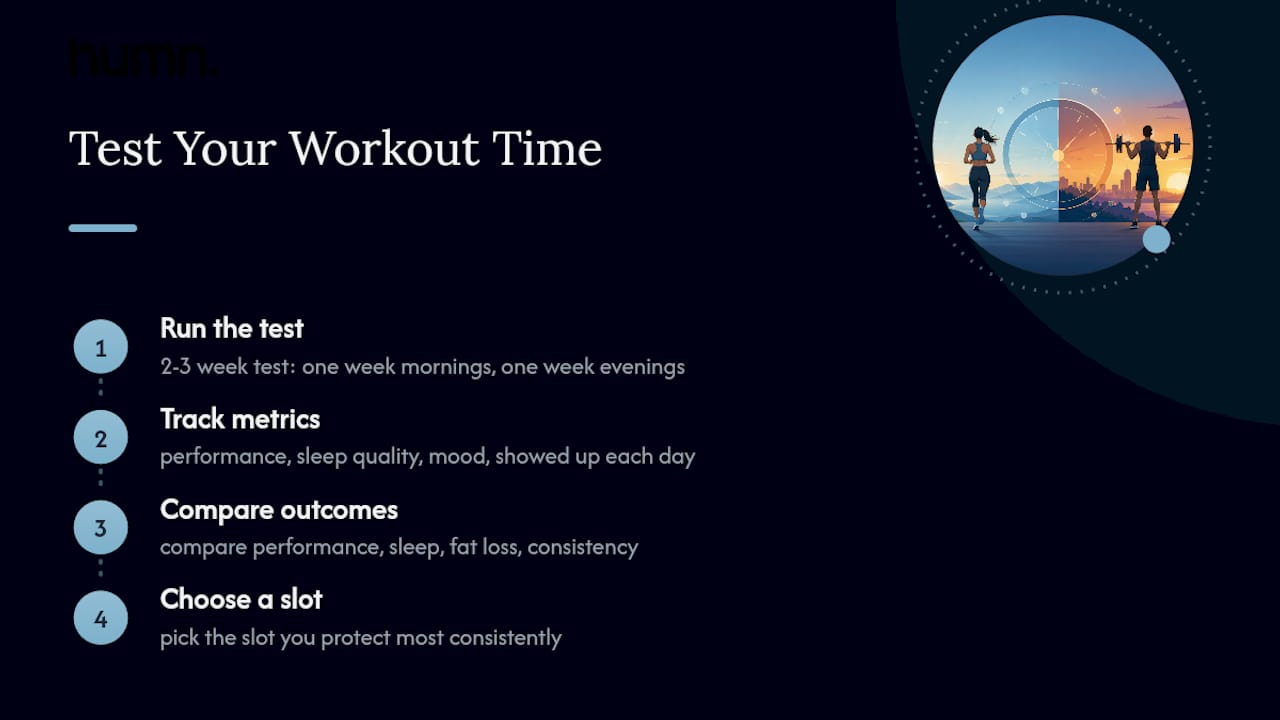
Once you’ve ranked those factors, run a short experiment instead of guessing:
- Train mornings for one full week, then evenings for one full week.
- Track four things daily: performance (weight lifted or pace), sleep quality, mood, and whether you actually showed up.
- Ask yourself which session you dreaded skipping less. That’s often more telling than any single data point.
- If a busy schedule keeps sabotaging either window, these scheduling strategies are worth building into your test.
The Research Behind Morning vs Evening Training
The clearest evidence comes from a 12-week randomized trial in Scientific Reports, which split sedentary adults into morning (6 to 8 a.m.) and evening (6 to 8 p.m.) exercise groups. Morning training won on fat loss and cholesterol markers; evening training won on vascular function. Neither group “won” outright, which is the whole point: the right answer depends on what you’re measuring.
Layer in the cohort study of over 90,000 people pointing to afternoon activity and lower mortality risk, and you get a fuller picture across three different outcome types: body composition, vascular health, and long-term survival.
- Circadian research shows exercise timing can shift peripheral body clocks, which partly explains why morning training nudges your sleep-wake cycle earlier.
- Strength and coordination climb through the day as core temperature rises, favoring late-afternoon and evening lifting sessions.
- Cleveland Clinic frames all of this correctly: the biggest predictor of long-term benefit isn’t the clock, it’s whether you keep showing up.
None of this overrides the basics. The American Heart Association and CDC both anchor their guidance on hitting 150 minutes of moderate activity or 75 minutes of vigorous activity weekly, plus strength work twice a week, regardless of what time you get it done.
Practical Tips for Training at Any Hour
Fueling and warm-up habits matter more than the clock. Morning sessions need a longer warm-up and a light carb snack beforehand; midday sessions can run on your last real meal with minimal prep; evening sessions should end with a cool-down and, ideally, a protein-forward recovery meal within an hour.
Keep intense evening work at least 60 minutes from bedtime, and swap in mobility or light walking if you’re training later than planned.
Three templates worth copying:
- Morning: 10-minute warm-up, 20 minutes of steady cardio, 10 minutes of mobility.
- Midday: 45 minutes of strength training during a lunch break, minimal warm-up needed since your body’s already primed.
- Evening/hybrid: Light cardio in the morning, heavier strength work in the evening, splitting the benefits of both windows.
A coach’s take on timing
The clients who make the most progress aren’t the ones who found the “perfect” hour. They’re the ones who picked a time that fit their actual life and then trained at it for months, not days. At humn., that’s why our Rhythm pillar exists: aligning your training schedule with your sleep, stress, and energy patterns matters more than chasing an optimal window that doesn’t fit your calendar.
Build a Schedule That Actually Fits Your Life
Reading about morning versus evening training only gets you so far. Figuring out which window actually works for your sleep, your job, and your energy levels takes some trial and error, and that’s exactly where a coach earns their keep.

humn.'s 1-on-1 coaching is built for busy professionals who don’t have time to run their own two-week experiment. Your coach looks at your calendar, your sleep patterns, and your goals, then builds a training rhythm around them instead of asking you to rearrange your life around a workout slot. It’s the difference between guessing at a schedule and having someone map one to your actual chronotype and constraints. If you’re ready to stop testing on your own, book a consult and find the training window that will actually stick.
Frequently Asked Questions
Should I work out in the morning or at night if I want to lose fat?
Morning tends to have a slight edge for fat loss, based on the 12-week Scientific Reports trial showing greater reductions in body fat and improved cholesterol markers among morning exercisers. The difference isn’t massive, so pick the time you’ll actually stick with.
What is the best time of day to lift weights?
Late afternoon to early evening, generally, since strength and power tend to peak as your core body temperature rises through the day. If you can only train early, a longer warm-up narrows the gap.
Does exercising at night ruin your sleep?
Not usually, according to Harvard Health, light-to-moderate evening exercise doesn’t meaningfully hurt sleep for most people. The risk rises with high-intensity training done less than an hour before bed.
Is it better to work out at the same time every day?
Consistency matters more than the specific hour you choose. Cleveland Clinic points out that sticking with a routine predicts long-term results better than optimizing for a theoretically ideal time slot, and consistency-focused coaching tends to outperform sporadic “perfect” sessions.
How do I know if morning or evening workouts are better for me?
Run a two-to-three-week test: one week training mornings, one week evenings, tracking performance, sleep quality, mood, and whether you actually showed up each day. The slot you protect most consistently is usually your answer.
This article is general information, not a substitute for advice from a qualified doctor. Consult a qualified healthcare professional about your own circumstances before acting on anything here.
Sources
- PubMed: 12-week morning vs evening exercise trial (Scientific Reports, 2025)
- Business Insider: Afternoon exercise and lower risk of early death (2023 summary of cohort study)
- Cleveland Clinic: Does it matter what time of day you exercise? (2024)
- American Heart Association: When is the best time of day to work out?
- Centers for Disease Control and Prevention: Adult physical activity guidelines
No Comments.