


Balancing work, fitness, and social life is defined as the active management of your time, energy, and priorities through intentional habits rather than equal time splits. Most busy professionals fail at this not because they lack discipline, but because they chase the wrong model. The goal is not to give every area the same number of hours each week. The goal is to give each area what it needs, when it needs it, based on a weekly rhythm that shifts with your demands. Experts confirm that this dynamic approach prevents the burnout that rigid equal-time strategies produce.
Why trying to balance work, fitness, and social life equally every day fails
The most common mistake busy professionals make is treating balance like a daily math problem. If you spent three hours on work, you feel obligated to spend three hours on fitness and three on friends. That logic collapses under real-world pressure within a week.
Balance is dynamic, shifting focus based on current priorities rather than a fixed daily formula. A product launch week demands more work hours. A recovery week after illness demands more sleep and less training. Trying to force equal splits during either scenario creates guilt, not progress.
The deeper problem is perfectionism. When professionals set an unrealistic standard of perfect daily balance, any deviation feels like failure. That feeling compounds over time into chronic stress and eventually burnout. The research is clear: intentional imbalance, where you prioritize one or two life areas at a time, creates more sustainable progress than trying to do everything equally all the time.
Pro Tip: Run a weekly review every Sunday for 10 minutes. Ask yourself which area needs the most attention next week, then adjust your schedule before the week starts rather than reacting to it.
The professionals who sustain high performance across work, fitness, and social life think in weekly rhythms, not daily quotas. They accept that Tuesday might be all work, Thursday might be all gym, and Saturday might be all friends. The week as a whole is balanced. No single day has to be.
How to structure your schedule for work, fitness, and social priorities
Scheduling is where intention becomes behavior. Without a structured plan, work expands to fill every available hour, and fitness and social time disappear.
Set hard boundaries around work hours
Setting clear work start and end times with a closing ritual improves mental transition and protects your personal time. A closing ritual can be as simple as writing tomorrow’s top three tasks, closing all browser tabs, and shutting your laptop. That physical act signals to your brain that work is done. Without it, you stay mentally at your desk even when you are physically somewhere else.
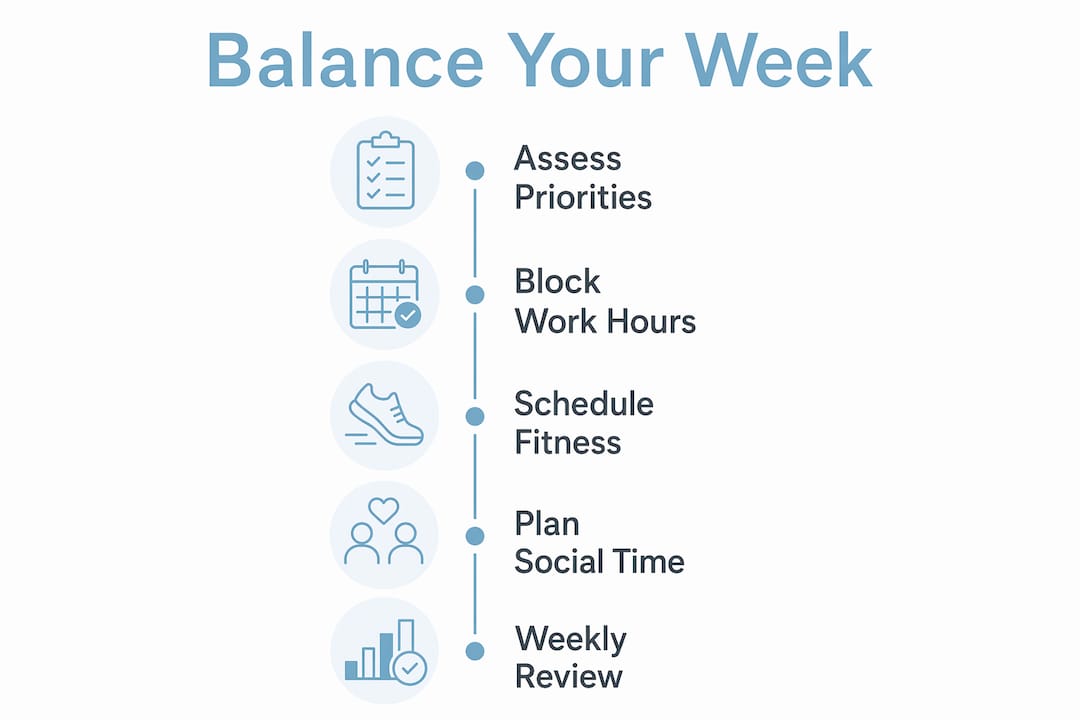
Use time-blocking for fitness and social time
Time-blocking is not just for work tasks. Block your workouts and social commitments into your calendar the same way you block meetings. Treat social and fitness activities as non-negotiable appointments to prevent work from encroaching on them. When a colleague asks for a 6:00 PM call on a day you have a gym block, you already have a conflict. That framing makes it easier to protect.

Break workouts into smaller sessions
Adults need at least 150 minutes per week of moderate-intensity aerobic activity for measurable health benefits. That is 30 minutes five days a week, or three 50-minute sessions, or even six 25-minute sessions. Breaking exercise into smaller consistent sessions removes the “I don’t have an hour” excuse entirely. A 25-minute walk at lunch counts. A 20-minute strength circuit before dinner counts.
Here is a sample weekly structure for a busy professional:
| Day | Work focus | Fitness | Social |
|---|---|---|---|
| Monday | Deep work blocks | 30-min morning lift | None |
| Tuesday | Meetings and admin | 20-min walk at lunch | Quick call with a friend |
| Wednesday | Deep work blocks | Rest or light stretch | None |
| Thursday | Meetings and admin | 45-min gym session | None |
| Friday | Wrap-up and planning | 30-min cardio | Evening with friends |
| Saturday | Off | Active outdoor activity | Social priority day |
| Sunday | Weekly review only | Rest | Family or close friends |
Pro Tip: Schedule your hardest workout of the week on the day after your lightest work day. Your energy will be higher and your performance in both areas will reflect it.
This structure is not rigid. It is a template you adjust weekly based on what each area needs most. The point is that fitness and social time appear in the calendar before the week starts, not after work claims everything else.
Why energy management matters more than time management
Time management tells you when to do things. Energy management tells you whether you actually have the capacity to do them well. For busy professionals, the second question matters more.
Sleep is the foundation. Experts recommend 7–9 hours nightly for optimal work productivity and fitness recovery. Poor sleep does not just make you tired. It reduces emotional regulation, impairs decision-making, and cuts workout performance. A professional running on five hours of sleep is not operating at full capacity in any domain, no matter how well their calendar is organized.
“Energy management is more effective than time management. Poor recovery causes tasks to cost more emotional and physical energy than necessary, leaving nothing for fitness or social connection by evening.”
Source: YourStory
Most professionals have a natural energy peak in the morning, a dip after lunch, and a secondary peak in the late afternoon. Matching your most demanding work to your peak hours means you finish that work faster and with less mental drain. That leaves real energy for a gym session or a social dinner, not just the physical presence of someone who checked out hours ago.
Physical activity itself feeds back into this cycle. Regular exercise improves cognitive function, emotional regulation, and stress resilience. Consistent movement habits that are repeatable and forgiving, such as a fixed morning walk or a standing gym appointment, build the energy floor that makes everything else sustainable. The goal is not to exhaust yourself at the gym. The goal is to move enough to keep your energy system running well.
How to combine fitness and social life without losing work performance
The most time-efficient strategy a busy professional can use is combining fitness with social connection. A solo gym session and a solo dinner with a friend are two separate time blocks. A workout with a friend is one.
Walking meetings replace sitting in a conference room and add movement to your day. A Saturday morning run with a colleague builds the relationship and the aerobic base simultaneously. Group fitness classes create a social environment around exercise, which research shows increases satisfaction more than the quantity of time spent in either activity alone. Quality of presence matters more than hours logged.
Practical ways to combine fitness and social time:
- Replace one weekly dinner out with a group hike, bike ride, or fitness class followed by a meal
- Schedule a standing weekly walk with a close friend or colleague instead of a coffee catch-up
- Join a recreational sports league that meets weekly, covering both fitness and social connection in one commitment
- Use rest days intentionally. A rest day is not a lost day. It is when your body consolidates the work you did and prepares for the next session
Saying no strategically is also part of this. Not every social invitation deserves a yes. Fitness goals require habits, not just intentions, and protecting your training schedule sometimes means declining a low-priority event. The key is being selective rather than absent. Show up fully for the commitments you keep, and decline the ones that drain without returning value.
Pro Tip: When you feel guilty about missing a social event for a workout, ask whether the event would have left you energized or depleted. Protect the activities that restore you.
The professionals who maintain strong social lives alongside demanding careers are not saying yes to everything. They are saying yes to the right things with full attention, which is exactly what quality presence means in practice.
Key Takeaways
Sustainable balance across work, fitness, and social life requires weekly rhythm management, energy-first scheduling, and treating personal commitments with the same protection as professional ones.
| Point | Details |
|---|---|
| Weekly rhythm over daily splits | Shift focus based on weekly demands rather than forcing equal time every day. |
| 150 minutes of movement per week | Break workouts into smaller sessions to meet the NIDDK activity standard without needing large time blocks. |
| Sleep is non-negotiable | Protect 7–9 hours nightly. Sleep loss reduces performance in every domain simultaneously. |
| Block fitness and social time first | Schedule personal commitments before work fills the calendar, treating them as protected appointments. |
| Combine fitness with social connection | Shared workouts and active outings cover both priorities in one time block, increasing efficiency and satisfaction. |
What I’ve learned about balance after years of watching people get it wrong
Most professionals I work with arrive believing their problem is time. They are convinced that if they could just find two more hours in the day, everything would fall into place. That is almost never the real issue.
The real issue is recovery. People are running on poor sleep, skipping rest days, and saying yes to every social obligation out of guilt rather than genuine desire. By the time they reach the gym or sit down with a friend, they have nothing left to give. The workout is half-hearted. The conversation is distracted. Neither experience delivers what it should.
What actually works is boring by most standards. Fixed sleep windows. A consistent training schedule that does not require heroic motivation. Social commitments that are protected and limited to what genuinely restores you. The Livehumn approach to this is built on exactly that principle: habits first, behavior second, performance as the result. Not the other way around.
The hardest thing to accept is that a week where you worked well, slept well, trained three times, and had one real conversation with someone you care about is a successful week. You do not need to do everything every day. You need to do the right things consistently over time.
— Josh
Livehumn’s approach to building a balanced, high-performance life
Busy professionals do not need more willpower. They need a system that accounts for recovery, strength, and real-life demands at the same time.

Livehumn in Gaithersburg, MD is built for exactly this. Through its four-pillar framework of Resist, Recover, Renew, and Rhythm, Livehumn integrates strength and conditioning coaching with dedicated recovery programming and lifestyle habits under one roof. Coaches work with you on sleep, stress, and nutrition alongside your training, so your fitness actually supports your work performance rather than competing with it. Whether you are starting fresh or rebuilding consistency, membership options are designed for long-term support, not short-term fixes. Explore recovery programming to see how structured rest fits into a performance-focused life.
FAQ
How many hours a week should I spend on fitness?
Adults need at least 150 minutes of moderate-intensity aerobic activity per week, which breaks down to about 30 minutes five days a week. Shorter daily sessions count equally toward that total.
What is the best way to protect social time from work?
Schedule social commitments as non-negotiable calendar appointments before the week starts. Treating them like meetings prevents work from claiming that time by default.
How does sleep affect work and fitness balance?
Poor sleep reduces emotional regulation and workout performance simultaneously. Protecting 7–9 hours nightly is the single highest-leverage habit for maintaining output across all three domains.
Is it realistic to balance work, fitness, and social life every day?
No. Sustainable balance is weekly, not daily. Shifting focus based on what each week demands prevents the burnout that comes from trying to do everything equally every single day.
How do I stay consistent with fitness during a heavy work period?
Break workouts into shorter sessions and protect even 20-minute movement blocks in your calendar. Fitness habits built on consistency rather than intensity hold up far better during high-demand work periods than ambitious training plans that require large time blocks.
No Comments.