


Yes, behavior-focused coaching reliably helps many people achieve clinically meaningful weight loss when it combines habit change, resistance training, and regular accountability. The clinical bar for success is a 5% reduction in body weight at a pace of about 1 to 2 pounds per week, and people who attend five or more coaching sessions hit that mark far more often than those who drop off early. The rest of this guide walks through the evidence, what a real program includes, and how to pick one, including where humn fits into the picture.
TL;DR:
- Attending at least five coaching sessions significantly increases the likelihood of achieving a 5% weight loss target in several studies.
- A sustainable weight loss pace of 1 to 2 pounds per week, achieved through about a 500-calorie daily deficit, is most recommended for long-term results.
- Behavior change techniques, such as goal-setting and habit stacking, are more crucial than specific diets in maintaining weight loss over time.
- Resistance training is prioritized in programs to preserve muscle mass and prevent metabolism decline during calorie restriction.
- The most effective coaching programs include regular, frequent sessions, focus on habit-building, and integrate sleep and stress management as key components.
Table of Contents
- How Effective Is Coaching for Sustainable Weight Loss?
- What Does a Sustainable Weight Loss Coaching Program Include?
- Who Actually Needs a Weight Loss Coach?
- How Does Weight Loss Coaching Actually Work?
- Practical Tactics That Make Coaching Programs Work
- What Should You Track to Measure Real Progress?
- How Do You Choose a Weight Loss Coach or Program?
- What I’d Tell a Friend Considering Coaching
- How humn Applies This Approach in Gaithersburg
- Ready to Build a Program That Actually Sticks?
- Sources
How Effective Is Coaching for Sustainable Weight Loss?
The strongest predictor of success in coaching isn’t the diet plan. It’s whether the person shows up.
A retrospective analysis of health coaching outcomes among overweight and obese adults found that people who attended five or more coaching visits had dramatically better odds of losing at least 5% of their body weight, an adjusted odds ratio of 5.23 compared to those with fewer visits. Having a specific weight-management goal mattered too, with an adjusted odds ratio of 4.5. Those numbers come from one program’s data, so treat them as a directional signal rather than a universal guarantee. Still, the pattern lines up with something coaches see constantly: consistency beats intensity.
That 5% threshold isn’t arbitrary. Clinical guidance on weight management and lifestyle interventions treats a 5% to 10% reduction in baseline weight as clinically meaningful, enough to improve blood pressure, blood sugar, and cholesterol markers even before someone reaches a long-term goal weight. Coaches use this as an early milestone precisely because it’s achievable in a matter of months and it builds momentum.
The pace matters as much as the target. Harvard Health’s guidance on calorie deficits recommends losing 1 to 2 pounds per week, usually achieved through a deficit of roughly 500 calories a day. That often lands in the range of 1,200 to 1,500 calories daily for many women and 1,500 to 1,800 for many men, adjusted for activity level and starting size. Cut deeper than that and you tend to lose more muscle than fat, which sets up the rebound weight regain that makes so many diets feel pointless in hindsight.
Here’s where the research gets honest about its limits. A look at variability across weight-loss program designs shows that outcomes swing widely depending on program intensity, visit frequency, and how long researchers tracked participants. Randomized trials with tightly controlled protocols often report larger early losses than real-world coaching programs do. That gap doesn’t mean coaching fails. It means results depend heavily on how the program is structured and how long someone stays engaged.
What the evidence supports, in short:
- Five or more coaching sessions correlates with significantly higher odds of reaching a 5% weight-loss target.
- A 1 to 2 pound weekly pace, driven by roughly a 500-calorie daily deficit, is the benchmark most clinical sources recommend.
- Program design and follow-up length explain much of the variation between studies, so no single number applies to every coaching format.
A 5% loss for a 200-pound adult is 10 pounds, achievable over a matter of months at the recommended pace, and it’s enough to move several health markers in the right direction.
What Does a Sustainable Weight Loss Coaching Program Include?
A program built for sustainable dieting support doesn’t start with a meal plan. It starts with behavior.
Most effective coaching leans on established behavior-change techniques: goal-setting, habit stacking, and self-monitoring. A narrative review of dietary and behavioral strategies found that adherence, not the specific diet chosen, predicts who keeps weight off long term. That’s a bigger deal than it sounds. It means the “best” nutrition approach is the one a person can actually follow for years, not the one that produces the fastest results on paper.
On the nutrition side, effective coaching for healthy eating avoids rigid rules in favor of flexible calorie management. Instead of banning entire food groups, coaches typically work with clients to hit protein and calorie targets while leaving room for real life, birthday cake included.

Exercise programming centers on resistance training, not just cardio. Strength training during calorie restriction helps preserve lean muscle mass and blunts the metabolic slowdown that often accompanies dieting. Cardio still has a role for cardiovascular health and calorie burn, but muscle preservation is what keeps the metabolism from tanking six months in.
Accountability ties it together. That might mean:
- Weekly or biweekly check-in sessions, in person or via video
- Digital food and activity logging through an app
- Regular weigh-ins paired with progress photos or measurements
- Group check-ins for shared motivation, alongside 1:1 sessions for individualized adjustments
Format matters here. One-on-one coaching allows for tighter customization and faster adjustments when something isn’t working. Small-group formats add peer accountability and tend to cost less per session. Hybrid models, some in-person and some digital, split the difference and often fit better into a packed work schedule.
Pro Tip: Reducing the number of daily decisions is often more powerful than any specific meal plan. A narrative review notes that behavioral fatigue drives regain more than any single food choice does, so a coach who helps you build two or three default meals removes dozens of small decisions a week.
Who Actually Needs a Weight Loss Coach?
Coaching isn’t for everyone chasing a number on the scale. It’s for people who already know what to do and still can’t make it stick.
Three profiles show up constantly among coaching clients:
- The repeat dieter. Someone who has lost the same 20 pounds three or four times and regained it every time, usually because the plan wasn’t built to survive real life.
- The plateaued exerciser. Someone who trains consistently but hasn’t seen the scale move in months, often because nutrition and recovery haven’t been addressed alongside the workouts.
- The busy professional. Someone with the income and motivation to change but not the bandwidth to research meal plans and training splits from scratch.
Beyond those profiles, a few concrete signs point toward needing coaching for healthy eating and structured accountability rather than another solo attempt:
- Difficulty staying consistent for more than a few weeks at a time
- Emotional or stress-driven eating that undoes progress made during the week
- A history of losing weight but regaining it within a year
- Feeling overwhelmed by conflicting nutrition advice online
One caveat worth stating plainly: anyone with a diagnosed medical condition, a history of disordered eating, or plans to lose more than a small percentage of body weight quickly should get medical clearance first. A good coach will ask about this during intake and refer out when something falls outside their scope, rather than pushing forward regardless.
How Does Weight Loss Coaching Actually Work?
Most programs follow a similar arc, even if the branding differs from one facility to the next.
Intake and assessment comes first. A coach gathers weight history, current habits, sleep patterns, stress levels, and sometimes baseline metrics like resting heart rate or body composition. This isn’t paperwork for its own sake. It’s what lets a coach spot the actual bottleneck, whether that’s late-night snacking, chronic under-sleeping, or a training program with no progressive overload.
Goal-setting follows, and it should go beyond a target number on the scale.
Session cadence is where a lot of programs quietly fail. Given the link between visit frequency and outcomes, five or more sessions in the first few months is a reasonable minimum to look for. Programs that offer a single kickoff call and then check in quarterly are unlikely to deliver the same results as ones with weekly or biweekly touchpoints.
Typical program length runs 12 to 24 weeks for an initial phase, though many clients continue longer once they see the maintenance benefits of ongoing support. This isn’t a fixed rule. It varies by starting point, goals, and how quickly habits take hold.
Adjustments happen throughout. A plateau at week eight might call for:
- A small calorie or macro adjustment rather than a drastic cut
- Added resistance training volume to counter muscle loss
- A closer look at sleep and stress, since both affect appetite regulation
- A recalibration of expectations if progress has actually been steady in ways the scale doesn’t show
Coaches who monitor for metabolic adaptation tend to favor small, incremental changes over abrupt deep cuts, since sudden restriction accelerates hunger and fatigue without producing better long-term results.
Practical Tactics That Make Coaching Programs Work
The theory behind sustainable weight loss is straightforward. The daily execution is where most people get stuck, which is why the tactical layer matters as much as the strategy.
- Build one micro-habit at a time. Start with something tied to an existing routine, like eating protein first at breakfast, and add a new habit every two to four weeks rather than overhauling everything at once.
- Design your environment, not just your willpower. Pre-made shopping lists, two or three default dinners, and visible healthy snacks at eye level in the fridge remove the need for constant decision-making.
- Balance resistance and cardio weekly. A time-efficient template for busy adults might look like three 45-minute resistance sessions and two 20-minute cardio sessions, structured around whichever days are realistically protected on the calendar.
- Prioritize protein and portion awareness over elimination. Hitting a protein target at each meal, then filling the rest of the plate with vegetables and a moderate carb portion, works better long-term than banning categories of food outright. For social meals, eating normally at the event and adjusting the following day’s meals is more sustainable than pre-restricting out of anxiety.
- Protect sleep and manage stress deliberately. Both directly affect appetite hormones, and poor sleep in particular is linked to increased hunger and cravings the next day.
- Track weekly, review monthly. Weekly weigh-ins under consistent conditions smooth out day-to-day water fluctuation, while a monthly review of measurements, strength numbers, and energy levels shows progress the scale alone misses.
Pro Tip: Behavioral fatigue, not lack of willpower, is what usually derails a diet by week six. Cutting the number of daily food decisions in half, through default meals and a short rotating grocery list, tends to matter more than optimizing any single macro number. Anyone looking for concrete weekly structures can see real training schedule examples that balance resistance work with recovery days. For a food-environment model built around minimally processed, whole-food defaults, RĀW Superfood Café’s approach illustrates how removing decision fatigue at the point of purchase supports the same principle.
What Should You Track to Measure Real Progress?
The scale tells part of the story. It’s rarely the most useful part on its own.
At a 1 to 2 pound weekly pace, a 180 pound adult would expect to reach a 9 to 18 pound loss, hitting that 5% mark, somewhere between 5 and 10 weeks.
Useful tracking methods beyond the scale:
- A tape measure at the waist, hips, and other key areas, taken monthly
- Strength benchmarks like how much weight you’re lifting on core exercises
- Sleep quality logs, since improved sleep often precedes visible fat loss
- Energy levels and mood, which tend to shift before the scale does
Plateaus of one to two weeks are normal and usually resolve with a small adjustment to calories or training volume. A plateau stretching past four to six weeks despite consistent adherence is the point to reassess tactics, and if fatigue, mood changes, or unusual symptoms show up alongside it, that’s the signal to involve a physician rather than push harder on the same plan.
How Do You Choose a Weight Loss Coach or Program?
Not every coach who calls themselves a “weight loss expert” is qualified to guide sustainable change, and the industry has essentially zero barrier to entry for anyone who wants to print business cards. A few concrete filters separate the credible options from the rest.
Look for these credentials and practices first:
- Formal training in behavior-change methods, not just a personal training certification
- Demonstrated experience programming resistance training for people mid-weight-loss, not only for athletes
- A clear system for measuring progress beyond the scale (photos, measurements, performance benchmarks)
- A stated plan for maintenance, not just the initial loss phase
During a consultation, ask questions that reveal how the program actually runs day to day:
- How often will we meet, and in what format?
- What does a typical first 90 days look like?
- How do you measure progress beyond body weight?
- What happens if I plateau for several weeks?
- Do you coordinate with my doctor if I have a medical condition?
- What’s your approach to strength training during a calorie deficit?
- How do you handle social events, travel, and real-life disruptions?
- What does the maintenance phase look like after I hit my goal?
- Can I see how you’ve adjusted a plan for someone who wasn’t progressing?
- What’s included in the price, and what costs extra?
Pricing varies widely by format and market. Group coaching programs often run cheaper per session than 1:1 work, while premium facilities that bundle coaching with recovery services, sauna, red light therapy, or dedicated strength programming typically charge more, reflecting the added access and personalization. Higher prices are justified when they come with more frequent contact, measurable tracking, and a real maintenance plan, not just a nicer studio.
Red flags worth walking away from:
- Guarantees of extreme, rapid weight loss with no mention of pace or safety
- No system for tracking progress beyond a bathroom scale
- Medical claims or supplement pushes outside a coach’s actual scope of practice
- Reluctance to explain what a typical session or program structure actually looks like
What I’d Tell a Friend Considering Coaching
Most people don’t fail at weight loss because they picked the wrong diet. They fail because nobody ever addressed the actual behavior that undid the diet, whether that’s stress eating at 9pm or skipping workouts the moment work gets busy. Coaching works precisely because it targets that gap instead of handing over another meal plan to ignore by week three.
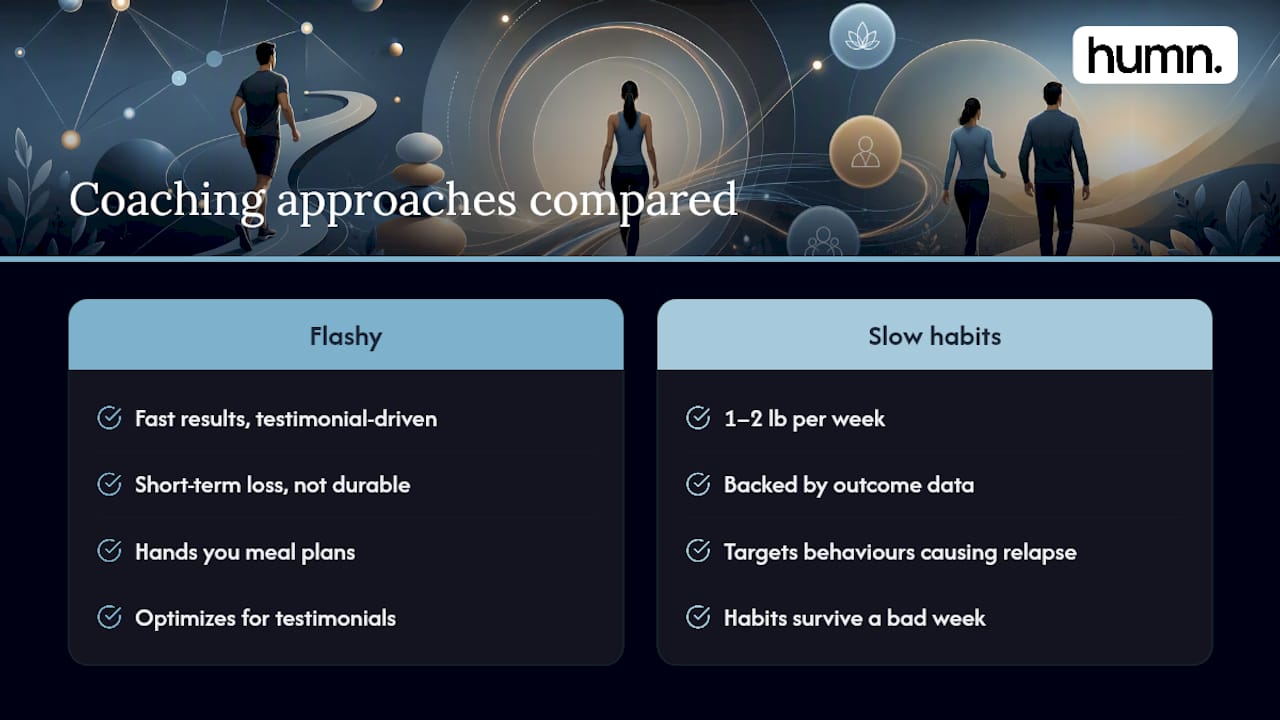
The uncomfortable truth the fitness industry doesn’t advertise: a program that promises fast results is usually optimizing for a testimonial, not for you keeping the weight off in three years. The slower, less flashy version, built around 1 to 2 pounds a week and habits that survive a bad week, is the one backed by actual outcome data. That’s a harder sell, but it’s the honest one.
Where I’d push back on conventional coaching advice: too many programs treat sleep and stress as an afterthought bullet point instead of a core lever. If appetite hormones are dysregulated by poor sleep, no amount of meal-plan discipline fully compensates for that. Any program worth paying for should be asking about your sleep in week one, not week twelve.
— Josh
How humn Applies This Approach in Gaithersburg
The approach is built around four pillars that map directly onto what the research above supports. Resist covers strength training designed to preserve muscle during a calorie deficit. Recover uses sauna, compression, red light therapy, and acupuncture to support the recovery side of sustainable change. Renew and Rhythm address the sleep, stress, and nutrition habits that determine whether progress sticks past the first few months.
Clients typically work with a dedicated coach through 1:1 sessions, small-group personal training, or a blend of both, inside a facility designed for long-term partnership rather than a revolving-door membership model.
Ready to Build a Program That Actually Sticks?
Everything covered above, the session frequency that predicts success, the resistance training that protects your metabolism, the habit-first approach to nutrition, is exactly what humn builds into its coaching model instead of treating as an afterthought. For busy professionals who have tried the DIY approach and hit the same plateau twice, the difference can be having a dedicated coach adjusting your plan every week instead of relying on a generic program.

A consult typically starts with the same kind of intake this guide describes: a look at your history, your goals, and where your current routine is breaking down. From there, your coach builds a plan around resistance training, recovery, and the habit changes most likely to hold up against a busy schedule. You can read more about how this works for professionals specifically on the 1-on-1 coaching page, or get a fuller picture of the coaching philosophy on the lifestyle coaching overview. If you’re ready to see what a personalized plan looks like, schedule a consult with humn and start with an assessment instead of another generic plan.
This article is general information, not a substitute for advice from a qualified doctor. Consult a qualified healthcare professional about your own circumstances before acting on anything here.
Sources
- Health Coaching for Weight Loss Among Overweight and Obese Individuals in Saudi Arabia: A Retrospective Analysis
- Calorie deficit explained: Is it a safe, sustainable approach to weight loss? - Harvard Health
- Clinical guidance on weight management and lifestyle interventions - NCBI Bookshelf
- Dietary and behavioral strategies for weight loss and weight loss maintenance: A narrative review
No Comments.