

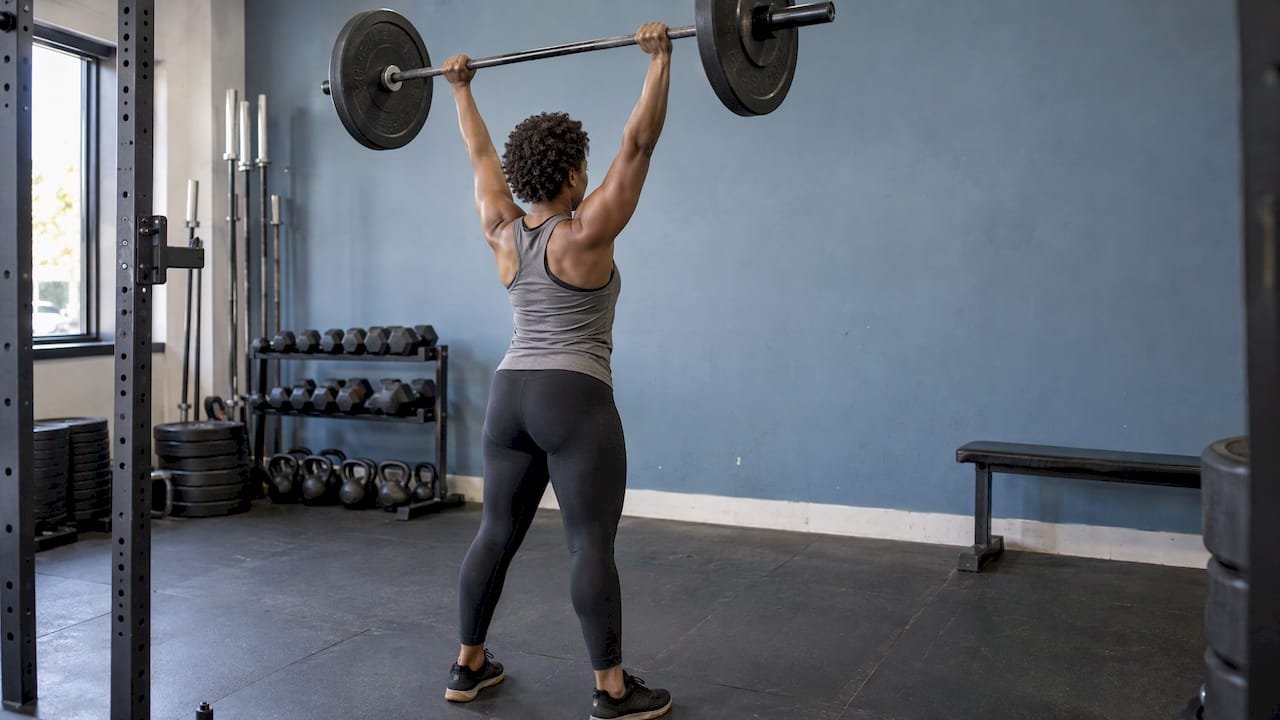
Bracing means building pressure inside your trunk and tightening the muscles around it all at once, so your spine stays stiff while your arms and legs move the weight. You take a breath into your belly, tighten your abs and sides as if pushing outward against a belt, keep your ribs stacked over your pelvis, and only then start the lift. How long you hold that pressure depends on the load, and that is where most lifters go wrong.
Below you will find the step-by-step sequence, how to time your breath through a squat or deadlift rep, what the Valsalva maneuver is, who should modify it, and how to check whether your brace is working.
TL;DR
- Brace before the bar moves: breathe into your belly, tighten your whole trunk 360 degrees, keep your ribs down, then lift.
- Match the brace to the load. Heavy singles, doubles and triples call for more pressure than lighter sets of eight to twelve, where you keep breathing.
- The Valsalva maneuver (a brief breath-hold under heavy load) is a tool for experienced lifters, kept short, with a breath between reps.
- If you have high blood pressure or a cardiovascular condition, talk to your physician before heavy lifting and avoid breath-holding.
- Sucking your belly in, over-arching your back and holding your breath too long are the most common errors.
Table of Contents
- What bracing does when you lift
- How to brace your core: the step-by-step sequence
- Timing your breath through a rep
- The Valsalva maneuver in lifting
- Should you brace the same way for every lift?
- Common bracing mistakes and how to check your brace
- Our perspective on bracing
- Learn to brace with a coach at humn.
- FAQ
- Sources
What bracing does when you lift
Think of your trunk as a pressurized cylinder. The diaphragm sits at the top, the pelvic floor at the bottom, and the abdominal wall and back muscles wrap around the middle. According to Human Kinetics, bracing does four jobs in weight training: it stabilizes the spine under load, connects the hips and rib cage so force transfers efficiently, helps manage blood pressure through changes in intra-abdominal pressure, and increases force production through the limbs compared with not bracing.
The NSCA describes intra-abdominal pressure as the foundation of stabilization. It steadies the spine, pelvis and ribcage, giving your muscles a solid fixed point to pull from. A soft trunk is like trying to push a heavy door while standing on a mattress: some of your effort leaks away before it reaches the load.
The diaphragm matters here too. In an ACE article, physical therapist Dr. Mike Reinold explains that the diaphragm plays a secondary role in core stability: it sits at the top of the abdominal cavity and works with the abdominal muscles and pelvic floor when you brace. That is why good bracing starts with the breath, not with squeezing your abs as hard as you can.
For maximal or near-maximal lifts in a single plane of motion, such as the deadlift, bench press or squat, ACE notes that abdominal bracing is a useful way to raise intra-abdominal pressure and reinforce spinal stability.
How to brace your core: the step-by-step sequence
The NSCA gives a three-step sequence that works as a base for most lifters:
- Breathe into your abdomen to pressurize it. Think low and wide, not up into your chest and shoulders.
- Without letting the air out, activate your abdominal wall and pull your ribs down into a caudal position, with no flexion in your spine.
- Once you are pressurized and your ribs are down, begin the movement.
A physical therapy clinic, OTB Physical Therapy, phrases the same idea in four steps: take a deep diaphragmatic breath before the lift, expand your abdomen in all directions as if gently pushing against a weightlifting belt, maintain that pressure through the lift to stabilize the spine, and exhale gradually once you are past the hardest part of the movement.
A cue that works in practice
Place your hands on your lower ribs and sides, thumbs toward your back. When you inhale, you should feel your belly, sides and lower back push outward together. If only your chest rises, or only your belly pokes forward, you are not bracing 360 degrees yet.
Two more details help:
- Ribs over pelvis. Imagine a line from the bottom of your ribs to the top of your hips. Keep that stack, rather than flaring the ribs and arching your lower back.
- Tighten everything, not one muscle. Strength coach Mike Robertson writes that the foundation of a super-stiff trunk is the simultaneous contraction of all the core muscles, not isolating one.
Practice it before you load it
The unloaded version is simple. Stand tall, take a breath into your belly, tighten around your midsection as though someone were about to nudge you, and walk across the room while holding that tension and breathing in small sips. Then practice the same position at the bottom of a goblet squat or a hip hinge with a light kettlebell. Add load only once the sequence feels automatic.

If you are new to lifting, build the pattern inside a plan that raises load gradually. Our beginner’s guide to progressive strength training shows how.
Timing your breath through a rep
Bracing is not a single moment. It is a cycle: set, lift, reset. Here is how the research describes it for the two lifts people ask about most.
Squat
The NSCA says that in the squat you breathe into the abdomen, pull the ribs down without expiring, begin the movement, and then slowly exhale through pursed lips as you move through the upward (concentric) portion. For maximal doubles, triples or sets of five, breathe out at the top and breathe in again for the next rep. That reset between reps is not optional, and it is what keeps the technique repeatable.
Deadlift
The deadlift starts from a dead stop, so you set the brace before you pull. A common pattern for heavier sets of one to five reps is to brace before reaching down for the bar, take your breath as you settle into your starting position, hold it through most of the pull, and then exhale slowly but not completely as you lower the weight. Between reps in a set, reset at the top or on the floor and take a fresh breath.
If you are deciding which bar to pull with, our comparison of trap bar and straight bar deadlifts walks through how each one changes your setup.
Bench press and overhead press
For presses, WebMD’s guidance for lifts such as the bench press is to take a big breath before starting and hold it until you bring the weight back down. For most training sets, a shorter hold and a controlled exhale through the sticking point keeps the pressure without the extended breath-hold.
The Valsalva maneuver in lifting
The Valsalva maneuver is the high-pressure end of bracing. ACE describes it as forced expiration against a closed glottis before the movement, holding your breath while lifting to create a lot of rigidity in the trunk. The NSCA’s basics manual adds that combined with contraction of the abdomen and rib muscles, it creates extra rigidity that helps stabilize the spine, and it reserves the technique for advanced athletes.
Human Kinetics describes two strategies: one that lets you keep breathing, for steady efforts that are not maximal (such as carrying a load across the gym floor), and one that requires holding your breath, for very high-threshold efforts moving very heavy loads. A 2013 review in the Journal of Strength and Conditioning Research found that a brief Valsalva, no longer than 3 seconds, could help experienced lifters maintain vertebral alignment and support and reduce lower back injury risk.
How long is too long?
Short. The same review reported that holding it for more than about 3 seconds can cause dizziness and fainting because of the drop in systolic, diastolic and pulse pressures. The NSCA basics manual says breath-holding should be transient, about 1 to 2 seconds, and lists dizziness, disorientation, excessively high blood pressure and blackouts as potential side effects. Its Stability and Weightlifting article adds that maximal pressure should be generated only for short periods, with a breath between each repetition, because it raises blood pressure significantly.
As a working rule: brace hard, lift, exhale through pursed lips as you pass the hardest point, reset. Do not hold a breath across multiple reps.
Who should modify or avoid it
This is where the safety guidance is clear, so read it closely.
- Heart and cardiovascular conditions. The 2013 review advises that people with a history of heart and cardiovascular disease avoid the Valsalva maneuver during resistance exercise.
- Beginners. The same review says novice lifters should start at lower intensities (below 80% of one-rep max), where the Valsalva can be avoided.
- High blood pressure. A 1995 study measured mean blood pressure of 311/284 mmHg at 100% of maximum with Valsalva, versus 198/175 mmHg with slow exhalation, and concluded heavy resistance exercise is safer with an open glottis. A 2023 evidence-based guide states that contractions at 50% of maximum voluntary contraction or above are likely to produce a pressor response above 200/100 mmHg and should be avoided in all but young, healthy people clinically free of cardiovascular disease.
- Untrained lifters going heavy. A 2019 systematic review recommends that untrained people not use heavy squats, deadlifts, box lifts and cleans until they have progressively adapted to high loads, and suggests the bench press and slide row as useful exercises for beginners and people with hypertension.
If you have high blood pressure or any heart condition, get your physician’s clearance before heavy lifting and keep breathing through every rep. Our guide to strength training with high blood pressure covers a safe way to start. ACE’s guidance for general clients is even more conservative: it advises avoiding the Valsalva or any breath-holding, because the pressure in the chest interferes with blood returning to the heart and may deprive the brain of blood, causing lightheadedness or fainting.
If you feel dizzy, see spots or feel your head pounding during a set, put the bar down safely and rest. Persistent symptoms are a reason to see your doctor.
Should you brace the same way for every lift?
No. Match the brace to the demand.

The NSCA says that for loads that do not need intense bracing (below 85% relative intensity, or sets over six reps), you should keep breathing through most of the movement, other than perhaps at the transition. Only for maximal or near-maximal lifts does it recommend the maximal-pressure approach, and then only briefly.
The lift itself matters as well. The 2019 systematic review found the highest intra-abdominal pressure during squats (over 200 mmHg), then deadlifts, slide rows and leg presses (161 to 176 mmHg), and the lowest during bench press (79 ± 44 mmHg).
| Situation | Brace approach | Breathing |
|---|---|---|
| Warm-ups, light sets, sets over six reps | Moderate 360-degree brace | Keep breathing, brief pause at the transition |
| Working sets of 3 to 6 reps, heavy but not maximal | Strong brace, set before each rep | Exhale slowly through pursed lips on the way up, reset between reps |
| Near-maximal singles, doubles, triples (experienced lifters, cleared by a physician) | Maximal brace | Very brief hold, breath between every rep |
| Carries, rows, accessory work | Moderate brace | Breathe continuously |
| Lifters with hypertension or cardiovascular disease | Light to moderate brace per clinician advice | No breath-holding |
When stiffness is not the goal
A rigid trunk suits heavy, slow, single-plane lifts. It is not what you want when your body needs to rotate, bounce or absorb force. ACE quotes movement coach Joanne Elphinston in a 2018 article: as an isometric contraction, bracing prevents normal movement when different parts of the body must move relative to each other, and without that movement we cannot store and release elastic energy or stabilize dynamically. The idea is the same one behind the osteogenic loading at home approach to short, high-force efforts: rigid bracing serves brief, heavy exertions, while athletic movement needs a trunk that can stay stable and still move. Our piece on functional strength training covers that side.
Common bracing mistakes and how to check your brace
Mistakes
- Sucking your belly in. OTB Physical Therapy lists this first because it reduces internal pressure and stability. Mike Robertson’s paper notes that hollowing or drawing in the abdominals raises transverse abdominis activity but does not improve spinal stability and can inhibit the obliques.
- Arching your lower back. A good brace keeps the spine neutral. If your ribs flare toward the ceiling, lower them before you lift.
- Holding your breath too long. Controlled breathing should be the default for most exercises, to avoid dizziness or elevated blood pressure.
- Relying on a vague cue. Robertson points out that the cue to tighten as if about to be punched gives clients too little detail, and ten people will produce ten different patterns. Breathe, expand, ribs down, then go.
A simple self-check
- Hand check. Hands on your sides and lower back: do you feel expansion in every direction before the bar moves?
- Video check. Film a heavy set from the side. Does your ribcage stay stacked over your pelvis through the pull or squat, or does your lower back arch near the top?
- Rep-to-rep check. Is the first rep braced as well as the fifth? If your brace fades, the load or rep count may be too high for now.
- Feel check. You should feel steady and strong, not lightheaded.
If your lower back complains even with good bracing, our guide to lower back pain strength training is a place to start, and a medical professional should check persistent pain.
Our perspective on bracing
Most people learn bracing from a single cue shouted across a gym floor, and then wonder why it falls apart on rep six or in a different lift. At humn., we treat bracing as a skill to be coached, not a trick to be copied.
That is why our approach starts with the person. We look at how you breathe, how you move, how you sleep and how you recover, because a brace is only as reliable as the habits behind it. A tired, stressed trunk braces differently from a rested one, and our coaching covers strength, recovery, nutrition, sleep and stress together for exactly that reason.
In small groups and in one-on-one coaching, a coach can watch your set-up, adjust the cue to your body and build load gradually, so your technique holds up as the bar gets heavier. We built the facility around that idea of long-term progress instead of short-term transformation.
Josh
Learn to brace with a coach at humn.
Reading about bracing is a start. Feeling it with a coach watching your set-up is faster. At humn. in Gaithersburg, MD, we combine small-group personal training and coaching and guidance with recovery access, so your strength work, sleep and stress get attention in one place. Our members work with dedicated coaches on habits-first programming built around the four pillars of Resist, Recover, Renew and Rhythm.
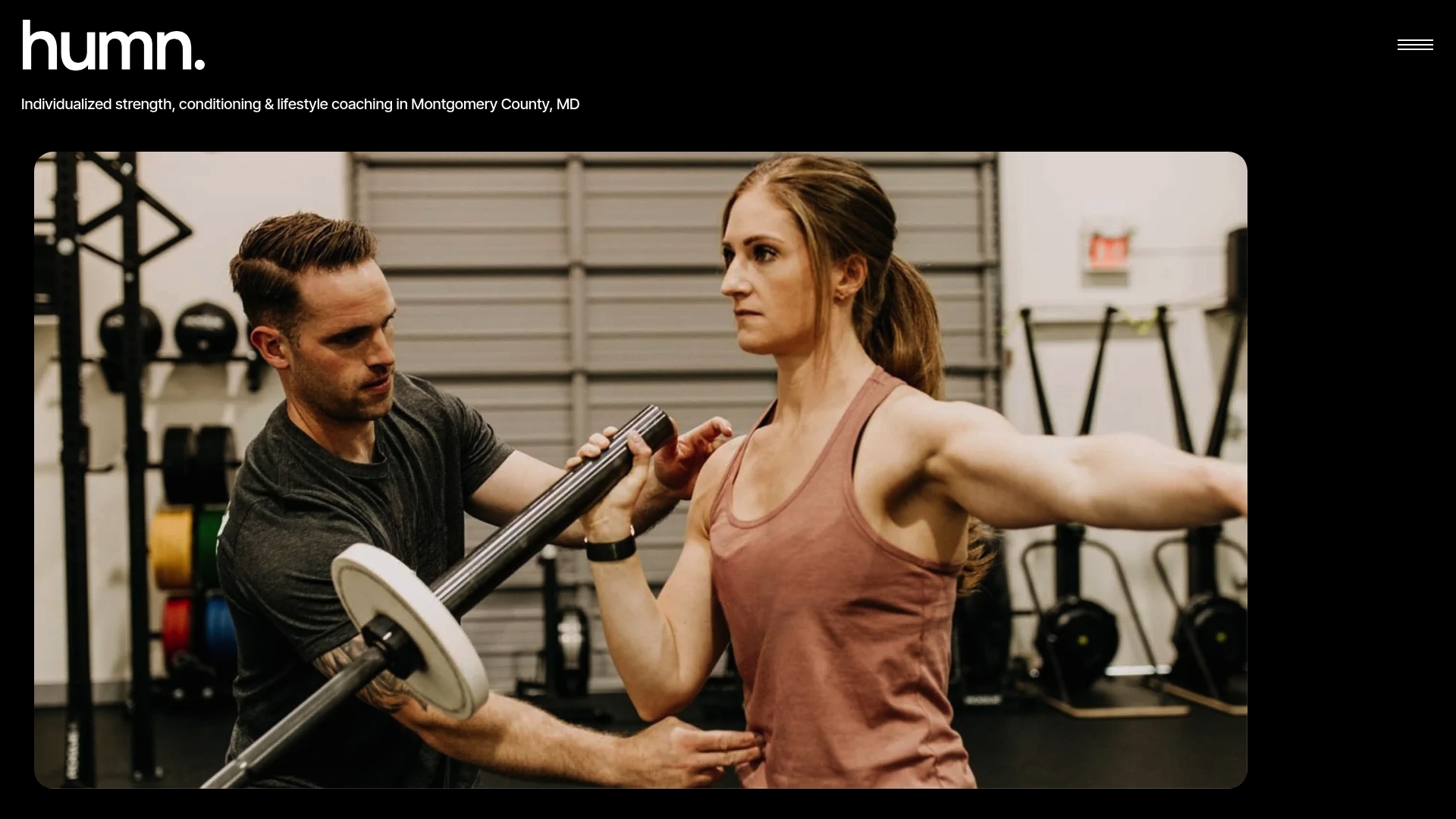
If you want a coach to refine your breath and brace on your squat, deadlift and presses, see our membership options. You can also read how fitness assessments trainers use with clients set a starting point before the load goes up.
FAQ
How do I brace my core without holding my breath?
Take a breath into your belly, expand your abdomen and sides in all directions, and keep your ribs down. Then breathe in small sips or exhale slowly through pursed lips while keeping that tension. This breathing-friendly brace fits lighter loads, sets of more than about six reps and steady efforts like carries.
Is the Valsalva maneuver safe for lifting?
For healthy, experienced lifters, a brief Valsalva of no more than about 3 seconds on very heavy lifts is described in the research as helpful for spinal support. Longer holds can cause dizziness and fainting. People with heart or cardiovascular disease are advised to avoid it, so ask your physician first.
Do I need a lifting belt to brace?
No. Bracing is a muscular and breathing skill. OTB Physical Therapy describes the feeling as pushing your abdomen outward as if gently against a weightlifting belt, so the cue works with or without one. Learn the brace first and decide on a belt later with your coach.
Should I brace for every exercise?
Brace for every exercise, but vary how hard. Warm-ups, higher-rep sets and accessory work need a moderate brace and continuous breathing. Your heaviest sets of squats and deadlifts need the strongest brace, set before each rep and reset between reps.
Sources
- Importance of Bracing and How to Do It, Human Kinetics
- Spinal Stability in the Real World: When to Brace and When to Breathe, ACE (November 2025)
- Stabilize From the Inside Out, ACE (October 2024)
- Spinal Stability: To Brace or Not to Brace? ACE (December 2018)
- Stability and Weightlifting: Mechanics of Stabilization, NSCA
- Basics of Strength and Conditioning Manual, NSCA
- The Valsalva Maneuver, Journal of Strength and Conditioning Research (2013)
- Influence of breathing technique on arterial blood pressure during heavy weight lifting (1995)
- An evidence-based guide to the efficacy and safety of isometric resistance training (2023)
- Systematic review of intra-abdominal and intrathoracic pressures during resistance exercise (2019)
- Breathing and Bracing: Core Stability for Heavy Lifts, OTB Physical Therapy
- Different Braces for Different Places, Robertson Training Systems
- Abdominal Bracing Exercises, WebMD
- How To Engage Your Core Correctly For Deadlifts and Squats
No Comments.