


Body recomposition coaching combines progressive strength training, personalized protein targets, and structured recovery to help you lose fat and build muscle at the same time. It works best for beginners, returning trainees, and people carrying moderate excess fat, and it’s particularly valuable for women over 40 navigating hormonal shifts that make muscle harder to hold onto. The right coach measures progress with more than a scale. Keep reading to learn how to evaluate one.
TL;DR:
- Progress measurement should include photos, circumferences, and strength benchmarks, not just scale weight, to accurately track recomposition progress.
- Visible changes often take 8 to 12 weeks, with early strength improvements occurring before noticeable body composition shifts.
- Coaches must customize programming for women over 40, emphasizing recovery, protein intake, and hormonal considerations, due to age-related changes.
- Proper training involves progressive overload with 2 to 4 weekly strength sessions focusing on compound lifts, combined with moderate calorie deficits and high protein targets.
- Long-term success relies on habit-based coaching supporting consistency, adaptability, and recovery, rather than quick fixes or rigid, short-term programs.
Table of Contents
- What Is Body Recomposition Coaching, Really?
- Who Sees Results Fastest, and How Long Does It Take?
- The Core Components: Training, Nutrition, Recovery, Measurement
- How Do You Choose the Right Recomposition Coach?
- Which Coaching Format Fits Your Budget and Goals?
- How humn.'s Coaching Model Supports Recomposition
- Getting Started: Your First Discovery Call and First 8 Weeks
- Why Slow, Coached Change Beats the Quick Fix
- Ready to Start? Here’s What a Discovery Call Looks Like
- Sources
What Is Body Recomposition Coaching, Really?
Body recomposition means changing the ratio of fat to muscle in your body, not just changing the number on the scale. You can lose fat, gain muscle, and see your weight barely move while your clothes fit differently and your strength climbs. That’s the entire premise, and it’s why body recomposition coaching looks different from a standard weight-loss program from day one.
Weight-loss-only approaches chase a lower number through calorie restriction, often with little regard for what tissue is being lost. Fat, sure, but often muscle too, especially when the deficit is steep and protein is an afterthought. Recomposition-focused coaching flips that priority. Strength training and higher protein intake come first, and calorie reduction stays moderate so the body has a reason to keep, or build, lean tissue instead of burning through it.
Scale weight can genuinely mislead you here. Someone doing recomposition correctly might see their weight hold steady for six weeks while their waist shrinks and their squat improves. A scale-only view would call that a stall. A coach using circumference measurements, progress photos, and strength logs would call it exactly what it is: working.
A few myths deserve to die on this topic:
- “More cardio burns more fat” ignores that excessive cardio without adequate protein and recovery can actually eat into muscle you’re trying to keep.
- “You have to choose between losing fat and building muscle” is only true at extremes; moderate, well-programmed recomposition does both simultaneously for most people.
- “The scale tells you what’s happening to your body” is the myth that causes the most frustration and the most needless program-hopping.
Who Sees Results Fastest, and How Long Does It Take?
Beginners and people returning to training after a long break see the quickest wins, often within the first several weeks. That’s not beginner’s luck. Untrained muscle responds fast to a new stimulus, and early “gains” are frequently nervous-system adaptations that show up as strength before they show up as visible size.
Visible composition change generally takes longer than most people expect. Runner’s World notes that meaningful visible shifts commonly emerge between 8 and 12 weeks, with strength improvements often noticeable earlier. Longer-term muscle growth continues to build over months, not weeks, which is exactly why coaching that treats this as a lifestyle shift outperforms anything marketed as a 30-day fix.
Recomposition is a slower, less scale-visible process than pure weight loss, so good coaches prepare clients up front for “invisible” early progress: better lifts, looser waistbands, no dramatic scale movement.
For women over 40, the timeline holds but the programming needs adjusting. Hormonal changes around perimenopause and menopause affect how the body partitions calories and repairs muscle, which is why volume, recovery time, and progression speed often need to shift compared to a program built for a 25-year-old.
Good candidates for recomposition coaching typically include:
- People new to structured strength training, regardless of age
- Anyone returning to the gym after a layoff of six months or more
- People with moderate fat to lose who also want visible strength and shape changes, not just a smaller number
- Women over 40 dealing with the muscle loss that comes with hormonal shifts, where resistance training frequency, adequate protein, and recovery strategies matter more than they did a decade earlier
The Core Components: Training, Nutrition, Recovery, Measurement
A recomposition program is only as good as its weakest pillar. Miss one of these and the other three can’t fully compensate.
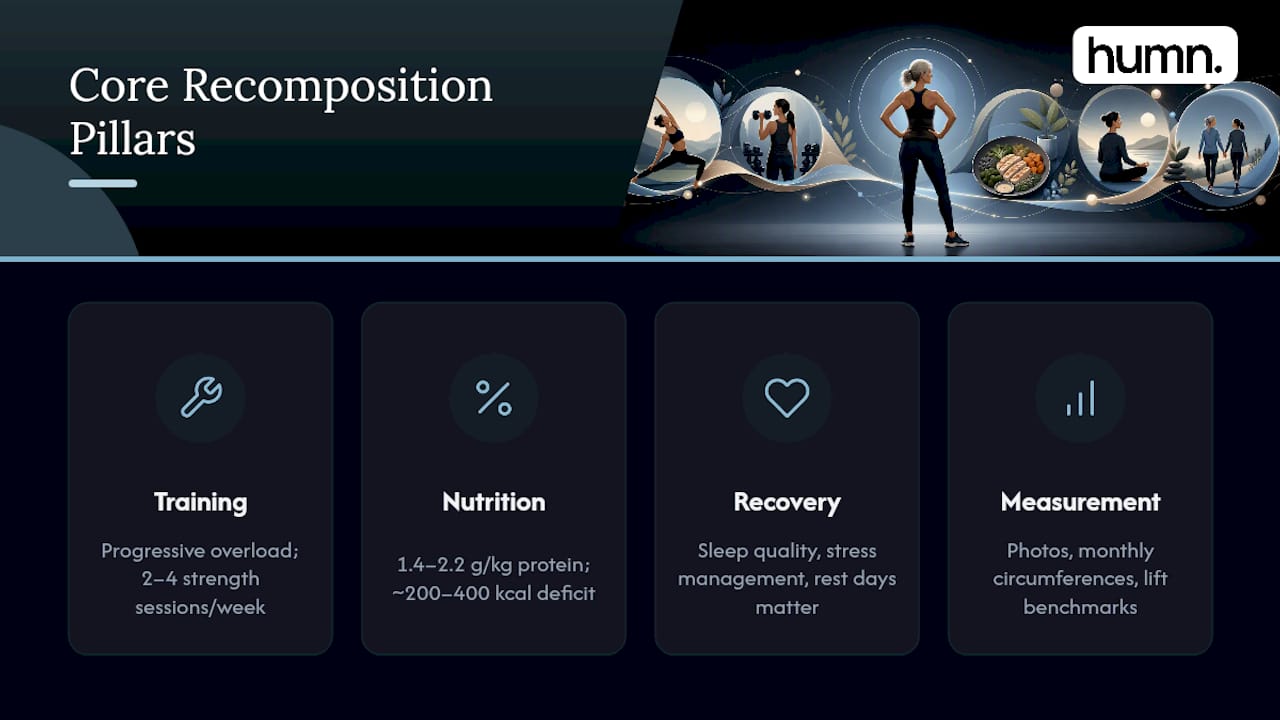
Training has to be progressive, meaning the stimulus increases over time through added weight, reps, or sets. Two to four strength sessions per week, built around compound lifts like squats, presses, rows, and hinges, gives most people enough volume to drive change without wrecking recovery. A coach who can’t explain how your program will progress over the next eight weeks doesn’t have a real plan, just a workout.
Nutrition centers on protein first. A practical target is 1.4 to 2.2 grams per kilogram of body weight, or roughly 0.64 to 1 gram per pound, when paired with resistance training. That’s a range, not a rigid number, and where you land in it depends on your training experience, current body composition, and how aggressive your fat-loss goal is. On calories, a moderate deficit of about 200 to 400 calories tends to allow fat loss without forcing the body to cannibalize muscle for fuel. Extreme deficits do the opposite, no matter how popular they are on social media.
Recovery isn’t optional garnish. Sleep quality, stress load, and rest days directly determine whether your body can actually use the training stimulus and protein you’re feeding it. Skimp here and you can do everything else right and still stall.
Measurement should never rely on one data point. Photos taken in consistent lighting, monthly circumference measurements at the waist and hips, and a logged progression on key lifts together tell a far more honest story than a daily weigh-in. Some coaches add periodic body-composition scans (DEXA or similar) as a checkpoint, though these work best as an occasional confirmation, not a weekly habit.
Pro Tip: If your coach can’t tell you which three numbers they’re tracking besides your body weight, ask before you sign anything. Photos, circumferences, and a strength benchmark on your main lifts should all be part of the plan from week one.
Progressive overload done wrong is the single most common reason recomposition stalls, and a structured beginner framework solves more problems than any nutrition tweak ever will.
How Do You Choose the Right Recomposition Coach?
Six criteria separate a coach who understands recomposition from one who’s rebranded a generic weight-loss template.
- Documented results. Ask to see real client progress, ideally with photos alongside strength numbers, not just before-and-after weight totals.
- Personalization. Your program should reflect your training age, schedule, injury history, and goals, not a template handed to everyone who signs up.
- Measurement methods. The coach should default to photos, circumferences, and strength benchmarks over scale weight alone.
- Coaching frequency. Weekly or biweekly check-ins allow real adjustments; monthly check-ins are often too slow to catch problems early.
- Nutrition strategy. Look for protein-first guidance with moderate, adjustable calorie targets, not a rigid meal plan copy-pasted across clients.
- Behavior-change support. Sustainable results come from habit coaching around sleep, stress, and consistency, not willpower alone.
On a discovery call, ask direct questions: What metrics do you track besides body weight? Can you walk me through a sample first-phase plan? How often do we check in, and what happens between check-ins? Who actually writes and adjusts my program, you or an algorithm? Their answers tell you more than any marketing page will.
Watch for red flags too. Be wary of promises tied to a fixed number of pounds lost per week, programs that never mention protein or strength training, coaches who can’t describe how they’ll measure anything besides weight, and anyone guaranteeing dramatic visible change inside a few weeks. Recomposition doesn’t work on that timeline, and a coach who claims otherwise is selling something other than results.
Which Coaching Format Fits Your Budget and Goals?
Coaching comes in a handful of formats, and the right one depends on how much personalization and accountability you actually need.
- 1:1 coaching offers the most individualized programming and the fastest adjustments, since the coach is watching only your data, not a group average.
- Small-group training splits coach attention across a handful of clients, keeping cost more manageable while still allowing form correction and program customization that a big-box class can’t match.
- Hybrid models pair in-person sessions with remote check-ins, useful for people who want face-to-face coaching but not every single day.
- Fully remote coaching works for disciplined, experienced trainees who mainly need programming and accountability rather than hands-on cueing.
Higher-cost programs generally justify the price through more frequent check-ins and deeper personalization to support the training itself. When comparing pricing, look past the sticker number and ask what’s actually included: how many check-ins per month, whether programming updates are automatic or coach-reviewed, and whether recovery access is bundled or billed separately. Transparent pricing structures tend to correlate with coaches who also measure and adjust transparently. A moderate, sustainable calorie approach should be part of that conversation regardless of format.
How humn.'s Coaching Model Supports Recomposition
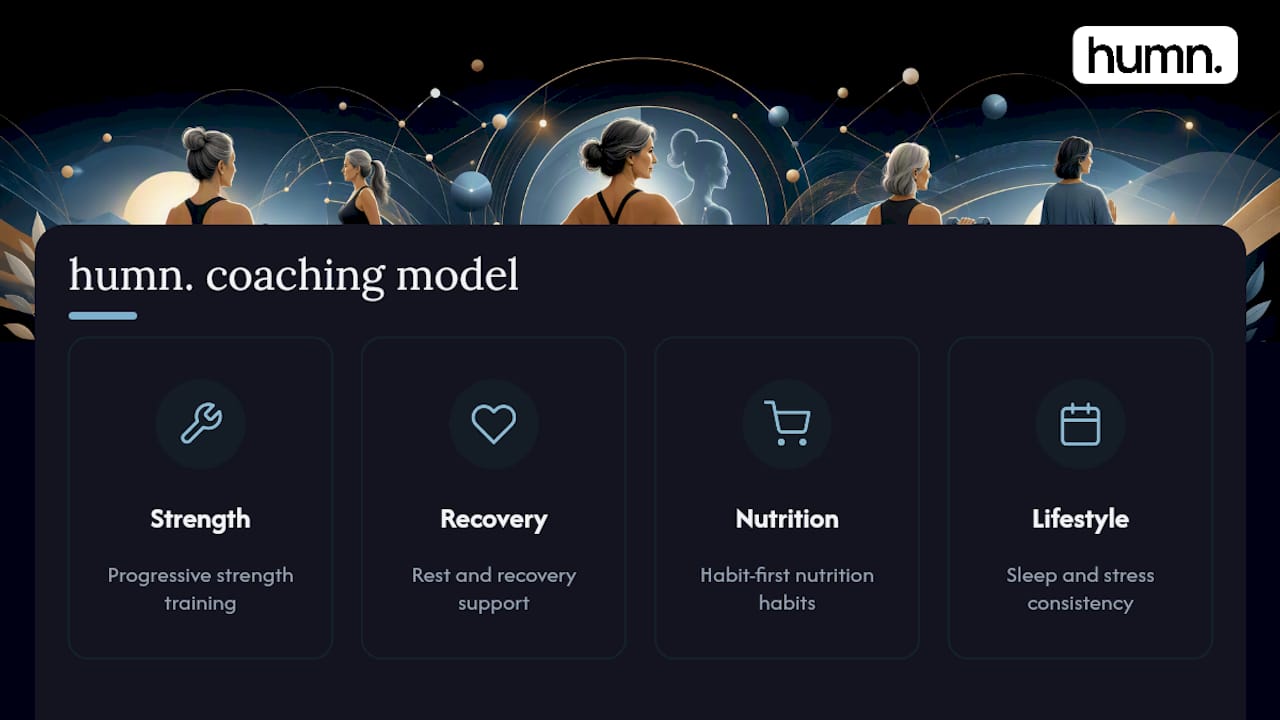
The programming builds around four pillars that map directly onto what recomposition actually requires: progressive strength training, recovery, nutrition habits, and lifestyle consistency, including sleep and stress, the pieces that determine whether a program survives a hard month at work.
Clients work through small-group personal training or 1-on-1 coaching depending on how much individualized attention they want, with habit-first, behavior-based programming built in rather than bolted on. A discovery call typically covers your training history, current measurements, and schedule constraints before any plan gets written, and progress gets tracked through the same evidence-based methods covered above: photos, circumferences, and strength benchmarks, not just a scale reading.
Getting Started: Your First Discovery Call and First 8 Weeks
Walk into a discovery call prepared, and you’ll get a far more useful conversation out of it.
- Bring your goals, training history, and any injuries or limitations worth flagging up front.
- Share your current measurements: recent weight, a starting photo if you’re comfortable, and your schedule constraints.
- In the first eight weeks, expect to establish baseline strength numbers, build a consistent protein habit, and lock in a realistic session schedule.
- Set up a simple tracking routine: one weekly photo, monthly circumference check, and an ongoing strength log for your main lifts.
Why Slow, Coached Change Beats the Quick Fix
Habit-based coaching scales better than short-term diets because it doesn’t collapse the moment life gets messy. A crash diet has one setting: perfect adherence or failure. Coaching that’s built around habits can flex when you travel for work, when a stressful month wrecks your sleep, or when you miss two sessions in a row and need a plan to get back on track without starting over.
That resilience is the actual value you’re paying for. Anyone can write you a meal plan. Fewer coaches can help you rebuild consistency after a rough patch without losing months of progress. Evaluate recomposition coaching the way you’d evaluate any long-term investment: not by how fast it promises results, but by how well it holds up when your life doesn’t cooperate.
— Josh
Ready to Start? Here’s What a Discovery Call Looks Like
If you’ve read this far, you already know what separates real recomposition coaching from a repackaged diet plan: progressive strength work, protein targets that fit your body, recovery that’s actually built into the plan, and measurement beyond the scale. humn. is built around exactly that framework, delivered through small-group and 1-on-1 personal training in a facility designed for people who want a long-term partner, not a 12-week challenge.

A discovery call starts with an honest look at your training history, current measurements, and schedule, followed by a plan outline and clear pricing before you commit to anything. There’s no guesswork about what you’re paying for or what results are realistic in your first two months. If you’re a woman over 40 looking for programming that accounts for how your body actually responds to training now, the strength training approach built for that stage of life is a good place to start. Book a discovery call and see what a personalized plan actually looks like before you decide anything.
Sources
- Body recomposition: what it is and how to do it | Healthline
- Protein requirements and recommendations — NCBI PMC
- Body recomposition vs weight loss: Nutritionist explains | Naked Nutrition
No Comments.