

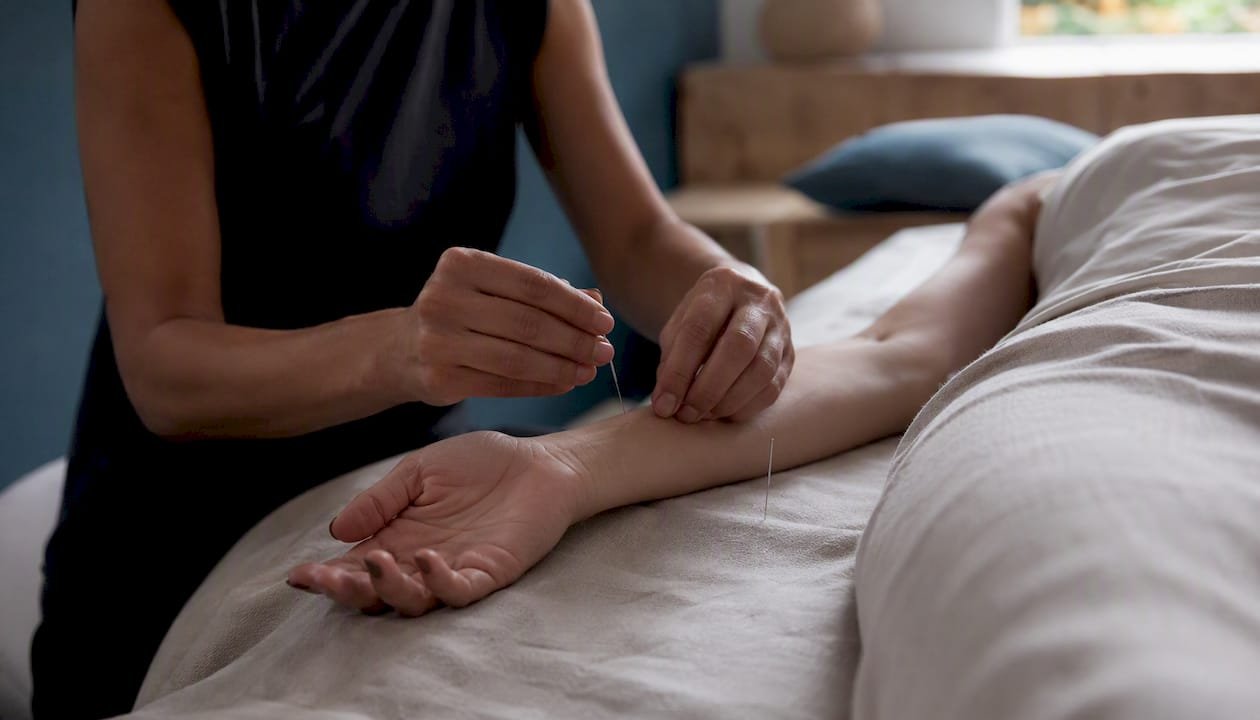
Your first acupuncture visit runs about 60 to 90 minutes and includes a health intake, a pulse and tongue check, and a treatment where a practitioner inserts 5 to 20 hair-thin needles that stay in place for 10 to 30 minutes. Most people feel a brief pinch on insertion, then a dull ache, heaviness, or mild tingling that isn’t painful in the way a shot or blood draw is painful. Acupuncture is generally low-risk when performed by a licensed practitioner using sterile, single-use needles, and most first-timers leave feeling either surprisingly relaxed or a little groggy.
Here’s what to have ready before you walk in:
- Loose, comfortable clothing that lets a practitioner access your arms, legs, and lower back or abdomen
- A list of current medications, supplements, and any recent injuries or surgeries
- A light meal an hour or two beforehand, since treatment on an empty stomach can cause lightheadedness
- A ride home if it’s your first session and you’re not sure how you’ll react afterward
- Your insurance card, if you plan to check coverage for the visit
Key Takeaways
Acupuncture works best as a low-risk, evidence-supported supplemental therapy when delivered by a licensed practitioner using sterile, single-use needles as part of a multi-session plan.
| Point | Details |
|---|---|
| Expect mild sensations, not pain | A brief pinch on insertion, then dull ache, heaviness, or tingling that fades quickly. |
| Sessions run 60 to 90 minutes | This includes intake, pulse and tongue check, needle placement, and 10 to 30 minutes of dwell time. |
| Verify credentials before booking | Confirm LAc licensure, NCCAOM certification, and single-use sterile needle practices. |
| Give it a real course | Most conditions need 6 to 12 sessions over about three months to show measurable change. |
| Pair it with a recovery plan | humn integrates acupuncture with strength coaching and other recovery modalities rather than treating it as a standalone service. |
Table of Contents
- What Happens Before Your First Acupuncture Appointment
- What Happens During an Acupuncture Session Step by Step
- How Does Acupuncture Feel During the Session?
- What Should You Expect After Acupuncture Treatment?
- How Many Acupuncture Sessions Will You Need?
- Is Acupuncture Safe, and How Do You Choose a Practitioner?
- What Does Acupuncture Cost, and Does Insurance Cover It?
- Why Acupuncture Works, According to the Evidence
- How Acupuncture Fits Into a Broader Recovery Plan
- Ready to Add Acupuncture to Your Recovery Routine?
- Where to Read More About Acupuncture
- Frequently Asked Questions
- Sources
What Happens Before Your First Acupuncture Appointment
The intake at a first visit is longer and more detailed than anything you’ll do at follow-up sessions, and that’s by design. A licensed acupuncturist needs a full picture before placing a single needle.
Expect questions about your medical history, current medications, allergies, chronic conditions, sleep patterns, digestion, stress levels, and the specific symptom that brought you in. Traditional Chinese Medicine treats the body as an interconnected system, so a practitioner working on your shoulder pain might still ask about your sleep or your stress at work. This isn’t small talk. It’s how they build a treatment plan tailored to you rather than a generic protocol. A standard first visit often runs longer than later sessions precisely because of this deeper medical history review.
A few practical dos and don’ts make the visit smoother:
- Eat something light within a couple of hours of your appointment. Don’t arrive starving or stuffed.
- Skip heavy alcohol the night before and avoid intense exercise right before or after treatment.
- Wear loose pants and a top that rolls up easily. Many clinics provide a gown or drape, but comfortable clothing saves time.
- Avoid scheduling anything demanding right after your session in case you feel drowsy or unusually relaxed.
- Tell the practitioner about any recent illness, pregnancy, or new medication, even if it seems unrelated to your main complaint.
Pro Tip: Ask your practitioner to write down a specific treatment plan, including expected number of sessions and what “improvement” should look like for your condition. Jot down your pain level, sleep quality, or mobility on a 1 to 10 scale before you start. That baseline makes it far easier to tell, three or four sessions in, whether the treatment is actually working or if you’re just hoping it is.
What Happens During an Acupuncture Session Step by Step
A typical session moves through a predictable sequence, and knowing the order takes a lot of the mystery out of it.
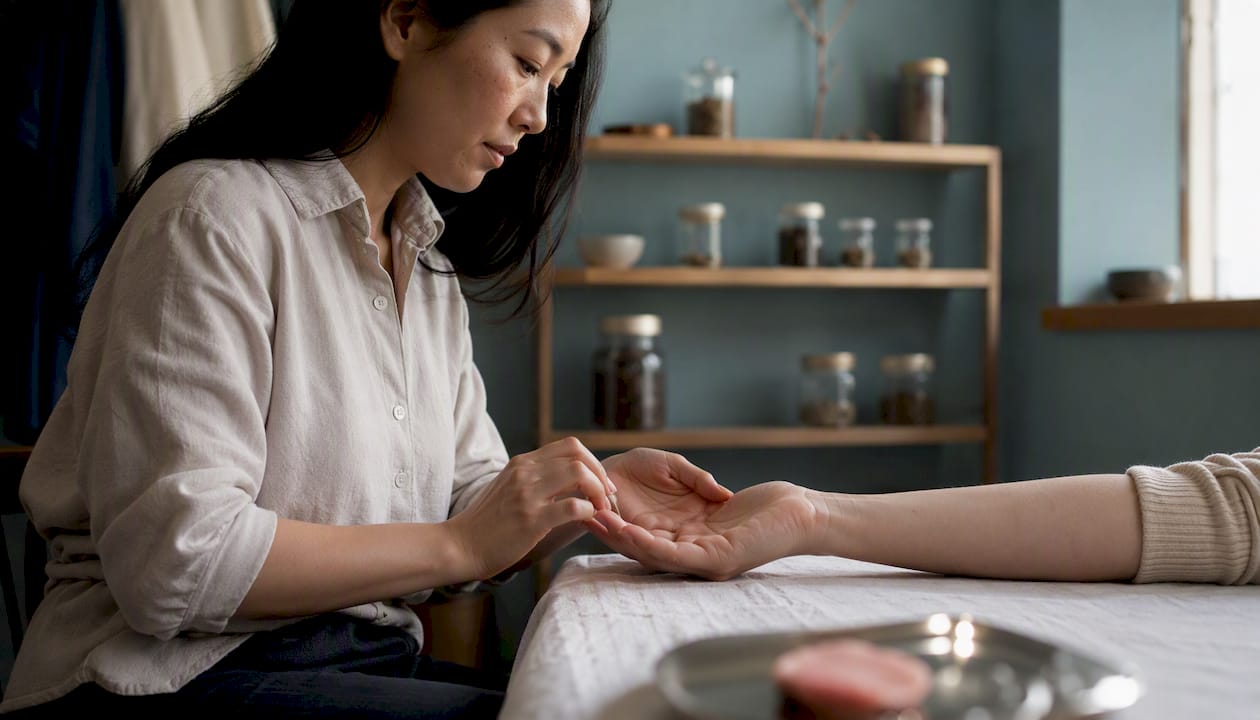
Check-in and consultation. You’ll discuss how you’ve felt since your last update, or review your intake if it’s day one. The practitioner may check your pulse at the wrist (they’re feeling for quality, rhythm, and strength, not just rate) and look at your tongue’s color, coating, and shape. Both are diagnostic tools in Mayo Clinic’s description of a standard visit.
Positioning. You’ll lie down on a treatment table, usually face up or face down depending on which points are being used. Modesty is standard practice: you’ll be draped with a sheet or towel, and only the treatment area is exposed.
Needle insertion. The practitioner inserts needles at specific points, often using a thin guide tube that taps the needle through the skin in a fraction of a second. This is the biggest difference between acupuncture needles and the hypodermic needles most people picture. Acupuncture needles are solid, not hollow, and roughly as thin as two human hairs, which is why insertion is often barely noticeable.
Needle manipulation. Depending on the practitioner’s style and your condition, needles might be gently twirled, connected to a mild electrical current (electroacupuncture), or paired with moxibustion, a technique that warms the point with a burning herb held near the skin.
Dwell time and removal. Needles typically stay in for 10 to 30 minutes while you rest, often with dim lights and quiet music. The practitioner then removes them quickly and checks the sites briefly before you get up.
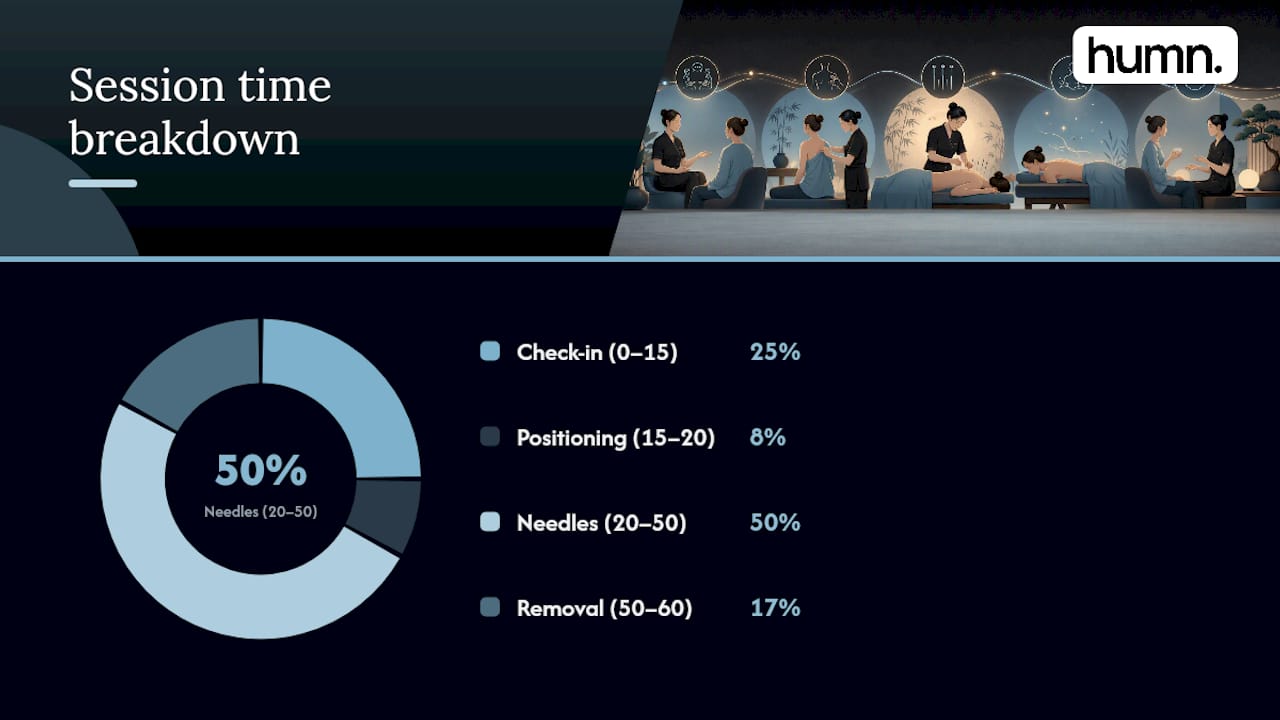
Quick numbers: A standard session uses 5 to 20 needles, left in place for 10 to 30 minutes, with total appointment time (including consultation) often reaching 60 minutes for a first visit.
Here’s the rough timeline for a typical appointment:
- 0 to 15 minutes: check-in, consultation, pulse and tongue assessment
- 15 to 20 minutes: positioning and needle insertion
- 20 to 50 minutes: needles remain in place, you rest
- 50 to 60 minutes: needle removal and brief follow-up conversation
How Does Acupuncture Feel During the Session?
Most people describe the actual sensation as underwhelming, in a good way. Insertion is usually a quick pinch, if you notice it at all, and it fades within seconds.
What comes next is more interesting. Practitioners call it “deqi,” a sensation of dull ache, heaviness, warmth, or tingling around the needle site. This isn’t a side effect to tolerate. It’s actually treated as a good sign that the point has been engaged correctly, and experienced acupuncturists watch for it as clinical feedback rather than something to apologize for. Sharp, shooting pain is different, and it’s not something you should sit through quietly.
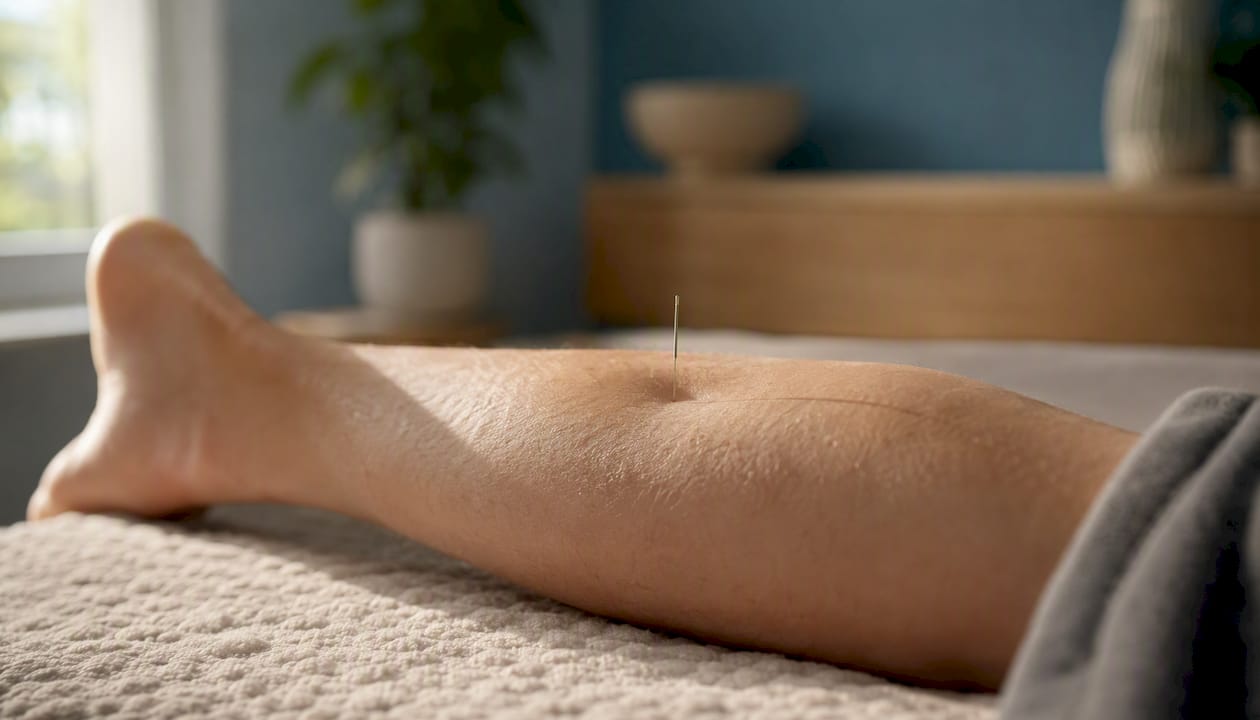
Sensitivity varies a lot by location. Hands, feet, and ears tend to feel more intense than fleshier areas like the thigh or lower back, because nerve endings are denser in those spots. If a practitioner is treating a point on your foot and it feels sharper than the point on your forearm, that’s normal anatomy, not a mistake.
Speak up right away if you notice any of the following:
- Sharp, stabbing, or electric pain that doesn’t fade
- Significant bleeding at a needle site
- Sudden dizziness, nausea, or fainting (this happens occasionally, especially on an empty stomach)
- Numbness or tingling that spreads well beyond the needle site
Pro Tip: Slow, steady breathing during insertion does more than you’d think. A few seconds of deliberate inhale-exhale right as the needle goes in tends to blunt the initial twinge, and it keeps your muscles from tensing up, which is often what turns a mild pinch into something more noticeable. Some clinics pair this with basic mindfulness techniques to help first-timers relax into the session.
What Should You Expect After Acupuncture Treatment?
The most common reaction is deep relaxation, sometimes to the point of falling asleep on the table. Some people instead feel a wave of energy, almost like a mental reset. Both are considered typical responses, and which one you get can vary from session to session.
A smaller number of people feel mildly fatigued or foggy for a few hours afterward. This tends to fade on its own and isn’t a reason for concern.
Minor bruising, light soreness, or a pinprick of blood at a needle site is common and usually clears up within a day or two. Complication rates stay very low overall when treatment comes from a trained provider using single-use sterile needles, which is now standard across licensed clinics.
A few aftercare habits help you get the most out of the session:
- Drink water. Many practitioners believe hydration supports the body’s response to treatment.
- Skip heavy alcohol and intense exercise for the rest of the day.
- Rest if you feel groggy rather than pushing through a full schedule.
- Give yourself a few extra minutes before driving, especially after your first session, since some people feel briefly disoriented.
Seek medical attention if a needle site shows signs of infection, redness, spreading around the puncture, warmth, or pus, or if you experience fainting that doesn’t resolve quickly. These outcomes are rare, but they’re not something to wait out at home.
How Many Acupuncture Sessions Will You Need?
A single visit rarely tells the whole story. Most practitioners recommend a course of treatment, and the typical pattern is one to two sessions per week for 6 to 12 sessions over about three months, though this shifts depending on what you’re treating. Chronic issues like long-standing back pain generally need a longer course than something acute, like a recent muscle strain.
Signs that treatment is working tend to show up gradually rather than all at once:
- Pain intensity drops, even if it hasn’t disappeared completely
- Pain-free stretches get longer between flare-ups
- Sleep quality improves, especially if pain was interrupting it before
- Range of motion or daily function gets noticeably easier
Keeping a simple symptom log, even just a weekly note rating pain or mobility from 1 to 10, makes it much easier to spot real progress instead of relying on memory. If you’re four to six sessions in with zero change on any measure, that’s the point to reassess with your practitioner rather than assume more sessions will eventually tip the scale.
Is Acupuncture Safe, and How Do You Choose a Practitioner?
Acupuncture carries a strong safety record when it’s performed correctly, and the biggest risk factor by far is an undertrained or unlicensed provider, not the treatment itself. The FDA classifies acupuncture needles as medical devices and requires them to be sterile, nontoxic, and properly labeled for single use, which is a big part of why infection rates stay so low in licensed clinics.
Certain conditions call for extra caution. Tell your practitioner if you’re on blood thinners, pregnant, or have a pacemaker, since electrical stimulation isn’t appropriate for everyone with implanted devices. A qualified acupuncturist will ask about these before treatment starts, not after.
Ask about credentials before you book, not after your first needle goes in. A practitioner who bristles at the question is telling you something.
Use this checklist when vetting a new provider:
- Confirm they hold an LAc (Licensed Acupuncturist) credential and are certified through the NCCAOM (National Certification Commission for Acupuncture and Oriental Medicine)
- Verify their license status through your state’s medical or acupuncture board
- Ask directly whether they use single-use, sterile, disposable needles for every patient
- Watch for red flags: no visible license, reused needles, unclean treatment rooms, or promises of a guaranteed cure
That last point is worth repeating. No legitimate practitioner promises a cure for a chronic condition after one or two sessions. Anyone who does is selling something other than medicine.
What Does Acupuncture Cost, and Does Insurance Cover It?
Session pricing varies widely by region and by whether you’re seeing an independent practitioner or a clinic bundling acupuncture into broader wellness services, so it’s worth calling ahead to check local rates rather than assuming a national average applies to you.
Insurance coverage is inconsistent but improving. Some plans cover acupuncture for specific diagnoses, most commonly chronic low back pain, while others exclude it entirely or require a referral and preauthorization. Before booking, it’s worth calling your insurer directly to ask three things: whether acupuncture is covered at all, whether the practitioner needs to be in-network, and whether a doctor’s referral is required first.
A few tips make the cost easier to manage:
- Ask about package pricing. Many practitioners discount multi-session bundles since courses of treatment are the norm, not the exception.
- Ask whether a sliding scale is available if you’re paying out of pocket.
- Check whether your gym or wellness membership includes recovery add-ons like acupuncture, which can lower the per-session cost significantly compared to booking a standalone provider.
Pro Tip: Before committing to a 10-session package, book a single introductory visit first. It lets you gauge how your body responds and confirm you’re comfortable with the practitioner before locking in a bigger spend.
Why Acupuncture Works, According to the Evidence
There are two ways to explain acupuncture, and neither one cancels out the other. The traditional framework describes needles as restoring the flow of “qi” along meridians, energy pathways mapped out over centuries of practice. Western medicine looks at the same needles and points to measurable biological effects: stimulation of nerve endings, changes in connective tissue, localized release of endorphins, and shifts in brain neurotransmitter activity that dampen pain signaling.
The clinical evidence leans toward real, if moderate, benefit. A Journal of Pain meta-analysis pooling 39 studies and roughly 21,000 participants found that real acupuncture outperformed both sham acupuncture and no treatment at all for chronic pain conditions. Some trials tracked benefits for low back pain lasting up to two years after treatment ended, which pushes back against the idea that acupuncture only produces a short-lived placebo effect.
That said, acupuncture works best as a supplemental therapy rather than a replacement for necessary medical treatment. If you have a diagnosed condition requiring medication, surgery, or physical therapy, acupuncture fits alongside that care, not instead of it.
How Acupuncture Fits Into a Broader Recovery Plan
Acupuncture rarely does its best work in isolation. In my experience looking at how recovery modalities perform together, the people who get the most out of acupuncture are usually the ones already paying attention to sleep, training load, and stress, not using needles as a stand-alone fix for a body that’s otherwise running on empty.
Timing matters more than people expect. Scheduling acupuncture on a rest day or the evening after a hard training session tends to work better than squeezing it in right before you lift, since the relaxation response it triggers doesn’t pair well with needing to be sharp and activated an hour later. Think of it as one input in a broader recovery pillar, alongside sleep quality, mobility work, and load management, rather than a magic reset button.
This is part of why a facility that treats recovery as seriously as it treats strength work tends to get better outcomes than bolting acupuncture onto a program as an afterthought. Recovery modalities compound when they’re coordinated instead of scattered, and that coordination is where a whole-person approach to fitness earns its keep.
Ready to Add Acupuncture to Your Recovery Routine?
If you’re already training hard and wondering where acupuncture fits, the honest answer is: it fits best alongside a plan, not on its own. That’s the gap humn was built to close. Instead of booking acupuncture as a one-off appointment disconnected from your training, humn integrates it directly into a membership that already includes strength coaching, sauna, compression, and red light therapy, all coordinated by a coach who actually knows your training load and recovery needs.
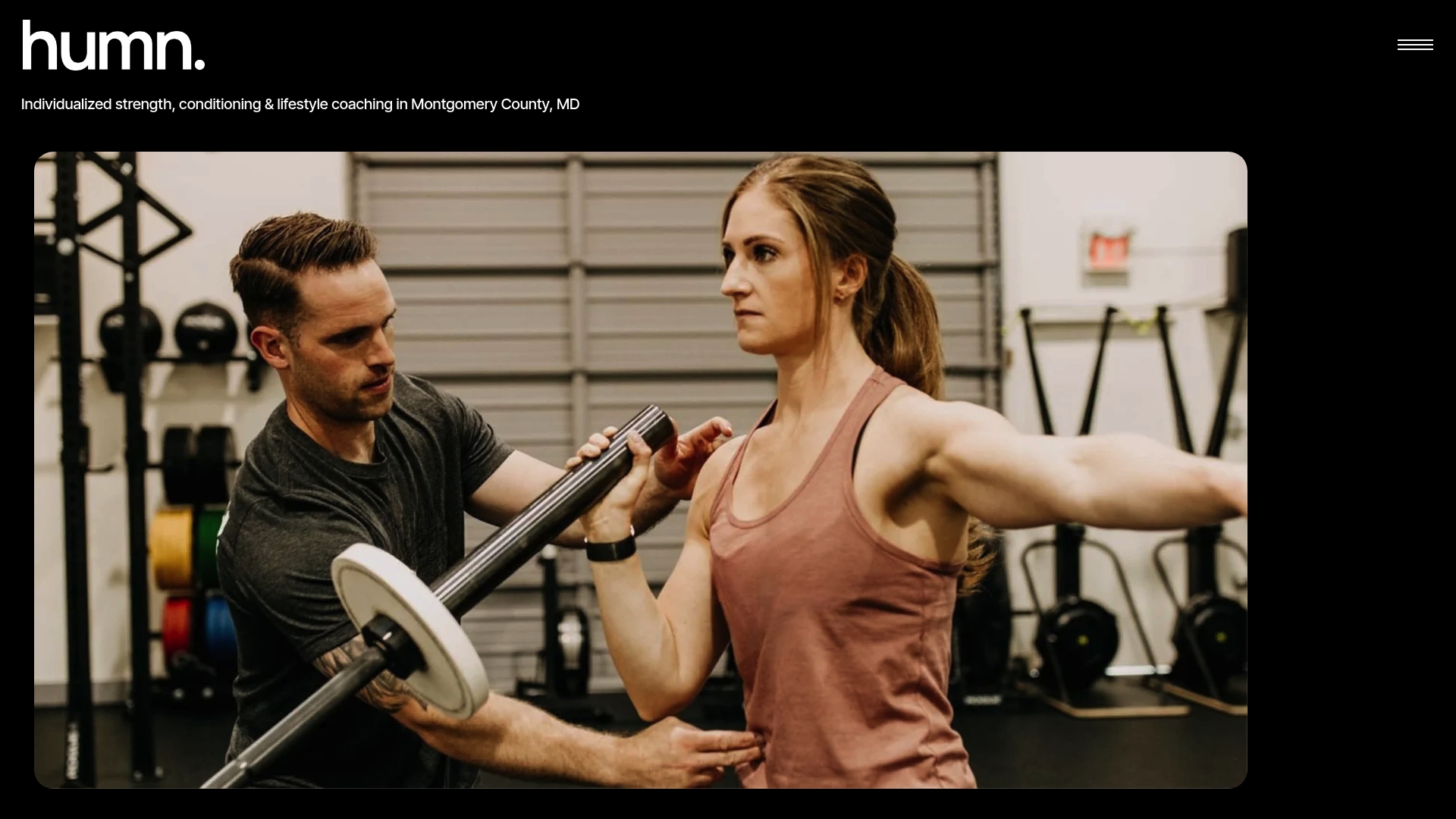
Every recovery service at humn, acupuncture included, is delivered by trained professionals in a facility built around the same standards outlined above: proper credentials, sterile single-use equipment, and a real assessment before treatment starts, not a one-size-fits-all protocol. If you want acupuncture that’s actually coordinated with your training rather than squeezed in around it, explore humn’s recovery services and book an in-person assessment to see how it fits your specific plan.
Where to Read More About Acupuncture
- Cleveland Clinic: Acupuncture covers needle counts, sensations, and safety standards in plain clinical language.
- Cleveland Clinic: What Acupuncture Really Feels Like breaks down sensitivity by body area and why insertion often goes unnoticed.
- Mayo Clinic: Acupuncture walks through the full procedure from diagnostic exam to needle removal.
- Harvard Health: Acupuncture for Pain Relief summarizes the clinical evidence, including meta-analysis findings on chronic pain outcomes.
Frequently Asked Questions
Does acupuncture hurt?
Most people feel a brief pinch during insertion, if anything at all, since acupuncture needles are solid and roughly as thin as two human hairs. Any deeper sensation, like dull ache or heaviness, is usually mild and considered a normal treatment response rather than pain.
How many needles are used in a typical session?
Sessions commonly use 5 to 20 needles, though this varies by condition and practitioner. Needles typically stay in place for 10 to 30 minutes before removal.
What should you wear to an acupuncture appointment?
Loose, comfortable clothing that allows easy access to your arms, legs, and lower back or abdomen works best. Most clinics also provide a gown or drape if needed.
Can you drive yourself home after acupuncture?
Most people can drive normally, but some feel briefly groggy or relaxed after their first session. It’s worth arranging a ride for your first visit until you know how your body responds.
Does insurance cover acupuncture?
Coverage varies by plan. Some insurers cover acupuncture for specific conditions like chronic low back pain, while others exclude it or require a referral. Call your insurer directly to confirm before booking.
How soon will you notice results from acupuncture?
Some people feel improvement after one or two sessions, but most conditions need a full course of 6 to 12 sessions over roughly three months to show consistent change. Tracking symptoms weekly makes progress easier to spot.
This article is general information, not a substitute for advice from a qualified doctor. Consult a qualified healthcare professional about your own circumstances before acting on anything here.
Sources
- Acupuncture: What To Know - Cleveland Clinic
- What Acupuncture Really Feels Like - Cleveland Clinic
- Acupuncture - Mayo Clinic
- Acupuncture for pain relief: How it works and what to expect - Harvard Health
No Comments.