

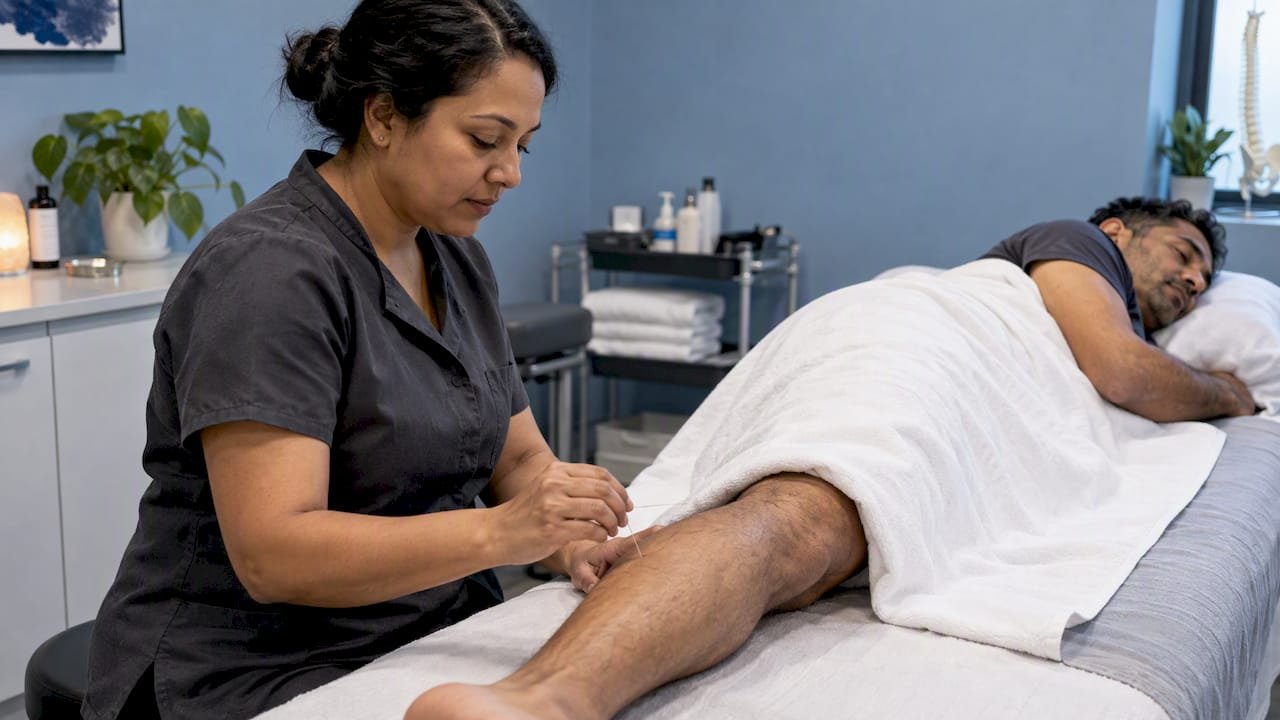
Acupuncture may reduce sciatica pain for some people, and the best recent trial supports that. The wider research is still uneven, though. It works best as one part of a plan that also includes movement, good sitting habits and a medical check when symptoms are serious. Below you will find what the studies found, what a session feels like, who should see a doctor first, and how to build a plan around the needles.
TL;DR
- A 2024 randomized trial in JAMA Internal Medicine found real acupuncture eased chronic sciatica leg pain more than sham acupuncture, with benefits lasting up to a year.
- Federal health researchers still say study quality is not good enough for definite conclusions, so treat acupuncture as a reasonable option, not a guaranteed fix.
- Sudden leg weakness, numbness, or bowel or bladder changes need urgent medical care, not an acupuncture appointment.
- Pair needling with strength work, sensible sitting and a gradual return to activity for the best chance of lasting relief.
- In Gaithersburg, acupuncture is available at humn. as an add-on to coached training and recovery.
Table of Contents
- What sciatica is and what it feels like
- What the research says about acupuncture for sciatica
- What happens in an acupuncture session for sciatica
- Safety, and when to see a doctor first
- Acupuncture is only part of the plan
- Our perspective: treat the person, not just the nerve
- Acupuncture and coached recovery in Gaithersburg
- FAQ
- Sources
What sciatica is and what it feels like
Sciatica is not a diagnosis on its own. MedlinePlus describes it as a symptom of a problem with the sciatic nerve: pain, weakness, numbness or tingling, usually on one side, that starts in the lower back and runs down the leg to the calf, foot or toes.
Mayo Clinic adds that the pain can be aching, burning, sharp or electric, and that coughing, sneezing or long stretches of sitting can make it worse. It also notes that sciatica is usually caused by a herniated disk or bone overgrowth pressing on the nerve.
That cause matters. Two people with the same leg pain can have different problems underneath, which is one reason results vary. If you want to see how people with back pain usually ease back into movement, this return plan for lower back pain walks through the stages and the typical causes, including herniated disks.
For desk workers, the pattern is familiar: a stiff lower back after a long day of meetings, then a deep ache in one buttock that travels down the back of the thigh by evening. That is the classic route, and it is also the point where many people start searching for options beyond rest and over-the-counter medication.
What the research says about acupuncture for sciatica
The honest summary: promising, with caveats. Here is how the evidence breaks down.
The strongest recent trial
A randomized trial published in October 2024 followed 216 patients with chronic sciatica from a herniated disk. Each person received 10 sessions of either real or sham acupuncture over four weeks. At week 4, leg pain on a 100 mm visual scale fell 30.8 mm in the acupuncture group versus 14.9 mm in the sham group, a difference of 16.0 mm.

Disability scores on the Oswestry Disability Index dropped 13.0 points versus 4.9. The benefits persisted through week 52, and no serious adverse events occurred. A sham comparison matters because it helps separate the effect of needling from the effect of simply getting attention and expecting to feel better.
An earlier, smaller trial
A 2019 sham-controlled trial in Pain Medicine enrolled 46 people with chronic disk-related sciatica. Twelve sessions over four weeks produced a 7.28 mm between-group difference in leg pain, which cleared the study’s 5 mm threshold for a clinically meaningful change. Adverse events were 4.3 percent, mild and temporary.
Reviews that pool many studies
A 2023 systematic review of 30 randomized trials with 2,662 participants found lower pain with acupuncture than with medication. Its authors also rated the certainty of that pain result as very low, citing high variation between studies and weak methods.
A 2026 meta-analysis of 11 trials, mostly from China, found reduced leg pain and disability but urged cautious interpretation because of different protocols, small samples and limited follow-up.
What the federal view is
The National Center for Complementary and Integrative Health says acupuncture may help sciatica pain, but research quality is not good enough to allow definite conclusions. It points to two 2015 reviews, one covering 12 studies with 1,842 participants and one covering 11 studies with 962, that reached the same hedged conclusion.
For the broader problem of back pain, NCCIH reports modest benefit for acute and moderate benefit for chronic low-back pain, and notes the American College of Physicians includes acupuncture as an option.
How to read all this
The pattern across studies is consistent in direction (pain and disability tend to improve) and inconsistent in quality. A reasonable reader’s takeaway is this: if your sciatica is persistent, you have been checked by a clinician, and you want a low-risk option to try alongside exercise, acupuncture is a fair candidate. If someone promises a cure, be skeptical.
What happens in an acupuncture session for sciatica
A practitioner will start with questions: where the pain runs, what makes it worse, how you sleep, how you sit, what you do for work and training. Treatment is then chosen based on your pattern, not a single formula.
The needles. The Maryland Board of Acupuncture says patients may feel a small prick, a dull ache, tingling, heaviness or numbness, and that acupuncture needles are much thinner than injection or blood-draw needles. Most people find the sensation milder than they expected.
The points. Point choice varies. A clinical practice guideline for low back pain lists A-shi (tender) points, Weizhong (BL40), Shenshu (BL23), Dachangshu (BL25) and Kunlun (BL60), selected by the practitioner’s assessment of your pattern. Expect points in the lower back, buttock, back of the leg and sometimes the ankle. Online lists of “the best sciatica points” are a starting vocabulary, not a prescription, and home acupressure is not the same as a trained practitioner needling.
The position and time. The same guideline says treatment is commonly done prone or side-lying, with needles retained for 20 to 30 minutes, and adapted to how you respond.
How many sessions. The trials above used 10 to 12 sessions over four weeks, which is a useful yardstick. A sensible approach is to commit to a defined block, track your leg pain and function, and decide with your practitioner whether to continue. If nothing has moved after a fair trial, that is information, not failure. Our guide on what to expect at your first acupuncture visit covers the intake, the room and the aftercare in more detail.
Safety, and when to see a doctor first
Acupuncture done properly has a good safety record in the trials above, but it is not risk-free. NCCIH warns that improper or nonsterile acupuncture can cause infection, punctured organs or central nervous system injury, and that FDA-regulated needles must be sterile and labeled for single use. Ask any practitioner about licensure and single-use needles before booking. Maryland licenses acupuncturists through its Board of Acupuncture, so the board’s site is the place to check.
More important is knowing when acupuncture is the wrong first step. Per Mayo Clinic, you should contact a clinician if self-care fails, pain lasts longer than a week, is severe, or gets worse. Seek immediate care for sudden leg numbness or weakness, pain after major trauma, or any problem controlling your bowels or bladder. Mayo also notes that people with severe sciatica and serious leg weakness, or bowel or bladder changes, might need surgery.
In practice: see your primary care physician or a spine specialist first if this is your first episode, if you have weakness, or if the pain is not settling. Acupuncture can then sit alongside their plan, and you should tell both providers what the other is doing.

Acupuncture is only part of the plan
Needles can turn the pain volume down. They do not fix the habits that loaded the nerve in the first place. What helps in the long run usually looks like this:
- Change how you sit. Mayo suggests a seat with lower-back support, armrests and a swivel base, a pillow or rolled towel to keep the curve of your lower back, and knees and hips level.
- Keep moving. Mayo also recommends regular exercise. Walking short distances often beats bed rest.
- Rebuild strength gradually. Core, glute and hip strength protects the lower back. Our piece on lower back pain strength training explains how to load the area without flaring it.
- Use a pain rule. When training around an irritated nerve, a simple scale keeps you honest. We explain ours in training around joint pain.
- Restart in stages. If you have been sidelined for weeks, follow a four-week plan to restart fitness after injury rather than jumping back to old numbers.
What about athletes? A sports medicine review found good evidence for short-term relief of knee osteoarthritis pain but little evidence that acupuncture improves athletic performance or prevents delayed-onset muscle soreness. That is a useful reality check: acupuncture is better framed as a pain and recovery tool than a performance booster. If you are curious about the recovery side, see our overview of acupuncture for muscle recovery.
Our perspective: treat the person, not just the nerve
We see sciatica as a signal that something in the system is overloaded. Sometimes it is a disk. Often it is also eight hours of sitting, poor sleep, a stressful quarter at work, and a training routine that stopped matching the body it was built for.
That is why we built humn. around four pillars: Resist, Recover, Renew and Rhythm. Strength training addresses the capacity of the tissue. Recovery work, including acupuncture as an optional add-on, helps calm things down. Coaching on sleep, stress, nutrition and daily habits is what makes the improvement stick.
Our advice to anyone with sciatica is simple. Get properly assessed. Choose treatments that are low-risk and measurable. Write down your leg pain and what you can do each week, so you can tell whether something is working. Be wary of any approach, ours included, that cannot be evaluated against how you actually feel and function.
Acupuncture earns its place when it makes it easier to move, sleep and train, because those are the things that rebuild resilience. It does not earn it by being a standalone miracle.
— Josh
Acupuncture and coached recovery in Gaithersburg
If you live or work in Gaithersburg and want acupuncture inside a broader plan, humn. offers it as an optional add-on alongside sauna, compression, red light therapy and coached training. You can see the full list on our recovery page, or look at how membership combines small-group training, one-on-one coaching and recovery access under one roof. Pricing is not published online, so reach out through the site to ask what fits your situation.
If stress and tension are part of your picture, our guide to acupuncture for stress relief explains what the research does and does not support there.
FAQ
Does acupuncture really work for sciatica?
The best recent trial says yes for chronic herniated-disk sciatica: real acupuncture reduced leg pain and disability more than sham treatment, with benefits lasting a year. However, NCCIH still says overall research quality does not allow definite conclusions. It is a reasonable option to try, not a guarantee.
How many sessions might I need?
The trials we cited used 10 to 12 sessions over four weeks. Many practitioners suggest a defined trial block and then a review of your progress. If you see no change after a fair trial, talk with your practitioner and your doctor about other approaches.
Does acupuncture hurt?
Usually not much. The Maryland Board of Acupuncture says you may feel a small prick, dull ache, tingling, heaviness or numbness, and that the needles are far thinner than those used for injections or blood draws. Tell your practitioner if any sensation becomes sharp or unpleasant.
When should I skip acupuncture and see a doctor?
Get immediate care for sudden leg numbness or weakness, pain after major trauma, or loss of bowel or bladder control. See a clinician if the pain lasts more than a week, is severe, or is getting worse. Acupuncture can come later, alongside medical guidance.
What is the best sitting position for sciatica?
Mayo Clinic advises a chair with lower-back support, armrests and a swivel base, with a small pillow or rolled towel behind your lower back and your knees and hips level. Stand and walk regularly instead of staying in one position for long stretches.
Sources
- Sciatica | MedlinePlus
- Sciatica: Symptoms and causes | Mayo Clinic
- Acupuncture vs Sham Acupuncture for Chronic Sciatica | JAMA Internal Medicine
- Efficacy and Safety of Acupuncture for Chronic Discogenic Sciatica | Pain Medicine
- The efficacy and safety of acupuncture therapy for sciatica | PMC
- Effectiveness of acupuncture in the treatment of sciatica | Frontiers in Medicine
- Acupuncture: Effectiveness and Safety | NCCIH
- Low-Back Pain and Complementary Health Approaches | NCCIH
- Acupuncture FAQs | Maryland Board of Acupuncture
- Acupuncture for low back pain: a clinical practice guideline | PMC
- The Utility of Acupuncture in Sports Medicine | Journal of Sports Medicine and Therapy
- 4 Stage Return Plan for Lower Back Pain
No Comments.