

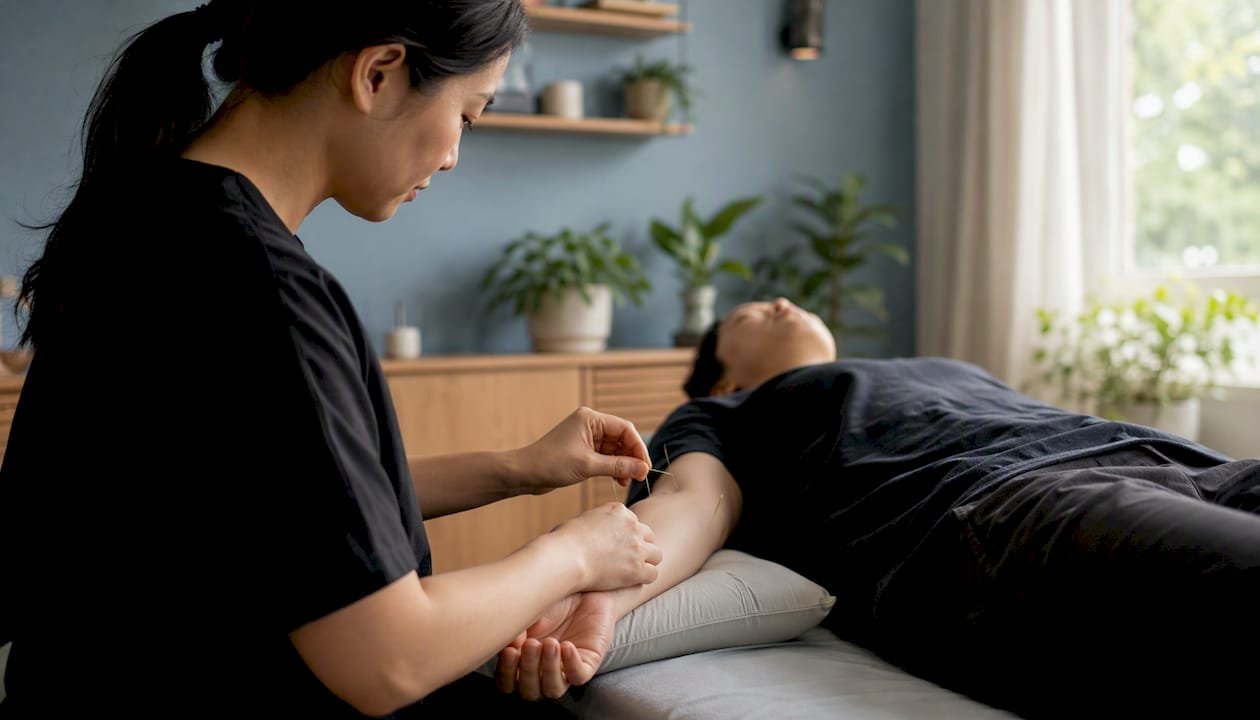
Acupuncture can meaningfully reduce stress, and the evidence for it is real enough to take seriously. Multiple clinical trials show measurable changes in autonomic nervous system function, heart rate variability (HRV), and self-reported stress scores after treatment. The evidence is not yet definitive, but it is consistent enough that major health systems including Johns Hopkins Medicine now describe acupuncture as a therapy that stimulates the central nervous system and may support emotional well-being. If you are weighing whether to try it, here is what to do first:
- Find a licensed practitioner. Look for state licensure and NCCAOM (National Certification Commission for Acupuncture and Oriental Medicine) certification before booking.
- Plan a short trial. Most clinical protocols use a consistent course of sessions over several weeks to assess whether the approach is working for you.
- Check with your clinician if you take anticoagulants, are pregnant, or manage a psychiatric condition with medication.
Key Takeaways
Acupuncture produces measurable physiological changes in the autonomic nervous system and consistently outperforms waitlist controls in stress and anxiety trials, though the evidence is not yet definitive enough to call it a proven first-line treatment.
| Point | Details |
|---|---|
| Evidence is real but limited | Trials show positive direction; HRV and ANS markers shift measurably, but most studies are small and blinding is imperfect. |
| Plan for 4–6 weeks | Clinical protocols recommend a consistent course before judging effectiveness; single sessions rarely produce lasting change. |
| Safety depends on licensure | Serious adverse events are rare with a licensed, NCCAOM-certified practitioner using single-use sterile needles. |
| Works best in combination | Pairing acupuncture with CBT, exercise, and sleep hygiene produces more durable stress relief than acupuncture alone. |
| humn coordinates the full plan | humn integrates acupuncture into a coached recovery pathway alongside sauna, red light therapy, and lifestyle coaching in Gaithersburg, MD. |
Table of Contents
- How does acupuncture reduce stress? What the physiology suggests
- What does the clinical research actually show?
- What does a typical acupuncture session for stress look like?
- Is acupuncture safe? Side effects and who should be cautious
- How many sessions do you need, and when should you expect results?
- How do you find a qualified acupuncturist in the U.S.?
- How does acupuncture fit with other stress-management strategies?
- How humn integrates acupuncture into a whole-person recovery plan
- What the evidence actually tells you about acupuncture for stress
- Stress relief that goes deeper than a single session
- Sources
How does acupuncture reduce stress? What the physiology suggests
Acupuncture appears to shift the autonomic nervous system toward parasympathetic dominance, the state your body enters when it is safe, rested, and not under threat. That shift is the most plausible physiological explanation for why people leave sessions feeling calmer.
The autonomic nervous system runs two competing branches: the sympathetic (“fight-or-flight”) and the parasympathetic (“rest-and-digest”). Chronic stress keeps the sympathetic branch overactive, which raises cortisol, disrupts sleep, and keeps heart rate elevated. HRV research shows that acupuncture stimulation is associated with measurable shifts toward parasympathetic-dominant function and reductions in heart rate, giving researchers an objective marker to track alongside subjective stress reports.
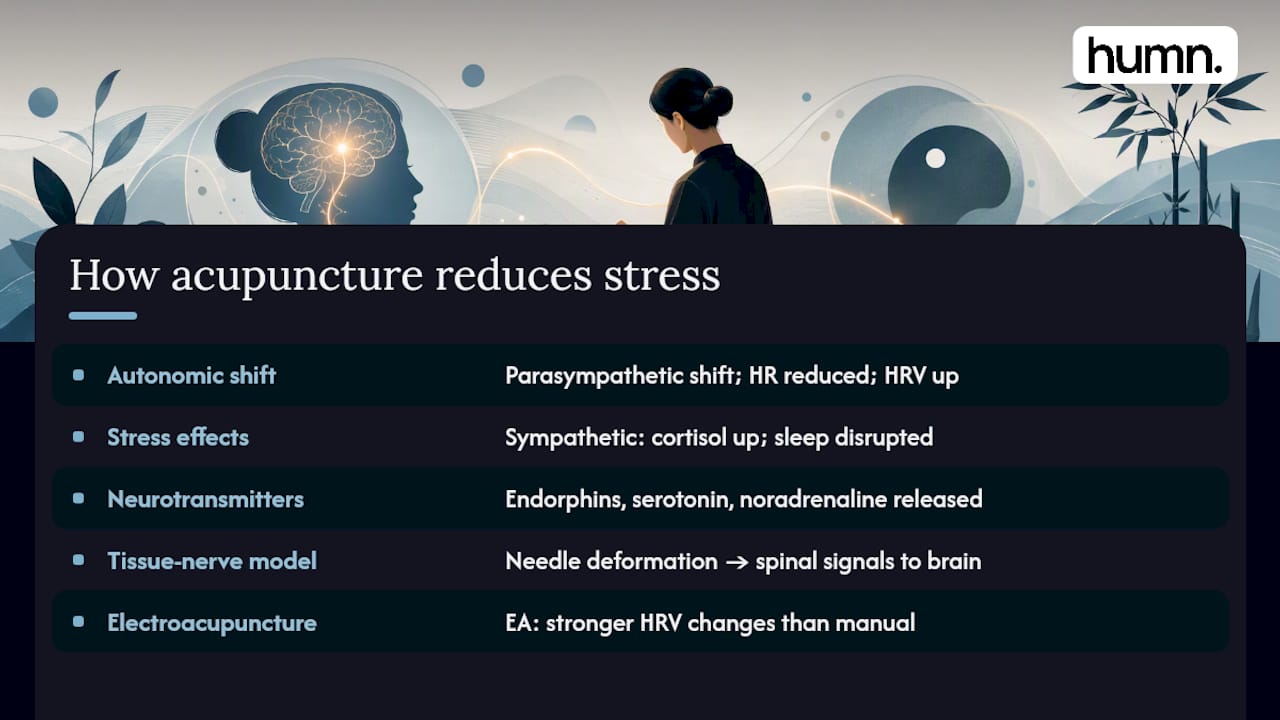
Beyond the autonomic system, Johns Hopkins Medicine notes that acupuncture stimulates the release of endorphins, serotonin, and noradrenaline in the muscles, spinal cord, and brain. These are the same neurotransmitters targeted by many anxiety medications, which is why the overlap between acupuncture and pharmacological approaches is an active area of research.
A third model focuses on connective tissue and nerve stimulation. Needles inserted at specific depths create mechanical deformation of connective tissue, which may activate local nerve fibers and send signals up the spinal cord to regions of the brain involved in stress regulation, including the hypothalamus and limbic system.
Pro Tip: If you want the most immediate autonomic effect, ask your practitioner about electroacupuncture (EA). EA applies a small electrical current through the needles and tends to produce stronger, more consistent HRV changes than manual needling alone, based on current physiologic studies. For relaxation-focused sessions, manual needling with longer retention time is the more common approach.
What does the clinical research actually show?
The overall pattern across trials is cautiously positive: acupuncture outperforms waitlist controls on stress and anxiety measures, and it often compares favorably to sham acupuncture, though the margin is not always statistically significant. The honest caveat is that most studies are small, blinding is genuinely difficult in needle-based research, and effect sizes vary.
The AkuRest pilot RCT (N=70) is one of the cleaner recent trials. It compared verum acupuncture, sham acupuncture, and a waitlist control in adults with elevated stress. Both treatment groups reduced stress more than the waitlist, and effect sizes favored verum over sham at follow-up. The difference between verum and sham did not reach statistical significance, which the authors attributed to the small sample. The study was explicitly framed as a feasibility pilot requiring a larger confirmatory RCT.
On the physiological side, a Frontiers in Human Neuroscience study measured HRV and heart rate during stimulation at specific acupoints including ST36 and CV12. Needling those points increased high-frequency HRV power and RMSSD (both markers of vagal activity) while decreasing heart rate. The effects persisted for roughly 5–10 minutes after treatment ended. Different points produced distinct autonomic signatures, suggesting that point selection is not arbitrary.
For anxiety, a systematic review published in Annals of General Psychiatry analyzed multiple RCTs on acupuncture for generalized anxiety disorder (GAD). Acupuncture alone or combined with medication outperformed medication alone on several anxiety scales in many of the included trials. The GRADE assessment rated the overall certainty of evidence as low to very low, primarily because of methodological limitations in the source studies. That rating reflects the quality of the research, not an absence of effect.
Strengths and limitations of the current evidence
What the evidence supports:
- Consistent positive direction across trials (acupuncture beats waitlist in most studies)
- Objective physiologic markers (HRV, heart rate) that track with subjective stress reports
- Plausible, multi-pathway biological mechanisms
- Favorable safety profile in licensed clinical settings
Where the evidence falls short:
- Sham acupuncture is an imperfect control (needles anywhere may have some effect)
- Most trials are small and underpowered for definitive conclusions
- Blinding participants in needle studies is inherently difficult
- Long-term maintenance effects are understudied
What does a typical acupuncture session for stress look like?
A standard session for stress runs 45–60 minutes from intake to exit, with needle retention typically lasting 20–30 minutes. According to Mayo Clinic, sessions typically use 5–20 hair-thin needles, and most people experience little to no discomfort during insertion.

Will it hurt?
Probably not in the way you expect. The needles are much finer than a blood-draw needle. Most people feel a brief pinch at insertion, followed by what practitioners call DeQi: a mild ache, heaviness, or pressure sensation at the needle site. DeQi is considered a sign of effective stimulation depth, not a sign that something is wrong.
Where are needles placed for stress?
For stress and anxiety, common points include Yin Tang (between the eyebrows), ST36 (below the knee), CV12 (upper abdomen), and points along the pericardium and heart meridians on the forearm and wrist. Point selection varies by practitioner and by your specific presentation, so your first session will include an intake assessment before any needles are placed.
What should you expect after the session?
Responses vary more than most people expect. Some people feel deeply relaxed or briefly sleepy. Others report a short energy surge. Both are normal. Neither predicts whether the treatment is working.
Practical prep tips:
- Eat a light meal 1–2 hours before (not on an empty stomach, not a heavy meal)
- Wear loose, comfortable clothing that allows access to arms, legs, and abdomen
- Hydrate well before and after
- Plan to rest or avoid intense activity for a few hours post-session if possible
Is acupuncture safe? Side effects and who should be cautious
Acupuncture is generally safe when performed by a licensed professional using sterile, single-use needles. Serious adverse events are rare in properly regulated clinical settings.
Common side effects (usually mild and short-lived):
- Soreness or mild bruising at needle sites
- Minor bleeding at insertion points
- Transient lightheadedness, especially after a first session
- Temporary fatigue or drowsiness
Rare but serious risks:
- Infection (almost exclusively associated with non-sterile technique)
- Pneumothorax (collapsed lung) from improper needling near the chest wall
- Nerve injury from incorrect depth or placement
Who should proceed with caution or consult a clinician first:
- People on anticoagulant therapy (warfarin, heparin, newer blood thinners): increased bruising and bleeding risk
- Those with bleeding disorders (hemophilia, thrombocytopenia)
- Pregnant people: certain points are traditionally avoided during pregnancy; discuss with both your OB and your acupuncturist
- Immunocompromised individuals: higher infection risk even with sterile technique
- Anyone with a pacemaker considering electroacupuncture: electrical stimulation is contraindicated
Pro Tip: Before your first session, ask the practitioner directly: “Do you use single-use, pre-sterilized needles, and do you dispose of them immediately after use?” A licensed acupuncturist will answer yes without hesitation. If there is any ambiguity, leave.
How many sessions do you need, and when should you expect results?
Acupuncture is cumulative. A single session can produce measurable physiological changes, but sustained stress relief typically requires a consistent course of care. Most clinical protocols and the GAD systematic review recommend assessing effectiveness after a few weeks of regular treatment, usually one to two sessions per week.
Some people notice a shift in sleep quality or baseline tension within the first two to three sessions. Others need four to six before any subjective change registers. That variability is normal and does not mean the treatment is failing. Chronic stress, especially when it has been present for months or years, tends to require more consistent care than acute situational stress.
A reasonable decision framework:
- After 3–4 sessions: Are you noticing any change in sleep, tension, or mood? Even small shifts count.
- After 6–8 sessions: If there is no change at all, discuss with your practitioner whether the point protocol needs adjustment or whether a different approach fits better.
- At any point: If stress is accompanied by severe anxiety, panic attacks, depression, or any thought of self-harm, acupuncture is not the right primary intervention. Involve a mental health provider immediately.
Maintenance frequency after an initial course varies. Some people taper to monthly sessions; others find that stress recurs without more regular care. There is no universal answer, and a good practitioner will not push you toward a predetermined package.
How do you find a qualified acupuncturist in the U.S.?
Licensure requirements vary by state, but the national standard is NCCAOM certification combined with a state license (typically “L.Ac.” or “Dipl. Ac.”). In most states, this requires a master’s-level degree from an accredited program and passage of national board exams.
Credential checklist:
- State acupuncture license (verify on your state’s health department website)
- NCCAOM certification (searchable at nccaom.org)
- Formal graduate training from an ACAOM-accredited program
- Clean, organized clinic with visible hygiene standards
Questions to ask before booking
- What is your training background, and are you NCCAOM-certified?
- Do you use single-use, pre-sterilized needles?
- Do you have experience treating stress and anxiety specifically?
- What points do you typically use for stress, and why?
- What does a typical course of care look like for someone in my situation?
- Do you accept insurance, and what is the out-of-pocket cost per session?
Red flags to avoid:
- No visible license or refusal to share credentials
- Pressure to purchase a large package of sessions upfront
- Upselling expensive supplements or herbal products as mandatory add-ons
- Vague answers about needle sterilization
- Claims that acupuncture can cure or replace treatment for serious medical conditions
Cost and insurance
Acupuncture session costs vary widely across the U.S. Some private insurance plans and HSA/FSA accounts cover acupuncture, particularly for pain-related indications. Coverage for stress or anxiety is less consistent. Call your insurer before your first appointment to confirm what is covered and whether you need a referral. Many practitioners offer a brief phone or video consultation at no charge, which is a practical way to screen fit before committing.
How does acupuncture fit with other stress-management strategies?
Acupuncture works best as part of a broader plan, not as a standalone fix. The physiological shifts it produces are real but time-limited without reinforcement from other lifestyle factors.
Acupuncture and CBT. Cognitive behavioral therapy (CBT) addresses the thought patterns and behavioral loops that sustain chronic stress. Acupuncture can lower baseline physiological arousal, which may make it easier to engage with CBT techniques. The two approaches target different layers of the stress response and complement each other well.
Acupuncture and exercise. Physical training, particularly resistance training and aerobic exercise, produces many of the same autonomic and neurochemical effects as acupuncture. Pairing the two tends to reinforce both. Mindfulness practices layered on top of a structured exercise routine add a third channel for downregulating the stress response.
Acupuncture and medication. The GAD meta-analysis found that acupuncture combined with medication outperformed medication alone in many trials. If you are on psychiatric medication, do not adjust your dosage based on how acupuncture makes you feel. Any medication changes should go through your prescribing clinician.
When acupuncture is not enough. Severe anxiety, panic disorder, major depressive episodes, or any suicidal ideation require urgent mental health care. Acupuncture is a supportive modality, not an emergency intervention. If your stress has escalated to that level, contact a licensed mental health provider or call 988 (the Suicide and Crisis Lifeline) before pursuing complementary therapies.
Prioritizing fitness habits alongside acupuncture creates a more durable stress-management foundation than either approach alone.
How humn integrates acupuncture into a whole-person recovery plan
humn’s approach to stress is built on the same logic the research supports: no single modality fixes chronic stress, but the right combination of recovery, movement, and coaching can shift the underlying physiology over time. Acupuncture sits within humn’s recovery services as an adjunct modality alongside sauna, red light therapy, and compression, all coordinated within a member’s broader coaching plan.
A typical care pathway at humn looks like this:
- Initial assessment: A coach maps your current stress load, sleep quality, and recovery habits before any modality is prescribed.
- Acupuncture sessions: Scheduled as part of the recovery pillar, often paired with sauna or red light therapy on the same visit to compound the parasympathetic effect.
- Strength and conditioning: Structured resistance training that builds resilience and reinforces the neurochemical benefits of acupuncture.
- Lifestyle coaching: Sleep, nutrition, and mindset habits are addressed in parallel, because acupuncture cannot override a chronically under-slept, over-caffeinated lifestyle.
- Progress checkpoints: Coaches review how recovery modalities are affecting training performance and subjective stress every few weeks, adjusting the plan accordingly.
This is the difference between booking a standalone session somewhere and having a coach who tracks whether it is actually working for you.
What the evidence actually tells you about acupuncture for stress
The conventional framing of acupuncture in wellness circles tends to go one of two ways: either it is ancient wisdom that Western medicine is too arrogant to appreciate, or it is elaborate placebo dressing. Both framings miss what the research actually shows.
The honest picture is more interesting. Acupuncture produces real, measurable physiological changes. HRV shifts, heart rate reductions, and vagal activation are not subjective. They show up on instruments. The problem is not that the mechanism is fake; it is that the research infrastructure to confirm long-term clinical outcomes at scale is still catching up. Small trials, imperfect sham controls, and heterogeneous protocols make it hard to say with confidence exactly how large the effect is and for whom.
What that means practically: acupuncture is not a gamble, but it is also not a guarantee. The people most likely to benefit are those who treat it as one component of a deliberate stress-management plan, not a one-time fix. The research on combining acupuncture with exercise and behavioral interventions is more encouraging than the standalone acupuncture literature, which makes sense physiologically. You cannot needle your way out of a lifestyle that is structurally incompatible with recovery.
The other thing most articles skip: the quality of the practitioner matters more than the modality itself. A skilled, licensed acupuncturist who takes a thorough intake, adjusts point selection based on your response, and communicates clearly about what to expect will produce better outcomes than the same needles placed by someone less experienced. Credentials are not bureaucratic box-checking; they are a proxy for the training that makes the difference between a session that shifts something and one that does not.
Stress relief that goes deeper than a single session
If you have been managing stress reactively, booking a session here and there when things get bad, you already know that approach has a ceiling. The research on acupuncture for stress relief points to the same conclusion the exercise and sleep science does: consistency and context matter more than any single intervention.
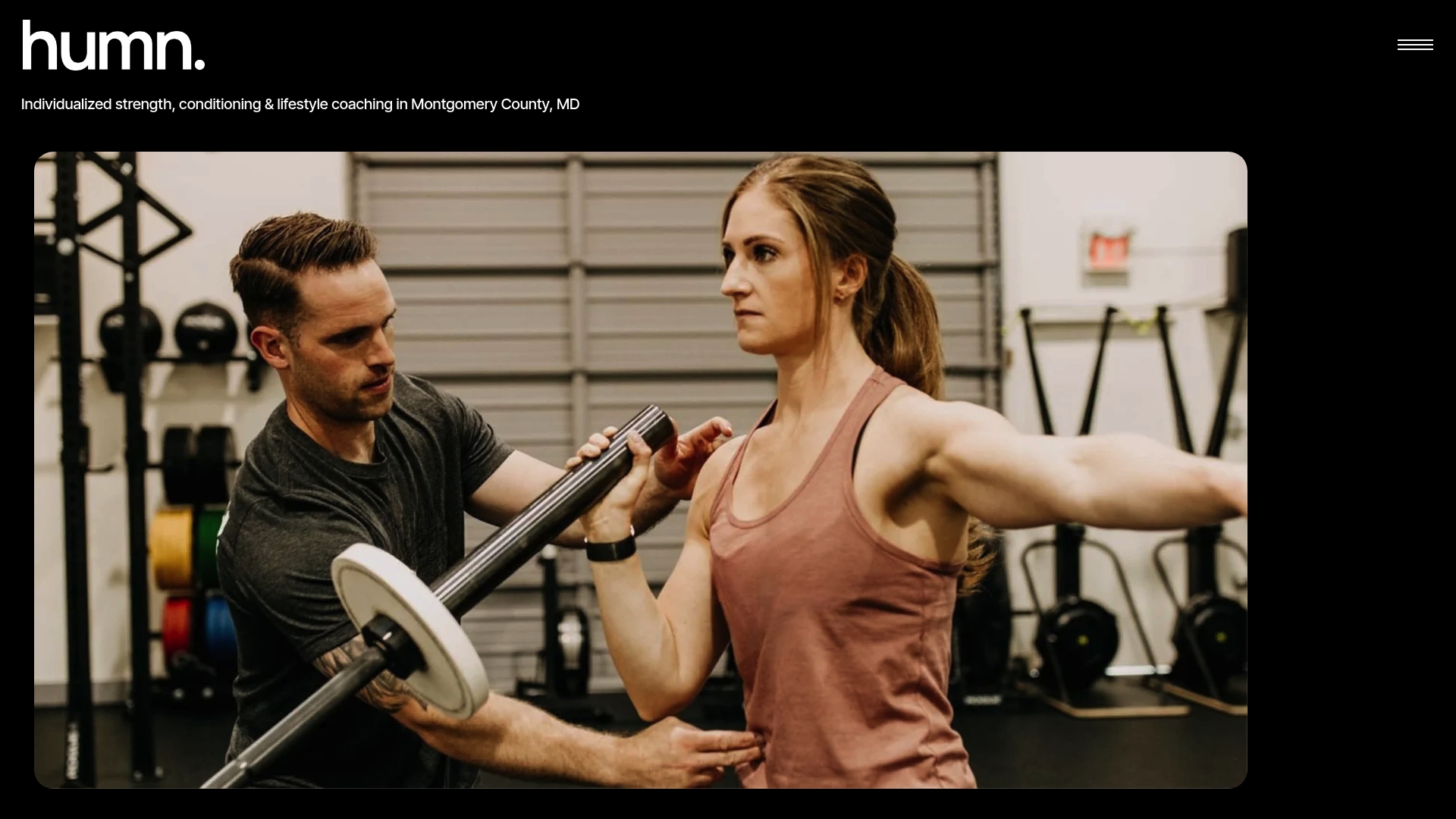
humn is built for exactly this. At our Gaithersburg, MD facility, acupuncture is not an add-on you book separately and hope connects to the rest of your health plan. It is integrated into a coached recovery pathway alongside sauna, red light therapy, and compression, coordinated by coaches who track whether it is actually moving the needle on your stress, sleep, and performance. Members get premium fitness coaching that addresses the full picture: strength, recovery, nutrition, and the lifestyle habits that determine whether any single modality sticks. If you want a plan that treats stress as a systems problem rather than a symptom to manage, explore what humn offers and take the first step toward a structured, evidence-based recovery plan.
This article is general information, not a substitute for advice from a qualified doctor. Consult a qualified healthcare professional about your own circumstances before acting on anything here.
Sources
These sources were selected for their clinical rigor, institutional authority, or direct relevance to the mechanisms and evidence reviewed in this article.
- Acupuncture - Mayo Clinic
- Does acupuncture reduce stress over time? A clinical heart rate variability study (PMC article)
- Acupuncture | Johns Hopkins Medicine
- Efficacy of acupuncture for generalized anxiety disorder: a systematic review | Annals of General Psychiatry | Springer Nature Link
No Comments.