

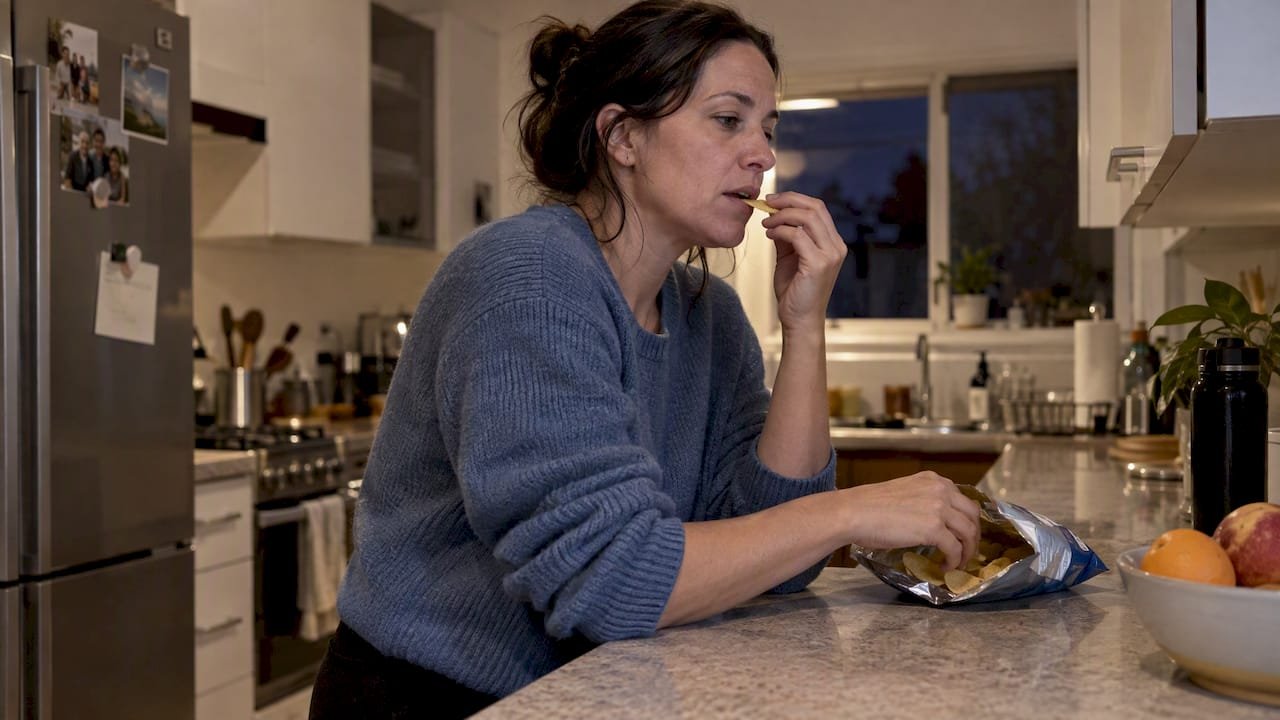
Stress eating stops when you do two things together: give your body a different way to calm down, and change the conditions that keep your stress high. Willpower and stricter diets rarely do either. Below you’ll find why stress pushes you toward food, a practical reset you can start today, and the signs that mean it’s time to talk to a clinician.
TL;DR
- Stress eating is usually a search for soothing, not pleasure. Food calms you briefly but leaves the stressor untouched, so the loop repeats.
- Chronic stress, not a single bad day, is what drives overeating through cortisol. Sleep, workload and recovery matter as much as food choices.
- Pause, name the feeling, and pick a non-food option. Mindfulness practice has measurably reduced emotional eating in research.
- Strict dieting tends to backfire. Build structure and awareness instead of restriction.
- Eating that feels out of control, happens in secret or brings intense distress deserves professional support.
Table of Contents
- Why stress makes you reach for food
- A five-step reset you can start today
- Why dieting harder usually makes it worse
- Fix the stress, not only the snacking
- Our perspective: habits first, then the willpower question disappears
- When stress eating may be something more
- How humn. can help
- FAQ
- Sources
Why stress makes you reach for food
Stress doesn’t affect everyone’s appetite the same way. A sudden scare can shut hunger off. Ongoing pressure does the opposite. A mini literature review on appetite and stress describes how acute stress releases CRH, which suppresses appetite, while chronic activation of the HPA axis releases cortisol, which increases the drive for energy-dense, highly palatable foods.
That helps explain the 4 p.m. vending machine run after a week of deadlines. It also explains why the same person can skip lunch on a frantic Monday and raid the pantry by Friday night.
The same review notes that people who show a sharp cortisol rise in response to a stressful event, so-called high cortisol reactors, are significantly more likely to overeat than low reactors. In plain terms: your stress response has a personal profile, and generic advice fits some people better than others.
Soothing is not the same as pleasure
The Cleveland Clinic’s explanation of stress eating makes a distinction worth holding onto. Eating can temporarily lower irritability, which feels like relief. But it doesn’t solve whatever caused the tension, so the brain learns to reach for palatable food the next time the same anxiety appears.
A quick test: if you’re eating chips standing at the counter and can’t say what they tasted like, you were probably soothing. If you chose a meal, sat down and enjoyed it, that’s pleasure. Both are fine. Only the first one needs a different tool.
Why you may not notice it happening
A 2025 translational review on decoupling stress and eating points to interoceptive awareness, the ability to read internal signals such as hunger, fullness and emotional arousal. That sense is often blunted in people who stress eat chronically. When tension and hunger feel the same, food becomes the automatic answer.
This is why “just listen to your body” is poor advice at first. The skill has to be rebuilt, and it takes practice.
A five-step reset you can start today
None of this requires a new diet. It requires a short gap between the urge and the action, and something to put in that gap.
- Stop for 15 minutes. You don’t have to refuse the food. You only have to wait. Urges peak and fade, and many pass inside that window.
- Take one slow breath and name the feeling. The Cleveland Clinic’s version of this is the S.T.O.P. method: stop, take a breath, observe what you feel, then pick a soothing activity. Try finishing the sentence “Right now I feel ___ because ___.” If you land on tired, anxious or overwhelmed, you’ve learned that food wasn’t the need.
- Choose a non-food comfort from a list you wrote in advance. Decide when you’re calm, not when you’re stressed. Good entries are a brisk walk, a call with a friend, stretching, a shower, or a few minutes of deep breathing. Our guide to breathwork for stress walks through a five-minute option built for busy days.
- If you still want to eat, eat on purpose. Plate it, sit down, remove screens and slow down. This is mindful eating, and it removes the guilt that fuels the next episode. Our piece on mindful eating for busy professionals shows how to do it in five minutes.
- Write down what triggered it. One line is enough: time, place, feeling. After two weeks, patterns show up, and patterns are fixable.
What the research says about mindfulness
In a 2024 study, a 31-day web-based mindfulness training reduced stress-related eating tendencies, and the changes tracked with differences in brain regions tied to emotion regulation and body awareness. It’s one study, not a promise for every person, but it supports practicing awareness as a skill rather than treating cravings as a character issue.
An earlier randomized pilot in overweight and obese women also tested a mindfulness program aimed at stress eating, looking at cortisol and abdominal fat. Small and exploratory, but the direction fits.
Why dieting harder usually makes it worse
The most common response to stress eating is to clamp down: cut carbs, skip snacks, count everything. It often backfires. A study on a mindfulness and prolonged-chewing intervention opens by noting that conventional calorie-deficit programs mostly fail at long-term weight reduction and leave eating styles unchanged. Its alternative redirects attention to the experience of eating, which reduced craving and emotional eating.
The Mayo Clinic’s guidance on emotional eating gives a practical version of the same idea: keep a food and mood diary, find ways to manage stress that don’t involve food, and don’t keep temptation foods within easy reach. It also advises against rigid deprivation.
A useful rule: regular meals with enough protein and fiber, no “forbidden” list, and a few easy foods at hand for the hard hours. Hungry people are less resilient to stress, and the evening binge often starts with a skipped lunch.
Fix the stress, not only the snacking
If your stress is chronic, your cravings will be too. The upstream levers are unglamorous and they work together.
Sleep
Short sleep makes every craving louder. If your evenings are your danger zone, look at your wind-down before you look at your pantry. Heat can help some people unwind. Our notes on using a sauna for sleep cover timing, which matters.
Movement as a pressure valve
A walk or a short strength session is a real alternative to food because it changes your physical state, which is what you were trying to do with the snack. Strength training in particular gives stress somewhere to go and gives you a measurable win. If you want ideas for making movement a coping tool, our article on adding mindfulness to your fitness routine is a good start. For a look at how other wellness practices use physical loading, this overview of stress and bone density loading sessions shows another angle on why structured movement matters.

Workload and recovery
You can’t snack-hack a calendar with no margin. Build in recovery on purpose: a real lunch away from your desk, a hard stop to the workday a few evenings a week, and time that is explicitly not productive. For techniques beyond food, see our guide to stress management coaching, and for the physiology of the stress-weight link, what the science says about stress and weight gain.
Support from other people
Non-food social connection is one of the strongest replacements for eating, and it’s the one people skip first when busy. A text to a friend counts. So does a coach who checks in on how the week actually went.
Our perspective: habits first, then the willpower question disappears
At humn., we coach busy professionals in Gaithersburg, and stress eating comes up more than almost any other topic, usually framed as a discipline problem. We don’t see it that way.
When someone tells us they “have no willpower at night,” we look at the day that came before. Was lunch skipped? Did they sleep six hours? Did they go from meeting to meeting with no gap to breathe? Most of the time the evening snack is the last link in a chain that began at 9 a.m.
That is why our approach is built on four pillars: Resist, Recover, Renew and Rhythm. Strength training is only one part. Recovery, sleep, stress and nutrition get equal attention, because changing one while ignoring the rest produces the kind of short-term result that fades. Our coaching is habits-first and behavior-based, so we start by making one small change automatic before adding the next. Our write-up on behavior change techniques explains the reasoning.
We also don’t use shame or restriction as a tool. People already carry plenty of both when they come to us. What helps is a consistent coach, a clear plan, honest tracking and a place where your week is understood, not judged.
— Josh
When stress eating may be something more
Eating more when you’re stressed is common. But some patterns call for clinical help, not a better habit plan.
The NIMH describes binge-eating disorder as recurrent episodes in which you feel a loss of control and marked distress over your eating, and unlike bulimia, episodes are not followed by purging or other compensatory behavior. NIMH also lists it as the most common eating disorder in the U.S. in its overview of eating disorders.
Consider talking to your primary care doctor, a licensed therapist or a registered dietitian if:
- you eat large amounts quickly and feel unable to stop;
- you eat alone or hide it because of shame;
- you feel intense distress, disgust or guilt afterward;
- you compensate by purging, fasting or extreme exercise;
- your eating is affecting your health, relationships or work.
NIMH notes that treatment is individualized and may include psychotherapy such as cognitive behavioral therapy. Eating disorders are not a choice, and people do recover with treatment. If you also have questions about medical options, including how medication interacts with binge eating, a clinician is the right person to ask. This clinician-oriented overview of GLP-1 medications and binge eating can help you prepare questions for that visit.
If you’re in crisis or having thoughts of harming yourself, call or text 988, the Suicide & Crisis Lifeline, or call 911 in an emergency. Coaching, ours included, is a complement to medical and mental health care, never a substitute.
How humn. can help
If you recognize yourself in the stress-then-snack loop and want a structure around it, this is what we do. Our membership combines small-group personal training with coaching and guidance, so your training, sleep, stress and habits are looked at together. Our 1:1 nutrition coaching focuses on building eating patterns that survive a hard week, and our recovery services, including sauna, compression, red light therapy and acupuncture, give you real ways to downshift that aren’t food. If you’re unsure whether coaching is the right fit, our 90 day test lays out how to judge it.
FAQ
Can stress make you eat more?
Yes, especially when stress is ongoing. Acute stress can suppress appetite, but chronic stress activates cortisol, which increases the drive for calorie-dense, palatable foods. Poor sleep and skipped meals make the effect stronger.
Can stress make you stop eating?
Yes. Short-term stress releases hormones such as CRH that suppress appetite, so some people lose their appetite during acute stress. If appetite loss lasts, or you’re losing weight without trying, see your doctor.
How do I stop stress eating at night?
Start earlier in the day. Eat regular meals with protein, then use the pause-and-name routine when the urge hits. Decide on a non-food wind-down such as a shower, stretching or breathing exercises. If evenings are still hard after a few weeks, a coach or dietitian can help find your specific trigger.
Is stress eating the same as binge-eating disorder?
Not necessarily. Stress eating is a common coping habit. Binge-eating disorder involves recurrent episodes with loss of control and marked distress. If that sounds like you, speak with a doctor or licensed therapist.
Does dieting help?
Usually not on its own. Restriction can intensify emotional eating, so building awareness, regular meals and stress tools tends to hold up better than cutting foods out.
Sources
- Neurohormonal Regulation of Appetite and its Relationship with Stress (PMC)
- Restoring a Healthy Relationship with Food by Decoupling Stress and Eating (PMC)
- Mindfulness meditation modulates stress-eating and its neural correlates (PubMed)
- Mindfulness Intervention for Stress Eating to Reduce Cortisol and Abdominal Fat (PubMed)
- A combined mindfulness-prolonged chewing intervention (PubMed)
- Stress Eating: Why It Happens and How To Stop (Cleveland Clinic)
- Weight loss: Gain control of emotional eating (Mayo Clinic)
- Eating Disorders (NIMH statistics)
- Eating Disorders: What You Need to Know (NIMH)
No Comments.