


Stress management coaching is a structured, evidence-based practice that helps you identify your personal stress triggers, build nervous-system regulation skills, and develop habits that make resilience the default rather than the exception. It is not therapy, and it is not a one-size-fits-all seminar. It is a working relationship between you and a trained coach, focused on practical tools you practice, track, and refine over time.
Three things you can do right now:
- Try a 60-second grounding reset: Name three things you see, three sounds you hear, and move three body parts. This is the 3-3-3 rule, and it interrupts a stress spiral faster than most people expect.
- Ask one question on your next discovery call: “How do you measure my progress?” A coach without a clear answer is a red flag.
- Rate your stress today on a 0–10 scale and write it down. That single number, tracked daily, becomes your baseline data.
The Mayo Clinic and Harvard Health both confirm that relaxation techniques are practical, learnable skills. The International Coaching Federation (ICF) sets the credential standards that separate qualified coaches from well-meaning amateurs. Facilities like humn. in Gaithersburg, MD, show what happens when coaching goes beyond a single tactic and addresses the whole system.
Key Takeaways
Stress management coaching works because it combines evidence-based techniques, consistent practice, and structured accountability into a system that changes your nervous system’s default response to pressure.
| Point | Details |
|---|---|
| Start with two techniques | Diaphragmatic breathing and the 3-3-3 rule are the fastest, most accessible entry points for acute stress relief. |
| Expect a multi-week timeline | Measurable shifts in sleep, mood, and focus typically emerge after six to twelve weeks of consistent coached practice. |
| Credentials signal quality | Look for ICF-credentialed coaches; seek a licensed clinician (LCSW, LMFT) if symptoms are severe or persistent. |
| Track specific metrics | A daily 0–10 stress rating and a count of micro-resets practiced per day give you real data to review with your coach. |
| humn. integrates the full system | humn.'s four-pillar model (Resist, Recover, Renew, Rhythm) addresses fitness, recovery, and lifestyle habits together for lasting resilience. |
Table of Contents
- What stress management coaching techniques actually work?
- Why does coaching actually reduce stress?
- How does a stress coaching program actually work?
- What does stress coaching cost, and how long until you see results?
- How do you choose the right stress management coach?
- How do you know if coaching is actually working?
- What happens in a single stress coaching session?
- How humn.'s integrated approach builds lasting stress resilience
- What most people get wrong about stress management coaching
- Ready to build real stress resilience with humn.?
- Sources
What stress management coaching techniques actually work?
The best coaches do not hand you a pamphlet. They teach you a small set of techniques, watch you practice them, and help you figure out which ones fit your life. Here is the core toolbox, with enough detail to try each one today.
Paced diaphragmatic breathing
Benefit: Slows heart rate within 60–90 seconds by activating the parasympathetic nervous system.
Steps:
- Sit or lie down with one hand on your belly.
- Inhale through your nose for 4 counts, letting your belly rise.
- Exhale through your mouth for 6–8 counts.
- Repeat 4–6 cycles.
Best for acute stress spikes, pre-meeting anxiety, or any moment you need to shift gears fast. People with certain respiratory conditions should check with a physician before using extended exhale techniques.
Box breathing
Benefit: Adds a structured pause that deepens the calming effect of breath control.
Steps:
- Inhale for 4 counts.
- Hold for 4 counts.
- Exhale for 4 counts.
- Hold for 4 counts.
Used by Navy SEALs and emergency responders for high-pressure situations. If breath-holding feels uncomfortable, drop the holds and use simple paced breathing instead.
The 3-3-3 grounding rule
Benefit: Pulls attention out of anxious thought loops and back into the present moment.
Steps:
- Name three things you can see.
- Identify three sounds you hear.
- Move three parts of your body (roll your shoulders, wiggle your toes, flex your hands).
This is a first-line tool for acute stress and panic, recommended by the Mayo Clinic as an accessible on-the-spot technique. It requires no equipment and works in a meeting, a car, or a crowded office.
Progressive muscle relaxation (PMR)
Benefit: Releases physical tension stored in the body and trains awareness of the difference between tension and ease.
Steps:
- Start at your feet. Tense the muscles firmly for 5 seconds.
- Release and notice the sensation for 10 seconds.
- Move upward through calves, thighs, abdomen, hands, arms, shoulders, face.
- Finish with three slow breaths.
PMR is a practice often done before sleep or after a demanding workday. MedlinePlus lists it alongside deep breathing and guided imagery as a recommended starting point for most people.
Guided imagery
Benefit: Reduces perceived stress by engaging the brain’s capacity to shift emotional state through vivid mental scenes.
Steps:
- Close your eyes and take three slow breaths.
- Picture a place where you feel completely safe and calm (a beach, a forest, a childhood room).
- Add sensory detail: what do you smell, hear, feel underfoot?
- Stay for 5–10 minutes, then slowly return attention to the room.
Coaches often record a short guided script for clients to use between sessions. Not ideal for people who find visualization frustrating or who have trauma associations with certain environments.
Brief mindfulness anchors
Benefit: Builds present-moment awareness that prevents stress from compounding across the day.
A mindfulness anchor is simply a chosen sensory cue you return to repeatedly: the feeling of your feet on the floor, the weight of your hands in your lap, the sound of your breath. You practice noticing it for 30–60 seconds, several times a day. Adding mindfulness to a fitness routine amplifies this effect by giving the body a second channel for regulation.
Journaling prompts and CBT-style thought records
Benefit: Externalizes stress patterns so you can see them clearly and challenge distorted thinking.
A simple CBT thought record asks three questions: What happened? What did I tell myself about it? What is a more accurate or useful interpretation? Coaches use this to help clients spot catastrophizing, all-or-nothing thinking, and chronic self-blame. A five-minute journaling session at the end of the day, using a prompt like “What stressed me most today, and what did I actually control?” builds the habit without demanding an hour of reflection.
Micro-resets
Benefit: Prevents stress accumulation by inserting brief recovery moments throughout the day.

A micro-reset is any 60–90 second practice (a few breath cycles, a short walk, a body scan) scheduled between tasks. Coaches often assign two to three per day as homework. The goal is not to eliminate stress but to prevent it from compounding into a chronic baseline.
Pro Tip: In coaching, sequence matters. Start clients with diaphragmatic breathing and the 3-3-3 rule in week one. Both are fast, require no equipment, and produce noticeable results quickly. Add PMR in week two, then journaling in week three. Layering somatic tools (breathing, PMR) before cognitive ones (thought records) tends to lower the nervous system’s reactivity first, which makes the cognitive work land better.
Why does coaching actually reduce stress?
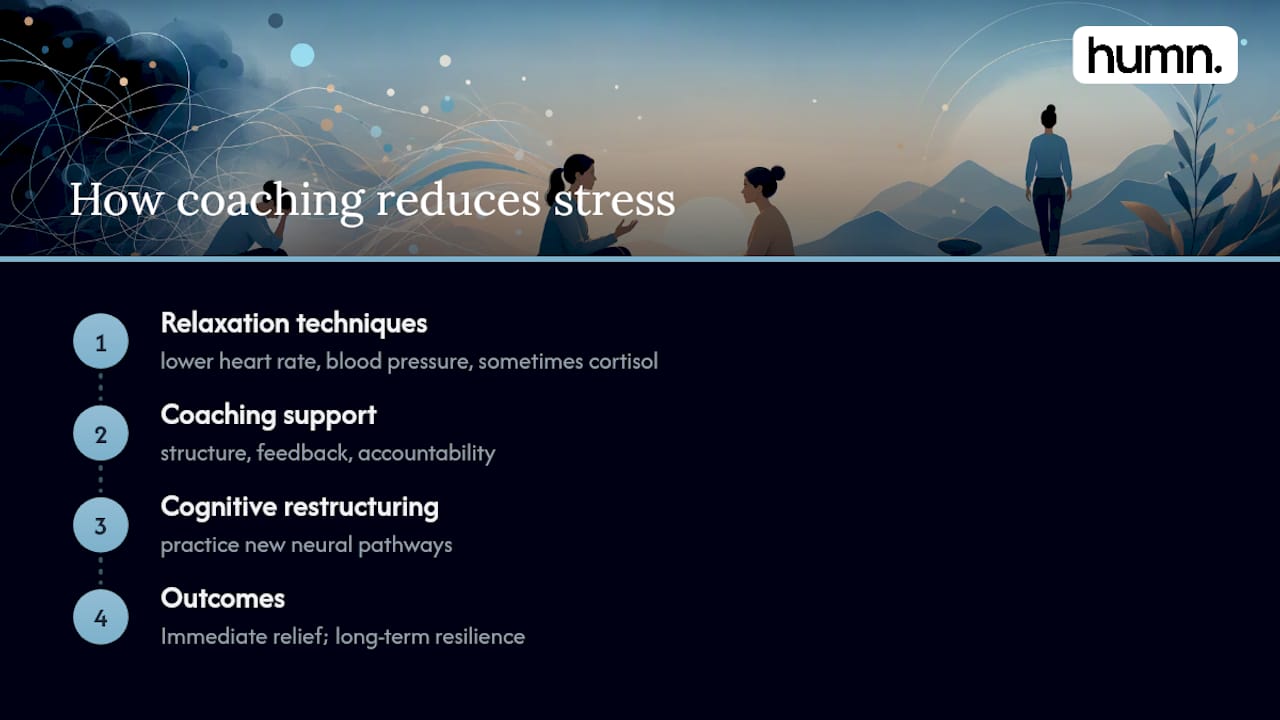
The short answer: coaching builds skills and routines that shift your nervous system’s baseline and expand your tolerance for pressure before it tips into overwhelm.
Herbert Benson’s research at Harvard identified the relaxation response as the physiological counterpart to the fight-or-flight reaction. Techniques like diaphragmatic breathing and PMR trigger this response, reducing heart rate, lowering blood pressure, and decreasing stress hormone output. NCBI Bookshelf’s clinical review confirms that relaxation techniques are therapeutic exercises with measurable physiological effects, including reduced cortisol in some studies.
Coaching adds what self-help alone cannot: structure, feedback, and accountability. Harvard Health notes that even a few minutes of daily practice builds a reserve of calm you can draw on during acute stressors. The problem is that most people do not practice consistently without a coach holding them to it.
Cognitive restructuring, the CBT-based component of most coaching programs, changes how the brain interprets threat. When you repeatedly challenge a catastrophic thought and replace it with a more accurate one, you are literally practicing a different neural pathway. Over weeks, the new interpretation becomes the faster, more automatic response.
The result is two-tiered: immediate symptom relief (slower heart rate, easier breathing, reduced muscle tension) and longer-term resilience (better sleep, steadier mood, improved focus at work). Chronic stress contributes to high blood pressure, headaches, anxiety, and depression, which is exactly why the goal is not to manage one bad week but to change the system that keeps producing them.
How does a stress coaching program actually work?
Coaching is not a lecture. It is a structured, repeating cycle of assessment, skill practice, experimentation, and measurement. Here is what that looks like in practice.
Common formats
- 1:1 coaching: The most personalized option. The coach tailors every technique and homework assignment to your specific triggers, schedule, and goals. Best for people with complex stress patterns or who want maximum accountability.
- Group or cohort coaching: Four to twelve participants work through a structured curriculum together. Lower cost, strong peer support, less individual customization. Common in workplace stress management programs.
- Short workshops: A single session or half-day intensive covering two to three core techniques. Useful for teams or as an introduction, but rarely sufficient for lasting change on its own.
- Hybrid (app + coach): A digital platform handles daily check-ins and habit tracking; a human coach reviews data and adjusts the plan weekly or biweekly. Growing in popularity for busy professionals.
Typical session flow
A standard 45–60 minute 1:1 session follows a predictable structure:
- Check-in and measurement (5–10 minutes): Review the week’s stress ratings, sleep quality, and homework completion. The coach notes patterns.
- Focused skill teaching or practice (15–25 minutes): Introduce or deepen one technique. The client practices it in session with real-time feedback.
- Planning micro-experiments and homework (10–15 minutes): Agree on one to two specific practices to try before the next session. Specificity matters: “practice box breathing for 3 minutes before your 9 AM meeting” beats “try to breathe more.”
- Closing anchor (3–5 minutes): A brief grounding practice to end the session and reinforce the skill just practiced.
Most programs run weekly 30–60 minute sessions for the first six to eight weeks, then shift to biweekly as skills become more automatic. A good coach also knows when to refer out. If a client’s stress is rooted in clinical anxiety, depression, or trauma, a licensed therapist (LCSW, LMFT, or LPCC) is the appropriate next step. Coaching and therapy can run in parallel, but they are not interchangeable.
What does stress coaching cost, and how long until you see results?
Pricing in the U.S. varies considerably based on coach credentials, session length, format, and whether you are buying individual sessions or a package. Costs depend on credentials, local market, and coaching format. Many coaches offer a brief free discovery call before committing.
Timeline expectations are equally important to set correctly. Acute skill benefits (feeling calmer in the moment, breaking a stress spiral) can appear within the first one to two sessions. Measurable shifts in sleep quality, mood stability, and workplace focus typically emerge after six to twelve weeks of consistent practice. Deep pattern change, the kind where your default response to pressure is fundamentally different, generally takes three to six months or longer.
The reason the timeline is not shorter: habits require repetition to become automatic. A coach accelerates the process through structure and feedback, but there is no shortcut around the practice itself.
How do you choose the right stress management coach?
Credentials are the starting point, not the finish line. Here is what to look for and what to ask.
Credentials that matter
- ICF credentials (ACC, PCC, MCC): The International Coaching Federation sets the global standard for professional coaching. An ICF-credentialed coach has completed accredited training and logged supervised coaching hours.
- LCSW, LMFT, LPCC: These are licensed clinical credentials. Professionals with these licenses can diagnose and treat mental health conditions. A coach with one of these backgrounds brings clinical depth, but they are operating as a coach (not a therapist) in a coaching context. If your stress is rooted in clinical anxiety or depression, a licensed clinician is the appropriate first call.
- Specialty certifications: Health and wellness coaching certifications (NBC-HWC, for example) add relevant training in behavior change and habit formation.
Trust signals to look for
- A structured session plan with measurable outcomes from session one
- Evidence-based tools (breathing, PMR, CBT-based techniques) rather than vague “energy work” or unverifiable methods
- Sample homework or home-practice assignments shared upfront
- Transparent pricing and a clear refund or cancellation policy
- Real testimonials or case examples with specific, measurable outcomes
Questions to ask on a discovery call
- What credentials and training do you hold?
- How do you assess my stress patterns at the start?
- What techniques do you use, and are they evidence-based?
- How do you measure my progress?
- What does a typical session look like?
- How much homework is involved, and how do you support me between sessions?
- What happens if I am not making progress after four to six weeks?
- Do you refer clients to therapists or physicians when appropriate?
Red flags
- Promises to “cure” your stress or anxiety
- Diagnosing you with a mental health condition without a clinical license
- No measurement plan or outcome tracking
- Pressure to commit to a long package before a trial session
- Dismissing the idea of therapy or medical referrals entirely
The benefits of 1-on-1 coaching come from the relationship and the structure, not just the techniques. A coach who cannot explain their process clearly is unlikely to deliver a clear process in sessions.
How do you know if coaching is actually working?
Progress in stress management coaching is measurable. The mistake most people make is waiting to feel “better” in a vague, general sense. Coaches track specific indicators.
Subjective measures:
- Daily stress rating on a 0–10 scale (tracked at the same time each day)
- Sleep quality rating (how rested you feel on waking, 1–5 scale)
- Mood check-in (a simple one-word or one-sentence daily note)
- Frequency of reactive incidents (snapping at a colleague, catastrophizing a setback)
Behavioral markers:
- Number of micro-resets practiced per day
- Journal prompts completed per week
- Boundary-setting attempts (saying no, delegating, protecting recovery time)
- Consistency of sleep and wake times
Performance indicators:
- Work focus and task completion
- Absenteeism or sick days
- Self-reported energy levels across the day
A good coach reviews these numbers at every session check-in and uses them to adjust the program. Small wins matter: going from zero micro-resets per day to two is a real behavioral shift, even if your stress rating has not dropped dramatically yet. Coaches translate those small wins into longer-term targets, building toward the kind of resilience where a hard week does not derail the whole system.
What happens in a single stress coaching session?
A session is practical, structured, and always includes skill practice and a specific homework assignment. Here is what a typical first session looks like, step by step.
- Pre-session intake (before you arrive or log on): Most coaches send a short questionnaire covering your top stressors, sleep patterns, current coping habits, and goals. Fill it out honestly. The more specific you are, the faster the coach can calibrate.
- Check-in (5–10 minutes): The coach reviews your intake or, in later sessions, your homework and stress ratings from the past week. You discuss what came up, what worked, and what did not.
- Focused intervention (15–25 minutes): The coach introduces one technique, explains the rationale briefly, and guides you through it in real time. In a first session, this is often diaphragmatic breathing or the 3-3-3 rule. You practice it, the coach observes and adjusts.
- Planning and homework (10–15 minutes): You and the coach agree on one to two specific practices for the week. The assignment is written down with a time, a trigger, and a duration. “Practice box breathing for 3 minutes when I sit down at my desk each morning” is a homework assignment. “Try to relax more” is not.
- Closing anchor (3–5 minutes): A brief grounding practice closes the session. This reinforces the skill and gives you a clean transition back into your day.
Preparation tips: Come with one specific stressor you want to work on. Bring your stress ratings if you have been tracking them. Wear comfortable clothes if the session includes any movement or body-based work. And expect to feel slightly awkward practicing techniques for the first time. That is normal, and it passes quickly.
How humn.'s integrated approach builds lasting stress resilience
Combining habit-first fitness, recovery services, and lifestyle coaching produces more durable stress resilience than any single technique practiced in isolation. That is the premise behind humn.'s four-pillar framework, and it holds up under scrutiny.
The four pillars map directly to stress outcomes:
- Resist (strength training): Regular resistance training reduces baseline cortisol, improves sleep architecture, and builds the physical capacity to absorb pressure. Mindset work tied to fitness compounds this effect by training the brain to tolerate discomfort and persist through difficulty.
- Recover (sauna, compression, red light therapy, acupuncture): These modalities support parasympathetic nervous system activation, the same physiological state that relaxation techniques aim for. Recovery services at humn. are built into the membership, not treated as an afterthought.
- Renew (sleep, nutrition, lifestyle habits): Sleep is the single most powerful stress-recovery tool available. Coaches at humn. address sleep hygiene, nutrition timing, and daily habit architecture as part of the program, not as optional extras.
- Rhythm (sustainable routines): Stress accumulates when life has no rhythm. Coaches help clients build predictable structures for work, movement, recovery, and rest so the nervous system is not constantly recalibrating.
What most people get wrong about stress management coaching
Most people who come to coaching arrive with one tactic they have already tried and one expectation: that the coach will give them a better tactic. That framing misses the point, and it is the most common reason people stall.
The real work in coaching is not finding the right breathing technique. It is practicing it consistently enough that it becomes automatic, and building the surrounding habits (sleep, movement, recovery, boundaries) that make the technique actually land. A single tool practiced once a week in a session will not change your baseline. Practiced twice a day for six weeks, with a coach reviewing your data and adjusting the plan, it will.
The other pattern worth naming: people underestimate how much the homework matters. The session is 45 minutes. The week is 10,000 minutes. What you do between sessions is where the change actually happens. Coaches who assign vague homework get vague results. The specificity of the assignment is a direct signal of the quality of the coaching.
Early weeks often feel slow. You are building a new skill, and new skills feel clunky before they feel natural. The clients who stay with the process past week three almost always report that something shifted around weeks five to eight. That is not magic. That is what consistent practice produces.
Ready to build real stress resilience with humn.?
Busy professionals in the Gaithersburg, MD area who want more than a breathing exercise and a pamphlet are exactly who humn. was built for. The difference between a single coaching session and a humn. membership is the difference between a tool and a system. You get strength training that lowers your cortisol baseline, recovery services that activate your parasympathetic nervous system, and lifestyle coaching that addresses sleep, habits, and stress patterns together, not in separate silos.
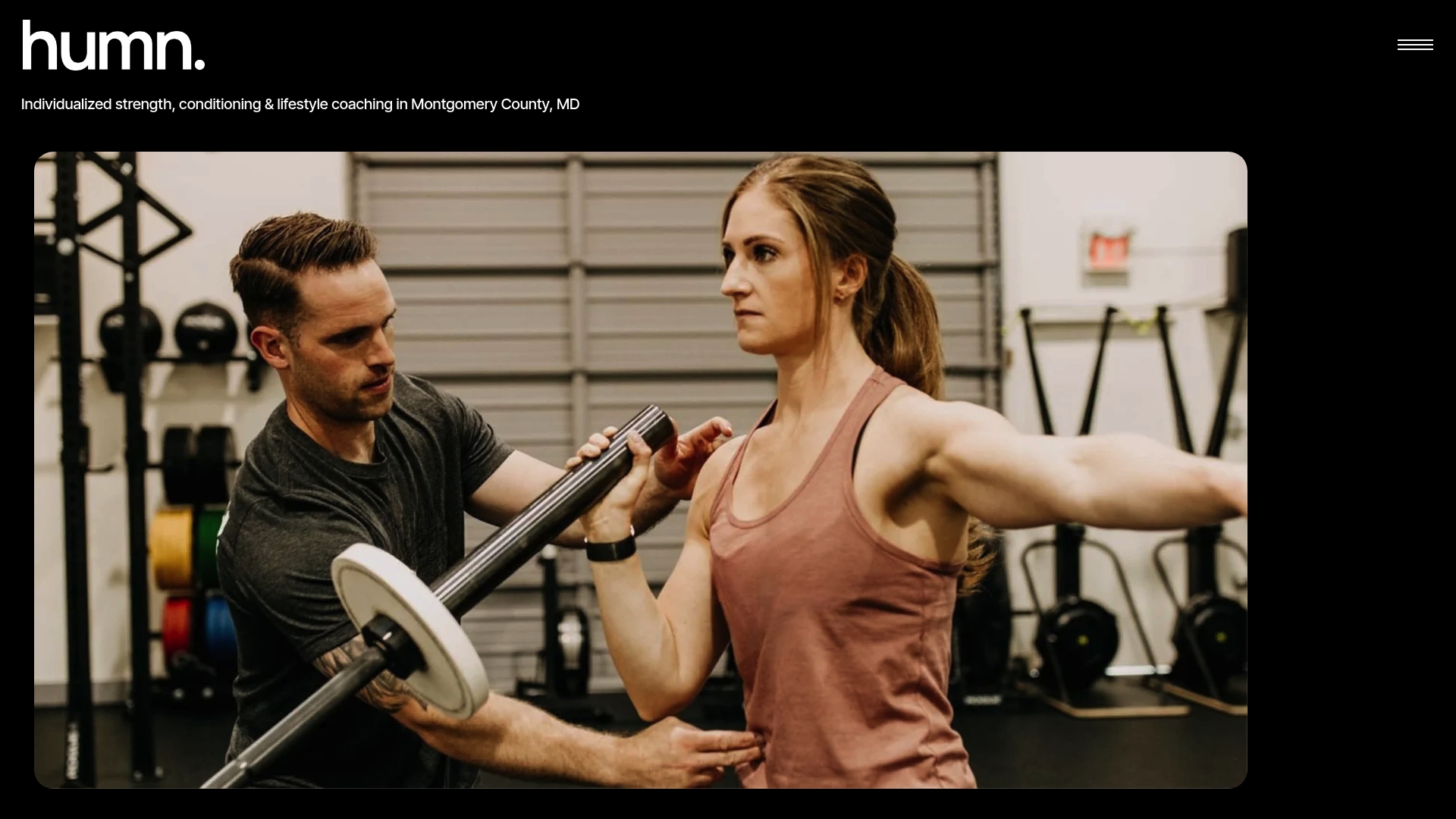
A first session at humn. starts with an honest assessment of where you are: your stress patterns, your sleep, your current habits, and what you actually want to change. From there, coaches build a program around your life, not a generic template. This is not a gym membership with a free consultation bolted on. It is a structured, coach-led program where stress resilience is a measurable outcome, not a vague aspiration.
humn. is not a substitute for licensed clinical care. If your stress is rooted in clinical anxiety, depression, or trauma, a licensed therapist is the right first call. For everyone else who wants a long-term partner in building a stronger, calmer, more capable version of themselves, explore what 1-on-1 coaching at humn. looks like and book a discovery call to get started.
Sources
- Relaxation techniques: Try these steps to lower stress - Mayo Clinic
- Six relaxation techniques to reduce stress - Harvard Health
- Relaxation techniques for stress: MedlinePlus Medical Encyclopedia
- Relaxation techniques (NCBI Bookshelf)
No Comments.