

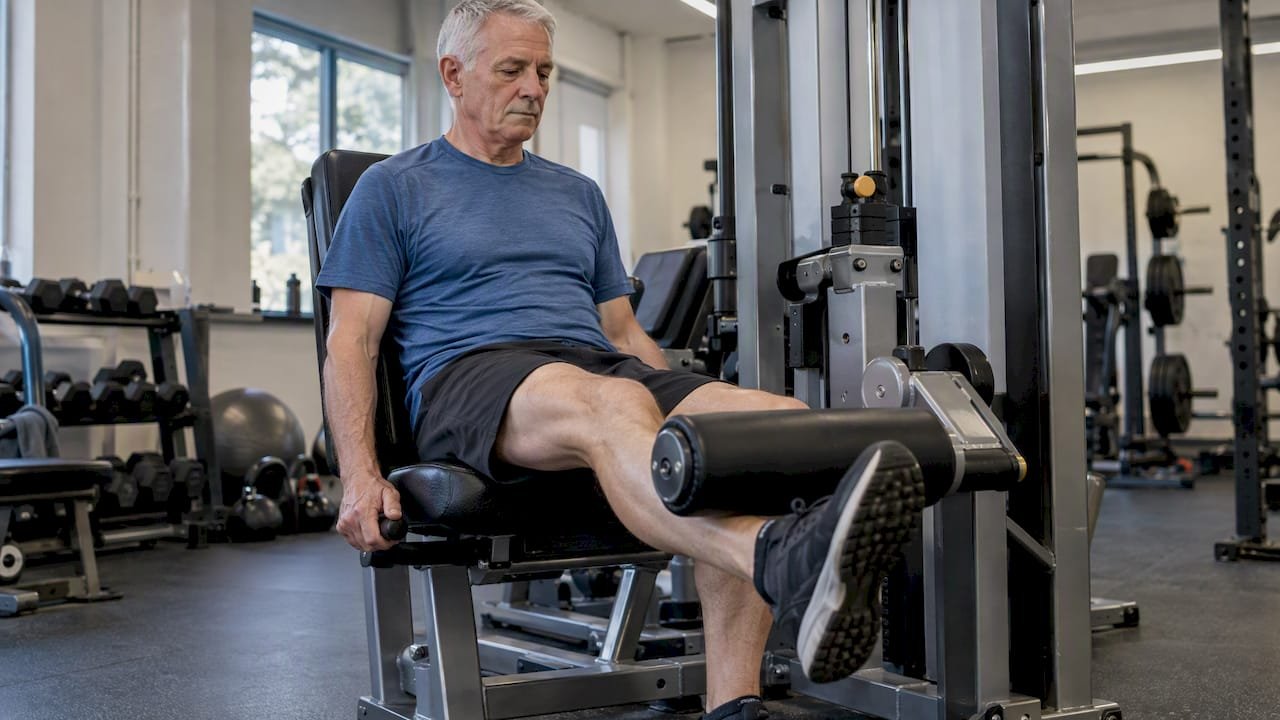
Yes, you can strength train with bad knees, and for most people it is one of the best things they can do for them. Stronger muscles around the joint take load off it, so the goal is not to avoid lifting. The goal is to choose movements you can control, keep effort in a tolerable range, and build up gradually. If your knee is swollen, locking, giving way or hurting at rest, see an orthopedic doctor or physical therapist first, then come back to the plan below.
TL;DR
- Strength training is a first-line approach for knee pain, not just something to try after you recover. The American Academy of Orthopaedic Surgeons (AAOS) strongly recommends strengthening and low-impact aerobic exercise for symptomatic knee osteoarthritis.
- Start with hip hinges, bridges, step-ups to a low box, supported squats to a chair and band work. Skip jumping and deep loaded bends until you tolerate the basics.
- Use a pain rule: mild discomfort during a set is common, but pain or swelling that lingers for hours, or heavy soreness the next day, means you did too much.
- Train the whole leg. Quads, hamstrings, glutes and calves work as a team, and ignoring one group can make the knee worse.
- Two to three short sessions a week beat one heroic session. Progress by small steps in reps, load or range.
Table of Contents
- Why lifting helps a painful knee
- Know your starting point
- The pain rule that keeps you training
- Knee-friendly strength moves, in order of difficulty
- What to avoid, or approach carefully
- A simple weekly plan
- Add balance work and low-impact cardio
- Body weight, nutrition and sleep
- Our perspective: knees are a system, not a part
- Where coaching helps
- FAQ
- Sources
Why lifting helps a painful knee
It feels backwards. The knee hurts, so rest should help. But the muscles that cushion and steer the joint weaken fast when you stop using them. OrthoInfo, the patient site of the AAOS, explains that strengthening the muscles that support your knee reduces stress on the joint.
The benefit is not only mechanical. Current clinical thinking, summarized in a recent review of exercise for knee osteoarthritis, is that strengthening works through the muscle and joint-control side and also through the nervous system’s own pain-control pathways. That is why exercise sits at the front of the treatment line.
The evidence on dose is getting specific too. A 2025 systematic review and network meta-analysis found that resistance training at moderate intensity, roughly 43 to 47% of your one-rep max, sustained over many weeks, was the most useful range for pain and function in knee osteoarthritis. High-speed resistance training (lifting the load up quickly, lowering it with control) showed the largest effects. Treat that as a research signal, not a prescription: it supports training moderately and consistently rather than maxing out.

Know your starting point
“Bad knees” covers a lot of ground: arthritis, old meniscus or ligament injuries, runner’s or patellofemoral pain, or general stiffness after years at a desk. The exercise choices are similar, but the red flags are not.
Get checked before you train if you have:
- A knee that locks, catches or gives way
- Visible swelling or warmth in the joint
- Pain at night or at rest
- A recent injury or surgery
An orthopedic physician or physical therapist can tell you which movements to avoid. If you are returning from an injury, our guide to restarting fitness after injury lays out a four-week on-ramp. For a broader look at how we think about sore joints, see training around joint pain and the 0 to 3 pain rule.
The pain rule that keeps you training
Some discomfort is normal when you begin. Pain is a different thing. A practical guide from OrthoInfo is that joint pain or swelling lasting hours after a workout, or heavy soreness the next day, means you should cut intensity or volume.
Here is a simple way to use it:
- Rate the knee from 0 (nothing) to 10 (worst) during the set.
- Stay at 3 or below. A dull ache that settles when you stop is fine; sharp, pinching or catching pain is not.
- Check the knee again that evening and the next morning. If it is worse than before you trained, drop a set or lower the load next time.
- If the same movement hurts three sessions in a row, swap it for a variation instead of pushing through.
Knee-friendly strength moves, in order of difficulty
The aim is to load the legs without sending sharp force through the joint. Start at the top of this list and move down only when the earlier steps feel easy for two weeks.
| Stage | Movement | What it builds | Knee-friendly tweak |
|---|---|---|---|
| 1 | Glute bridge | Glutes, hamstrings | Feet flat, press through heels, pause at the top |
| 1 | Banded side walk | Hip stabilizers | Light band above the knees, small steps |
| 1 | Seated or standing calf raise | Calves | Slow lower, hold a wall for balance |
| 2 | Box squat to a chair | Quads, glutes | Sit back to a high seat, stand without pushing off your hands |
| 2 | Hip hinge (Romanian deadlift) | Hamstrings, glutes | Light dumbbells, soft knee bend only |
| 2 | Seated row or cable row | Back, grip | Seated, so the knees stay quiet |
| 3 | Low step-up | Quads, glutes | 4 to 6 inch step, hand on rail |
| 3 | Split squat with short range | Single-leg strength | Shallow depth, torso upright |
| 3 | Sled push or leg press | Quads, glutes | Partial range, light load |
A few of these (bridges, banded lateral walks, hinge patterns) also appear in knee-safe leg workouts from Welltech, which stress slow, deliberate reps and knees tracking over the toes.
Why the hamstrings matter as much as the quads
Most people with sore knees are told to do leg extensions and little else. Harvard Health points out that the muscles around the knee work in pairs, so strengthening the quads while leaving tight, weak hamstrings alone can leave the joint unbalanced. Pair every quad-dominant move with a hinge or bridge, and finish each session with a few minutes of gentle stretching.
Slow reps beat heavy reps
When you are tired, form slips, and a wobbly knee takes the hit. Mass General’s physical therapy handout on strength training for the knee is built around a structured, gradual approach with pain precautions. In practice, that means a three-second lowering phase, a short pause, and a controlled stand. Stop the set when speed or alignment changes, not when the clock says so.
What to avoid, or approach carefully
Nothing is banned for everyone, but some movements ask a lot of a sensitive knee. Be careful with:
- Jumping and plyometrics. Add them only after months of steady strength work and with a clinician’s okay.
- Deep loaded knee bends. Limit range to what feels smooth. Depth is a progression, not a requirement.
- Twisting on a planted foot. Pivoting under load is hard on the meniscus and ligaments.
- Leg extension machines at heavy loads. Light, partial-range sets can be fine for some people; others find them irritating. Test with a light weight.
- Training through swelling. Swelling means the joint is irritated. Rest it and ask a professional.
If you want a low-impact way to get your heart rate up between strength days, the same Mass General guidance favors controlled, low-impact options like rowing and cycling while you build stability.
A simple weekly plan
Here is a template for a busy adult. Each session takes roughly 30 to 40 minutes.
Day 1: Lower body focus
- Glute bridge, 2 sets of 10
- Box squat to a high chair, 2 sets of 8
- Romanian deadlift with light dumbbells, 2 sets of 8
- Banded side walk, 2 sets of 10 steps each way
- Calf raise, 2 sets of 12
Day 2: Upper body and core
- Seated row, 3 sets of 10
- Dumbbell press on a bench, 3 sets of 8
- Dead bug or plank, 2 sets of 20 to 30 seconds
- Light stretching for hamstrings and calves
Day 3: Lower body, slightly harder
- Low step-up, 2 sets of 8 each leg
- Hip hinge, 3 sets of 8
- Short-range split squat, 2 sets of 6 each leg
- Glute bridge with a longer pause, 2 sets of 10
The research suggests the intensity should be moderate, not maximal. If the last two reps of a set feel challenging but clean, you are in the right place. Raise difficulty one variable at a time: first reps, then range, then load. Our beginner’s guide to progressive strength training explains how to do that without guessing, and the compound lifts for beginners plan shows how to learn the big patterns one at a time.
Add balance work and low-impact cardio
Strength is half of the picture. The AAOS guideline conditionally recommends neuromuscular training, meaning balance, agility and coordination, alongside traditional exercise to improve function and walking speed in knee osteoarthritis. A few minutes of single-leg stands near a counter, heel-to-toe walks and slow lateral steps will do.

For general activity, the CDC says adults with arthritis should aim for at least 150 minutes of moderate activity a week, and that even smaller amounts help if you cannot reach that yet. Walking, cycling and swimming all count. If you want a wider look at how lifting fits into a long life, read what 90 minutes of strength training a week does.
Body weight, nutrition and sleep
Knees carry your body weight with every step, so small changes add up. The CDC notes that losing even 5% of body weight can reduce arthritis pain and disability. For someone at 250 pounds, that is about 12 pounds.
How you lose it matters. CDC-hosted guidance on older adults says that combining diet with both aerobic and resistance exercise helps limit the muscle and bone loss that calorie cutting alone can cause, and improves physical function and osteoarthritis symptoms. In other words, do not diet and skip the weights. Lifting is what protects the muscle you are trying to keep.
If you have thinning bones as well as sore knees, ask your doctor about impact and loading limits. This guide to high-impact exercise for osteoporosis covers what loading looks like for bone health, and our own page on bone density training explains how we approach it.
Our perspective: knees are a system, not a part
Most people who come to us with bad knees have been told two things: rest, and do more leg extensions. Neither is a plan. At humn., we treat the knee as the visible symptom of a larger system: how you sleep, how stressed you are, how you sit all day, whether your hips and ankles move well, and whether you have ever been taught to load a leg properly.
That is why our framework runs on four pillars: Resist, Recover, Renew and Rhythm. Resist is the strength work, scaled to what the joint tolerates today. Recover is what lets you train again on Thursday. Renew covers nutrition, sleep and stress. Rhythm is the habit layer, because a perfect program you do for three weeks loses to an imperfect one you do for three years.
In practice, we start by asking what you can do without pain, and we build from there. We would rather you leave a session feeling like you had one more good set in you than limping to the car. The best knee program is the one that you are still doing a year from now.
— Josh
Where coaching helps
You can follow everything above on your own. Many people do. But if you are unsure how much is too much, or you keep restarting after flare-ups, a coach who watches your movement changes the picture. At humn. in Gaithersburg, membership includes small-group personal training and coaching with a dedicated coach, so exercise selection and progression are matched to you instead of a generic class. Our recovery services (sauna, compression, red light therapy and acupuncture) sit under the same roof, and 1:1 nutrition coaching is available if body weight or eating habits are part of your knee story. If you are new to training altogether, start with our page on personal trainers for beginners.
FAQ
Can you strength train with knee issues?
In most cases, yes. The AAOS strongly recommends strengthening for symptomatic knee osteoarthritis, and supervised or unsupervised programs both help. The exceptions are a swollen, locking or unstable knee, or a recent injury or surgery, where you should see a clinician first.
What exercises should you avoid with bad knees?
Be cautious with jumping, deep loaded bends, twisting on a planted foot and heavy leg extensions. You do not have to avoid them forever, but they should come after you have built a base with bridges, hinges, box squats and step-ups. If a movement causes sharp pain or lingering swelling, swap it out.
Does weight lifting affect the knees?
Done with control and moderate loads, lifting tends to help the knees by strengthening the muscles that absorb force. Problems usually come from poor form under fatigue, too much load too soon, or training through swelling. Use the 0 to 3 pain scale and check how the knee feels the next morning.
How often should I train?
Two to three strength sessions a week fits most schedules, with at least one rest day between lower-body sessions. Add walking or cycling on other days to work toward the CDC’s 150 minutes of weekly moderate activity.
Sources
- Optimal resistance training strategies for knee osteoarthritis symptom relief (2025 network meta-analysis)
- AAOS: Management of Osteoarthritis of the Knee
- CDC: Self-Care for Arthritis
- CDC: weight loss, diet and exercise guidance for older adults
- Exercise for knee osteoarthritis: clinical review (PMC)
- OrthoInfo: Knee Exercises
- Harvard Health: Exercising with knee or hip pain
- Mass General: Strength Training for the Knee
- Welltech: Leg Exercises for Bad Knees
No Comments.