

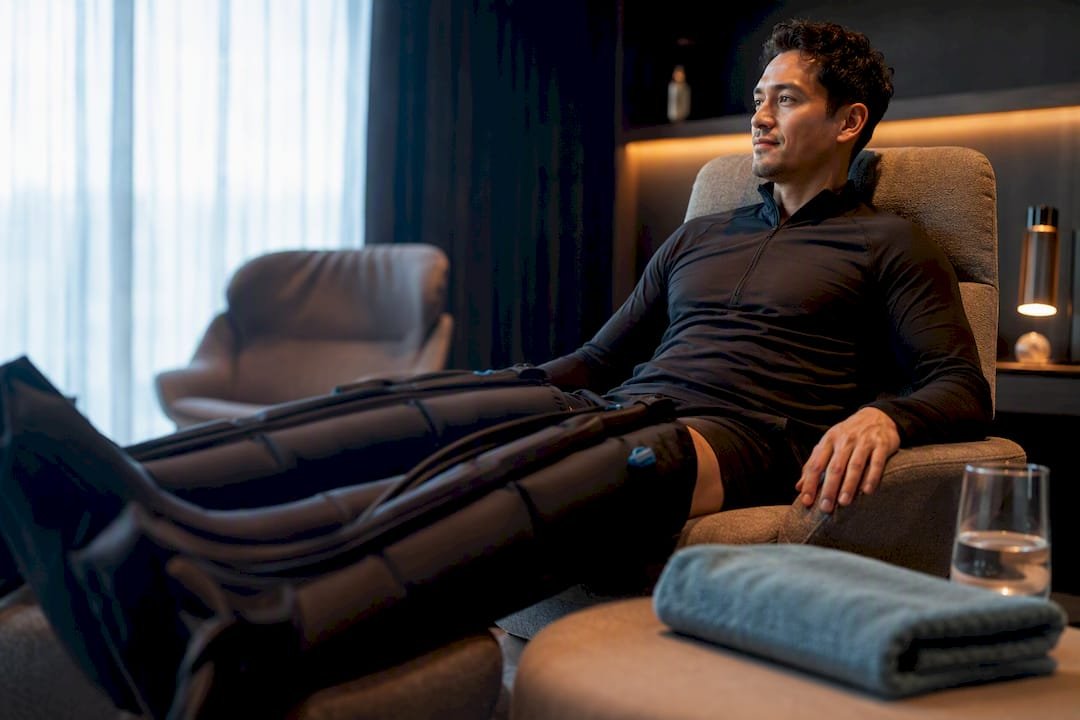
Post-workout pneumatic compression works best as a soreness-and-swelling reliever, not a performance drug. Members who use it consistently report feeling less leg heaviness and bouncing back faster between hard sessions, and a 2024 systematic review backs that up with modest-to-moderate improvements in perceived pain. Objective markers like strength and lactate clearance move far less. Used at humn.'s typical moderate pressure range, it is a legitimate recovery tool. Just don’t expect it to replace sleep or protein.
TL;DR:
- Compression therapy provides subjective recovery benefits, such as reducing soreness and swelling, but offers limited measurable improvements in strength or lactate clearance.
- Using pneumatic compression boots at 60 to 80 mmHg for 20 to 30 minutes within an hour after training is optimal, especially during heavy training blocks or quick turnarounds.
- Avoid compression if you have deep vein thrombosis, unexplained swelling, open wounds, or uncontrolled heart failure, and stop immediately if adverse symptoms appear.
- Regular use in high-volume or frequent training phases can help manage fatigue buildup and promote consistent attendance rather than offering long-term physiological gains.
- Compression works best when combined with sleep, proper nutrition, hydration, and other recovery methods, not as a standalone solution.
Table of Contents
- What Compression Therapy Benefits Actually Feel Like
- How Pneumatic Compression Works on Your Legs
- What the Research Actually Says About Compression Therapy Benefits
- The Right Way to Use Compression Boots After a Workout
- Who Should Avoid Compression Therapy
- Building Compression Into Your Weekly Recovery Rhythm
- Do the Benefits of Compression Therapy Add Up Over Time?
- Compression Therapy vs. Massage and Cryotherapy for Recovery
- Compression Sleeves vs. Pneumatic Boots: Which Device Actually Helps
- Beyond Blood Flow: How Compression Reduces Inflammation and Swelling
- A Boutique Coaching Perspective on Compression Therapy
- Try Supervised Compression Therapy at humn.
- Sources
- FAQ
What Compression Therapy Benefits Actually Feel Like
Ask a member who trains hard three or four times a week what compression does for them, and you rarely hear about lab metrics. You hear about legs that feel lighter walking downstairs the next morning, or a training block that doesn’t leave them limping into session four.
That’s the real value of compression boots benefits for most gym-goers: subjective recovery, not a measurable strength boost. A 20 to 30 minute session tends to blunt the achiness of delayed-onset muscle soreness (DOMS) and visibly reduces the puffiness that shows up in ankles and calves after a long run or a heavy leg day.
The functional payoff shows up fastest in the 24 to 48 hour window after a session, which is exactly when it matters most for someone training again soon.
- Noticeably less leg heaviness and stiffness the morning after leg day
- Reduced visible swelling in the lower legs and ankles after long runs, rides, or flights
- A subjective sense of “readiness” to train again within a day
- Useful on quick turnaround days, mid-block during heavy lifting phases, and after travel
None of this replaces adaptation from training itself. It just makes the days between sessions feel less like damage control.
How Pneumatic Compression Works on Your Legs
Compression boots use sequential air chambers that inflate from the foot upward, squeezing and releasing in a wave. That mimics your body’s own muscle pump, the mechanism your calf and thigh muscles normally used to push blood back toward your heart when you walk or flex.
The mechanical pumping action increases venous blood flow and helps move fluid that has pooled in tissue back into circulation, which is the working theory behind reduced swelling and that “lighter legs” feeling. A controlled physiology study found that intermittent compression timed correctly during exercise and recovery increases both arterial and venous blood flow, not just venous drainage.
This is where dynamic intermittent pneumatic compression (IPC) differs from static compression garments like sleeves or tights. A sleeve applies constant, unchanging pressure. Boots pulse. That pulsing action is closer to an active pump than a passive squeeze, which is part of why researchers study IPC and compression garments as related but distinct interventions.
What the Research Actually Says About Compression Therapy Benefits
The honest answer is: it helps how you feel more than it helps how you perform, and the size of that effect depends heavily on the study design.
The 2024 systematic review and meta-analysis on lower-limb IPC in sports recovery found modest-to-moderate benefits for subjective soreness and swelling. Objective measures of muscle function, like force output or jump height, showed small and inconsistent effects across studies. Most protocols reviewed used moderate pressures for about 20 to 30 minutes.
A closer look at the evidence: the review’s own data shows effect sizes for soreness varying widely across the 0 to 96-hour recovery window, which tells you timing and measurement method matter as much as the compression itself.
A few other findings round out the picture:
- One trial found lactate actually rose during a subsequent bout of exercise after IPC boot use, a reminder that compression between hard efforts isn’t automatically performance-neutral.
- A small crossover trial comparing daily pneumatic compression treatments against a continuously-worn compression sleeve found the daily pneumatic sessions reduced swelling, restored range of motion, and lowered peak pain more effectively in a DOMS model.
The inconsistency across studies mostly comes down to differences in pressure, session length, timing relative to the workout, and how fit the participants already were. Blinding is also nearly impossible with a device that squeezes your leg, so some of the reported benefit is likely a placebo response layered on top of a real physiological one. The practical takeaway: expect a genuine but moderate subjective boost, not a measurable performance edge.
The Right Way to Use Compression Boots After a Workout
Most of the benefit comes down to getting three variables right: pressure, timing, and consistency. Here’s the default approach used across recovery-focused programs.
- Standard post-workout session: sequential mode, 60 to 80 mmHg, for 20 to 30 minutes, ideally within an hour of finishing your workout.
- Long-event protocol: for marathon training, long rides, or tournament days, extend to 30 to 60 minutes, or split into two 30-minute sessions a few hours apart.
- First-time protocol: start around 15 minutes at the lower end of the pressure range, then build up over your next two or three sessions as your legs adjust to the sensation.
- Frequency: three to five sessions a week during heavy training blocks works for most people; daily use is fine for short, intense phases but isn’t necessary long term.
Pro Tip: Hydrate before your session, not during it. Sitting still with a full bladder for 30 minutes while your legs are locked in compression boots is a rookie mistake everyone makes exactly once.
A few other habits matter more than people expect. Wear bare legs or thin shorts so the chambers seat properly against your skin. Stay seated and still. Don’t sleep in the boots. And log your sessions, pressure, and duration so you can tell what’s actually working versus what just feels good in the moment.
Who Should Avoid Compression Therapy
Compression is low-risk for most healthy, active adults, but it’s not risk-free, and skipping the screening step is the most common mistake in home use.
Avoid pneumatic compression if you have any of the following:
- A known or suspected deep vein thrombosis (DVT)
- Swelling in only one leg with no clear cause
- Open wounds, active infection, or recent skin changes on the treated limb
- Uncontrolled congestive heart failure
Sessions are run at 60 to 80 mmHg, with new users starting at the lower end during their first session; a protocol detailed in the facility’s compression safety guidance. If you feel numbness, sharp or persistent pain, or notice skin discoloration that doesn’t resolve after the session, stop immediately.
Clinical guidance from the Cleveland Clinic is direct on this point: persistent or one-sided swelling needs a doctor’s evaluation, not a longer compression session. That’s a medical question, not a recovery-protocol one.
Building Compression Into Your Weekly Recovery Rhythm
Compression works best as one piece of a routine, not a standalone fix. It won’t compensate for five hours of sleep or a diet that skips protein after training.
A sequencing that works well: finish your workout, get protein and carbs in within 30 to 60 minutes, then do your compression session, followed by sauna or red light therapy later in the day if your schedule allows. During heavy training blocks, three compression sessions plus three or four sauna sessions a week is a sustainable rhythm. Reserve full rest days for exactly that, no compression, no forced recovery modalities, just downtime.
Sleep still does more heavy lifting for recovery than any device strapped to your legs. Compression fills the gap on the days sleep alone isn’t enough.
Do the Benefits of Compression Therapy Add Up Over Time?
A single session helps you feel better tomorrow. The more interesting question is what six months of consistent use does.
There’s no controlled long-term trial tracking cumulative effects of regular pneumatic compression the way there is for resistance training adaptations, so any claim of compounding physiological benefit should be treated as reasoned inference, not proven fact. What does hold up: members who use compression consistently through heavy training blocks tend to report fewer days lost to nagging soreness, simply because they’re managing the accumulation of fatigue week to week instead of letting it stack up unaddressed.
That’s a behavioral benefit as much as a physiological one. Regular use builds a recovery habit, the kind that gets you back on the mat or under the bar instead of skipping a session because your legs feel wrecked. It also creates a feedback loop: members who log sessions and track how their legs feel across a training cycle start noticing patterns, like needing compression more during strength-focused blocks than during lighter conditioning weeks.
Where cumulative benefit likely matters most is in high-volume phases, marathon builds, in-season sports, or stacked lifting cycles, where the goal isn’t a single fast recovery but staying available for every session on the calendar. Used that way, compression functions less like a treatment and more like a maintenance habit, similar to consistent sleep hygiene or a standing mobility routine.
Compression Therapy vs. Massage and Cryotherapy for Recovery
None of the popular recovery methods are interchangeable, and the differences matter more than most marketing suggests.
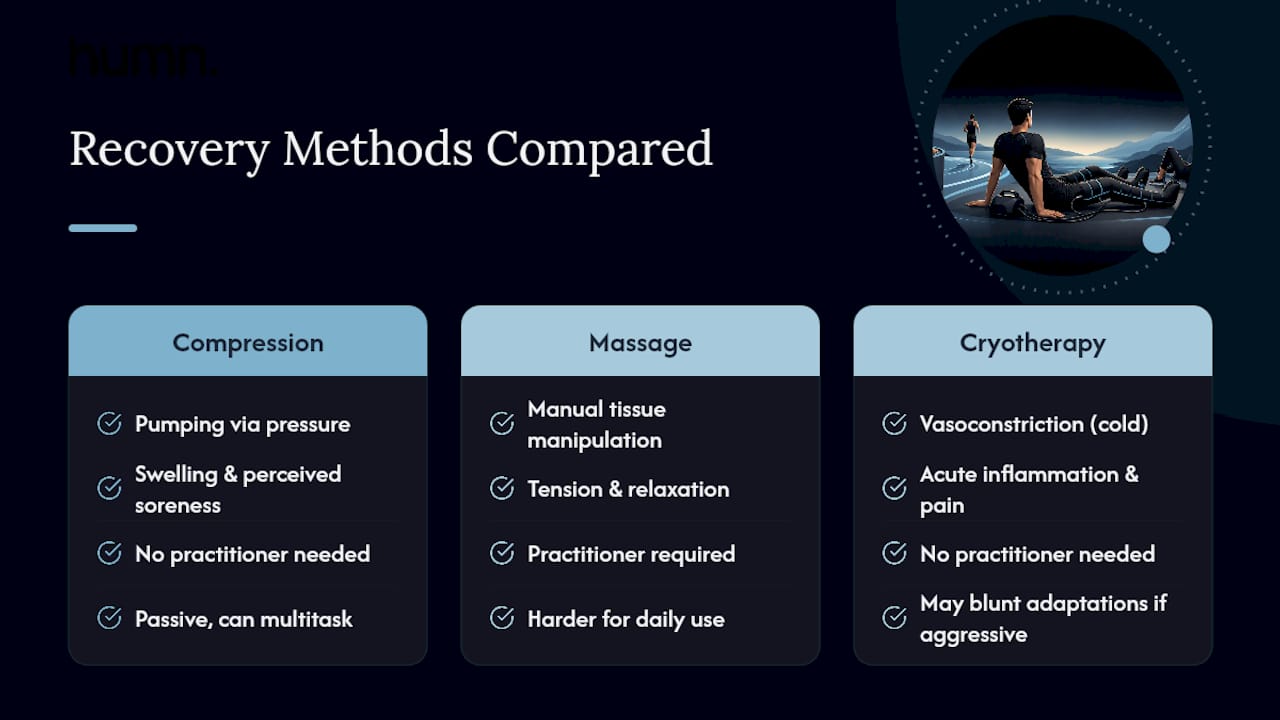
Massage works through manual tissue manipulation and tends to have a stronger effect on perceived muscle tension and relaxation, along with a psychological wind-down benefit that a machine can’t replicate. It requires a practitioner’s time, though, which makes it harder to use daily. Cryotherapy, whether whole-body chambers or cold plunges, works through vasoconstriction rather than the pumping mechanism compression relies on, and its evidence for reducing DOMS is similarly mixed, with some athletes reporting it blunts training adaptations when used too aggressively right after strength work.
Compression’s advantage is practical, not necessarily physiological: it’s passive, requires no practitioner, and members can sit through a session while checking email or stretching. It’s also gentler on the nervous system than a cold plunge, and it doesn’t carry the same theoretical concern about interfering with the inflammatory signaling that drives muscle adaptation.
The honest framing is that compression, massage, and cryotherapy solve overlapping but distinct problems. Compression targets swelling and perceived soreness through circulation. Massage targets tissue tension and relaxation. Cryotherapy targets acute inflammation and pain perception through cold. Most well-rounded recovery programs rotate between them based on what a specific training block demands, rather than picking one and using it exclusively.
Compression Sleeves vs. Pneumatic Boots: Which Device Actually Helps
Not all compression is the same device doing the same job, and conflating them is where a lot of confusion starts.
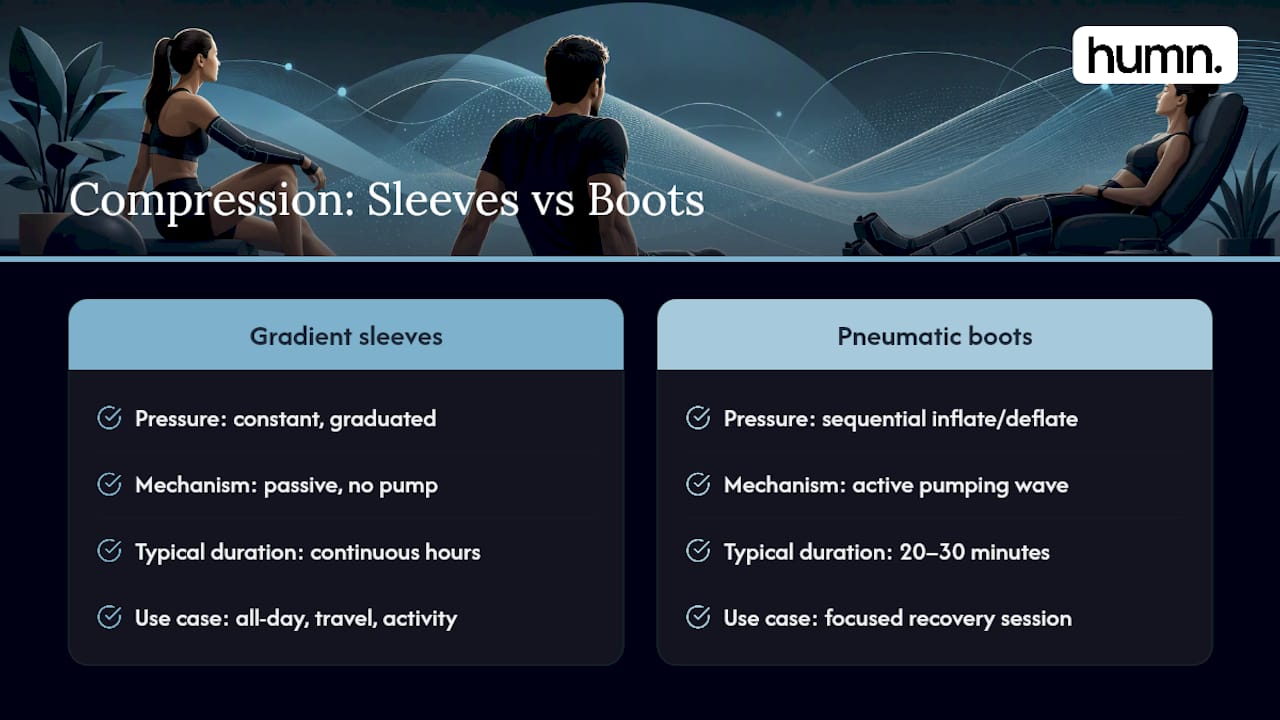
Gradient compression sleeves and socks apply constant, graduated pressure, tighter at the ankle, looser moving up the leg, without any pumping action. They’re designed for continuous wear during activity or travel and work well for reducing swelling on long flights or through an endurance event. A randomized study on compression tights worn for about four hours after eccentric resistance exercise found improved venous return and better perceptual recovery scores compared to a control condition, which supports static garments as a legitimate lower-effort option.
Intermittent pneumatic compression boots, the kind used at recovery-focused facilities, work differently. Sequential chambers inflate and deflate in a wave, actively pumping rather than passively squeezing. That’s the version studied most heavily for post-exercise recovery, and it’s the version behind most of the soreness and swelling data referenced earlier in the systematic review.
The practical distinction: sleeves are for all-day, low-effort wear, on a plane, during a long shift, under running gear. Boots are for a focused 20 to 30 minute session where you’re not doing anything else. Neither replaces the other. Sleeves suit passive, extended use. Boots suit an active, time-boxed recovery block.
Beyond Blood Flow: How Compression Reduces Inflammation and Swelling
Increased venous return is the headline mechanism, but it’s not the only thing happening under those inflated chambers.
The same mechanical pumping action that pushes blood back toward the heart also has a role in lymphatic drainage, the body’s separate fluid-clearance system that moves excess interstitial fluid, proteins, and metabolic waste out of tissue and toward lymph nodes. Unlike the circulatory system, lymph has no central pump. It relies almost entirely on muscle contraction and external pressure to move, which is exactly what sequential compression provides externally when your legs are too fatigued to do the job through movement alone.
That secondary drainage effect is part of why swelling reduction shows up so consistently in the research even when strength and power measures don’t budge. Less fluid sitting in tissue means less pressure on nerve endings and less of that “tight, stiff” sensation that gets labeled as soreness, even when the muscle damage underneath hasn’t actually changed.
There’s also a working theory around inflammation clearance: faster fluid turnover may help clear some of the local metabolic by-products and inflammatory markers that accumulate after intense training, though this mechanism is less directly measured in the human trials than the blood flow and swelling outcomes. It’s a plausible extension of the venous return findings, not yet a separately proven pathway. Treat it as a reasonable “why,” not a settled fact.
A Boutique Coaching Perspective on Compression Therapy
At humn., compression sits inside the Recover pillar, always supervised, never a solo add-on bolted onto a workout. That structure exists for a reason: pressure and timing matter, and a coach catching a skin change or a lopsided swelling pattern early is worth more than any protocol on paper. The members who benefit most are usually mid-block, stacking hard sessions with tight turnarounds, not chasing a miracle fix.
— Josh
Try Supervised Compression Therapy at humn.
Most people using compression boots at home are guessing at pressure and duration. humn. removes that guesswork by running every session supervised, starting new members at the lower end of the 60 to 80 mmHg range and adjusting from there based on how your legs actually respond. Compression is one piece of the Recover pillar, alongside sauna, red light therapy, and acupuncture, all built around the same coached, whole-person approach that shapes strength and coaching programming at the facility.
If you’re mid-training-block and your legs feel like they’re playing catch-up between sessions, that’s exactly the scenario compression was built for. Explore membership options to add supervised recovery access alongside your training, and book your first session to see how your body responds before committing to a weekly rhythm.
Sources
- Effects of lower-limb intermittent pneumatic compression on sports recovery: A systematic review and meta-analysis
- Cleveland Clinic: Intermittent pneumatic compression (IPC) device overview and safety guidance
FAQ
Do Compression Boots Actually Work for Recovery?
Yes, for how sore and swollen your legs feel, according to a systematic review showing modest-to-moderate subjective benefits. Objective performance markers like strength and jump height show much smaller and less consistent improvements.
What Pressure Should Compression Boots Be Set To?
Most research protocols use around 80 mmHg, and humn. runs sessions in the 60 to 80 mmHg range, starting new users at the lower end. Going higher isn’t automatically better and can increase discomfort without added benefit.
How Long Should a Compression Therapy Session Last?
A standard session runs 20 to 30 minutes, ideally starting within an hour after your workout. Longer events or race days may call for 30 to 60 minutes, sometimes split into two shorter sessions.
Is Compression Therapy Better Than Ice or Massage for Soreness?
They target different things. Compression reduces swelling and perceived soreness through circulation, massage relaxes tissue tension, and cold therapy blunts acute inflammation, so many recovery programs use all three depending on the training phase.
Can Compression Therapy Replace Sleep or Nutrition for Recovery?
No. Compression is an adjunct that works best alongside adequate sleep, hydration, and post-workout nutrition, not a substitute for any of them. Skipping the fundamentals and relying on compression alone limits how much benefit you’ll actually feel.
No Comments.