


Semi-private training in the U.S. typically runs $28 to $60 per person per session, with most 2x/week monthly packages landing between $250 and $450. That’s roughly 40 to 60 percent less than one-on-one coaching for a comparable amount of coach attention, and it usually beats large group classes on personalization, even though it costs more per session. If your goal is real, measurable progress without paying full private rates, semi-private is worth a serious look, especially if a trial session is on the table before you commit.
TL;DR:
- Semi-private training costs typically range from $40 to $60 per person per session, with monthly packages between $150 and $450 depending on frequency and amenities.
- True semi-private programs keep group sizes at three or fewer, providing individualized attention through active cueing, program adjustments, and progress tracking.
- Pricing benefits occur when a trainer bills multiple clients in the same hour, making the per-person cost lower than private coaching without sacrificing personalized programming.
- Evaluating a program involves checking for credible certification, genuine individualization, consistent group composition, and clear progress measurement.
- Additional fees like initiation, freezing, or renewal costs can significantly affect overall expense, so always compare per-session costs and review cancellation policies carefully.
Table of Contents
- What Semi-Private Training Actually Means
- Real Semi-Private Training Prices Across the U.S.
- How Billing Works and What Fees to Watch For
- How to Evaluate a Semi-Private Program Before You Sign
- How humn. Structures Premium Semi-Private Coaching
- Ready to See What Semi-Private Coaching Costs at humn.?
- Sources
- FAQ
What Semi-Private Training Actually Means
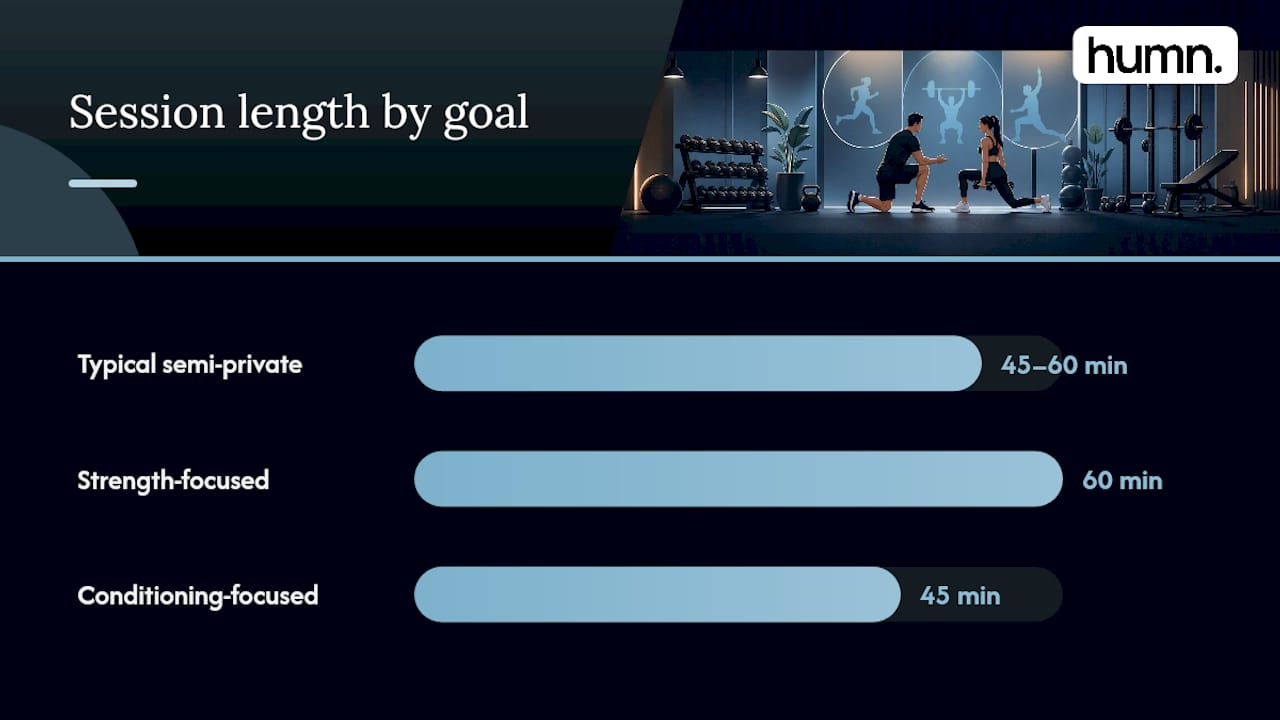
Semi-private training puts two or three clients with one coach, sometimes up to four, in a session that usually runs 45 to 60 minutes. Each person works from an individualized program the coach designs and adjusts, not a shared script everyone follows in unison. That distinction is the whole ballgame: a true semi-private session gives you your own plan while sharing the coach’s hourly rate, whereas a small-group or bootcamp class puts everyone through the same workout regardless of goals, injuries, or fitness level.
The research backs the format. Research indicates that group-based resistance training can produce outcomes in strength and body composition similar to individual training over typical study periods, provided the coach gives appropriate attention to each participant. That’s the operative condition. A 3:1 ratio with genuine attention beats a 1:1 session where the coach is only half paying attention.
A few things shape whether semi-private delivers on that promise:
- Group size stays at three or fewer for true individualized attention.
- Coaches actively cue and correct each person, not just the group as a whole.
- Programs shift over time based on your own progress, not a fixed template.
- Session length matches the goal. Strength work often needs the full 60 minutes; conditioning can work in 45.
Real Semi-Private Training Prices Across the U.S.
Semi-private personal training rates cluster in a predictable range, but where you land inside that range depends heavily on format, market, and what’s bundled in. Industry pricing data puts semi-private (2 to 3 people) at roughly $40 to $60 per person per session, with small-group formats of four to six people running closer to $20 to $40. Monthly membership equivalents fall somewhere between $150 and $450 depending on how often you train.
Here’s what that looks like in practice for common schedules:
- 2x/week: roughly $250 to $450 per month, or about $31 to $56 per session
- 3x/week: roughly $350 to $650 per month, or about $29 to $54 per session
- Unlimited plans: flat monthly rates that reward higher-frequency training with a lower per-session cost
By the numbers: Small-group and semi-private formats commonly cut per-person cost by 40 to 60 percent compared with one-on-one training, without sacrificing individualized programming.
Several factors push prices toward the top of the range: boutique facilities with recovery amenities like sauna or compression, coaches holding advanced certifications, and major metro markets where real estate and labor costs run higher. A basic gym semi-private slot in a mid-size city might sit near $30 a session. A premium studio in a dense suburb with recovery services built in can justify $55 or $60.
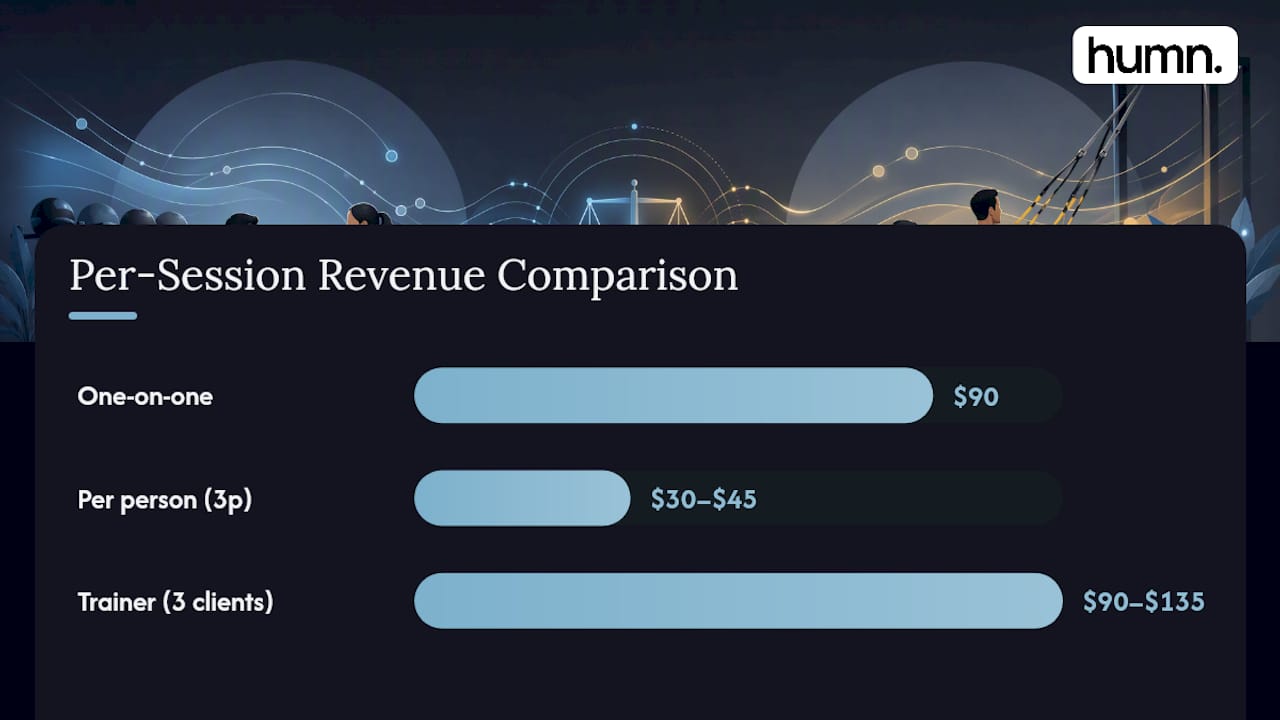
Do the math on savings and the appeal becomes obvious. A one-on-one session at $90 splits three ways in a semi-private format to roughly $30 to $45 per person, while the trainer’s hourly revenue actually increases because they’re billing multiple clients for the same hour. That’s the economic engine behind the whole pricing model, and it’s why semi-private rates sit meaningfully below private coaching without feeling like a discount product.
How Billing Works and What Fees to Watch For
Most studios sell semi-private training through one of four models, and each affects your real cost differently.
- Monthly subscription — a fixed number of sessions per week, billed automatically. This tends to improve retention because it removes the friction of repurchasing packages, and many studios price it slightly below the per-session equivalent of drop-in rates.
- Session packs — you buy a block of 10, 20, or more sessions upfront, often with a modest discount for volume.
- Drop-in or pay-per-session — the most flexible and usually the most expensive per visit.
- Unlimited plans — a flat monthly fee for as many sessions as you can attend, which rewards people who train three or more times a week.
Watch for extra costs layered on top of the sticker price: initiation fees charged at signup, reinstatement fees if you let a membership lapse, and freeze fees for pausing during travel or injury. None of these show up in the advertised per-session rate, but they add up over a year.
Pro Tip: Always convert every offer to a per-session cost before comparing studios. Divide the total monthly price by the number of sessions included. A $380/month unlimited plan used four times a week works out to about $24 a session, while a $300/month plan capped at two sessions a week comes out closer to $38.
Read the cancellation terms closely. Long automatic renewal clauses and vague make-up session policies are the two most common red flags in semi-private contracts.
How to Evaluate a Semi-Private Program Before You Sign
Price is only one factor; the key consideration is whether the program offers individualized coaching rather than simply a shared workout delivered at a lower cost.
Judge a program against these criteria:
- Whether the coach holds a recognized credential like NASM’s Certified Personal Trainer designation or an ACSM-backed certification
- Whether your program is actually personalized or identical to everyone else’s in the group
- How consistent the group composition is week to week, since a revolving cast of strangers changes the coaching dynamic
- Whether progress gets tracked and measured on any regular cadence
- Whether the schedule realistically fits your week without constant rebooking
On a tour or sales call, ask directly:
- Does the first session include a real fitness assessment, or does training start cold?
- Will I get my own program, or do I follow whatever the group is doing that day?
- What’s the typical coach-to-client ratio, and does it ever creep higher during busy hours?
- How do you measure progress, and how often do we revisit the plan?
- What’s the policy for missed sessions or freezing my membership?
If a studio cannot clearly address assessment and personalization questions, that indicates potential issues. Semi-private training commands higher prices than large classes only if genuine individualization is provided. If your goals are highly specific (rehab, a competition, or advanced strength work) one-on-one coaching still makes sense despite the higher cost. If you mainly want structure, accountability, and a lower price point, a bigger group class may serve you fine.
How humn. Structures Premium Semi-Private Coaching
humn. builds its small-group programming around four pillars: Resist, Recover, Renew, and Rhythm. Strength training (Resist) sits alongside recovery access, lifestyle coaching, and habit-based programming rather than functioning as an isolated workout hour. Premium semi-private packages at humn. commonly pair individualized strength programming with recovery services like sauna and compression, plus coaching on sleep, stress, and nutrition that extends beyond the session itself.
Clients get matched to a coach and a small group based on goals and scheduling, then progress gets revisited on an ongoing basis as part of the broader lifestyle coaching relationship, not a one-time intake form filed away and forgotten.
Ready to See What Semi-Private Coaching Costs at humn.?
If you’re a busy professional in Gaithersburg weighing semi-private against a private trainer or a big class, the calculation usually comes down to how much personalization you actually need for the price you’re paying. humn. built its small-group model specifically for people who want individualized programming, recovery access, and lifestyle coaching without paying full one-on-one rates or settling for a shared workout in a large class.
A membership at this facility combines small-group personal training with recovery services like red light therapy and acupuncture, plus ongoing coaching on the habits that determine whether results stick. Some members add supplements like muscle recovery capsules to support training between sessions. The first step is a starting assessment where a coach reviews your goals and matches you to the right group and program before you commit to anything. Book a visit through humn.'s membership page to see current pricing and find a schedule that fits your week.
Sources
Pricing ranges and coaching economics referenced here come from trainerblueprint’s small group pricing breakdown, FlexWerk’s analysis of semi-private economics, Revolution PTS’s cost comparison data, training outcome research from PMC, health context from Harvard Health, and credential standards from NASM.
FAQ
What Is Semi-Private Personal Training?
Semi-private training means two to four clients share a coach and a session, with each person following an individualized program rather than the same shared routine everyone else in the group follows.
How Much Does a 12-Week Semi-Private Program Cost?
At $250 to $450 per month for a typical 2x/week package, monthly costs vary depending on frequency and studio amenities, with premium studios offering recovery services at the higher end.
Is $50 an Hour a Reasonable Rate for a Personal Trainer?
For one-on-one coaching, rates vary widely across U.S. markets, while for semi-private training, about $40 to $60 per person per session represents the standard range.
Is 40 Too Old to Start Working With a Personal Trainer?
No. Coached resistance training benefits adults at any age, and strength training’s documented benefits for function and longevity apply just as strongly to someone starting at 40 or later as to someone starting in their 20s.
No Comments.