

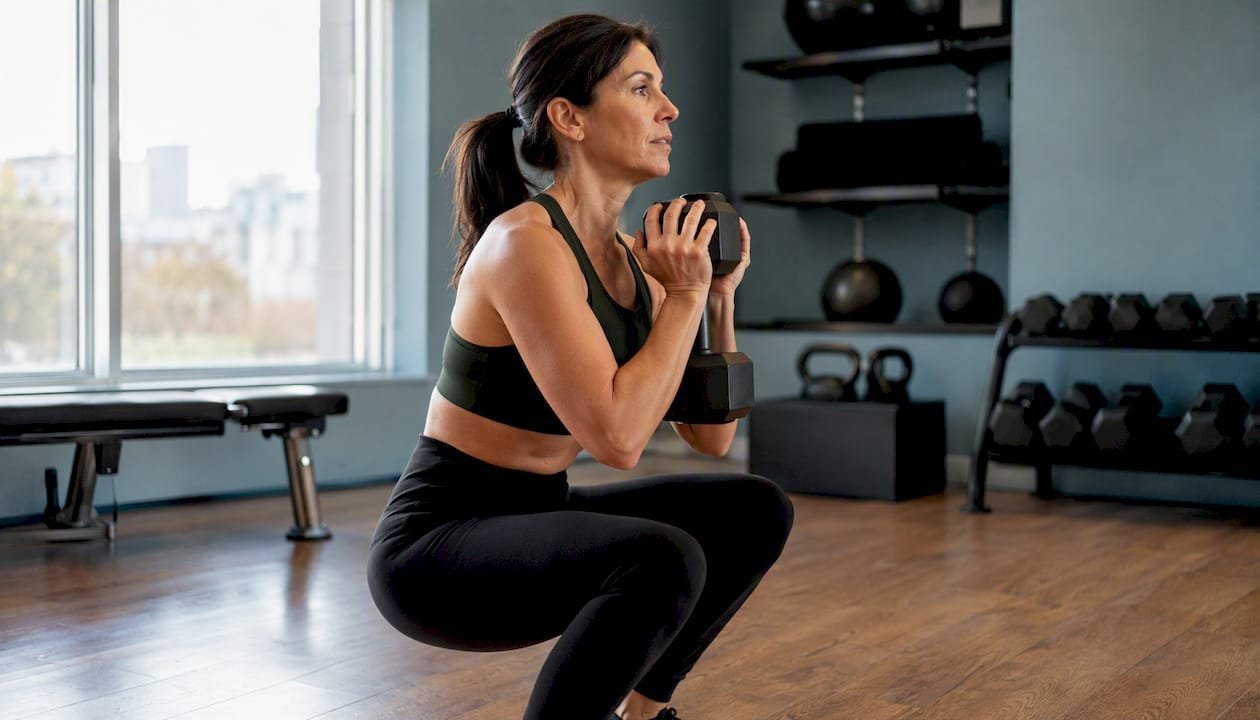
Start with three full-body strength sessions per week, built around compound movements like squats, hinges, and rows, and add weight or reps every one to two weeks. That is the whole plan in one sentence. Everything below shows you exactly how to execute it.
Your 3-step quick-start checklist:
- Schedule: Block three non-consecutive days this week (Monday/Wednesday/Friday works well). Forty minutes per session is enough to start.
- Equipment: A set of adjustable dumbbells or a few fixed pairs (10, 15, 20 lbs), a resistance band, and a mat cover most beginner workouts. A barbell and rack are great but not required.
- Track: Log your exercises, weights, and reps in a notebook or a free app like Strong. Consistent sessions per week is your first metric, not how much you lift.
If you have an active joint condition, osteoporosis, or a recent injury, check with your doctor before starting. Otherwise, healthy women over 40 can begin strength training safely with proper form and a sensible load.
Pro Tip: Aim for three logged sessions in your first two weeks before worrying about weight progression. Consistency is the only metric that matters at the start.
Table of Contents
- Why strength training matters more after 40
- How to structure your training after 40
- Your 8-week beginner strength program
- Key exercises, form cues, and workout modifications
- Nutrition basics that actually support your training
- Recovery, sleep, and hormone-aware training habits
- How to train safely and avoid common injuries
- Key Takeaways
- The part most programs get wrong
- Strength training at humn: coached, structured, and built for women 40+
- Useful sources
Why strength training matters more after 40
Muscle loss starts earlier than most people expect. Adults begin losing roughly 3–8% of muscle mass per decade after age 30, and that rate accelerates after 60 according to the Cleveland Clinic’s sarcopenia overview. For women, the hormonal shift of perimenopause and menopause compounds the problem: falling estrogen levels reduce the anabolic signaling that helps muscle tissue repair and rebuild after exercise.
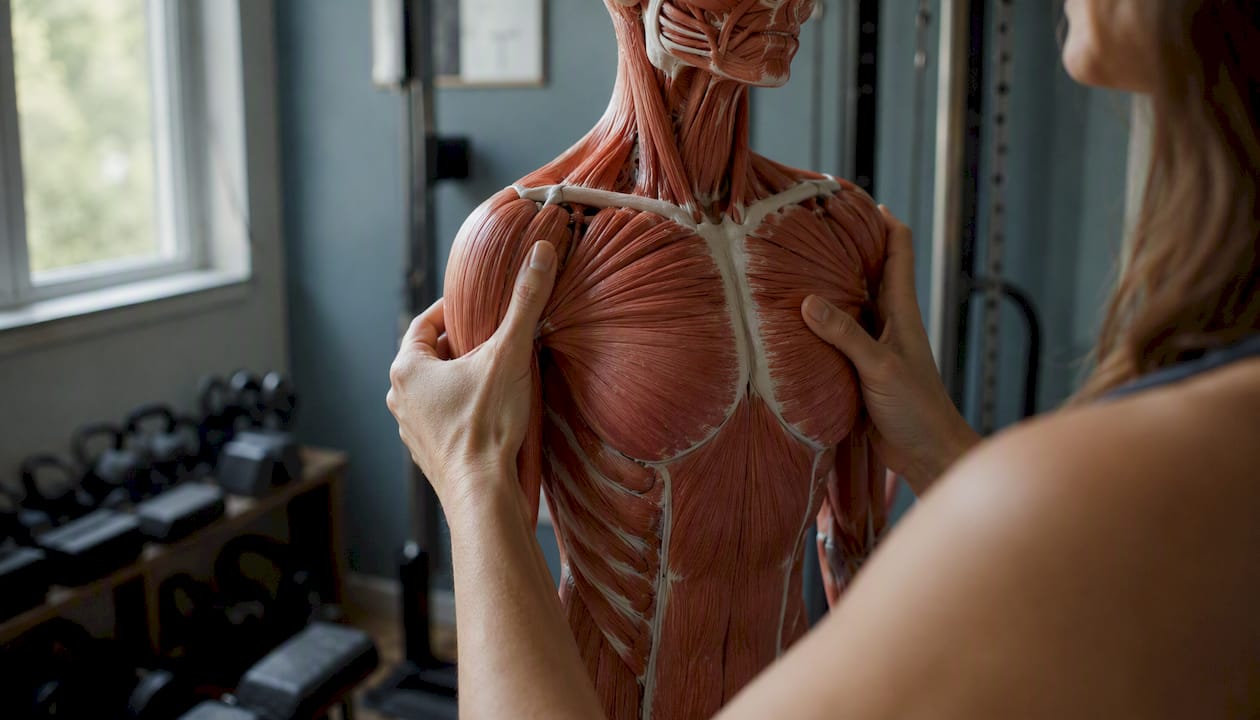
The practical consequences go beyond aesthetics. Less muscle means a slower resting metabolism, reduced bone density, worse balance, and a higher risk of falls and fractures later in life. Resistance training directly counters all of these.
UCLA Health notes that strength training is critical for preventing muscle loss during weight loss and recommends three sessions per week to preserve metabolic rate after menopause. A systematic review in BMC Women’s Health found that structured resistance training programs improved lean body mass and muscle strength in menopausal women, with longer programs (12 weeks or more) producing the largest effects.
Bone health is another strong argument. Resistance training at moderate to higher loads stimulates bone remodeling, which is one of the few non-pharmacological ways to slow postmenopausal bone density loss. Protecting bone density now matters far more than most women realize at 40.
Key benefits of resistance training for women over 40:
- Preserves and rebuilds lean muscle mass
- Slows metabolic rate decline
- Improves bone mineral density
- Reduces fall risk through better balance and coordination
- Supports insulin sensitivity and blood sugar regulation
- Reduces symptoms associated with perimenopause (fatigue, mood shifts, sleep disruption)
A meta-analysis published in PMC confirmed small to moderate increases in lean body mass and marked improvements in handgrip and knee extension strength across resistance training trials in menopausal women. Those are measurable, functional gains, not just numbers on a scale.
Pro Tip: Strength training plus adequate protein plus seven to nine hours of sleep produces better long-term body composition than adding more cardio sessions. Cardio has its place, but it cannot replace the metabolic and structural benefits of lifting.
How to structure your training after 40
The research is consistent on dose: three sessions per week, each lasting 20–90 minutes, produces meaningful gains in muscle mass and strength for women in midlife. Three sessions is the sweet spot for most beginners.
Full-body vs. split training
For women new to weight training over 40, full-body sessions three times per week outperform body-part splits in almost every practical way. You hit each muscle group more frequently, you get more practice on the fundamental movement patterns, and missing one session does not leave a muscle group untrained for a week. Splits (upper/lower or push/pull/legs) make sense once you have six or more months of consistent training and want to increase volume per session.
Progression rule
Add weight when you can complete all prescribed reps with good form and feel like you could do two more. For most beginners, that means adding small incremental weight increases on upper-body and lower-body lifts every one to two weeks. If you cannot add weight, add one rep per set instead.
Your 8-week beginner strength program
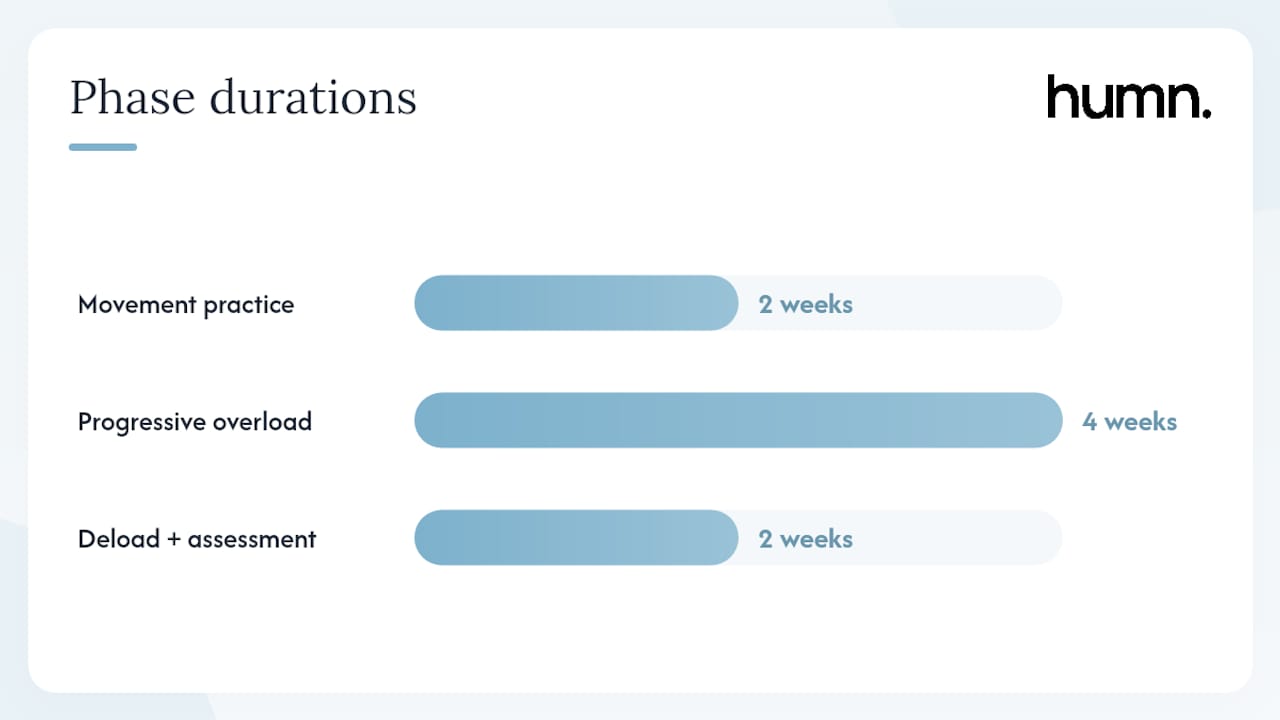
This program follows a three-phase structure: movement practice, progressive overload, and a deload/assessment week. Evidence supports programs of at least 12 weeks for the largest gains, but this 8-week block builds the foundation and gives you a clear benchmark to measure from.
Phase overview
| Phase | Weeks | Focus | Sessions/Week | Sets × Reps |
|---|---|---|---|---|
| Movement practice | 1–2 | Form, consistency, light load | 3 | 2–3 × 10–12 |
| Progressive overload | 3–6 | Add weight/reps each session | 3 | 3 × 8–10 |
| Deload + assessment | 7–8 | Reduce volume, test progress | 2 | 2 × 8 (lighter) |
Weekly schedule (3 days, full-body)
Day A — Lower emphasis
- Goblet squat: 3 × 10
- Romanian deadlift (dumbbells): 3 × 10
- Single-arm dumbbell row: 3 × 10 each side
- Glute bridge: 3 × 12
- Farmer’s carry: 3 × 20 yards
Day B — Upper emphasis
- Dumbbell floor press: 3 × 10
- Dumbbell Romanian deadlift: 3 × 10
- Resistance band pull-apart: 3 × 15
- Reverse lunge: 3 × 10 each leg
- Dead bug: 3 × 8 each side
Day C — Full-body
- Sumo squat: 3 × 12
- Single-leg Romanian deadlift (bodyweight or light dumbbell): 3 × 8 each
- Dumbbell overhead press: 3 × 10
- Bent-over dumbbell row: 3 × 10
- Plank: 3 × 20–30 seconds
Progression rules
- Complete all sets and reps with RIR 2–3 before adding load.
- Add 2.5–5 lbs on upper-body movements; 5–10 lbs on lower-body movements.
- If load increase feels too large, add one rep per set instead.
- During weeks 7–8, reduce sets to two per exercise and drop load by 10–15%. Use this time to assess: can you do more reps at the same weight you used in week 5?
Pro Tip: Take a short video of your squat or deadlift in week 1 and again in week 6. The form improvement alone is motivating, and it helps you catch technique drift before it becomes an injury.
Key exercises, form cues, and workout modifications
The five foundational movement patterns cover everything your body needs: squat, hinge, push, pull, and carry. Master these and you have a complete training vocabulary.
Movement patterns and beginner variations
| Pattern | Beginner variation | Intermediate step |
|---|---|---|
| Squat | Goblet squat (dumbbell at chest) | Barbell back squat |
| Hinge | Romanian deadlift (dumbbells) | Trap bar deadlift |
| Push | Dumbbell floor press | Dumbbell bench press |
| Pull | Single-arm dumbbell row | Barbell bent-over row |
| Carry | Farmer’s carry (dumbbells at sides) | Suitcase carry (one side) |
Form cues and common mistakes
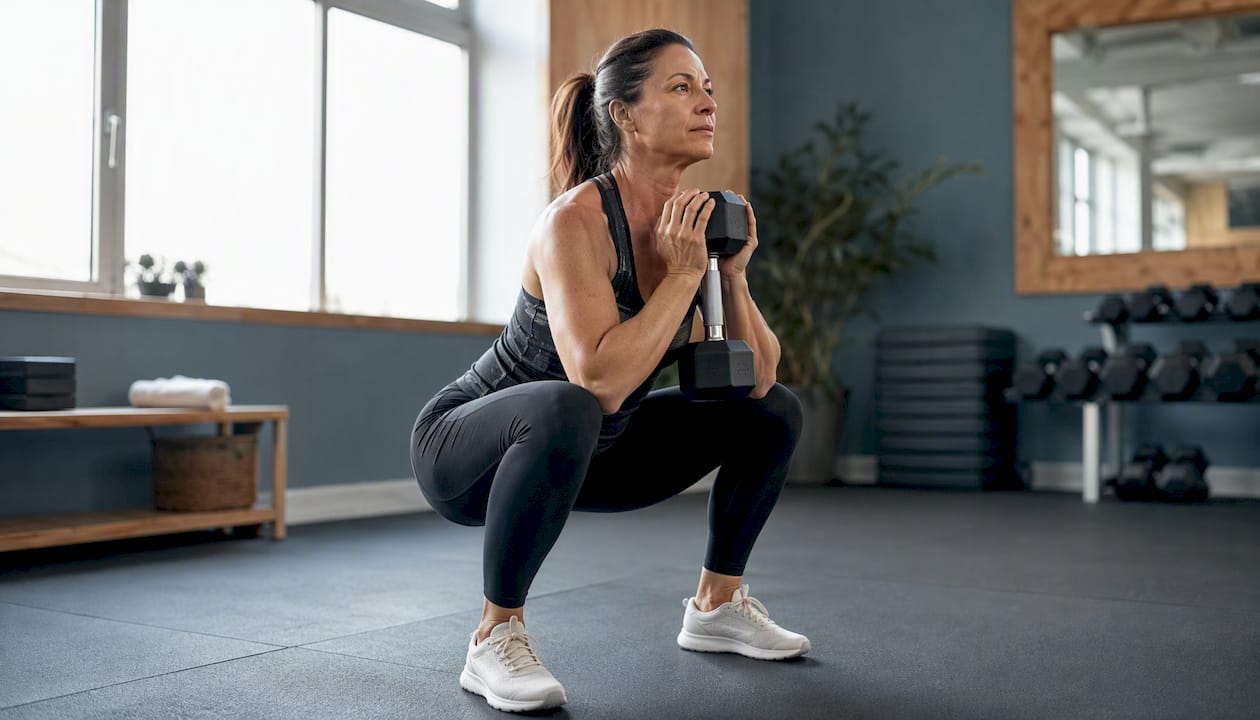
Goblet squat: Hold a dumbbell vertically at your chest. Push your knees out over your toes, keep your chest tall, and sit your hips back and down. The most common mistake is letting the heels rise, which usually means the load is too heavy or ankle mobility is limited. Elevate your heels slightly on a small plate if needed.
Romanian deadlift: Hinge at the hips, not the waist. The bar (or dumbbells) stays close to your legs as you lower. Stop when you feel a stretch in your hamstrings, not when your back rounds. Rounding the lower back under load is the error to avoid.
Floor press: Lying on your back removes the lower-back arch issue that can occur on a bench. Press the dumbbells straight up, lower until your upper arms touch the floor, pause briefly, then press again. Keep your shoulder blades pulled together throughout.
Single-arm row: Brace your core before you pull. Drive your elbow toward your hip, not toward the ceiling. A common mistake is rotating the torso to get the weight up, which reduces the work on the target muscle.
Farmer’s carry: Stand tall, shoulders back, core braced. Walk with control. If your shoulders start to creep toward your ears, the weight is too heavy.
At-home and lower-impact modifications
If you have knee sensitivity, swap the goblet squat for a box squat (sit to a chair, stand up). For hip discomfort, replace the Romanian deadlift with a hip thrust using a dumbbell on your lap. If floor work is uncomfortable, a standing resistance band row replaces the single-arm dumbbell row with no floor contact required.
Pro Tip: If a joint feels sharp or pinching during a movement, stop and try a regression. Dull muscle fatigue is normal. Sharp, localized joint pain is a signal to modify or rest.
For women who also want to add cardio without undermining recovery, combining cardio and strength training effectively covers the sequencing and timing in detail.
Nutrition basics that actually support your training
Protein is non-negotiable. Research supports intakes of approximately 1.4–2.0 g of protein per kilogram of bodyweight per day for active adults focused on muscle building and recovery. For a 150-lb (68 kg) woman, that works out to roughly 95–136 grams of protein per day. Most women eating a typical American diet land well below that.
Practical protein targets per meal (aiming for 30–40 g per sitting, three to four times per day):
- 5 oz grilled chicken breast: ~42 g
- 1 cup Greek yogurt (plain, 2%): ~17–20 g
- 2 eggs + 3 egg whites: ~24 g
- 6 oz canned tuna: ~40 g
- 1 cup cooked lentils: ~18 g
Distributing protein across meals rather than loading it all at dinner improves muscle protein synthesis throughout the day. One practical rule: include a palm-sized protein source at every meal.
Calories: maintenance vs. modest fat loss
If body composition is a goal, a modest calorie deficit of 200–300 calories per day is enough to support gradual fat loss without sacrificing muscle. Aggressive restriction while strength training tends to stall progress and increase fatigue. Prioritize protein first, then adjust total calories around it.
Supplements worth knowing about
A review in Sports Medicine Open found that vitamin D supplementation showed small improvements in handgrip strength in some trials, though the overall evidence on supplements remains mixed and should be individualized. Creatine monohydrate has a stronger evidence base for supporting strength and lean mass in older adults and is generally safe at 3–5 g per day. Neither replaces adequate protein and consistent training.
For a deeper dive into meal timing and fueling around workouts, humn’s nutrition guide for exercise performance covers practical examples.
Pro Tip: Eat 20–40 g of protein within two hours after your session. You do not need a special recovery shake. A Greek yogurt with fruit or a chicken wrap works just as well.
Recovery, sleep, and hormone-aware training habits
Recovery is where adaptation actually happens. The workout creates the stimulus; sleep and rest create the result. For women over 40, this is not a soft suggestion. Recovery windows widen with age, meaning the same training load that a 25-year-old bounces back from in 24 hours may take 48–72 hours for a woman in her 40s or 50s.
Sleep and stress
Seven to nine hours of sleep per night is the range where muscle protein synthesis and hormonal recovery are optimized. Chronic sleep restriction below six hours elevates cortisol, which directly opposes the muscle-building signal. Simple sleep hygiene habits that actually move the needle: consistent wake time (even on weekends), keeping the bedroom cool and dark, and avoiding screens for 30 minutes before bed.
High life stress has the same effect as poor sleep on recovery. When stress is elevated, training load should come down, not up. This is not weakness; it is physiology.
Deload weeks
Plan a deload every four to six weeks. During a deload, reduce your training volume by roughly 40–50% (fewer sets, same or slightly lighter weight) for one week. This is when connective tissue catches up with the load you have been placing on it. Skipping deloads is one of the most common reasons women over 40 plateau or get injured.
Low-impact conditioning and mobility
Walking, cycling, and swimming on non-lifting days support cardiovascular health without adding recovery debt. Aim for 20–30 minutes of low-intensity movement two to three times per week. Ten minutes of hip flexor stretches, thoracic rotations, and ankle circles after each session reduces stiffness and keeps joints mobile.
Practical recovery signals to track:
- Resting heart rate elevated more than 5–7 beats above your normal
- Persistent muscle soreness lasting more than 72 hours
- Declining performance across two consecutive sessions
- Disrupted sleep or unusual fatigue
Any two of those signals together is a reason to take an extra rest day or reduce that week’s training load.
Pro Tip: Track your resting heart rate each morning before getting out of bed. A free app or a basic fitness watch handles this automatically. It is one of the simplest and most reliable readiness signals available.
How to train safely and avoid common injuries
Most injuries in beginner strength training come from one of three sources: too much load too soon, skipping the warm-up, or ignoring early warning signs. All three are preventable.
Warm-up checklist (5–8 minutes)
- 3–5 minutes of light cardio (brisk walk, stationary bike)
- 10 hip circles each direction
- 10 bodyweight squats
- 10 shoulder rolls forward and back
- 10 glute bridges
- One light warm-up set of your first exercise at 50% of your working weight
Red flags: when to stop and seek assessment
- Sharp or stabbing pain during a movement (stop immediately)
- Joint swelling that persists after a session
- Pain that worsens over consecutive sessions rather than improving
- Numbness or tingling in the arms or legs during lifting
Dull muscle soreness 24–48 hours after a session is normal. Sharp, localized joint pain is not. When in doubt, rest for two to three days and consult a physical therapist or sports medicine physician before returning.
Safe at-home progression checklist
- Start with bodyweight or very light dumbbells for the first two sessions
- Film yourself from the side on compound movements to check form
- Never add weight and reps in the same session
- Rest at least 48 hours between sessions targeting the same muscle groups
When to hire a coach: If you have a history of joint surgery, osteoporosis, or chronic pain, working with a qualified coach for at least the first four to six weeks is worth it. A coach catches form errors before they become injuries and adjusts load based on how you move, not just how much you can lift.
Pro Tip: The most protective thing you can do for your joints is build the muscles around them. Weak glutes are behind most knee and hip complaints in women over 40. Prioritize hip hinge and glute work from day one.
Key Takeaways
Strength training three times per week, built around compound movements with progressive overload and adequate protein, is the most effective approach for women over 40 to preserve muscle, support bone density, and maintain metabolic health.
| Point | Details |
|---|---|
| Train 3 days per week | Non-consecutive full-body sessions of 40 minutes produce measurable gains in lean mass and strength. |
| Prioritize protein | Target 1.4–2.0 g per kilogram of bodyweight daily, distributed across three to four meals. |
| Progress gradually | Add weight only when you can complete all reps with 2–3 reps in reserve; deload every 4–6 weeks. |
| Protect recovery | Seven to nine hours of sleep and planned rest days are not optional; they are where adaptation happens. |
| humn for guided support | humn in Gaithersburg, MD offers 1-on-1 coaching, small-group training, and recovery services built around this exact approach for women 40+. |
The part most programs get wrong
There is a version of this conversation that goes: find a program online, follow it for six weeks, see what happens. And for some people, that works. But for most women over 40 who come to strength training after years of cardio-only routines or no structured exercise at all, the program is rarely the problem. The habits around it are.
What I see consistently is that women in this stage of life are not lacking motivation. They are dealing with competing demands, disrupted sleep, hormonal variability, and a fitness industry that has spent decades telling them to do more cardio and eat less. Starting a strength program on top of that without addressing recovery, stress, and nutrition is like trying to build a house on a cracked foundation.
The four-pillar framework that humn uses, Resist, Recover, Renew, and Rhythm, exists precisely because lifting alone is not enough. The Recover pillar (sleep, stress management, active recovery) and the Rhythm pillar (habit formation, scheduling, behavioral consistency) are what make the Resist pillar actually work over months and years. One concrete habit that reliably improves consistency: scheduling sessions as fixed calendar appointments, not as something you will do “if there is time.” That single behavioral shift, treating training like a meeting you cannot cancel, accounts for more long-term progress than any program variable.
The timeline question comes up constantly. Functional strength improvements, moving better, feeling more stable, lifting more, show up within four to six weeks of consistent training. Visible body composition changes take 12 weeks or more. Bone density changes take months of sustained effort. None of that is a reason to wait. It is a reason to start now and stay consistent.
Strength training at humn: coached, structured, and built for women 40+
Most women over 40 who want to start lifting weights do not need another program to download. They need someone to watch their squat, adjust their load when life gets hard, and build a plan that accounts for sleep, stress, and hormonal variability, not just sets and reps.
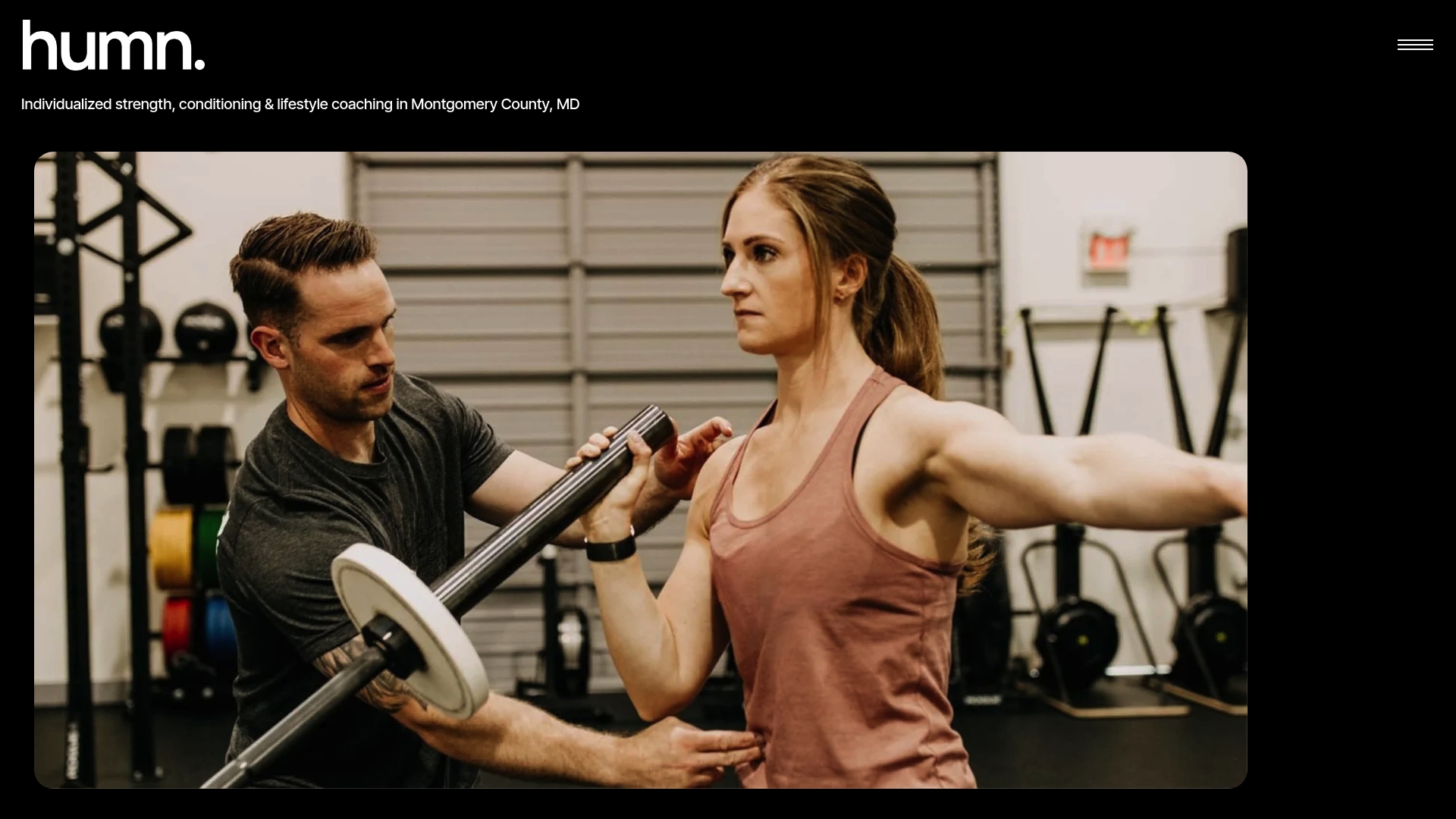
That is what humn delivers in Gaithersburg, MD. Through 1-on-1 coaching and small-group personal training, coaches build individualized programs using the same evidence-based principles in this article, then adjust them in real time based on how you are recovering and progressing. Recovery services including sauna, compression therapy, and red light therapy are available on-site to support adaptation between sessions. Nutrition and lifestyle habit coaching rounds out the picture.
If you are ready to stop guessing and start building, explore the benefits of 1-on-1 fitness coaching or learn what a premium coaching membership looks like at humn.
Useful sources
This article draws on peer-reviewed research, systematic reviews, and clinical guidance. The sources below support the specific claims made throughout.
- UCLA Health — Best way to work out after menopause
- PoinT GO Research — Training for older adults over 40
- PMC — Velocity-based resistance training insights
This article is general information, not medical advice. Consult your physician or a qualified health professional before starting a new exercise program, particularly if you have a history of bone, joint, or cardiovascular conditions.
No Comments.