

Yes. For adults whose sleep problems come from habits, schedules, or a noisy bedroom rather than a medical condition, sleep coaching reliably improves sleep continuity, extends total sleep time, and cuts daytime sleepiness. Peer-reviewed and app-based studies show measurable gains in sleep latency, wake time after sleep onset, and sleep efficiency within about 12 weeks. The caveat: coaching works on behavior, not diagnosis, so it isn’t the right first step for suspected sleep apnea or other medical sleep disorders.
TL;DR:
- Sleep coaching improves sleep latency by about 11 minutes and reduces wake time after sleep onset by 28 minutes within 12 weeks.
- The most significant improvements occur in individuals starting with poor sleep efficiency or short sleep duration.
- Engagement with coaching, such as adherence to messages, strongly correlates with better sleep outcomes.
- Coaching is most effective for behavior and habit-related sleep issues, not for diagnosing or treating medical sleep disorders.
- Most programs last 4 to 12 weeks and require consistent participation to achieve measurable, lasting benefits.
Table of Contents
- What Are the Real Benefits of Sleep Coaching?
- What Does the Research Actually Show?
- How Does Sleep Coaching Actually Work?
- Who Actually Benefits From Sleep Coaching?
- What Does a Sleep Coaching Program Actually Look Like?
- How Do You Choose a Good Sleep Coach?
- How Long Does Sleep Coaching Take to Work?
- What Can’t Sleep Coaching Do?
- Why I Think Sleep Gets Undersold in Fitness Coaching
- Get Sleep and Recovery Coaching Under One Roof
- Sources
What Are the Real Benefits of Sleep Coaching?
Sleep coaching targets four measurable outcomes: how fast you fall asleep, how much you wake up at night, how long you actually sleep, and what percentage of time in bed you spend asleep. Sleep researchers call that last number sleep efficiency, and it’s often the single best indicator of whether someone has a real sleep problem or just a bad night now and then.
The clearest data comes from a 12-week app-based coaching program that combined personalized text coaching with nightly tracking. People who completed the full program saw sleep latency drop by 11 minutes, wake time after sleep onset (WASO) drop by 28 minutes, sleep efficiency climb by 6.6 percentage points, and total sleep time increase by about 44 minutes a night. Those aren’t small numbers. An extra 44 minutes of sleep, sustained over weeks, changes how a person functions at 3 p.m. on a Tuesday.
Quick stat: Participants with the lowest starting sleep efficiency and the shortest baseline sleep duration saw the largest improvements, according to the same study. Coaching tends to help most the people who need it most.
Better sleep continuity doesn’t stay contained to the night. It shows up the next day in ways that matter more to most adults than the raw numbers:
- Sharper attention and working memory during the first half of the day
- More stable mood and lower irritability under stress
- Faster physical recovery after exercise, since deep sleep is when much of tissue repair and hormone regulation happens
- Less reliance on caffeine to get through an afternoon slump
- Reduced use of over-the-counter or prescription sleep aids
That last point matters more than it might seem. In the same 12-week program, 41% of participants who used sleep aids at baseline had stopped using them by week 12. That’s not a claim that coaching replaces medication for everyone, but it does suggest that a meaningful share of sleep aid use is driven by fixable habits rather than an underlying disorder.
The daytime functioning piece deserves its own mention because it’s what people actually notice first. Sleep latency and WASO are useful clinical markers, but “I stopped falling asleep at my desk” is what gets someone to stick with a program. Coaching that improves sleep efficiency by even a few points often produces a daytime alertness change that feels disproportionate to the numbers, because consolidated sleep (fewer awakenings, not just more hours) is what restores cognitive sharpness.
What Does the Research Actually Show?
Two studies anchor most of what’s currently known about structured sleep coaching, and both point the same direction while leaving real gaps.
The larger one tracked adults through a 12-week app-supported coaching program that paired a wearable or sleep diary with personalized, text-based coaching messages. Completers saw the improvements described above: sleep latency down 11 minutes, WASO down 28 minutes, sleep efficiency up 6.6%, total sleep time up roughly 44 minutes. The people who benefited most were those who started with poor sleep efficiency or short sleep duration, which tracks with what you’d expect. Someone already sleeping well and efficiently has less room to improve.
A second, smaller pilot trial from Frontiers tested personalized SMS-based coaching messages rather than app dashboards. It measured outcomes using RU_SATED, a composite sleep-health score covering regularity, satisfaction, alertness, timing, efficiency, and duration. The trial found reasonable adherence to the coaching messages and an overall trend toward improved RU_SATED scores. More telling: adherence to the coaching messages correlated with the size of the improvement (a correlation of 0.54, statistically significant at p = 0.004). People who engaged more consistently with their coaching messages got more out of the program. That’s not a surprising finding, but it’s an important one, because it means outcomes are not fixed. They depend heavily on how much a person actually does with the coaching, not just whether they sign up.
Where the evidence is thinner:
- Both key studies used uncontrolled designs. There was no comparison group getting a placebo or generic sleep advice, so it’s hard to isolate exactly how much of the improvement came from the coaching itself versus simply paying closer attention to sleep for 12 weeks.
- Both relied on completer analyses. People who dropped out mid-program, often the ones struggling most, aren’t reflected in the reported effect sizes. That tends to inflate how good the results look for the “average” participant.
- Sample sizes in the pilot work are small enough that the researchers themselves called for larger randomized controlled trials with intent-to-treat analysis before drawing firm conclusions.
None of that erases the signal. It does mean the honest claim is “sleep coaching produces measurable improvements in the people who stick with it,” not “sleep coaching cures insomnia for everyone who tries it.” Those are different claims, and the second one isn’t supported by anything currently published.
How Does Sleep Coaching Actually Work?
Coaching isn’t advice delivered once and forgotten. It’s a structured loop: measure, personalize, adjust, repeat.
- Baseline measurement. A coach starts with objective or self-reported data, usually a sleep diary or a wearable device, tracking bedtime, wake time, awakenings, and perceived sleep quality for a week or two before making any changes.
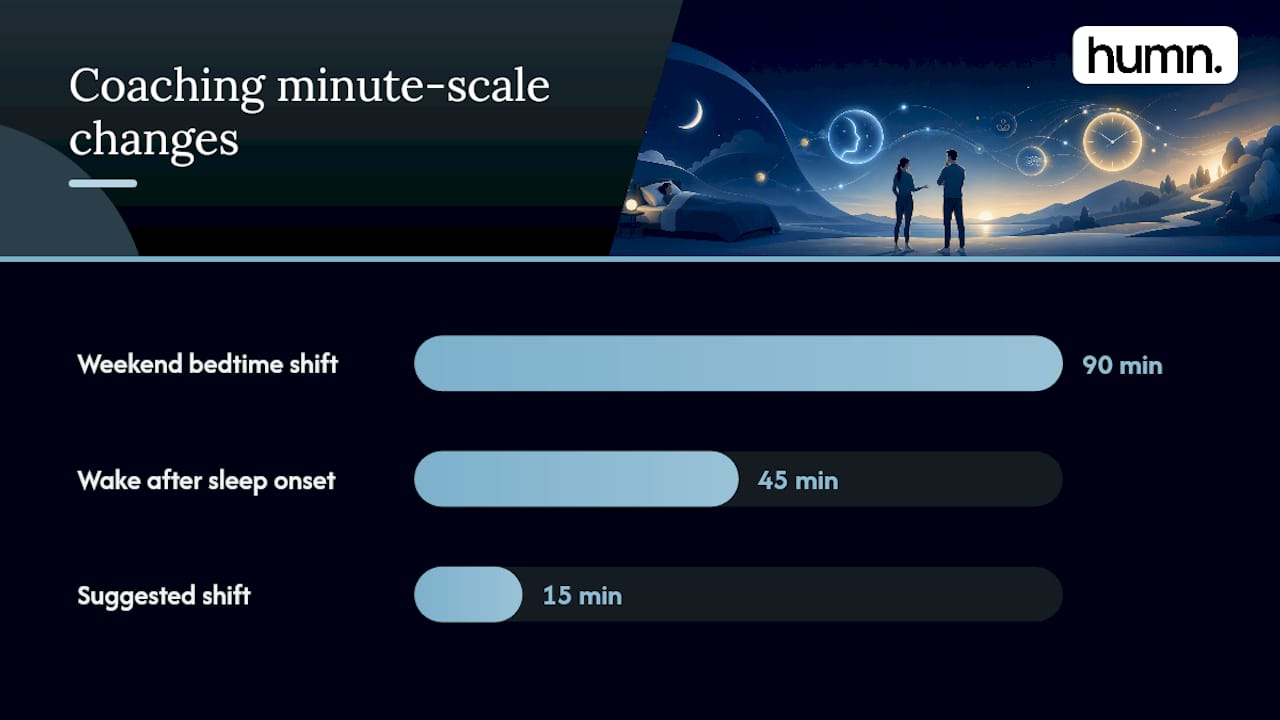
- Personalized plan. The baseline data shapes a plan built around that specific person’s patterns, not a generic sleep hygiene checklist. Someone with a 90-minute weekend bedtime shift gets different guidance than someone waking up four times a night.
- Habit-level interventions. Most plans lean on stimulus control (using the bed only for sleep) and schedule regularity, the two behavioral levers with the most consistent research support behind them.
- Ongoing coaching contact. Weekly check-ins or daily messages keep the plan adjusting in real time, catching problems (a bad week of travel, a new stressor) before they undo progress.
- Motivational support. Good coaching uses techniques closer to motivational interviewing than lecturing, small suggestions, framed as choices, tied to the person’s own stated goals.
The message structure used in one of the pilot trials followed a pattern worth borrowing for anyone coaching themselves: insight, then education, then suggestion. A message might note “You’ve been averaging 45 minutes of wake time after sleep onset this week” (insight), explain briefly why that matters for how rested someone feels (education), then offer one specific, small change like moving the wake time 15 minutes later for three nights (suggestion). That three-part sequence appears in the Frontiers pilot trial and mirrors how evidence-based fitness coaching approaches any habit change: data first, context second, one small ask third.
Pro Tip: If you’re tracking your own sleep without a coach, resist the urge to change five things at once. The studies that show the strongest results used single, incremental adjustments, not a full lifestyle overhaul in week one.
Who Actually Benefits From Sleep Coaching?
Sleep coaching works best on problems that live in behavior, environment, and timing, not in the airway or the nervous system.
Good candidates typically include:
- Adults with habit-driven insomnia, irregular bedtimes, or a schedule that drifts on weekends
- Shift workers trying to stabilize sleep around a rotating or overnight schedule
- People relying on sleep aids who want to reduce dependence through better sleep habits first
- Anyone with generally healthy sleep architecture who just can’t seem to build consistency
Coaching is the wrong first step, and potentially a dangerous delay, for anyone showing signs of a medical sleep disorder. That includes loud, chronic snoring, witnessed pauses in breathing during sleep, extreme daytime sleepiness that goes beyond normal tiredness, unexplained neurological symptoms, or a complex psychiatric condition layered on top of the sleep complaint. Medical experts are consistent on this point: sleep coach is not a regulated clinical title, and coaches aren’t equipped to diagnose conditions like sleep apnea or restless leg syndrome.
A quick self-screen before booking a coach: Do you snore loudly or has a partner noticed you stop breathing at night? Do you fall asleep unintentionally during the day, even in low-stimulation moments like driving or a meeting? Is your fatigue disproportionate to the number of hours you’re actually sleeping? A “yes” to any of those points toward a primary care visit or a sleep study before a coaching program, not instead of one.
What Does a Sleep Coaching Program Actually Look Like?
Most structured programs run somewhere between 4 and 12 weeks, long enough to build and stabilize a new sleep pattern without dragging on indefinitely. The 12-week window shows up repeatedly in the research because it gives enough time for both fast wins (falling asleep faster) and slower ones (a fully regulated sleep schedule) to show up.
Delivery formats vary more than people expect:
- 1:1 coaching with a live person, usually weekly check-ins plus asynchronous messaging between sessions
- App-plus-text models, where a wearable or sleep diary feeds data into an app, and a coach sends personalized text guidance based on that data
- Hybrid programs combining scheduled calls with daily or near-daily nudges
Intake almost always starts the same way regardless of format: a baseline tracking period, a sleep diary or device sync, and an initial conversation about goals, schedule constraints, and any red-flag symptoms worth screening out before starting. From there, the plan gets built, and follow-up sessions exist specifically to adjust it as real-world data comes in, not to repeat the same advice every week.
Cost varies widely and isn’t standardized the way, say, a gym membership is. Consumer-pay coaching programs run from roughly the cost of a mid-tier subscription service up through several hundred dollars for extended 1:1 programs, and most are paid out of pocket rather than covered by insurance. That’s a real consideration when comparing coaching to a clinical route like cognitive behavioral therapy for insomnia (CBT-I), which is sometimes covered under medical insurance when delivered by a licensed provider.
How Do You Choose a Good Sleep Coach?
Not all coaching is built the same, and the term itself covers a wide range of training levels. Consumer health guidance is blunt about this: check a coach’s background before you check their calendar.
- Ask about training in behavioral sleep medicine specifically, not just general wellness or life coaching certification. The strongest coaches have some formal grounding in sleep science, not just enthusiasm for the topic.
- Ask what they measure and how. A coach who can’t tell you whether they’re tracking sleep latency, WASO, or total sleep time, and why, probably isn’t running a data-driven program.
- Ask about their screening process for medical issues. A responsible coach asks about snoring, breathing pauses, and excessive daytime sleepiness before building a plan, and has a clear referral pathway to a sleep physician if those show up.
- Ask to see a sample plan or session structure. You should be able to picture what week one actually involves before you pay for week one.
- Ask about their refund or cancellation policy. A coach confident in their process usually has a straightforward answer here.
Red flags are usually easy to spot once you know to look for them: promises of a “fixed sleep problem in one week,” no intake questions about medical history, no measurable tracking at all, or a plan that looks identical for every client regardless of their starting point.
Pro Tip: Ask a prospective coach one direct question: “What would make you tell me to see a doctor instead of continuing with you?” A good coach has a ready answer. One who hesitates or dismisses the question is a reason to look elsewhere.
How Long Does Sleep Coaching Take to Work?
Early signals usually show up faster than people expect. Falling asleep a bit quicker and feeling subjectively more rested often appears within 2 to 6 weeks, especially once a consistent wake time takes hold. The larger, more durable gains, meaningfully lower WASO, a real jump in sleep efficiency, tend to build across 8 to 12 weeks, which lines up with the timeline used in the app-based coaching study.
Coaches typically track a consistent set of metrics: sleep latency (minutes to fall asleep), WASO (minutes awake after initially falling asleep), total sleep time, sleep efficiency (percentage of time in bed actually asleep), and sometimes a composite score like RU_SATED or a daytime sleepiness measure like the Epworth Sleepiness Scale.
Quick stat: Adherence is the biggest lever in the outcome data. In the Frontiers pilot, engagement with coaching messages correlated with improvement at 0.54, meaning roughly a quarter of the variation in outcomes tracked with how consistently people engaged, not with anything about the program design itself.
That’s worth sitting with. The plan matters, but showing up for it matters more.
What Can’t Sleep Coaching Do?
Coaching changes behavior. It doesn’t diagnose or treat sleep apnea, restless leg syndrome, narcolepsy, or severe clinical insomnia tied to another medical or psychiatric condition. A coach can notice red flags and point someone toward help; they generally cannot order a sleep study, prescribe treatment, or rule out a physiological cause.
That distinction shapes a few practical realities worth knowing before you sign up:
- Most coaching services are out-of-pocket. Unlike CBT-I delivered by a licensed clinician, which insurance sometimes covers, consumer sleep coaching rarely qualifies for reimbursement.
- A responsible coach has an explicit escalation plan: routine screening for apnea risk factors like loud snoring, witnessed breathing pauses, or obesity, paired with a referral path to home sleep testing or a sleep medicine specialist when those show up.
- Coaching best fits lifestyle and habit-based sleep issues. People with a suspected medical sleep disorder should prioritize a licensed sleep physician first, and use coaching, if at all, as a complement afterward rather than a substitute.
If a coach never asks about your medical history, never screens for apnea risk, and never mentions the possibility of a referral, that absence is itself informative.
Why I Think Sleep Gets Undersold in Fitness Coaching
Most people chasing better strength or fat loss numbers treat sleep as background noise instead of the mechanism that makes the rest of their effort pay off. That’s backwards. Recovery, not the workout itself, is where adaptation actually happens, and sleep is the largest lever inside recovery. A client hitting every session but sleeping five broken hours a night is fighting their own biology.
At humn, sleep coaching isn’t bolted onto training as an afterthought. It runs alongside the Recover and Rhythm pillars because better sleep efficiency directly amplifies what strength work and recovery modalities are trying to accomplish. A client sleeping 44 extra minutes a night, consolidated and efficient rather than fragmented, recovers faster between sessions and shows up with more capacity to train hard.
The pathway that works best pairs habit-based sleep coaching with structured training and recovery access in the same relationship, not three separate providers who never talk to each other. That’s the integration most gym-based approaches miss entirely.
— Josh
Get Sleep and Recovery Coaching Under One Roof
If you’ve read this far, you already know sleep coaching works best when it’s not operating in isolation. Some providers build habit-based sleep support directly into lifestyle coaching, alongside strength training and recovery access like sauna, compression, and red light therapy, so your sleep plan and your training plan work together instead of competing for your energy.

An initial assessment at humn starts with the same kind of baseline most good sleep programs use: current sleep patterns, stress load, training schedule, and recovery habits, then builds a personalized plan that coordinates all of it with a dedicated coach. You’re not managing a sleep app in one hand and a workout plan in the other. If chronic fatigue or inconsistent sleep has been capping your results in the gym, start with humn’s lifestyle coaching program and book an assessment to see how sleep, training, and recovery fit together under one plan.
This article is general information, not a substitute for advice from a qualified doctor. Consult a qualified healthcare professional about your own circumstances before acting on anything here.
Sources
- App-supported sleep coaching: implications for sleep duration and sleep quality — PMC
- Pilot study of personalized sleep-coaching messages to promote healthy sleeping behaviors — Frontiers
- Sleep coaching vs. sleep therapy: what’s the difference — Men’s Health
- What Is a Sleep Coach? — WebMD
No Comments.