


Most adults in the U.S. pay a moderate amount per month for nutrition coaching, depending on whether they go online or in-person, work with a Registered Dietitian or a certified coach, and choose a package or pay session by session. A realistic budget for a mid-range package covers several months of coaching. If you have a clinical condition like diabetes or an eating disorder, check your insurance first — a credentialed RD providing medical nutrition therapy is often at least partially covered. If your goals are habit-based (better eating patterns, weight management, sports performance), a structured 8–12 week coaching package from a certified nutrition coach is usually the most cost-effective starting point.
ConsumerAffairs’ review of 21 services found online packages running $99–$200 per month, while in-person initial consultations typically land at $100–$250 with follow-ups at $75–$165. Those ranges hold up well across the broader market.
| Format | Typical Monthly Cost | Notes |
|---|---|---|
| Online coaching package | $99–$200/month | Most common entry point |
| In-person initial consult | $100–$250 per session | One-time or first visit |
| In-person follow-up | $75–$165 per session | Ongoing check-ins |
| 8–12 week package | $600–$1,200 total | Core program range |
| Premium 3–6 month program | $1,200–$2,000+ total | High-touch, full-service |
Table of Contents
- What pricing models actually mean for your wallet
- What do typical price bands look like in practice?
- What factors push the price up or down?
- Can insurance, telehealth, or sliding-scale options lower your cost?
- Do you need a Registered Dietitian or a nutrition coach?
- Questions to ask before you hire a nutrition coach
- How these price ranges were compiled
- Key Takeaways
- A note on what the numbers don’t tell you
- What humn offers for nutrition and lifestyle coaching
- Useful sources and further reading
What pricing models actually mean for your wallet
Every nutrition coach structures fees differently, and the model shapes what you get as much as the dollar amount does.

Hourly or per-session billing is the simplest to understand but often the worst deal for clients who want real results. You pay $65–$250 per session depending on the coach’s credentials and market, but there’s no built-in accountability between sessions. ISSA’s pricing guidance reports median hourly rates around $65–$75 for newer coaches, while experienced practitioners charge $100–$250 or more. The catch: hourly billing rewards slow coaches and punishes efficient ones, which is why most established practitioners move away from it.
Fixed packages (8–12 weeks or 3–6 months) are the industry standard for a reason. You pay a flat fee upfront and get a defined set of deliverables: an initial assessment, weekly or biweekly check-ins, a meal plan, messaging access, and progress tracking. Precision Nutrition recommends moving from hourly to package or value-based pricing precisely because it aligns the coach’s incentives with your outcomes rather than their clock.
Monthly subscriptions or memberships work like a retainer. You pay $250–$450 per month and get ongoing access to your coach, usually with a set number of check-ins and app-based messaging. This model suits people who want continuity without committing to a long program upfront.
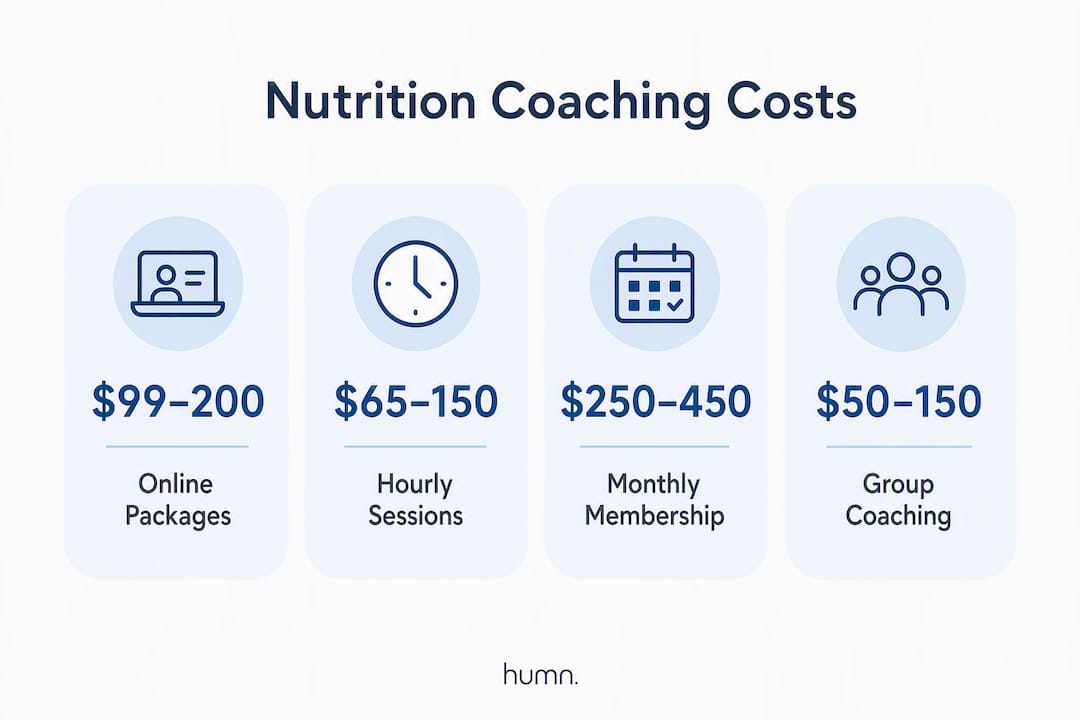
Group coaching cuts the per-person cost significantly, often to $50–$150 per month, by spreading the coach’s time across multiple clients. You lose personalization but gain community accountability, which works well for general wellness goals.
Value-based pricing is what experienced coaches charge when their results speak for themselves. The price reflects the outcome (losing 30 pounds, reversing pre-diabetes markers, hitting a performance goal) rather than the number of sessions. Packages at this tier often run $2,000–$5,000 for a multi-month engagement.
| Model | Typical Price Band | What’s Usually Included | Best For |
|---|---|---|---|
| Hourly/per-session | $65–$250/session | Single session, basic guidance | One-off questions, occasional check-ins |
| 8–12 week package | $600–$1,200 | Assessment, check-ins, meal plan, messaging | Habit change, weight loss, sports goals |
| Monthly subscription | $250–$450/month | Ongoing check-ins, app access, messaging | Long-term maintenance, accountability |
| Group coaching | $50–$150/month | Group sessions, shared resources | General wellness, budget-conscious clients |
| Premium 3–6 month | $1,200–$2,000+ | Full-service: labs, body comp, daily support | Clinical goals, high-performance athletes |
Pro Tip: Value-based pricing makes the most sense when a coach can point to measurable client outcomes. If a coach charges $3,000 for a program that has helped clients drop 25 pounds and normalize blood sugar, that price is defensible. Ask for outcome data before dismissing a high price tag.
What do typical price bands look like in practice?
Translating ranges into actual budgets is where most guides fall short. Here’s how the numbers stack up across three spending levels.

The Content Cook’s 2026 pricing framework maps packages to three tiers: starter programs at $250–$400 for four weeks, core programs at $600–$900 for 8–12 weeks, and premium programs at $1,200–$2,000 or more for three to six months. Monthly subscriptions in that framework run $250–$450 per month.
Conservative budget (online group or starter package)
- Month 1: $99–$250 (online subscription or starter 4-week package)
- Months 2–3: $99–$200/month (continued subscription)
- 3-month total: roughly $300–$650
This tier gets you app-based coaching, a basic meal framework, and limited 1:1 access. Fine for someone who mostly needs structure and accountability.
Typical budget (core 8–12 week package or mid-range monthly)
- Month 1: $300–$450 (first installment of a core package, or monthly subscription)
- Months 2–3: $300–$450/month
- 3-month total: roughly $600–$900
At this level, expect an initial assessment, biweekly check-ins, a personalized meal plan, and messaging access between sessions. This is the sweet spot for most adults with specific goals.
Premium budget (high-touch 1:1 or in-person program)
- Month 1: $500–$700 (in-person initial consult + first follow-up + program setup)
- Months 2–3: $400–$600/month
- 3-month total: roughly $1,200–$2,000+
Premium programs often add body composition assessments, lab review, daily check-ins, and sometimes integration with fitness coaching. For 12-week online programs, prices range from $699–$1,200; hybrid or in-person programs run higher.
What factors push the price up or down?
Credential is the single biggest lever. A Registered Dietitian (RD or RDN) commands higher fees than a certified nutrition coach because the credential requires a graduate degree, supervised clinical hours, and a national licensing exam. RDs also carry insurance eligibility that coaches don’t. Expect to pay 20–40% more for an RD on a comparable program.
The four main cost drivers:
- Credential and specialization: RD/RDN, sports dietitian (CSSD), or oncology nutrition specialist all justify higher rates than a general certified nutrition coach. Niche expertise (eating disorders, pediatric nutrition, GI conditions) adds another premium.
- Session frequency and contact access: Daily messaging and weekly check-ins cost more than monthly touchpoints. A coach who responds within hours is priced differently from one who replies within 48 hours.
- Delivery mode: In-person sessions carry facility overhead and travel time. Online coaching removes both, which is why online packages run $99–$200/month while comparable in-person programs cost more. A functional nutrition approach that includes root-cause assessments and lab review will always sit at the higher end regardless of delivery mode.
- Add-ons: Body composition testing, food sensitivity panels, continuous glucose monitoring interpretation, and fitness assessment integration all add cost. These are worth it when they directly inform the plan; they’re padding when they don’t.
Geography matters too, though less than it used to. A coach in San Francisco charges more than one in rural Ohio for in-person work, but online coaching has compressed that gap considerably. In the Gaithersburg, MD area, nutrition coach prices for in-person or hybrid programs tend to track the broader mid-Atlantic market, which aligns with the national mid-range.
“Undercharging is often the result of an unclear offer rather than a market ceiling. When deliverables are specific and visible, premium pricing is easier to defend.”
— ISSA Nutrition Coaching Pricing Guide
Pro Tip: When comparing two coaches at different price points, ask for their onboarding materials and a sample week of the program. A coach with a clear intake process, defined check-in schedule, and written deliverables is worth more than one who “customizes everything” with no documented structure.
Can insurance, telehealth, or sliding-scale options lower your cost?
Yes, but only under specific conditions. The key variable is credential.
When insurance may cover nutrition services:
- The provider is a credentialed RD or RDN
- The service is classified as Medical Nutrition Therapy (MNT)
- You have a qualifying diagnosis (diabetes, kidney disease, obesity, eating disorders, cardiovascular disease)
- Your plan includes preventive or outpatient nutrition benefits
- You have a physician referral (required by many insurers)
Top Nutrition Coaching’s insurance breakdown confirms that credentialed RDs are far more likely to be covered than non-regulated nutrition coaches, whose services are almost always out-of-pocket. Medicare covers MNT for diabetes and kidney disease when provided by an RD. Many commercial plans cover preventive nutrition visits under the ACA’s preventive care mandate, though the number of covered visits varies widely.
Steps to check your coverage:
- Call the member services number on your insurance card and ask specifically about “Medical Nutrition Therapy” (CPT codes 97802 and 97803) and “preventive nutrition counseling.”
- Ask whether a referral is required and whether the provider must be in-network.
- Confirm your deductible status — even covered services may apply to your deductible before the plan pays.
- Ask your employer’s HR department about FSA/HSA eligibility for nutrition coaching fees.
Telehealth and lower-cost options:
Online coaching consistently runs cheaper than in-person. The $99–$200/month range cited earlier is almost entirely an online phenomenon. Telehealth RD visits through platforms connected to major health systems can run $50–$150 per session with insurance, or $100–$200 out-of-pocket.
University nutrition clinics offer some of the most affordable supervised options. The Kendall Reagan Nutrition Center at Colorado State University, for example, lists individual sessions near $110 with package discounts for multi-session bundles. Community health centers and teaching clinics often operate on sliding-scale fees tied to income.
Do you need a Registered Dietitian or a nutrition coach?
The answer depends almost entirely on your medical situation.
Choose an RD when:
- You have a diagnosed condition (diabetes, celiac disease, kidney disease, eating disorder, cancer)
- You need Medical Nutrition Therapy that insurance will cover
- You’re managing a complex medication-nutrition interaction
- You want clinical lab interpretation integrated into your plan
Choose a certified nutrition coach when:
- Your goals are behavioral: building consistent eating habits, managing weight without a clinical condition, improving energy, or supporting athletic performance
- You want accountability and structure more than clinical oversight
- Budget is a factor and insurance won’t apply
| Registered Dietitian (RD/RDN) | Certified Nutrition Coach | |
|---|---|---|
| Credential | Graduate degree + supervised hours + national exam | Varies: ISSA, Precision Nutrition, ACE, NASM |
| Insurance eligibility | Often covered for MNT with qualifying diagnosis | Rarely covered; typically out-of-pocket |
| Typical cost | $100–$250/session; $200–$500/month | $65–$200/session; $99–$450/month |
| Best for | Clinical conditions, medical nutrition therapy | Habit change, weight management, sports goals |
| Scope of practice | Can diagnose and treat nutrition-related conditions | Behavior change, education, accountability |
A quick decision rule: if your doctor has mentioned your diet in the context of a health condition, start with an RD and check insurance. If you’re healthy and want to eat better, perform better, or lose weight without a clinical diagnosis, a certified nutrition coach with a structured package is the more cost-effective path.
Questions to ask before you hire a nutrition coach
The price on the website tells you almost nothing about value. What matters is what you get for it.
Before committing, ask for:
- A sample meal plan or program overview (not a generic template)
- Their onboarding process and intake questionnaire
- How progress is measured and how often
- Their refund or pause policy if life gets in the way
- Proof of credential (RD license number, certification body, and ID)
- Whether they carry professional liability insurance
12 questions worth asking during an initial consult:
- What does a typical week of coaching look like for a client with my goals?
- How many clients do you work with at once?
- How do you handle it when a client isn’t seeing results?
- What’s your communication policy between sessions?
- Do you provide written meal plans, or is it more of a framework?
- How do you track progress — scale weight, labs, performance metrics, photos?
- What happens if I need to pause the program?
- Have you worked with clients who have my specific condition or goal?
- What’s your refund policy if the program isn’t a fit?
- Do you collaborate with my doctor or other healthcare providers?
- What certifications do you hold, and when were they last renewed?
- Can you share an example of a client outcome (anonymized) similar to my situation?
Five red flags that suggest poor value:
- No written agreement or program outline before payment
- Promises of specific weight loss numbers or timelines (“lose 20 pounds in 30 days”)
- Pressure to buy a long program before a discovery call
- No clear credential or certification when asked directly
- Cookie-cutter plans with no intake assessment
Pro Tip: Compare two coaches on deliverables, not price. A $500/month coach who provides weekly video check-ins, a custom meal plan, daily messaging, and progress tracking is a better deal than a $200/month coach who sends a PDF and checks in once a month.
How these price ranges were compiled
The ranges in this guide come from three types of sources: industry surveys and practitioner pricing guides, published clinic fee schedules, and market-level reviews of coaching services.
Primary sources used:
- ISSA’s nutrition coaching pricing guide: practitioner-reported hourly rates and package structures, including median rates of $65–$75 for newer coaches and $100–$250+ for experienced practitioners
- Precision Nutrition’s pricing framework: rationale for moving from hourly to value-based pricing and package design principles
- The Content Cook’s 2026 package pricing guide: tiered package framework with starter, core, and premium bands
- ConsumerAffairs’ review of 21 services: market-level online vs. in-person pricing data
- Kendall Reagan Nutrition Center fee schedule: institutional pricing as a real-world clinic reference
- Getindya’s regional pricing data: 12-week online program ranges and hybrid pricing
- Top Nutrition Coaching’s insurance guide: insurance eligibility by credential type
Important caveats:
- Prices reflect the U.S. market as of available data; regional variation is real, with coastal metros running 15–30% above national averages for in-person services
- Insurance coverage scenarios vary by plan, diagnosis, and provider network; always verify directly with your insurer
- Package inclusions vary widely even within the same price band; deliverables matter more than price alone
| Source | What It Covers |
|---|---|
| ISSA Pricing Guide | Hourly rates, package structures, practitioner survey data |
| Precision Nutrition | Value-based pricing rationale, package design |
| The Content Cook (2026) | Tiered package bands: starter, core, premium |
| ConsumerAffairs (21 services) | Online vs. in-person market pricing |
| Kendall Reagan Nutrition Center | Institutional/clinic fee schedule example |
| Top Nutrition Coaching | Insurance eligibility by credential |
Key Takeaways
Nutrition coaching in the U.S. costs $99–$450 per month for most adults, with a realistic three-month budget of $600–$900 for a mid-range package that includes an assessment, check-ins, and a personalized meal plan.
| Point | Details |
|---|---|
| Typical monthly cost | Online packages run $99–$200/month; in-person or premium programs cost $250–$450/month or more. |
| Best model for outcomes | Package-based pricing (8–12 weeks or 3–6 months) delivers better results than paying session by session. |
| Insurance eligibility | RDs providing Medical Nutrition Therapy are often covered; certified coaches are almost always out-of-pocket. |
| Three-month budget | Conservative: $300–$650. Typical: $600–$900. Premium: $1,200–$2,000+. |
| humn approach | humn integrates nutrition and lifestyle coaching into bundled membership programs in Gaithersburg, MD. |
A note on what the numbers don’t tell you
The price ranges in this guide are accurate, but they flatten something important: the difference between a coach who changes how you eat for six months and one who changes how you think about food for the rest of your life.
Most people shopping for nutrition coaching are looking at the wrong variable. They compare monthly fees when they should be comparing what happens after the program ends. A $900 package that leaves you with a sustainable framework, a clear understanding of your own patterns, and habits that hold under stress is worth more than a $200/month subscription that you cancel after eight weeks because nothing stuck.
The credential debate follows the same logic. An RD is the right call for clinical complexity. But for the majority of adults whose goals are behavioral, the credential matters less than the coach’s ability to build a program around your actual life, not a theoretical version of it. Structured packages with clear deliverables, regular check-ins, and a defined outcome beat open-ended hourly billing every time. The research backs this up, and so does common sense: you don’t hire a personal trainer by the hour and expect a transformation.
One more thing worth saying plainly: the cheapest option is rarely the best investment. A $99/month app with AI-generated meal plans is not nutrition coaching. It’s a tool. Coaching is the relationship, the accountability, and the expertise that adjusts the plan when your life doesn’t cooperate with the spreadsheet.
What humn offers for nutrition and lifestyle coaching
If you’re in the Gaithersburg, MD area and want nutrition coaching that’s built into a broader system rather than bolted on as an afterthought, humn takes a different approach than standalone coaching services. Nutrition and lifestyle habit coaching are integrated into humn’s membership programs alongside strength training and recovery, which means your eating habits, sleep, stress, and movement are addressed together rather than in separate silos.

That bundled structure changes the value equation. Instead of paying separately for a nutrition coach, a personal trainer, and a recovery service, humn members get all three as part of a single membership program designed around long-term behavior change. The 1:1 and small-group coaching formats mean you get personalized attention without the premium price of a fully custom standalone program.
To get a personalized quote or book an introductory consult, visit livehumn.com or reach out directly. Bring your current goals, any relevant health history, and a sense of what hasn’t worked before. That context is what makes the first conversation useful.
Useful sources and further reading
The sources below were used to build the price ranges and guidance in this guide. Each one is worth bookmarking if you want to go deeper on a specific topic.
- ISSA: How Much Should You Charge as a Nutrition Coach? — Practitioner-facing pricing guide with survey data on hourly rates, package structures, and the case for moving away from hourly billing. Useful for both coaches setting prices and clients understanding what drives them.
- The Content Cook: How to Price Your Nutrition Coaching Packages in 2026 — The clearest tiered framework available for starter, core, and premium package pricing with specific dollar ranges.
- ConsumerAffairs: How Much Does a Nutrition Coach Cost? — Market-level review of 21 services covering online vs. in-person pricing; the most useful single source for consumer-facing price comparisons.
- Kendall Reagan Nutrition Center: Fees for Nutrition Coaching — A real institutional fee schedule from Colorado State University’s nutrition center; useful as a benchmark for clinic-based pricing.
| Source | Best Used For |
|---|---|
| ISSA Pricing Guide | Understanding hourly rates and package structures |
| Precision Nutrition | Value-based pricing and package design rationale |
| The Content Cook (2026) | Concrete tiered package price bands |
| ConsumerAffairs | Consumer-facing online vs. in-person comparison |
| Kendall Reagan Center | Clinic/institutional fee schedule benchmark |
| Top Nutrition Coaching | Insurance eligibility and credential comparison |
No Comments.