

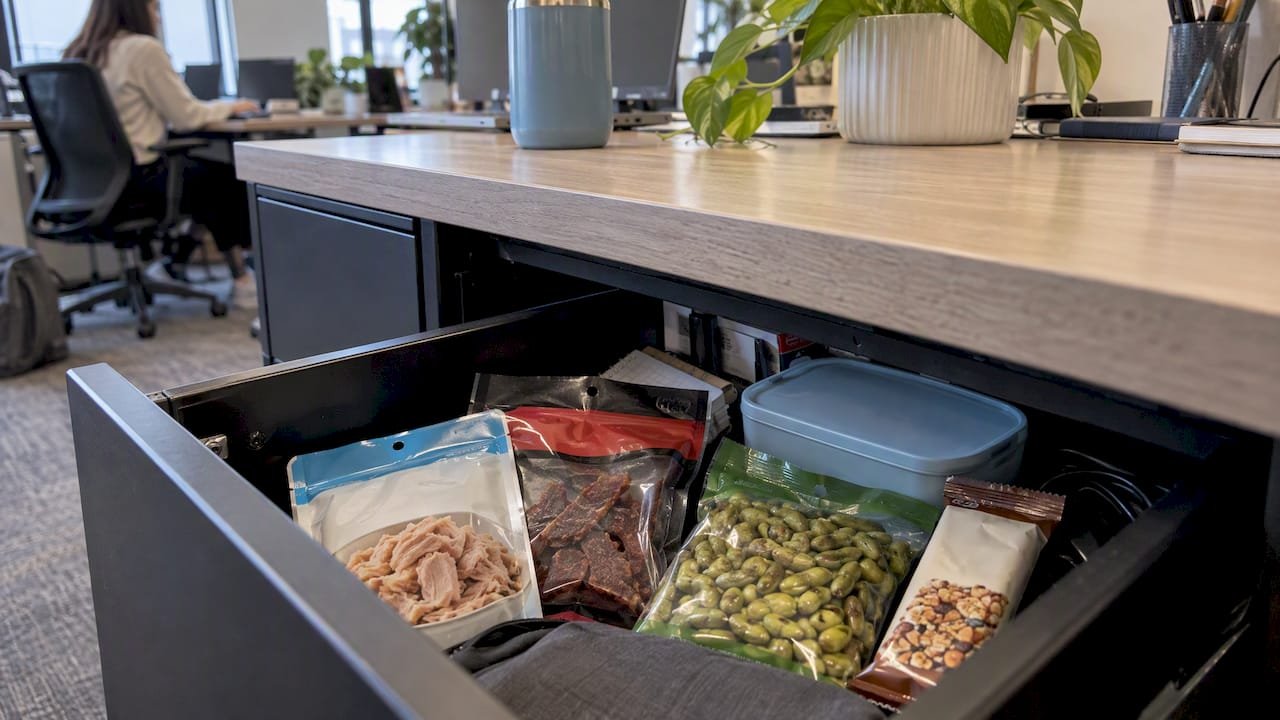
The best high-protein office snacks are the ones you can eat in two minutes with no cooking and no mess, and that deliver roughly 8 to 15 grams of protein. Greek yogurt, hard-boiled eggs, jerky, tuna pouches, edamame, nuts and seeds, and cheese sticks all clear that bar. Below you’ll find how much protein each one gives you, which ones survive a desk drawer, which need a fridge, and how to set up a week of snacks so the vending machine never gets a vote.
TL;DR
- Aim for 8 to 15 grams of protein per snack, plus some fiber and not much added sugar or sodium.
- Shelf-stable picks (tuna or chicken pouches, jerky, dry-roasted edamame, nuts, seeds) can live in a drawer. Yogurt, cottage cheese, eggs, and string cheese belong in a fridge or an insulated bag with cold packs.
- Keep two snacks within reach: one savory, one sweet. That covers both the meeting-driven hunger and the mid-afternoon sugar pull.
- Portion snacks ahead of time. A snack is a bridge between meals, not a second lunch.
Table of Contents
- What counts as a high-protein snack at work
- How much protein is in each snack
- Desk-drawer snacks: no refrigerator needed
- Fridge snacks: higher protein, a little planning
- Keeping perishable snacks safe
- Build a snack safety net for the week
- When to eat a protein snack, and how it fits your day
- Plant-based and animal-based options
- Don’t let snacking become grazing
- Our perspective
- Getting more than a snack plan
- FAQ
- Sources
What counts as a high-protein snack at work
There’s no legal definition, so use a practical one. Harvard Health suggests healthy snacks with at least 5 grams of protein. For an office, where a snack often has to carry you through a long meeting block, a target of 8 to 15 grams per serving is more useful, and Marmels lands on the same range. Go lower and you’re mostly eating carbohydrate. Go much higher and you’re really having a small meal.
Three filters make the choice easier:
- Protein: 8 grams or more per serving.
- Fiber: some, ideally. Edamame, chickpeas, nuts, and fruit paired with yogurt all bring it.
- Added sugar and sodium: keep both modest. MyPlate advises choosing nutrient-dense protein foods while limiting added sugars, saturated fat, and sodium. Flavored yogurts and some jerkies are where these creep in.
How much protein is in each snack
Here are the numbers from Harvard Health’s protein snack guide, sorted by where each snack lives during the workday.
| Snack | Serving | Protein | Where it keeps |
|---|---|---|---|
| Tuna | 3 oz | 25.5 g | Drawer (pouch), fridge once opened |
| Edamame | 1 cup | 18 g | Fridge, or dry-roasted in a drawer |
| Greek yogurt | ¾ cup | 17 g | Fridge or cold pack |
| Cottage cheese | ¾ cup | 12 g | Fridge or cold pack |
| Jerky | 1 oz | 10 to 12 g | Drawer |
| Pumpkin seeds | 1 oz | 8 g | Drawer |
| Peanuts | 1 oz | 7 g | Drawer |
| Peanut butter | 2 tbsp | 7 g | Drawer |
| Cheese stick | 1 oz | 5 to 7 g | Fridge preferred |
| Hard-boiled egg | 1 large | 6.3 g | Fridge or cold pack |
| Chia seeds | 2 tbsp | 5 g | Drawer |
A few pairings push the total higher without any effort. Protein Ring documents 150 grams of Greek yogurt with 28 grams of almonds at 22 grams of protein. Two eggs plus a cheese stick lands in the same neighborhood.
Desk-drawer snacks: no refrigerator needed
The snacks that live in a drawer are your safety net for the days when lunch runs late or a meeting eats your break. According to Marmels, tuna or chicken pouches, jerky, dry-roasted edamame, and high-protein dark chocolate bars can sit in a drawer for weeks.
Tuna and chicken pouches
A 2.6-ounce pouch gives 16 to 17 grams of protein, per the same Marmels guide, and needs no can opener or draining. Tuna is the heavyweight: Harvard Health puts 3 ounces at 25.5 grams. Bring a fork and a pack of crackers, or eat it straight. If you’re home on the weekend, tuna salad also works as a spread for crackers or a dip for vegetables.
Jerky
Beef jerky provides about 10 grams per ounce, salmon jerky about 12, and chicken jerky about 10, according to Harvard Health, which also advises watching sodium. When you shop, Healthline suggests looking for jerky that is uncured, low in sodium, and made from few ingredients. Flip the bag over: if the ingredient list reads like a chemistry set, put it back.
Dry-roasted edamame, nuts, and seeds
Dry-roasted edamame is crunchy, high in protein, and carries fiber. Pumpkin seeds (8 grams per ounce) and peanuts (7 grams per ounce) are the cheapest protein per bite in the building. MyPlate specifically suggests a mix of unsalted nuts and sunflower seeds with dried fruit. Pre-portion them into small containers or bags on Sunday. Eating from a big jar at your desk is how 1 ounce quietly becomes 4.
Peanut butter and apple
Two tablespoons of peanut butter give 7 grams, and MyPlate lists nut butter with apple or celery as a practical protein snack. Keep a jar and a knife at work, and buy apples weekly. It takes under a minute.

Fridge snacks: higher protein, a little planning
If your office has a refrigerator, these are the most satisfying options.
- Greek yogurt. Harvard Health describes a packable parfait with plain Greek yogurt, berries, and nut-filled granola. Choose plain and add your own fruit to keep sugar down.
- Cottage cheese. 12 grams per ¾ cup. It is good with fruit or cracked pepper and cherry tomatoes.
- Hard-boiled eggs. 6.3 grams each. Boil a dozen on Sunday, peel as you go.
- Cheese sticks. 5 to 7 grams per ounce, which makes them a supporting player. Pair with fruit or a handful of nuts.
- Edamame, shelled and chilled. At 18 grams per cup it’s the best plant-based option on the list.
Vacuum-sealed hard cheese holds up for a workday on a desk, Marmels notes, but it does better overnight in a refrigerator.
Keeping perishable snacks safe
No fridge at work? You can still bring yogurt or eggs, but follow the rules. The USDA Food Safety and Inspection Service says perishable foods such as meat, poultry, and eggs must be kept cold, recommends an insulated lunch bag with at least two cold sources, and says perishables should not sit at room temperature for more than 2 hours, or 1 hour when it’s above 90°F.
That last number matters if you’re commuting in a Maryland summer or leaving a bag in a parked car. Practical habits:
- Pre-chill the food before packing.
- Pack two frozen cold sources directly against the items. Eat Breadless says this can hold safe temperatures for four to six hours.
- Keep the bag closed until you’re ready to eat. Each opening warms the inside.
- When in doubt about how long something sat out, throw it out.
Build a snack safety net for the week
The most reliable approach isn’t a clever recipe, it’s a small system. The Reshape App recommends mixing shelf-stable items with make-ahead or fridge-friendly ones so you aren’t forced to rely on the vending machine. Mo Mandegar, PhD, writing for Marmels, suggests keeping at least two protein-anchored snacks within reach: one savory for the hunger that hits during meetings, and one sweet to head off the 3 p.m. candy dish.
Here’s a simple setup:
| Slot | Savory option | Sweet option |
|---|---|---|
| Drawer (always stocked) | Jerky or tuna pouch | Nut and seed mix with dried fruit |
| Fridge or cold bag | Hard-boiled eggs or cottage cheese | Greek yogurt with berries |
| Back-up | Dry-roasted edamame | Peanut butter and apple |
If you want a meal-level version of this, our guide to meal prep for busy professionals covers how to batch a few components once and use them all week.
When to eat a protein snack, and how it fits your day
Snacks work best when they’re planned. The Reshape App frames it as spacing intervals of 3 to 4 hours between meals to prevent extreme hunger, which is what sends people to the vending machine and into whatever is closest. If lunch is at noon and dinner at 7, a mid-afternoon snack makes sense. If you ate a big lunch at 2, you may not need one.
Harvard Health also notes that a protein snack within 30 to 60 minutes after strength training may support muscle growth and recovery. If you train after work, a snack in your bag or car is a practical bridge to dinner. Our post on fueling your workout with proper nutrition goes deeper on timing.
Where snacks fit in your daily protein
The adult RDA is 0.8 grams per kilogram of body weight, or 0.36 grams per pound, according to Harvard Health, and needs vary with age, activity level, pregnancy, and breastfeeding. A 170-pound adult at the RDA works out to about 61 grams a day. People who train regularly often aim higher, and the right number depends on the individual. If you have a kidney condition or a medical diet, ask your physician or a registered dietitian before raising your intake.
Snacks shouldn’t carry the whole load. Most of your protein should come from meals, and for strength training specifically, spreading it across meals matters more than any single snack. If you’re recovering from an injury, a guide on nutrition for injury recovery covers which nutrients matter while you heal.
Plant-based and animal-based options
Both work well in an office.
Plant-based: edamame (18 grams per cup), pumpkin seeds (8 grams per ounce), peanuts (7 grams per ounce), chia seeds (5 grams per 2 tablespoons), chickpeas, and peanut butter on toast with apple.
Animal-based: Greek yogurt, cottage cheese, cheese sticks, eggs, jerky, and tuna.
If you eat plant-based, chia pudding made the night before and roasted chickpeas in small containers are easy to prep. Edamame and pumpkin seeds do the heavy lifting for grams per bite.
Don’t let snacking become grazing
High-protein doesn’t mean unlimited. Harvard Health’s guidance on low-calorie snacks warns that excessive snacking can lead to weight gain and recommends controlling portions, portioning snacks ahead, and eating mindfully. Pre-portioning nuts, roasted chickpeas, and snack boxes also helps prevent mindless eating on stressful days, per the Reshape App.
Two habits help. First, step away from the screen for the five minutes it takes. Our piece on mindful eating for busy professionals gives a quick routine. Second, ask whether you’re hungry or just bored, tired, or stressed. If it’s the 3 p.m. slump, a short walk or a stimulating drink may serve you better than a second snack.

Our perspective
We coach busy professionals, and snacks come up constantly, usually as a symptom rather than the problem. Someone skips breakfast, has a late lunch between meetings, and by 4 p.m. the nearest sugary thing wins. The fix is rarely a better snack in isolation. It’s a rhythm: meals with enough protein, a planned bridge when the gap is long, and enough sleep that your appetite isn’t running the show.
That’s why we think about food as one part of a whole system alongside strength training, recovery, and stress. A great snack drawer won’t rescue five hours of sleep, and perfect macros won’t matter if you can’t keep the routine up. So we favor habits-first changes: stock the drawer once, pre-portion on Sunday, keep two options within reach, and notice how you feel after you eat. Small, repeatable steps beat a perfect plan you abandon by Thursday.
— Josh
Getting more than a snack plan
If you’re a busy professional in Gaithersburg who wants help turning nutrition, training, sleep, and stress into a routine you can keep, that’s what we do at humn. Our 1:1 nutrition coaching builds habits around your actual schedule, and our membership combines small-group personal training, coaching, and recovery access under one roof.

Curious how the pieces fit together? Start with how we approach fitness on a busy schedule, then reach out when you’re ready to talk.
FAQ
What is a good protein snack to bring to work?
Plain Greek yogurt with berries and a handful of nuts is a strong all-rounder: Harvard Health lists Greek yogurt at 17 grams of protein per ¾ cup. If you have no fridge, a tuna pouch or a bag of jerky gives 10 to 17 grams and stays in a drawer for weeks.
How much protein should an office snack have?
A practical target is 8 to 15 grams per serving, with some fiber and limited added sugar and sodium. Harvard Health’s floor for a healthy snack is 5 grams. Anything beyond about 15 grams starts to resemble a small meal.
Can I leave eggs or yogurt at my desk?
Not for long. USDA guidance says perishable foods shouldn’t sit at room temperature for more than 2 hours, or 1 hour above 90°F. Use an insulated bag with at least two cold sources, or a shared refrigerator.
How many grams of protein do I need per day?
The adult RDA is 0.8 grams per kilogram of body weight (0.36 grams per pound), and needs vary with age, activity, pregnancy, and breastfeeding. If you have a medical condition or you’re adjusting your intake significantly, talk with your physician or a registered dietitian.
Sources
- High-protein snacks to build muscle and keep hunger at bay, Harvard Health
- Low-calorie snacks: healthy, delicious, and satisfying, Harvard Health
- Vary Your Protein Routine, MyPlate
- Keeping Bag Lunches Safe, USDA Food Safety and Inspection Service
- Best High-Protein Office Snacks That Keep You Full, Marmels
- Zero-prep high-protein foods, Protein Ring
- Healthy Protein Snacks for Work, Reshape App
- Portable High Protein Lunch Ideas for Busy Workdays, Eat Breadless
- 33 Simple and Healthy Snacks for Work, Healthline
No Comments.